




















You've found a hidden discount!

HN Unlock Layer 1
HN Unlock Layer 2
HN Unlock Layer 3
HN Unlock Layer 4
HN Unlock Layer 5
  • 00Hours
  • 00Minutes
  • 00Seconds

Category: financial management

97110 vs 97530: How to Choose the Right CPT Code for Therapy Billing

CPT 97110 vs 97530 — What is the difference?

CPT 97110 is for therapeutic exercise targeting a single musculoskeletal impairment — strength, endurance, range of motion, or flexibility — billed in 15-minute units. CPT 97530 is for therapeutic activities that are functional, multi-outcome, and simulate real-life tasks — also billed in 15-minute units. 97110 changes a tissue capacity. 97530 changes what the patient can do. Both can be billed on the same day when each has separate time tracking and a distinct documented clinical justification.

Key Takeaways

    • 97110 targets a single musculoskeletal impairment through isolated therapeutic exercise — 97530 targets functional performance through multi-outcome activities that simulate daily life
    • The clinical test is simple: if the intervention changes a tissue capacity, bill 97110 — if it changes what the patient can do, bill 97530
    • Both codes can be billed on the same day and often should be — but each needs its own time tracking and its own documented clinical justification
    • Modifier 59 may be required by some payers for same-day 97110 and 97530 billing — verify per payer before submitting
    • HelloNote’s templates enforce separate clinical justifications for each code so same-day billing is always documented correctly

Table of Contents

Every therapist knows these two codes. Every therapist has questioned them at some point. 97110 and 97530 sit at the center of outpatient PT and OT billing, they often appear on the same claim, and they are the source of more documentation confusion — and more claim denials — than almost any other code pair in the therapy billing system.

The distinction between them is not complicated once you understand it. But understanding it in theory and applying it correctly in a busy clinic with back-to-back patients are two different things. The pressure to chart quickly, the habit of defaulting to familiar codes, the instinct to describe what you did rather than why you did it — these are the conditions that produce billing patterns payers flag and auditors investigate.

This guide is the practical version of the 97110 vs 97530 conversation — the one that covers the clinical distinction, the documentation requirements, the same-day billing rules, and the specific mistakes that generate denials. For the full individual code guides see: hellonote.com/cpt-97110/ and hellonote.com/therapeutic-activity-cpt-code-97530/

CPT 97110 therapeutic exercise versus CPT 97530 therapeutic activity showing resistance band exercise and functional overhead reaching in outpatient clinic

CPT 97110 vs 97530 — The Core Clinical Distinction

The distinction between 97110 and 97530 is not about the activity. It is about the clinical target. Two therapists can run their patients through exercises that look nearly identical from across the gym. One is billing 97110 correctly. The other is billing 97530 correctly. The difference is not visible in the room — it is documented in the note.

97110 targets a musculoskeletal impairment. The clinical question is: what specific tissue capacity are we trying to change? Strength, endurance, range of motion, or flexibility — one of those four, targeted directly through therapeutic exercise. 97530 targets a functional performance deficit. The clinical question is: what specific task can the patient not perform, and how do we practice and improve that performance? The answer is always a functional activity — something that resembles what the patient needs to do in their daily life.

The One Question That Resolves Every Code Selection Decision

When our team is deciding between 97110 and 97530, we ask one question: if this intervention worked perfectly, what would be different? If the answer is a tissue measurement — the quad tests at 5/5, the shoulder reaches 150 degrees of flexion, grip strength is 45 pounds — that is 97110. If the answer is a functional task — the patient can get off the floor, climb the stairs to their bedroom, return to their construction job, prepare their own meals — that is 97530. Document the answer to that question. That is your code justification and your medical necessity statement in one sentence.

What is CPT 97110?

What is CPT 97110 (Therapeutic Exercise)?

CPT 97110 is a timed therapeutic procedure code for therapeutic exercise targeting a single measurable outcome — strength, endurance, range of motion, or flexibility. Billed in 15-minute units, it requires direct one-on-one licensed therapist contact throughout. It applies when the clinical goal is improving a specific musculoskeletal impairment, not a functional performance deficit. Definition sourced from the American Medical Association CPT code set.

The Four Qualifying Outcomes for 97110

Strength

Progressive resistance exercise targeting a specific muscle group or movement pattern with a documented baseline deficit and measurable strength target. MMT grade, dynamometer reading, or pounds of force.

Endurance

Exercise targeting the ability to sustain a muscle contraction or movement pattern over time, tied to a specific activity demand the patient needs to return to.

Range of Motion

Structured exercise specifically intended to increase joint or soft tissue mobility, with documented goniometric baseline and target degrees.

Flexibility

Elongation exercises targeting shortened tissue with documented limitation and functional impact. Outcome measured in degrees or functional reach distance.

What 97110 Does Not Cover

97110 does not apply to multi-outcome functional activities (use 97530), gait training (use 97116), neuromuscular reeducation targeting proprioceptive or motor control deficits (use 97112), or any exercise performed without continuous direct therapist contact. The code requires a single measurable target and active therapist involvement throughout.

What Is CPT 97530

What is CPT 97530 (Therapeutic Activity)?

CPT 97530 is a timed therapeutic procedure code for therapeutic activities — dynamic, functional tasks that simulate real-life activities of daily life. Billed in 15-minute units, it requires direct one-on-one licensed therapist contact throughout. It applies when the clinical goal is improving functional performance through multi-outcome activities, not an isolated musculoskeletal impairment. Definition sourced from the American Medical Association CPT code set.

The Three Clinical Requirements for 97530

Dynamic

The patient is actively performing movement — not being moved by the therapist. The activity requires patient effort and coordination across multiple systems simultaneously.

Functional

The activity mirrors something the patient needs to do in their real life — a task with the multi-joint, multi-outcome complexity of daily living. Not an isolated exercise targeting a single tissue.

Direct

The licensed therapist must be present and actively directing the activity for the entire billed duration. Not supervising from across the room. Direct contact, direct instruction, direct skilled input throughout.

What 97530 Does Not Cover

97530 does not apply to isolated therapeutic exercise targeting a single tissue capacity (use 97110), standalone gait training (use 97116), patient education where the therapist explains or demonstrates rather than directly guiding active patient performance, or any activity performed without continuous direct therapist contact throughout the billed duration.

Side-by-Side Comparison: CPT 97110 vs 97530

CPT 97110 — Therapeutic Exercise CPT 97530 — Therapeutic Activity
Target: Single musculoskeletal impairment Target: Functional performance deficit
System: Contractile tissue, joint mechanics System: Functional movement system
Outcome: MMT grade, degrees ROM, pounds force Outcome: Functional task performance
Activity: Isolated exercise, single outcome Activity: Dynamic multi-outcome functional task
Patient role: Performs the exercise Patient role: Performs the functional task
Billing unit: 15-minute timed units Billing unit: 15-minute timed units
Direct contact: Required throughout Direct contact: Required throughout
Example: Seated shoulder ER with resistance band Example: Overhead reaching practice for kitchen tasks
Documentation: Functional goal connection sentence required Documentation: Functional goal connection sentence required
Same-day billing: Yes — with 97530 Same-day billing: Yes — with 97110
Modifier 59: May be required by payer Modifier 59: May be required by payer

When to Bill 97110 and 97530 on the Same Day

Billing 97110 and 97530 together on the same day is not just acceptable — it is often the most clinically accurate way to represent a complete outpatient rehabilitation session. The sequence makes clinical sense: therapeutic exercise addresses the specific impairment (97110), then therapeutic activity practices the functional task that impairment was limiting (97530). Build the quad. Practice the stairs. Restore shoulder ROM. Practice the overhead reach. The two codes work as a clinical pair.

The Three Requirements for Defensible Same-Day Billing

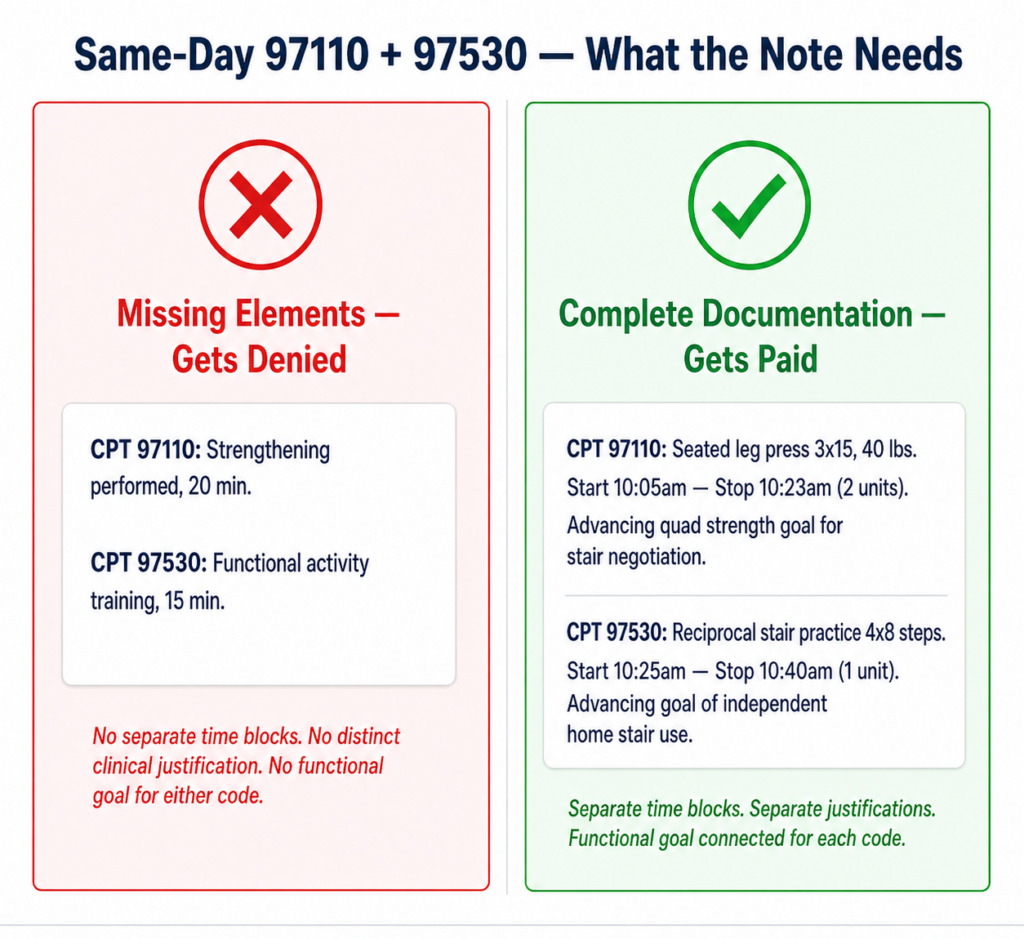
  1. Separate time blocks for each code

Each code needs its own start and stop time documented separately. The exercise block has its own time. The functional activity block has its own time. They do not overlap. Total timed minutes for each code independently satisfies the 8-minute rule.

  1. Separate clinical justification for each code

The note for 97110 must establish the specific impairment being targeted. The note for 97530 must establish the specific functional task being practiced. Each code needs its own medical necessity statement. Combined or vague documentation that covers both codes with one description is not defensible.

  1. A coherent clinical narrative connecting both codes

The combined documentation should tell a logical clinical story: we built this capacity (97110) so the patient could practice this functional task (97530). The impairment addressed under 97110 is the same impairment that was limiting the functional task practiced under 97530. When this connection is clear in the note, same-day billing is not an audit flag — it is complete documentation.

Modifier 59 for CPT 97110 and 97530

When do you need Modifier 59 for CPT 97110 and 97530?

Modifier 59 is required by some payers when CPT 97110 and 97530 are billed on the same day to confirm they represent distinct and separately identifiable services. Not all payers require it — verify requirements per insurer before submitting. When required, the documentation must provide the clinical distinction the modifier signals: the modifier tells the payer these are separate services; the notes prove it.

Modifier 59 does not protect a poorly documented claim. It signals to the payer that two codes on the same claim represent separate procedures — but if the clinical notes do not clearly establish the distinct purpose of each code, the modifier alone will not prevent a denial or audit. The modifier and the documentation work together. Never apply Modifier 59 without documentation that independently justifies each code.

Documentation Requirements for Each Code

What Every 97110 Note Must Include

    • Specific exercise name and description — not ‘strengthening exercises’ but ‘seated resisted shoulder external rotation, 3 x 12, 3 lb, pain-free arc 0–90 degrees’
    • Exercise parameters — sets, repetitions, resistance or load, patient position
    • Actual start and stop time — not an estimate, the real clock times
    • Objective outcome measure — the session’s result compared to baseline
    • Functional goal connection sentence — the one sentence connecting the impairment-level work to a functional goal in the plan of care

What Every 97530 Note Must Include

    • Specific activity name and its multi-outcome components — not ‘functional activity training’ but ‘reciprocal stair negotiation, 3 x 8 steps, targeting loading tolerance, dynamic balance, and hip extension mechanics’
    • Skilled therapist direction throughout — specific cues provided, modifications made, clinical decisions during the activity
    • Actual start and stop time — separate from the 97110 time block
    • Functional goal connection sentence — connecting the activity to the documented functional goal in the plan of care
Same-day CPT 97110 and 97530 documentation comparison showing denied note with missing elements versus paid note with separate time blocks and functional goal connections

Common Coding Mistakes and How to Avoid Them

Mistake 1 — Using 97530 for Impairment-Level Exercise

Applying 97530 to exercises that are genuinely 97110 interventions because they happen in a functional position or involve multiple joints. A standing exercise is not automatically a functional activity. Code to the clinical intent: if the therapeutic goal is a tissue capacity, the code is 97110 regardless of the exercise position or the number of joints involved.

Mistake 2 — Using 97110 for Multi-Outcome Functional Activities

Defaulting to 97110 for activities that involve multiple simultaneous clinical outcomes and resemble daily life tasks. Sit-to-stand practice, stair negotiation, kitchen simulation, and work task replication are 97530 activities regardless of the strength component involved. If the activity is functional and multi-outcome, the code is 97530.

Mistake 3 — Combined Time Documentation for Same-Day Codes

Estimating total treatment time and splitting it between 97110 and 97530 without separate documented time blocks. Each code needs its own start and stop time. When payers audit same-day billing, separate time documentation is the first thing they verify. If it is not there, the claim is vulnerable regardless of how appropriate the clinical interventions were.

Mistake 4 — Missing the Functional Goal Connection on Both Codes

Documenting the exercise or activity accurately while omitting the sentence that connects it to a functional goal in the plan of care. This is the most common denial reason for both codes. Medical necessity is not established by describing the intervention — it is established by connecting the intervention to a documented functional outcome that justifies why the patient needs skilled therapy to achieve it.

Mistake 5 — Applying Modifier 59 Without Supporting Documentation

Using Modifier 59 on same-day 97110 and 97530 claims without documentation that independently justifies each code. Modifier 59 signals separate services — the notes prove it. If both codes share a single combined description in the note, Modifier 59 will not prevent a denial.

CPT 97110 vs 97530 in Practice — What Our Clinic Does

A patient presents at visit four following right knee arthroplasty. Assessment this session: quadriceps strength 3+/5 right versus 5/5 left, active knee extension lacking 15 degrees compared to the uninvolved side, and single-leg stance time 8 seconds right versus 22 seconds left. The patient’s documented goal is returning to independent stair use in his two-story home within six weeks.

Our team’s session plan: therapeutic exercise first targeting the quad strength and knee extension deficit (97110), followed by therapeutic activity practicing the stair negotiation pattern the patient needs to achieve his functional goal (97530).

The 97110 block runs 18 minutes: seated leg press 3 x 15 at 40 lbs targeting knee extension strength, terminal knee extensions 3 x 20 with theraband targeting quad recruitment in terminal range. Start time 10:05am, stop time 10:23am. Two units. Note documents the specific exercises, parameters, resistance, and the outcome measure: active knee extension improved from −15 to −10 degrees by end of session. Functional goal connection: ‘Quad strengthening targeting 5/5 strength required for safe reciprocal stair negotiation per patient’s goal of independent stair use in his home.’

The 97530 block runs 15 minutes: reciprocal stair negotiation on 4-step training stairs, 4 sets ascending and descending, with therapist cuing weight distribution symmetry and controlled knee flexion loading on descent. Start time 10:25am, stop time 10:40am. One unit. Note documents the activity, cues provided, patient response, and the functional goal connection: ‘Stair negotiation practice advancing patient’s goal of independent two-story home stair use without handrail assist.’

Two codes. Separate time blocks. Separate clinical justifications. A coherent clinical story where the 97110 impairment work directly supports the 97530 functional task practice. This is same-day billing done correctly.

READY TO STREAMLINE YOUR CLINIC?

See How HelloNote Handles All of This in One Platform

Managing staff hours, compliance, inventory, and financial reports — all inside one HIPAA-compliant EMR built for PT, OT, and SLP clinics.

No credit card required · HIPAA Compliant · PT, OT & SLP

How HelloNote Handles CPT 97110 and 97530

When our team built the HelloNote documentation templates, the 97110 vs 97530 distinction drove several core design decisions. The two most important: each code has its own separate time entry field, and each code requires its own functional goal linkage before the note can be closed. These two structural requirements eliminate the most common same-day billing mistakes before the claim is ever submitted.

    • Separate time entry per code — start and stop times are entered independently for each timed code block. HelloNote calculates units for each code separately using the 8-minute rule. There is no combined time field that gets split between codes.
    • Separate functional goal linkage — each code must be connected to a plan of care goal before sign-off. The 97110 goal and the 97530 goal are documented independently. The note cannot close until both connections are made.
    • Same-day code pairing guidance — when 97110 and 97530 appear on the same visit, HelloNote surfaces documentation guidance so the clinical distinction between the two codes is captured in the note structure.
    • Pre-submission claim scrub — before the claim goes out, HelloNote checks both codes against common denial triggers and flags missing elements for review.
    • Modifier 59 reminder — when 97110 and 97530 are billed together, HelloNote flags the Modifier 59 consideration so the therapist can verify payer requirements before submission.

Frequently Asked Questions — CPT 97110 vs 97530

What is the difference between CPT 97110 and CPT 97530?

CPT 97110 is for therapeutic exercise targeting a single musculoskeletal impairment — strength, endurance, range of motion, or flexibility. CPT 97530 is for therapeutic activities that are functional, multi-outcome, and simulate real-life tasks. 97110 changes a tissue capacity. 97530 changes what the patient can do. The distinction is clinical intent, which must be documented explicitly in the note for both codes.

Can you bill CPT 97110 and 97530 on the same day?

Yes. Same-day billing of 97110 and 97530 is appropriate when each code represents a distinct intervention with separate time tracking and a separate documented clinical justification. 97110 addresses the musculoskeletal impairment; 97530 practices the functional task that impairment was limiting. Some payers require Modifier 59 for same-day billing — verify payer-specific requirements before submitting.

When should I use 97110 instead of 97530?

Use 97110 when the therapeutic goal is to change a single tissue capacity: strengthen a specific muscle group, increase ROM in a specific direction, improve endurance for a specific demand, or increase flexibility in shortened tissue. If the intervention targets one measurable impairment through isolated exercise, bill 97110. If the activity is functional, multi-outcome, and resembles a daily life task, bill 97530.

When should I use 97530 instead of 97110?

Use 97530 when the therapeutic goal is to improve a patient’s ability to perform a specific functional task — sit-to-stand, stair negotiation, meal preparation, transfer training, work simulation, sport-specific movement. The activity must be dynamic (patient-performed), functional (resembles real-life tasks), and delivered under direct therapist contact throughout the billed duration.

What is Modifier 59 for 97110 and 97530?

Modifier 59 indicates that two procedures billed on the same day are distinct and separately identifiable services. Some payers require it when 97110 and 97530 are both billed on the same claim to confirm they are not duplicate billings of the same service. The modifier signals separation; the clinical documentation in each note proves it. Never apply Modifier 59 without documentation that clearly establishes the distinct clinical purpose of each code.

How many units of 97110 and 97530 can I bill per session?

Units for each code are determined independently by the 8-minute rule. One unit requires at least 8 minutes of direct therapist contact, two units require at least 23 minutes, three units require at least 38 minutes. Calculate units for 97110 from its own documented time block and units for 97530 from its own separate time block. The total combined time determines neither — each code stands on its own time documentation.

Is CPT 97110 or 97530 used in occupational therapy?

Both codes are used in occupational therapy and physical therapy. OTs commonly bill 97110 for isolated upper extremity strengthening, grip and pinch strengthening, and ROM exercises following hand or shoulder conditions. OTs commonly bill 97530 for ADL retraining, functional upper extremity task practice, home management simulation, and work task replication. The clinical criteria apply identically regardless of discipline.

What triggers an audit for same-day 97110 and 97530 billing?

Common audit triggers include: combined time documentation that gets split between codes rather than separately tracked, notes where both codes share a single clinical description without distinct justifications, high-frequency same-day billing without documented clinical rationale for both codes in every visit, and Modifier 59 applied without supporting documentation that establishes the separate nature of each service.

How does HelloNote help with 97110 and 97530 same-day billing?

HelloNote’s templates require separate time entry and separate functional goal linkage for each code before the note can be closed. Same-day code pairing guidance surfaces when both codes appear on the same visit. The pre-submission claim scrub checks both codes against common denial triggers. Modifier 59 is flagged for payer verification when 97110 and 97530 are billed together.

Bill Both Codes Right — Every Session

The 97110 vs 97530 distinction is not a compliance technicality. It is a clinical documentation practice that accurately represents the work being done and protects the revenue that work generates. When both codes are documented correctly — with separate time blocks, separate clinical justifications, and clear functional goal connections — same-day billing is not a risk. It is an accurate billing record of a complete, skilled rehabilitation session.

Looking up more cpt codes?

See 97110, 97530, and 50+ therapy procedure codes – with billing guidance and documentation tips in one place.

The Architect’s Guide to Physical Therapy Billing and Financial Compliance

Table of Contents

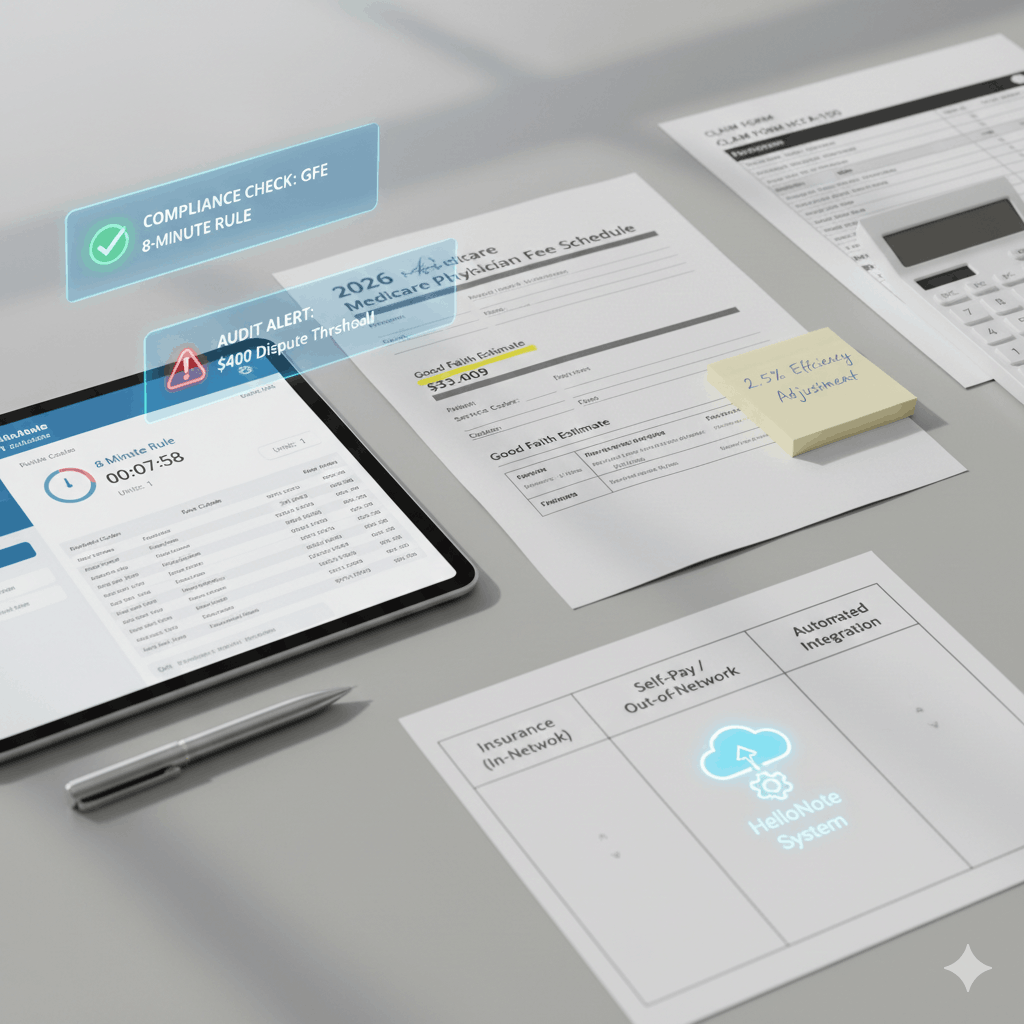
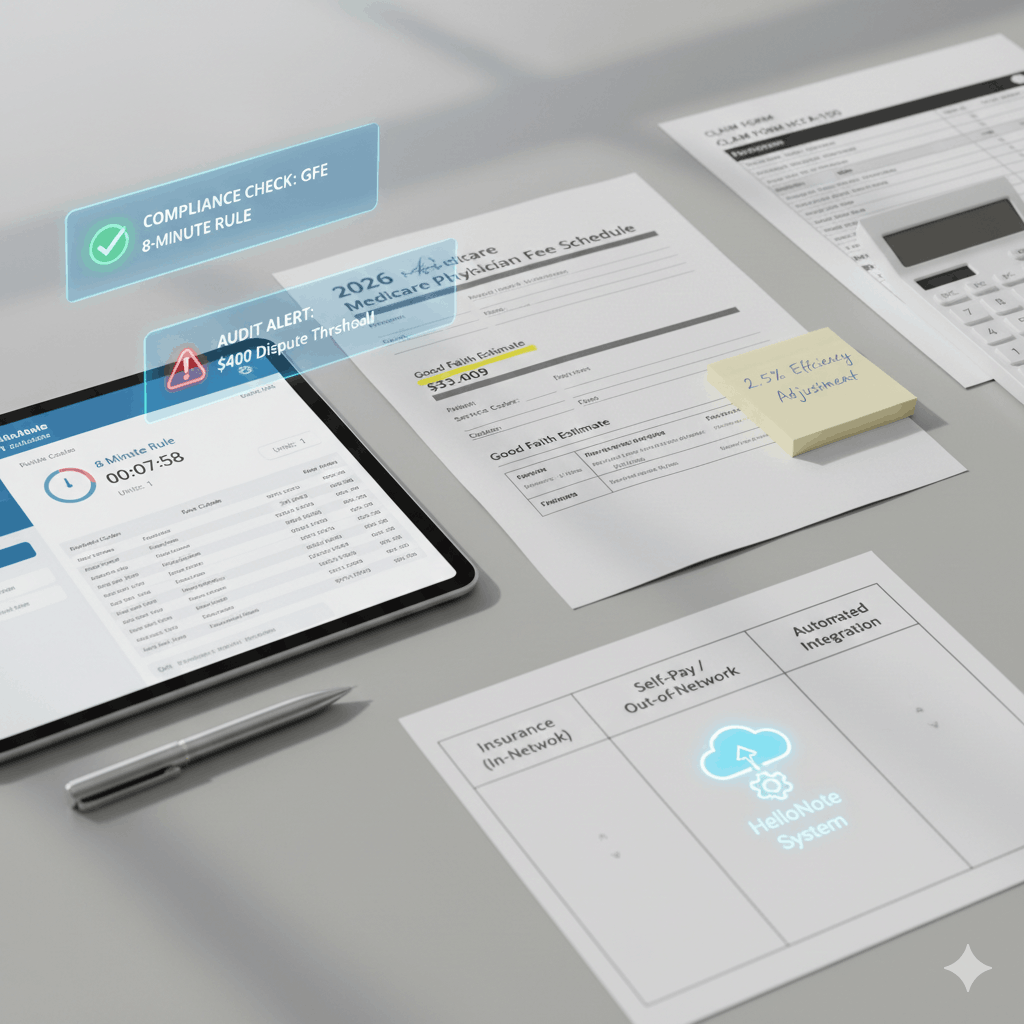
In 2026, the 8-Minute Rule remains the CMS standard for billing timed CPT codes (like 97110 and 97140). To bill one unit, you must provide at least 8 minutes of direct care. For 2026, the Medicare Physician Fee Schedule (MPFS) has finalized a $33.4009 conversion factor (a 3.26% increase from 2025), making accurate unit calculation essential to offset the new -2.5% efficiency adjustment applied to non-timed work RVUs.

Clinical Methodology and 2026 Regulatory Compliance

Physical therapist reviewing RTM billing codes CPT 97110 and 97140 on a tablet showing a $33.40 conversion factor. In the background, a patient performs therapeutic exercises in a modern 2026 clinic.

The financial landscape of 2026 is governed by stricter transparency laws and updated CMS fee structures.

The No Surprises Act and Estimate Accuracy

For every self-pay or out-of-network patient, clinics must provide a Good Faith Estimate (GFE) within one to three business days of scheduling. This document must include expected CPT codes (e.g., 97110, 97140) and diagnostic ICD-10 codes.

Audit Warning: If the final bill exceeds the GFE by $400 or more, patients have a federal right to dispute the charges. Estimate accuracy is no longer just a courtesy—it is a critical compliance metric for 2026.

Mastering the 8-Minute Rule in 2026

The 8-Minute Rule remains the gold standard for Medicare. To bill a single unit of a timed service, a therapist must provide at least 8 minutes of direct, one-on-one care.

In 2026, payers have increased their use of “Supplemental Portion” audits, scrutinizing “mixed remainders”—the leftover minutes from different interventions. HelloNote’s real-time unit calculator prevents these errors by automatically applying the 8-Minute Rule logic as you type your note.

2026 Cost Drivers: Insurance vs. Self-Pay

FactorInsurance (In-Network)Self-Pay / Out-of-NetworkHelloNote Integration
Conversion FactorFixed at $33.40 (MPFS)Determined by ClinicAutomated Fee Schedules
Price TransparencyEOB (Post-Service)Good Faith EstimateBuilt-in GFE Generator
Assistant Modifier15% reduction (CO/CQ)Usually Full RateAuto-Modifier Application
Complexity Level3-Tier Eval (97161–97163)Flat Evaluation FeeComplexity-Driven Templates

The "Therapist’s Insight": Combating Sticker Shock

In my clinical practice, the most dangerous time for patient retention isn’t the first session—it’s the arrival of the first bill. With deductibles often exceeding $3,000 in 2026, a patient might see a $450 bill for their first three visits and immediately cancel.

The Financial Evaluation Strategy

Perform a “Financial Evaluation” simultaneously with your Clinical Evaluation. Use HelloNote’s Insurance Verification tool before the patient walks in. I tell my patients:

“Your plan has a $3,000 deductible, which means today’s session will cost approximately $125. However, completing this 8-week plan now prevents a $20,000 surgery next year.”

By framing the cost as an investment in “Surgery Prevention,” you shift the psychological value from a “bill” to a “saving.”

Frequently Asked Questions

Q1. What is the "Efficiency Tax" on my 2026 claims?

CMS finalized a 2.5% reduction in work Relative Value Units (RVUs) for most non-time-based services (like evaluations). This reflects a federal assumption that “workflow improvements,” such as AI Scribes, have made these tasks faster to complete.

Q2. Can I bill for a 30-minute session if I only spent 22 minutes with the patient?

No. Under the 8-Minute Rule, 22 minutes equals one unit (8–22 mins). You must reach at least 23 minutes of direct care to bill two units.

Q3. Do I need a new Good Faith Estimate if the patient's diagnosis changes?

Yes. If the scope of care changes significantly (e.g., a patient with LBP develops sciatica), you must issue an updated GFE at least one business day before the next session.

Q4. What is the 2026 KX Modifier threshold?

For 2026, the KX modifier threshold is $2,480 for PT and SLP combined, and $2,480 for OT.

Q5. Does the 15% assistant reduction apply to all codes?

No. It only applies to the practice expense (PE) portion of the payment for services billed with the CO or CQ modifiers when a PTA or OTA provides more than 10% of the service.

Clearinghouse Switching: A Game-Changer for Therapy Billing and Revenue Cycle Management

Clearinghouse switching is a pivotal feature in the world of therapy billing and revenue cycle management, where efficiency and flexibility are crucial for maintaining steady cash flow and reducing costly claim denials. This capability, which sets advanced EMR solutions apart, allows clinics to seamlessly transition between multiple clearinghouses without disrupting operations, directly impacting the speed and success of getting paid.

For physical therapy, occupational therapy, and speech-language pathology practices, having such flexibility on demand provides greater financial control, faster reimbursements, and fewer claim processing issues. This article explores why the ability to switch intermediaries is a game-changer, how to reduce claim denials in therapy billing using this approach, how it benefits therapy practices, and why it should be a key factor in choosing an EMR system.


Conceptual image: HelloNote EMR transforms stacks of therapy claim denials into approvals, symbolizing improved reimbursements through efficient processes like clearinghouse switching.

What Is Clearinghouse Switching?

A clearinghouse is an intermediary between healthcare providers and insurance payers, helping to submit claims, verify patient eligibility, and detect errors before claims reach insurers. Traditionally, practices lock into a single clearinghouse, limiting flexibility and sometimes leading to delayed reimbursements or avoidable claim denials due to system inefficiencies.

This advanced system allows therapy clinics to:

Choose the best intermediary for their needs (e.g., Inovalon for Medicare, Trizetto for commercial payers) instead of being tied to just one.
Reduce claim rejections by selecting an intermediary with better claim acceptance rates for specific payers.
Adapt quickly if their primary clearinghouse experiences downtime or inefficiencies.
Optimize payment speed by selecting an option known for faster processing times for certain payers.

Instead of being forced into one-size-fits-all billing, having flexible intermediary options gives therapy clinics more control over their revenue cycle and financial health.

Why is the Ability to Switch Clearinghouses Crucial for Therapy Practices?

This operational advantage directly addresses several common frustrations in therapy billing and significantly impacts the bottom line.

1. Eliminates Clearinghouse Lock-In

Many EMR systems restrict therapy practices to a single clearinghouse partner. This can lead to billing inefficiencies and delays if that provider has:

Slow claim processing times
Higher rates of claim rejections
Limited payer connectivity

Having multiple options removes these limitations, allowing therapy practices to select the best partner for different payers, ultimately improving the rate of successful reimbursements.

2. Reduces Claim Denials and Rejections

If a clinic’s current intermediary has high rejection rates for certain payers, selecting another with better acceptance rates for those specific claims can significantly improve cash flow and reduce unpaid claims. This flexibility is key if you’re asking how to reduce claim denials in therapy billing effectively.

For example:

Provider A may process Medicare claims faster with fewer issues, while Provider B has better performance with specific commercial insurers.
With the means to select the optimal route, clinics can direct claims through the most efficient channel, reducing errors and increasing approval rates, leading to fewer frustrating claim denials.

3. Increases Revenue Collection Speed and Reimbursements

A slow clearinghouse can delay payments by weeks or even months, creating cash flow challenges. Changing to an intermediary with faster claim processing for key payers can:

Accelerate revenue collection
Reduce days in accounts receivable
Improve overall financial stability through quicker reimbursements.

For high-volume therapy practices, faster payment cycles are essential for sustainable business growth.

4. Provides Flexibility During Clearinghouse Downtime

Clearinghouses sometimes experience technical issues or processing delays. Being locked into one provider means clinics are stuck waiting, potentially halting their billing operations.

With the option to reroute, therapy practices can immediately send claims to another functional intermediary without significant delays, ensuring more consistent cash flow and uninterrupted billing.

5. Expands Payer Connectivity and Options

Some intermediaries have limited partnerships, restricting clinics from billing certain insurance providers efficiently. Using an EMR that supports multiple connections can:

Allow selection of providers that work optimally with target insurance payers
Increase the number of payers that can be billed smoothly
Maximize opportunities for reimbursements

This is especially beneficial for clinics expanding services or working with a diverse payer mix.

How This Feature Sets Advanced EMRs Apart

Most standard EMR systems force practices into a single clearinghouse agreement. However, advanced EMRs offer this built-in flexibility, empowering clinics to:

Avoid being trapped with a poorly performing provider.
Optimize claim approvals and reduce claim denials by choosing the most effective path for each payer.
Minimize cash flow disruptions by instantly redirecting claims during system downtimes.

Such a capability is particularly valuable for therapy practices needing efficient processing for high patient volumes and diverse payer mixes.

HelloNote EMR: Leveraging Clearinghouse Switching for Fewer Claim Denials

HelloNote EMR integrates robust clearinghouse switching capabilities to give therapy clinics unparalleled billing flexibility and efficiency. With HelloNote EMR, practices can:

Choose from multiple integrated clearinghouses, including Inovalon, Trizetto, and ClaimMD, to ensure maximum claim acceptance.
Benefit from intelligent routing suggestions based on payer performance (where applicable).
Prevent billing interruptions by easily changing intermediaries if one experiences delays.
Enhance the speed of reimbursements by optimizing claim pathways.

This specific function within HelloNote EMR ensures that therapy practices stay in control of their revenue cycle, making billing more efficient and reducing common causes of claim denials.

Looking for an EMR that optimizes billing and helps reduce claim denials? Book a free demo of HelloNote EMR today!

Final Thoughts: Optimizing Reimbursements with Clearinghouse Flexibility

The ability to choose and change claim intermediaries is a powerful tool for therapy practices looking to streamline billing, minimize claim denials, and improve cash flow. By selecting an EMR system with this core function, therapy clinics can:

Eliminate clearinghouse lock-in and maximize payment rates.
Reduce denials by selecting the most effective intermediary for each payer situation.
Maintain financial stability with uninterrupted claim processing for faster reimbursements.

As billing and insurance requirements evolve, therapy practices need control over their revenue cycle. Access to flexible claim submission options is no longer a luxury—it’s essential for financial success.

How Auto ERA Transforms Payment Posting for Therapy Clinics 

Table of Contents

Payment posting is one of the most time-consuming and error-prone steps in the billing cycle for therapy practices. Between deciphering payer remittance advice, matching payments to claims, and correcting small discrepancies, billing teams often spend hours on work that adds no clinical value.

This is where Auto ERA makes a real difference.

Instead of manually reviewing electronic remittance advice and entering payments line by line, Auto ERA allows eligible payments to post automatically inside your EMR improving speed, accuracy, and financial visibility without increasing staff workload.

For PT, OT, SLP, and chiropractic clinics managing high claim volume, this automation is no longer a “nice to have.” It’s a practical safeguard against billing backlogs and revenue leakage.

What Is Auto ERA?

Modern EMR billing dashboard showing automated insurance payments, claims confirmation, and payment posting across desktop and tablet screens in a therapy clinic workspace.

Auto ERA refers to the automated posting of Electronic Remittance Advice (ERA) directly into your EMR system.

When insurance payments are received electronically, the ERA contains detailed information about:

    • Allowed amounts

    • Adjustments

    • Patient responsibility

    • Denials or partial payments

With Auto ERA enabled, the EMR reads this data and applies payments to the correct claims automatically without manual entry.

Why Manual ERA Posting Creates Problems for Therapy Clinics

Many clinics still rely on manual processes for payment posting, even when ERAs are already available electronically. This approach introduces several risks:

    • Increased posting errors from manual data entry

    • Delayed reconciliation, especially during high-volume weeks

    • Missed underpayments that go unnoticed

    • Billing staff burnout from repetitive, low-value work

Over time, these issues impact cash flow, reporting accuracy, and compliance readiness.

The Operational Benefits for Therapy Practices

When Auto ERA is built into an EMR workflow, clinics typically see improvements across multiple areas:

Faster Payment Posting

Payments are reflected in the system sooner, improving real-time financial visibility.

Cleaner Reporting

Accurate posting leads to more reliable A/R, write-off, and revenue reports.

Better Use of Staff Time

Billing teams spend less time on repetitive tasks and more time resolving denials or following up on unpaid claims

Reduced Backlogs

ERA files are processed as they arrive, preventing week-long posting delays.

How Auto ERA Fits Into a Modern EMR Workflow

Auto ERA works best when it is fully integrated into the EMR not layered on as a separate billing tool.

In a well-designed system like HelloNote:

    • ERA files are imported automatically

    • Eligible payments post without manual review

    • Exceptions are clearly flagged for staff attention

    • Payment history remains fully auditable

This creates a billing workflow that is faster, cleaner, and easier to manage as a clinic grows.

Compliance and Audit Considerations

Accurate payment posting is not just about speed it also supports compliance.

Automated ERA posting helps clinics:

    • Maintain consistent adjustment logic

    • Preserve clear audit trails

    • Reduce discrepancies between claims, payments, and reports

For practices working with Medicare, Medicaid, and commercial payers, this consistency reduces audit risk and documentation stress.

Is Auto ERA Right for Every Clinic?

Auto ERA is most valuable for clinics that:

    • Process a steady volume of insurance claims

    • Work with multiple payers

    • Have limited billing staff capacity

    • Want clearer financial reporting without adding headcount

Even smaller practices benefit as soon as claim volume increases beyond what manual posting can reasonably support.

Q1. What does Auto ERA mean in medical billing?

Auto ERA refers to the automated posting of electronic remittance advice into an EMR, allowing insurance payments and adjustments to apply without manual entry.

Q2. Does Auto ERA replace billing staff?

No. It reduces repetitive data entry while allowing billing staff to focus on exceptions, denials, and follow-ups that require human judgment.

Q3. Is Auto ERA safe for insurance compliance?

Yes, when implemented correctly. Automated posting maintains audit trails and consistency, which can improve compliance accuracy.

Q4. Can Auto ERA handle partial payments or denials?

Most systems flag exceptions rather than auto-posting them, ensuring staff review is still required where needed.

Q5. Do small therapy practices benefit from Auto ERA?

Yes. Even small clinics save time and reduce errors as claim volume increases, especially when working with multiple payers.

Final Thoughts

Billing efficiency directly impacts a clinic’s financial health. While documentation and scheduling often get the most attention, payment posting is where small inefficiencies quietly add up.

Auto ERA helps therapy clinics reduce billing friction, improve accuracy, and gain clearer control over revenue without sacrificing oversight or compliance.

When paired with an EMR designed for therapy workflows, automation becomes a practical advantage rather than a risky shortcut.

Revenue Cycle Management (RCM) in Therapy: A Comprehensive Guide

Therapy practice professionals reviewing financial documents for smarter Revenue Cycle Management (RCM) in therapy, featured in an essential guide.

The financial health of any healthcare practice, including physical, occupational, and speech therapy clinics, hinges on effective financial processes. Revenue Cycle Management (RCM) in Therapy is the critical framework that encompasses all administrative and clinical functions contributing to the capture, management, and collection of patient service revenue. It’s the backbone ensuring that providers receive proper reimbursement for their valuable services while maintaining operational efficiency and compliance. As the healthcare landscape evolves with new regulations, technological advancements, and increasing patient financial responsibility, therapy practices must adopt streamlined workflows to remain financially sustainable. Many therapists ask, what does RCM mean in physical therapy billing? – essentially, it’s the entire lifecycle of a patient account from creation to payment.

As the global market for these financial solutions continues to grow, healthcare providers are increasingly focused on Therapy Practice RCM Optimization. This involves leveraging automation, adhering to compliance-driven billing strategies, and implementing efficient payment collection systems. This comprehensive guide explores the essential elements of managing your revenue cycle, common challenges faced in these operations, and innovative solutions that can enhance financial performance and patient satisfaction within your therapy practice.

Understanding Revenue Cycle Management (RCM) in the Therapy Context

Revenue Cycle Management (RCM) refers to the entire financial process used by healthcare providers, including therapy clinics, to track patient care episodes from the initial appointment scheduling through to the final collection of payment for services rendered. A well-structured system for managing these financial operations ensures a smooth revenue flow by minimizing claim denials, reducing administrative burdens, and optimizing cash flow. Without an efficient strategy for your clinic’s revenue cycle, therapy practices risk delayed payments, potential regulatory compliance issues, and ultimately, financial instability. This is where understanding the Key Components of Healthcare RCM becomes vital.

Key Components of an Effective Revenue Cycle Management System for Therapists

A robust system for managing revenue involves several interconnected stages. Success in each phase is crucial for the overall financial health of the practice.

1. Patient Registration and Insurance Verification

The revenue cycle begins before the patient even sees a therapist.

    • Accurate Information: Ensuring complete and accurate patient demographic and insurance information during registration is fundamental. Errors here are a primary cause of claim denials.

    • Eligibility Verification: Automated tools can confirm insurance coverage and patient responsibility (copays, deductibles, coinsurance) before services are provided. This proactive step minimizes rejected claims and unexpected patient bills.

2. Charge Capture and Medical Coding

This phase translates services rendered into billable charges.

    • Accurate Coding: Proper use of CPT codes (for services) and ICD-10 codes (for diagnoses) ensures that healthcare services are accurately represented and reimbursable under payer guidelines. Medical Billing for Therapy Practices relies heavily on this.

    • Timely Charge Entry: Delays in capturing charges can lead to missed billing opportunities and cash flow issues.

    • Avoiding Errors: Errors in coding can result in delayed reimbursements, underpayments, or even compliance violations.

3. Claims Submission and Processing

The goal is to submit “clean claims” – claims that are error-free and meet all payer requirements.

    • First-Pass Success: Submitting clean claims the first time significantly reduces denials and the administrative work of resubmissions.

    • Automated Claims Scrubbing: Modern Therapy Billing Software, often part of an Integrated EMR and RCM system like HelloNote for Therapy Revenue Cycle, can detect common errors (e.g., missing information, coding conflicts) before claims are submitted, ensuring greater compliance.

4. Payment Posting and Reconciliation

Once payments are received from payers and patients, they must be accurately posted and reconciled.

    • Correct Allocation: Diligently allocating received payments to the correct patient accounts and line items prevents revenue leakage.

    • Identifying Discrepancies: Promptly identifying underpayments, overpayments, or incorrect adjustments is essential for maintaining financial integrity and addressing issues with payers.

5. Patient Billing and Collections

The patient financial experience is a critical part of the revenue cycle.

    • Clear Statements: Providing clear, easy-to-understand patient statements improves the likelihood of timely payment and reduces billing disputes.

    • Efficient Collections: Implementing digital payment solutions, offering payment plans, and having a defined process for Efficient patient collections for therapists can enhance transparency and cash flow.

6. Reporting and Analytics

Data is key to Therapy RCM analytics and reporting and continuous improvement.

    • Tracking Performance: Analytics tools track key performance indicators (KPIs) such as claim denial rates, days in A/R (accounts receivable), payment velocity, and payer performance.

    • Data-Driven Decisions: Custom reports help administrators identify revenue trends, pinpoint inefficiencies in the billing cycle, and make informed financial decisions.

By integrating best practices for the revenue cycle into each stage, therapy practices can minimize claim denials, improve financial stability, and maintain regulatory compliance.

Common Challenges in Revenue Cycle Management for Therapy Clinics

Despite advancements in automation, many therapy organizations still face significant hurdles in their financial operations:

    • Administrative Burdens: Complex insurance policies and evolving healthcare regulations require significant administrative effort for Therapy Financial Management. This increased workload can lead to inefficiencies and staff burnout.

    • High Claim Denial Rates: Errors in coding, missing documentation, prior authorization issues, and frequently changing payer policies contribute to claim denials. Without proper denial management and understanding how to reduce claim denials with therapy RCM software, providers risk substantial revenue loss.

    • Lack of Pricing Transparency: Patients increasingly demand clarity on their financial responsibility before treatment. Poor communication of payment expectations leads to disputes and delayed collections.

    • Inefficient Billing and Collections Processes: Outdated billing systems or manual processes slow down collections, disrupt cash flow, and increase the likelihood of errors and financial losses.

    • Navigating Regulatory Compliance: Healthcare providers must constantly navigate compliance regulations, including Medicare updates, HIPAA (for which HIPAA compliant billing software is essential), and payer-specific policies. Staying compliant is crucial to avoid penalties and audits.

Innovative Solutions for Optimizing the Therapy Revenue Cycle

To overcome these challenges, therapy practices must adopt automation tools and best practices for Streamlining Therapy Billing Processes.

    • AI-Powered Automation: Artificial intelligence (AI) driven systems can streamline claims processing, automatically detect billing errors, and assist with coding. Machine learning solutions can analyze payment patterns to optimize collection strategies.

    • Integrated EMR and RCM Platforms: Seamless integration between financial platforms and Electronic Medical Records (EMR) ensures accurate and complete documentation flows directly to billing, reducing manual data entry errors and enhancing billing accuracy. EMR for Therapists with strong RCM capabilities is a game-changer.

    • Patient-Centric Billing Solutions: Digital payment platforms that allow online bill payments, offer self-service options for patients, and provide clear e-statements improve the patient experience. Automated payment reminders can also improve collections and reduce overdue accounts.

    • Predictive Analytics: Business intelligence tools analyze denial trends, payer contract performance, and staff productivity to optimize billing efficiency. Data-driven decision-making improves financial sustainability.

    • Outsourcing Services: Some therapy providers rely on specialized outsourcing services to manage billing, coding, and collections. These vendors can sometimes reduce administrative costs and improve claim accuracy, though an integrated in-house system with a powerful EMR offers more control.

Future Trends in Healthcare Revenue Cycle Management

The Healthcare Revenue Cycle Management industry is continually evolving, with emerging trends shaping the future of therapy billing. Understanding the Understanding the RCM workflow for outpatient therapy clinics in light of these trends is important:

    • AI and Machine Learning: Expect even more sophisticated AI-powered platforms for fraud detection, revenue forecasting, and predictive models analyzing patient payment behavior.

    • Value-Based Care Models: The shift from fee-for-service to value-based care models (which reward providers for patient outcomes rather than just volume of services) will increasingly impact revenue structures. Quality-based reimbursement will depend heavily on documented patient progress and outcomes.

    • Cybersecurity: Enhanced data security measures will be paramount to protect sensitive patient financial and medical records, with a continued emphasis on HIPAA-compliant solutions.

    • Real-Time Payment Verification & Estimation: Tools providing instant insurance verification and patient cost estimates before treatment will become more common, improving pricing transparency.

    • Competitive Advantage Through Efficiency: Therapy organizations investing in modern RCM technology and efficient workflows will gain a competitive edge, allowing for reinvestment in patient care and practice expansion.

Strengthening Your Revenue Cycle Management with HelloNote EMR

As therapy clinics navigate the complexities of their financial operations, the right software can make a significant impact. HelloNote EMR for Therapy RCM is designed to enhance efficiency by optimizing billing, claim management, and compliance processes, making it a key part of your Practice Management Solutions for Therapists.

How HelloNote Improves Your Therapy Practice’s Revenue Cycle:

    • Automated therapy claims management: HelloNote helps streamline claims submission and tracking, reducing the likelihood of denials and accelerating reimbursements.

    • Seamless EMR + RCM Integration: Ensures that accurate clinical documentation directly informs the billing process, minimizing errors and supporting compliance.

    • Patient-Friendly Billing Features: Contributes to enhanced collections with clear statements and facilitates easier patient payment processes.

    • Financial Insights & Analytics: Provides tools for real-time revenue tracking, identifying payment trends, and generating reports to inform decision-making.

    • HIPAA-Compliant Security: Protects sensitive financial and patient data with robust security measures.

Final Thoughts: The Future of Your Therapy Practice’s Financial Health

A strong strategy for managing your revenue cycle is essential for therapy providers looking to optimize revenue, reduce costly claim denials, and improve overall patient satisfaction. By investing in automation, leveraging predictive analytics, and adopting patient-centric billing solutions, therapy organizations can achieve greater financial stability and long-term success.

If you’re ready to streamline your financial operations and enhance your clinic’s efficiency, HelloNote provides the robust tools and integrated platform to help your therapy practice succeed in today’s complex healthcare environment.

Medicare Cost in 2025: What Patients and Providers Need to Know 

Medicare costs are rising in 2025, impacting premiums, deductibles, and out-of-pocket expenses for patients and providers. This article explores key updates to Medicare costs, including higher Part B premiums, increased Part A deductibles, and IRMAA adjustments for higher-income beneficiaries. Learn how these changes affect patient care, provider reimbursement, and healthcare operations. Discover strategies to navigate rising Medicare costs, such as optimizing billing processes, educating patients on coverage options, and adopting value-based care models. Stay ahead of Medicare cost changes to ensure financial stability and quality care in 2025.

A healthcare provider reviewing Medicare cost updates on a computer, analyzing changes in premiums and deductibles for 2025.

For millions of Americans relying on Medicare, changes in premiums, deductibles, and out-of-pocket expenses can significantly impact their financial well-being. As we move into 2025, Medicare costs are set to increase across various parts of the program. Understanding these adjustments is essential for both beneficiaries and healthcare providers to navigate the shifting landscape of healthcare reimbursement and service delivery. 

This article explores the Medicare cost increases in 2025, why they are happening, and what patients and providers can do to manage these rising expenses effectively. 

Medicare Part B: Higher Premiums and Deductibles

Medicare Part B covers physician services, outpatient care, durable medical equipment, and preventive services. In 2025, Medicare costs for Part B—including the standard monthly premium and the annual deductible—will increase. 

Key Changes for 2025: 

  • Standard Monthly Premium: $185.00 (up from $174.70 in 2024) 
  • Annual Deductible: $257 (up from $240 in 2024) 

The rise in Medicare costs for Part B is driven by higher utilization of healthcare services and increased medical expenses, including physician services and diagnostic tests. 

Impact on Patients: 

  • Beneficiaries will face higher monthly premiums, increasing their financial burden. 
  • A higher deductible means patients must pay more out-of-pocket before Medicare begins covering their services. 
  • Those with Medigap policies should review their plans to understand how these Medicare cost increases may affect supplemental coverage. 

Impact on Providers: 

  • Providers may experience more billing inquiries and financial counseling needs as patients adjust to higher Medicare costs. 
  • Some patients may delay or forgo necessary outpatient care due to cost concerns, which could lead to more severe health conditions later. 
  • Reimbursement rates for Medicare services may need to align with these changes, requiring providers to closely monitor their billing processes. 

Medicare Part A: Rising Costs for Hospital Stays

Medicare Part A covers inpatient hospital stays, skilled nursing facility care, hospice, and some home health services. While most beneficiaries do not pay a premium for Part A, Medicare costs for deductibles and coinsurance are increasing in 2025. 

Key Changes for 2025: 

  • Inpatient Hospital Deductible: $1,676 per benefit period (up from $1,632 in 2024) 
  • Coinsurance Costs: 
  • Days 1-60: $0 per day (covered in full after the deductible) 
  • Days 61-90: $419 per day (up from $408 in 2024) 
  • Lifetime Reserve Days (91+): $838 per day (up from $816 in 2024) 
  • Skilled Nursing Facility (Days 21-100): $209.50 per day (up from $204 in 2024) 

Impact on Patients: 

  • Higher inpatient hospital deductibles increase upfront Medicare costs for hospital admissions. 
  • Extended hospital stays beyond 60 days will incur higher daily coinsurance rates. 
  • Skilled nursing facility care will be more expensive after the first 20 days, requiring additional out-of-pocket payments. 

Impact on Providers: 

  • Hospitals and skilled nursing facilities may face higher risks of uncompensated care due to patients’ inability to afford rising Medicare costs. 
  • Providers may see more patients shifting to Medicare Advantage plans to manage these expenses, potentially altering patient demographics. 
  • Administrative challenges may arise from billing disputes and financial hardship appeals. 

Higher-Income Beneficiaries Face Greater Medicare Costs

2025 IRMAA Brackets for Part B Premiums

Individual Income

Joint Income

Monthly Part B Premium

Up to $106,000

Up to $212,000

$185.00 (standard rate)

106,001−106,001−133,000

212,001−212,001−266,000

$259.00

133,001−133,001−167,000

266,001−266,001−334,000

$370.00

167,001−167,001−200,000

334,001−334,001−400,000

$480.90

200,001−200,001−500,000

400,001−400,001−750,000

$591.90

Above $500,000

Above $750,000

$628.90

Impact on Providers: 

  • Higher-income patients may reconsider elective procedures or specialty care due to increased Medicare costs. 
  • Prescription trends may shift as patients explore alternative medication options to lower Part D expenses. 
  • Concierge or private-pay models may grow in popularity as higher-income patients opt out of traditional Medicare. 

How Providers Can Navigate Rising Medicare Costs

Healthcare providers must proactively adapt to these Medicare cost increases to sustain operations and maintain patient care quality. 

  1. Educate Patients on Coverage Options:

Help patients explore Medicare Advantage, Medigap, and Part D plans to manage their out-of-pocket Medicare costs. 

  1. Optimize Billing and Reimbursement Processes:

Ensure coding and reimbursement practices align with Medicare cost changes to minimize claim denials. 

  1. Focus on Value-Based Care Models:

Implement preventive care strategies to reduce costly interventions and hospital readmissions. 

  1. Expand Financial Assistance Programs:

Provide sliding-scale payment plans for patients facing challenges with rising Medicare costs. 

  1. Advocate for Policy Adjustments:

Work with Medicare advocacy groups to address reimbursement rates and ensure fair policies. 

FAQs About Medicare Cost Increases in 2025

  1. Why are Medicare costs increasing in 2025?

Medicare costs are rising due to higher utilization of healthcare services, increased medical expenses, and inflation.

  1. How can I reduce my Medicare costs?

Consider enrolling in a Medicare Advantage plan, reviewing Medigap policies, or exploring financial assistance programs.

  1. What is IRMAA, and how does it affect me?

IRMAA is an income-based surcharge on Medicare Part B and Part D premiums for higher-income beneficiaries. In 2025, these surcharges will increase.

  1. How can providers prepare for Medicare cost changes?

Providers should optimize billing processes, educate patients, and focus on value-based care models.

Final Thoughts: Preparing for Medicare Cost Increases in 2025

The rise in Medicare costs for 2025 will significantly affect both patients and providers. By staying informed and implementing proactive financial and operational strategies, healthcare practices can adapt to these changes while continuing to provide high-quality care. 

If you’re a healthcare provider, now is the time to assess your Medicare patient population, adjust your financial policies, and prepare for the impact of rising Medicare costs. Understanding these changes will help ensure sustainability and effective service delivery in the evolving healthcare landscape. 


Key Metrics for Therapy Practice Success: Strategies for Growth

Track key metrics in your therapy practice to enhance patient satisfaction, improve operational efficiency, and achieve sustainable business growth in 2025. By focusing on metrics like patient retention, revenue trends, and operational efficiency, you can identify opportunities for improvement, foster long-term success, and deliver exceptional care tailored to your practice’s goals and patient needs.

A happy therapist in a bright, welcoming clinic, symbolizing success in tracking key metrics for an efficient therapy practice

Providing quality care is at the heart of every therapy practice, but to continue making a meaningful impact, clinics must also be operationally efficient and financially sustainable. Success in a therapy practice isn’t just about the number of patients seen but also about ensuring patient satisfaction, steady business growth, and a well-managed workflow. 

Tracking the right performance metrics allows therapists and clinic owners to identify what’s working, what needs improvement, and how to create a long-term strategy for success. Whether your practice operates on an insurance-based, cash-based, or hybrid model, understanding these key indicators can help you make informed decisions that enhance patient outcomes while maintaining a thriving business. 

Why Tracking Metrics Matters in Therapy Practices

Many therapists hesitate to focus on numbers, believing that quality patient care should be the priority. However, you can’t improve what you don’t measure. Without tracking performance indicators, clinics may struggle with low retention rates, unpredictable revenue, or operational inefficiencies. 

A well-run clinic that measures key performance indicators can: 

    • Identify gaps in patient engagement and satisfaction  
    • Optimize scheduling and reduce cancellations  
    • Improve cash flow and financial planning  
    • Enhance clinic efficiency and streamline workflows 

Let’s break down the most important clinic metrics therapists should track. 

Patient-Centric Metrics: Measuring Trust and Retention

These metrics reflect the patient experience, ensuring that your practice meets their needs while also fostering long-term relationships. 

Net Promoter Score (NPS): 

How likely are your patients to recommend your clinic to others? This is one of the most reliable indicators of patient satisfaction. Patients who score your clinic highly (9-10 on a scale of 1-10) are more likely to refer others. If your NPS is low, it’s a sign that improvements are needed in communication, wait times, or treatment effectiveness. 

Referral Rate from Past Patients:

How many of your new patients come from word-of-mouth referrals? A high referral rate means patients trust you and are satisfied with your care. If your practice is mostly dependent on paid marketing or insurance referrals, consider strategies to increase patient engagement, such as: 

    • Encouraging satisfied patients to leave reviews 
    • Creating a referral incentive program
    • Strengthening follow-ups and communication 

Cancellation and No-Show Rates:

How often are appointments canceled or missed? Frequent cancellations lead to lost revenue and disrupted treatment plans. A high no-show rate may indicate scheduling conflicts, lack of patient commitment, or a need for better reminders. 

Ways to reduce no-shows:  

    • Use automated appointment reminders  
    • Offer flexible rescheduling  
    • Educate patients on the importance of attending each session 

Online Reviews and Reputation Management 

What are patients saying about your clinic on Google and social media? Your online presence matters. Positive Google reviews increase trust, attract new patients, and boost local SEO rankings. Addressing negative reviews professionally and promptly can also enhance credibility. 

    •  Regularly request patient reviews  
    •  Engage with comments on social media 
    •  Address patient concerns publicly and privately 

Financial Metrics: Ensuring Long-Term Stability

Tracking financial performance helps clinics stay profitable, scale operations, and plan for growth. 

Revenue Growth (Year-over-Year Increase):

Is your clinic growing financially each year? A stable, increasing revenue trend ensures that your practice can cover expenses, invest in new equipment, and expand services. Declining revenue may signal issues such as high attrition rates, poor marketing, or inefficient billing processes. 

Profit Margin:

How much of your revenue is actual profit?  

Even if your revenue is high, a low profit margin means that operational costs are too high. Evaluating billing processes, overhead expenses, and pricing strategies can help maximize profit without compromising patient care. 

Revenue Per Patient: 

How much revenue does each patient bring to the clinic? Tracking this metric can help you evaluate if your pricing structure aligns with your costs. A hybrid model combining insurance-based and cash-based services can help balance financial sustainability while keeping therapy accessible to more patients. 

Understanding Your Break-Even Formula: 

Knowing your break-even point is essential for financial planning. This formula helps determine the minimum revenue required to cover your clinic’s expenses. It includes factors such as rent, salaries, utilities, and equipment costs. Understanding your break-even point allows you to set realistic revenue goals and pricing structures while identifying opportunities for growth. 

Operational Metrics: Scaling and Efficiency

Operational metrics measure how well your clinic functions on a daily, monthly, and yearly basis. 

Monthly and Yearly Visit Trends:

Are patient visits increasing, staying stable, or declining? A steady increase in visits indicates a growing, healthy practice. A drop in visits may mean patients are not returning, requiring strategies to improve retention and patient engagement. 

Increase in New Referrals:

Is your referral network expanding? Growing referral numbers mean that more physicians, case managers, and healthcare providers trust your clinic. If referral numbers are stagnant, consider networking more with local providers, hospitals, and community organizations. 

Evaluations Performed:

How many new evaluations are conducted each month? New evaluations indicate clinic growth and demand for services. If numbers are dropping, analyze marketing efforts, referral partnerships, and patient outreach strategies. 

Bringing It All Together: Key Takeaways for Therapists: 

A thriving therapy practice balances patient satisfaction, financial health, and operational efficiency. No single metric alone defines success, but tracking these together creates a clearer picture of overall performance and allows for data-driven decisions that enhance patient care and clinic growth. 

To stay ahead: 

    • Regularly analyze patient satisfaction scores, referrals, and online reviews to track patient experience and retention.  
    • Adjust financial strategies based on profit margins, revenue per patient, and year-over-year growth to ensure sustainability. 
    • Monitor operational efficiency by tracking visit trends, referral numbers, and evaluations performed to scale effectively.  
    • Understand your break-even point to maintain financial stability and make informed business decisions. 

By keeping an eye on these key performance indicators, therapy practice owners can stay ahead of industry challenges, improve patient care, and build a strong, sustainable clinic. 

Discussing These Metrics at The Clinic Talk

We recently started The Clinic Talk, a platform where therapy professionals discuss real-life challenges, success strategies, and best practices in running a thriving clinic. 

Our goal is to share insights from industry experts who have built sustainable practices, helping therapists navigate financial planning, patient retention, and business expansion while staying focused on delivering high-quality care. 

If you want to hear how other therapists track success, optimize workflows, and grow their therapy practices, stay tuned for upcoming discussions! 

Equipment Leasing & Maintenance Investments for Healthcare Clinics

Equipment leasing and maintenance for healthcare clinics offer smart, cost-effective solutions. Learn how to choose the right equipment, calculate ROI, and drive clinic growth with strategic investments.

Equipment Leasing vs. Purchasing: A healthcare professional considers options for his practice

For clinic owners and healthcare professionals selecting the right equipment is one of the most critical decisions you’ll make for your practice. With so many choices, from advanced technology to everyday essentials, it can be challenging to decide what will provide the most benefit to your patients while also fitting within a reasonable budget. Every purchase impacts the clinic’s bottom line, so it’s crucial to approach these decisions thoughtfully, with an eye toward what will best meet clinical needs and maintain financial stability. 

In this article, we’ll explore key factors to consider when investing in equipment for your clinic. With these insights, you can make smart choices that enhance patient care, improve clinic efficiency, and support your clinic’s growth. 

1. Assessing Clinical Needs: Identifying the Essentials

The first step is to evaluate the specific needs of your practice. Each clinic has its own focus and priorities, which often shape what equipment is truly essential. For example, a general physical therapy clinic will have different needs than a clinic that specializes in pediatric occupational therapy or adult speech therapy. Consider the following factors as you decide: 

  • Treatment Demands: What types of conditions are most common in your clinic? If sports rehabilitation is a major focus, for instance, therapeutic exercise machines and ultrasound equipment might be top priorities. In contrast, a clinic specializing in pediatric OT might need tools like swings or sensory integration equipment. Understanding the primary needs of your patient population can guide you toward the equipment that will be most useful day-to-day. 
  • Patient Demographics: The age, condition, and needs of your patients should strongly influence equipment choices. Clinics with a high volume of older adult patients, for example, might benefit from balance and fall-prevention tools. Meanwhile, clinics that cater to children might need therapy mats, adaptive tools, and other pediatric-specific items. 
  • Clinician Expertise: Consider the skill sets and specializations of your clinical team. If your therapists are trained in specific techniques—such as manual therapy, ultrasound, or neuro-rehabilitation—prioritize equipment that aligns with their expertise and allows them to provide optimal patient care. 

Evaluating your clinic’s specific clinical needs helps separate the “must-haves” from the “nice-to-haves,” allowing you to make decisions that focus on clinical impact rather than trends. 

2. Purchasing vs. Leasing: Choosing the Right Approach

  • Benefits of Purchasing: Buying equipment outright is often a cost-saving move in the long run. You’ll own the equipment and won’t be locked into ongoing leasing contracts, which can be advantageous as your clinic evolves. Purchasing can also be beneficial if the equipment has a long lifespan and requires minimal maintenance. However, it does require a larger upfront investment, and you’ll also be responsible for repairs and maintenance over time. 
  • Advantages of Leasing: Leasing reduces the initial financial burden and can be a good choice for clinics with tight cash flow. It’s often a more flexible option for new or expanding practices. Leasing is also ideal for equipment that may become outdated, such as certain electronic modalities, because it allows for easier upgrades without the commitment of a purchase. Be sure to check the terms of the lease, however, to understand the total cost and any potential limitations on equipment upgrades or replacements. 

3. Calculating Return on Investment

For any equipment investment, understanding the return on investment (ROI) is key. ROI measures the potential financial benefit of equipment over time, taking into account not only direct revenue generation but also the impact on clinic efficiency, patient satisfaction, and reputation. 

 Consider these factors to evaluate ROI: 

  • Revenue Generation Potential: Determine whether the equipment allows for additional billing opportunities. For instance, if a new ultrasound machine enables you to offer ultrasound therapy sessions, calculate how many sessions you need to book each month to break even on the cost of the equipment. This gives a concrete measure of how the equipment can contribute to revenue. 
  • Efficiency Gains: Some equipment can streamline your workflows, helping you see more patients in a given timeframe. For example, investing in a high-quality gait trainer could reduce the amount of time therapists spend on manual support, potentially increasing your clinic’s capacity and productivity. Efficiency gains may not generate direct revenue, but they can reduce wait times and improve patient satisfaction. 
  • Patient Retention and Satisfaction: Quality equipment can make a noticeable difference to patients, impacting their satisfaction and loyalty. Equipment that improves treatment outcomes, comfort, or experience increases the likelihood that patients will return and refer others, adding long-term value to the clinic’s bottom line. 

For example, let’s say a new balance training device costs $5,000. If it allows you to add a specialized session that brings in $50 per treatment, you’d need to book 100 sessions to break even. Once you’ve reached this point, any additional session revenue goes directly to profit, improving your ROI. 

4. Investing in Equipment with Staying Power

Healthcare technology changes rapidly, and some equipment may lose relevance as new advancements come along. Investing in tools that will have staying power—those that will remain effective and valuable over the years—can help you avoid frequent upgrades and replacement costs. 

  • Durability and Quality: High-quality equipment may come with a higher initial price tag, but if it’s reliable and long-lasting, it can save you from frequent replacement expenses. Look for well-established brands with strong customer support and reliable warranty programs. 
  • Versatility: Versatile equipment that serves multiple functions can provide more value across a range of treatments. For instance, a therapeutic exercise system that can be adapted for strength, balance, and coordination training is a smart choice that can benefit multiple patient types and conditions. 
  • Compatibility with EMR Systems: Some equipment is designed to integrate with electronic medical record (EMR) systems, making it easier to document treatments and track progress. For clinics using EMR platforms like HelloNote, equipment that connects seamlessly with the system can save time, improve accuracy, and enhance the overall patient experience. 

5. Phased Investment: A Step-by-Step Plan

If your clinic has identified several equipment needs, a phased investment plan may be the best way forward. Phasing your investments allows you to focus on immediate priorities and gradually add other tools as the clinic’s revenue grows. 

  • Immediate Needs vs. Future Plans: Start by investing in the equipment that will have the biggest impact on patient care and revenue. For example, if balance training tools are essential for your patient population, prioritize those. As revenue increases, plan for additional purchases that will further expand your services. 
  • Budgeting for Maintenance and Repairs: Even the best equipment requires upkeep, so allocate a portion of your budget for ongoing maintenance and potential repairs. This helps prevent interruptions in patient care and reduces the risk of costly breakdowns. 

6. Taking Advantage of Tax Benefits and Financial Incentives

To ease the financial burden, consider potential tax benefits or grants that can help offset the cost of equipment purchases. Certain equipment investments may qualify for tax deductions or credits, depending on local regulations. 

  • Section 179 Deduction: In the U.S., the Section 179 tax deduction allows businesses to deduct the full purchase price of qualifying equipment. This can provide significant savings, so consult with an accountant to see if this deduction or similar options apply to your practice. 
  • Grants and Financial Aid: Some clinics, especially those in underserved areas, may be eligible for grants to support essential equipment purchases. Check with local and national healthcare organizations to see if there are any grants that could help fund your clinic’s equipment needs. 

Final Thoughts

Investing in the right equipment can transform your clinic’s patient care, operational efficiency, and long-term success. By carefully evaluating your clinic’s specific needs, considering whether to buy or lease, calculating potential ROI, and planning strategically for future growth, you can make equipment investments that are both clinically beneficial and financially sound. 

Whether you’re choosing advanced diagnostic tools, specialized therapy equipment, or versatile treatment aids, every piece of equipment should serve a purpose in enhancing patient outcomes and supporting your clinic’s day-to-day operations. 

Ready to maximize the impact of your equipment investments? Partner with HelloNote for EMR solutions that integrate seamlessly with your practice. With HelloNote, you can track ROI, streamline documentation, and keep every aspect of your clinic’s workflow connected. Reach out to learn how HelloNote can support your clinic’s growth and help you get the most out of every investment. 

Superbill: #1 Guide for Cash-Based Therapy Practices

A superbill is a crucial document for cash-based therapy practices, helping patients submit claims for reimbursement to their insurance providers. This comprehensive guide explains the key benefits of offering superbills, what essential information to include, and how to streamline the process using an EMR system like HelloNote. By creating accurate superbills, therapists can support their patients’ reimbursement efforts, reduce administrative burdens, and improve overall patient satisfaction. Learn how to make the most out of superbills in your therapy practice today!

Superbill for cash-based therapy practice reimbursement.

If you own a therapy practice, especially a cash-based one, you’ll likely encounter a patient asking for a bill they can submit to their insurance for potential reimbursement. A simple invoice works if they’re just looking for a receipt, but for reimbursement, insurance companies typically require something more comprehensive: a superbill. I remember when I first started in a cash-based practice, it was easy to feel unprepared when a patient requested a document for reimbursement. But over time, I learned the ins and outs of superbills and found that having a template ready can be a lifesaver. Here’s what I’ve learned about superbills and why they’re valuable tools in a cash-based setting.

What Exactly is a Superbill?

In short, a superbill is a detailed document that includes everything an insurance company needs to determine if a patient’s health expenses are eligible for reimbursement. Think of it as a claim, only in this case, the patient submits it directly to their insurance rather than the clinic doing it on their behalf. This distinction is crucial for cash-based practices, as we often need to provide patients with this option while not directly handling the claims ourselves.

A superbill can make all the difference when it comes to patient satisfaction. Not only does it show we’re supporting their reimbursement efforts, but it also opens the door to a broader patient base—especially those with insurance coverage but who prefer the flexibility of cash-based services.

Why Offer Superbills? Key Benefits

Patients Feel Supported and More Likely to Continue Therapy.

From my experience, many patients appreciate knowing they might receive partial reimbursement for their therapy. When patients are confident they can recover some out-of-pocket costs, they tend to be more comfortable committing to their treatment plan.

Expands Client Base in Cash-Based Practices.

By providing superbills, you can attract insured patients who might otherwise hesitate to pay out-of-pocket. This has helped many therapists, myself included, expand their client base and retain patients who want quality care with a possibility of reimbursement.

Saves Time on Claims Processing.

Creating superbills means therapists like us spend less time on the nitty-gritty of insurance submissions, freeing us up to do what we love—caring for patients! Let the patient handle the insurance submission, while we focus on patient care.

Allows for Upfront Payment and Reduces Reimbursement Wait Times.

One of the great things about superbills is the option to request payment after each session. By giving patients the superbill, they’re in charge of their reimbursement process, avoiding the wait that’s common in traditional insurance billing.

What to Include in Creating a Superbill


Superbills are not your everyday invoice. They need to meet specific criteria to be valid for insurance purposes. Here’s what I make sure to include every time:

  • Clinic Information: Your clinic’s name, address, and phone number should appear at the top.
  • Tax ID Number (TIN): This is essential for identifying your clinic for tax and insurance purposes.
  • Patient Information: Include the patient’s name, date of birth, phone number, and address.
  • Diagnosis Codes (ICD-10): Every diagnosis must be coded with the correct ICD-10 classification.
  • Detailed Service List (CPT Codes): List each service provided as separate line items, including costs, and if relevant, include any equipment purchased, like therabands or cold packs.
  • Payment Details: Total amount charged, amount paid, and any remaining balance.
  • Therapist Information: Include your name, credentials, license number, clinic address, and NPI number.
  • Place-of-Service Code: This code indicates where the session took place, whether in-clinic, telehealth, etc.
  • Signature and Date: Don’t forget to sign and date each superbill to validate it.

When I first started, I realized that missing even one of these elements could lead to a rejected reimbursement. Since then, I’ve created a template that I use for every superbill. If you’re using an EMR like HelloNote, it can generate superbills for you, saving you even more time and stress.

Patient’s Next Steps: Submitting the Superbill

Often, patients are unfamiliar with the process of submitting superbills, so I take a few moments to explain the next steps. After receiving the superbill, the patient needs to complete any additional forms required by their insurance, attach the superbill, and send it to their insurance provider. Each insurer may have a slightly different process, so it’s worth advising patients to check with their provider for exact instructions.

Common Pitfalls and How to Avoid Them

Over time, I’ve noticed some recurring issues that can prevent patients from receiving reimbursement. Here are a few things to watch out for:

  1. Incomplete Information: Leaving out details, such as the Place-of-Service Code or patient diagnosis, can result in rejected claims.
  2. Incorrect Codes: Ensure all ICD-10 and CPT codes are accurate, as any mistakes here can lead to denial of reimbursement.
  3. Missing Signature: Every superbill needs to be signed to be valid. It sounds simple, but I’ve forgotten this on more than one occasion!

How an EMR Can Streamline Superbill Creation

I can’t emphasize enough how much time I save with an EMR like HelloNote. Instead of manually filling out superbills, an EMR auto-populates critical fields, like CPT and ICD-10 codes, and even the Place-of-Service Code. This has greatly reduced errors in my superbills and has streamlined my workflow overall. HelloNote also stores templates, making it easy to create superbills on the fly whenever a patient requests one. Plus, the software ensures that each superbill meets insurance requirements, so I don’t have to worry about errors leading to rejections.

Conclusion

Creating superbills has become a key part of my practice, especially when it comes to supporting patients in a cash-based setting. With the right superbill in hand, patients are empowered to seek out-of-network reimbursement on their own, which makes them more likely to commit to therapy. The benefits are clear: satisfied patients, streamlined processes, and, ultimately, a more thriving practice. And when superbills are made easy with the help of an EMR like HelloNote, everyone wins.

Start simplifying your superbill process and enhancing patient satisfaction. HelloNote’s EMR system is here to help generate superbills with ease. Request a demo today and see how Hellonote can support your practice’s growth.

Check HelloNote EMR in Action!

How to Determine Private Pay Therapy Cash Rates in Your Area

Set competitive private pay therapy rates for your practice with insights on market research, expense calculation, and fee schedules. Achieve your financial goals while providing personalized care to patients.”

A therapist reviewing payment details with a patient, representing private pay therapy rates in a cash-based practice.

In today’s day and age, it seems like many clinicians’ who are opening their own therapy practices are deciding to open cash-based clinics. One of the biggest reasons for this is that oftentimes with third-party insurances there are limits on the number of sessions a patient can receive and most practices prefer to treat the patient as a whole. Treating the patient as a whole means seeing them through the recovery process rather than having limits on the patient’s ability to receive therapy sessions, based on what insurance companies deem as appropriate.

If you are considering opening a cash-based physical therapy practice, the first question that will likely come to your mind is how much should I charge? If you charge too little, you are at risk of undervaluing your services and potentially not having enough money to keep your clinic running, but if you overcharge, then there’s a good chance that you might not attract enough patients, resulting in not being able to cover your business expenses. So how do you find that sweet spot of what to charge to bring in the clientele you want while being able to cover necessary business expenses? If you are looking to open a cash-based physical therapy business in your area, you must consider the following:

Will you accept third-party payers or is your business going to be strictly cash-based?

Bottom line is you have to know where your payments are going to be coming from in order to accurately and appropriately price your services. If you decide to be an all cash-based clinic, then you will have a lot more wiggle room with how you price your services.

However, if you decide that you will be accepting third-party payers, such as different insurance companies, then you need to do a little bit more research on what the reimbursement rates are for each insurance company in your state. After figuring out reimbursement rates, then you will have a more accurate picture of how much you will need to charge cash-based payers to be able to meet your revenue goals.

The importance of knowing and surveying your market!

Research, research, research! When opening any business, you have to research the area that you want to have your practice in. Not only that, but you should also be researching what the general cost of therapy rehabilitation services are in your area.

The most important question to ask yourself is: would your target patient population, in that specific location, be willing to pay for cash-based physical therapy or not? If you answered no, then maybe a solely cash-based physical therapy business isn’t the right option. If you answered yes, then dig deeper into the demographics of your market, as that will often provide valuable insight as to what you should be charging for cash-based services.

If you are opening a clinic in an area where other therapy services are not yet available, meaning you are unable to determine what other practices are charging, one tip for determining your rate is to figure out what the individuals in that market are paying for personal trainers, massage therapists, etc. and use that information to help determine your fee schedule, based on your expertise and experience.

Figure out the numbers!

Another thing to consider is your estimated business expenses and your financial goals for the business. For this one, you’ll have to sit down and estimate your annual business expenses, such as overhead costs, marketing, insurance, etc., and set your annual financial goals for the clinic. After determining both of those, then you can use that information to set an appropriate fee schedule.

When determining the numbers, keep in mind that a lot of people may have a difficult time comprehending why they should choose cash-based physical therapy vs going through their insurance for therapy services. One of the ways to emphasize why they should choose cash-based therapy is through figuring out how much to charge so that you are not having to see 12-15 patients a day. By decreasing your caseload, while still meeting your financial goals, as a therapist you are able to avoid burnout and provide overall improved patient care plus your patients receive that 1:1 time that isn’t always guaranteed in larger clinics!

Determine and stick to a single fee schedule!

While it might be tempting to create a different fee schedule for third-party payers, the APTA highly recommends that you stick to a single fee schedule and instead offer discounts based on negotiated contracts with payers. Similarly, with a cash-based practice, you should stick to a single fee schedule which allows you to still offer discounts to patients.

There are many things to consider when starting a cash-based private physical therapy business. The bottom line is that you should set your fees so that you are charging enough for your services, but not double-booking or treating an unrealistic amount of patients each day. Through considering the above, researching, and developing a plan for your fee schedule that does not undervalue your expertise, while also keeping in mind market rates, your goal of achieving a successful cash-based clinic can come true!

You've found a hidden discount!

  • 00Hours
  • 00Minutes
  • 00Seconds