



















🎁 September Offer: Save 5% Every Month Claim 5% Savings New Subscribers Only

You've found a hidden discount!

HN Unlock Layer 1
HN Unlock Layer 2
HN Unlock Layer 3
HN Unlock Layer 4
HN Unlock Layer 5
  • 00Hours
  • 00Minutes
  • 00Seconds

Category: revenue generation

The Ultimate Guide to Pricing Your Massage Services for Profitability

Table of Contents

Modern massage therapy rates typically range from $70 to $150 per hour, with a national average of $102–$112. To ensure profitability, clinics are moving away from flat fees toward Hybrid Membership models ($70–$120/mo) and Tiered Pricing (20–30% premiums for specialty modalities) to stabilize recurring revenue and increase average visit value.

Step 1: Analyze Your Current Operating Costs

Before adjusting your rates, you must understand your real overhead structure. In a modern clinic, pricing without data is just guessing.

Studio Overhead and Fixed Costs

Urban clinic overhead currently averages between $18,000 and $50,000 per month. This includes rent, utilities, insurance, and property expenses. If you don’t know your fixed monthly break-even number, you cannot set a sustainable price.

Labor: Your Largest Variable Driver

Therapist labor typically represents 35–50% of total revenue. This includes commission splits, payroll taxes, and benefits. If labor exceeds 50%, your pricing is likely too low, or your booking density is inconsistent.

Technology Stack Investment

To remain competitive, a modern clinic must budget for high-quality infrastructure:

    • EMR Systems: Integrated platforms like HelloNote.

    • Online Booking: Engines that support secure payment processing.

    • Cybersecurity: HIPAA-compliant data storage and encryption.
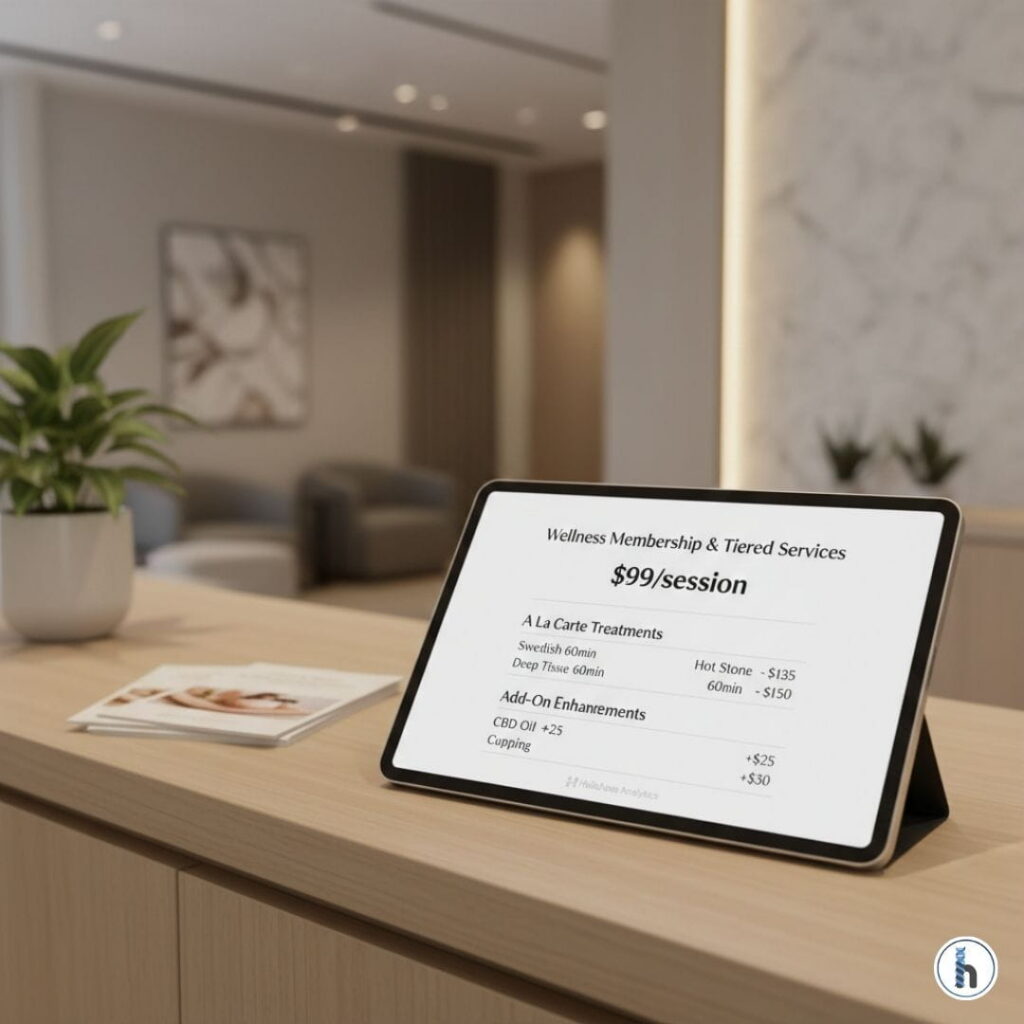
A digital tablet on a professional clinic reception desk displaying a massage therapy pricing strategy including wellness memberships, tiered services for deep tissue, and add-on enhancements like CBD oil and cupping.

Step 2: Choose a Strategic Pricing Model

The “flat fee” model is outdated. Successful clinics now implement structured tiers to reflect the varying skill levels required for different modalities.

Pricing ModelDescriptionBest For
Duration-Based$1/minute rule (e.g., 60m = $100)Relaxation-focused practices
Tiered Modality20–30% premium for advanced skillsSports, Deep Tissue, Clinical
Membership ModelRecurring monthly fee (e.g., $89/mo)Retention-driven clinics
Dynamic PricingPremium rates for peak hoursHigh-traffic urban studios

Why Tiered Pricing is the Modern Standard

Clinical modalities like deep tissue or sports massage require greater physical effort and advanced training. Charging a $10–$20 premium reflects this expertise and protects against therapist burnout.

Step 3: Increase Average Visit Value (AVV)

A successful massage clinic should aim for an Average Visit Value (AVV) of approximately $164. This is achieved through strategic enhancements rather than base rate hikes alone.

Strategic Add-On Enhancements

Increase revenue without extending appointment time by offering:

    • Hot Stones: $15–$30

    • Cupping: $20+

    • CBD Oil Enhancement: $20+

Retail Integration

Retail should represent 8–15% of total sales. Positioning yourself as a wellness authority by selling foam rollers, therapeutic oils, or postural supports increases both revenue and client retention.

Strategic Revenue Optimization with HelloNote

Pricing isn’t just about the number on the menu—it’s about scheduling efficiency. HelloNote provides the analytics needed to move from guessing to growing.

Identify Underbooked Time Slots

Use HelloNote’s revenue analytics to spot gaps in your schedule. Instead of a blanket price increase, you can implement a “Prime Time” premium for Saturdays while maintaining lower weekday morning rates to fill gaps.

Tracking Performance and Margins

HelloNote allows you to track AVV by service type and provider. This data tells you exactly which services are your “profit engines” and which may need a price adjustment.

Frequently Asked Questions

Q1. How much more should I charge for Mobile Massage?

Mobile services are typically 20–30% higher than in-clinic rates to cover fuel, travel time, and equipment transport.

Q2. What is “Charm Pricing” vs. “Prestige Pricing”?

Charm Pricing ($99) uses a psychological discount effect, while Prestige Pricing ($150) signals authority and expertise. Modern clinical practices increasingly use Prestige Pricing to simplify their messaging.

Q3. Can I charge more for Deep Tissue?

Yes. Most practitioners charge a $10–$20 premium due to the increased physical strain and the advanced training required for the modality.

Q4. How often should I review my clinic's pricing?

You should conduct a formal cost analysis every 12 months. However, with HelloNote’s real-time analytics, you can monitor your margins monthly to stay ahead of inflation.

Q5. How do I communicate a price increase to clients?

Provide at least 60 days’ notice and frame the change around value. Mention investments in therapist training or new recovery technology to build trust.

Conclusion: Pricing is a Strategy, Not a Guess

The clinics thriving in today’s market are not the cheapest—they are the most structured. By combining membership stability with the data-driven insights of HelloNote, you can ensure your clinic remains both profitable and sustainable.

Ready to see how HelloNote’s analytics can optimize your revenue? Schedule your demo today.

Maximizing Physical Therapy Salary Through Board Specialization

Table of Contents

In 2026, board-certified physical therapy specialists (GCS, OCS, NCS) are commanding a 5–15% salary premium. By mastering high-complexity documentation for CPT 97163 and leveraging HelloNote outcome reports, specialists can effectively negotiate higher pay in high-reimbursement settings like Home Health and Acute Care.

Board-certified Physical Therapist using a tablet to track CPT 97163 high complexity evaluation data for salary growth in a modern clinic.

The Financial ROI of ABPTS Board Certification

To maximize earning potential in 2026, Physical Therapists must transition from general practice to Board-Certified Clinical Specialization (ABPTS). Specializations in Geriatrics (GCS), Pediatrics (PCS), and Oncology command higher salaries because they align with high-reimbursement settings like Home Health and Acute Care. In these environments, clinical complexity justifies premium compensation tiers and leadership roles.

Clinical Methodology and Career ROI

The American Board of Physical Therapy Specialties (ABPTS) offers certifications that validate a clinician’s advanced knowledge. From a compliance and billing perspective, specialists are better equipped to document the “complex clinical reasoning” required to justify higher-level CPT codes, such as 97163 for High Complexity Evaluations.

Impact on MIPS and Value-Based Care

Specialization directly impacts MIPS (Merit-based Incentive Payment System) scoring. Specialists who produce superior functional outcomes help their practices earn performance-based bonuses from Medicare. This transforms the therapist from a cost center into a high-revenue asset for the clinic.

High-Earning PT Specialties & Settings Comparison

Specialty / SettingPrimary CertificationHigh-Pay EnvironmentHelloNote Advantage
GeriatricsGCSHome Health / SNFMobile documentation for travel PTs
SportsSCSPrivate Practice / Pro TeamsCustom “Return to Play” templates
NeurologyNCSInpatient Rehab (IRF)Tracking long-term functional goals
Pelvic HealthWCSCash-Pay / BoutiqueIntegrated HIPAA-compliant intake
Travel PTGeneral or SpecialistVariable (Short-term)Cloud-based access from any state
CardiovascularCCSAcute Care / ICUReal-time vitals & complex monitoring
OncologyBoard-CertifiedCancer Centers / HospiceSpecialized lymphedema & fatigue logs

How to Prevent Patient "Sticker Shock" and Improve Retention

In clinical practice, the most dangerous time for patient retention isn’t the first session—it’s the arrival of the first bill. With deductibles often exceeding $3,000 in 2026, a patient might realize they owe $450 for their first three visits and immediately cancel.

The "Financial Evaluation" Strategy

Perform a “Financial Evaluation” simultaneously with your Clinical Evaluation. Use HelloNote’s Insurance Verification tool before the patient walks in. Frame the cost as an investment: “Your plan has a $3,000 deductible, but completing this 8-week plan now prevents a $20,000 surgery next year.”

Frequesntly Asked Questions

Q1. Does Medicare pay more for a Board-Certified Specialist?

Directly? No. CPT codes pay the same regardless of your credentials. However, specialists are more likely to successfully bill for High-Complexity Evaluations (97163) and provide “Skilled Maintenance” that justifies higher reimbursement.

Q2. Which setting pays the most for a new grad?

Typically, Home Health and Skilled Nursing Facilities (SNFs) offer the highest starting salaries, often exceeding $108,000. Using an efficient, mobile-friendly EMR like HelloNote is vital in these high-productivity environments.

Q3. Is the cost of the SCS or OCS exam worth the investment?

Yes. Beyond the immediate 5–15% salary bump, it qualifies you for Legal Expert Witness work and Consultancy roles, which can pay $200–$500 per hour in 2026.

Q4. How do I use my certification to negotiate a raise in my current role?

Certification alone isn’t always enough; you must show Revenue Impact. Use HelloNote’s reporting to demonstrate that your specialty skills lead to lower cancellation rates or higher “High Complexity” evaluation counts. Ask for a “Certification Bonus” or a performance-based salary adjustment tied to your niche’s growth.

Q5. What is the Medicare KX Modifier threshold for 2026?

For 2026, the KX modifier threshold is $2,480 for PT and SLP services combined, and a separate $2,480 for OT services. Specialists are often more confident in documenting the medical necessity required to continue care once these thresholds are met, preventing lost revenue for the clinic.

HelloNote–Fiserv Integration: Simplifying Payments for Therapy Practices

Table of Contents

In the evolving world of outpatient care, therapy practices face an ongoing challenge: bridging the gap between clinical delivery and financial management. HelloNote and Fiserv are actively closing that gap.

Through a strategic collaboration that integrates HelloNote’s therapy-specific EMR with Fiserv’s enterprise-grade payment infrastructure (including Clover POS), clinics gain a seamless, end-to-end operational platform designed for PT, OT, SLP, and behavioral health practices.

This isn’t a future concept—it’s already live.

Merging Clinical Precision with Fintech Infrastructure

HelloNote was built by therapists to solve documentation, scheduling, billing, and workflow challenges unique to rehab and behavioral health practices.

Fiserv, a global leader in payment processing and financial services, brings secure, compliant fintech infrastructure trusted across healthcare and enterprise commerce.

Together, they create a unified clinical-financial ecosystem that replaces fragmented systems with a single, connected experience.

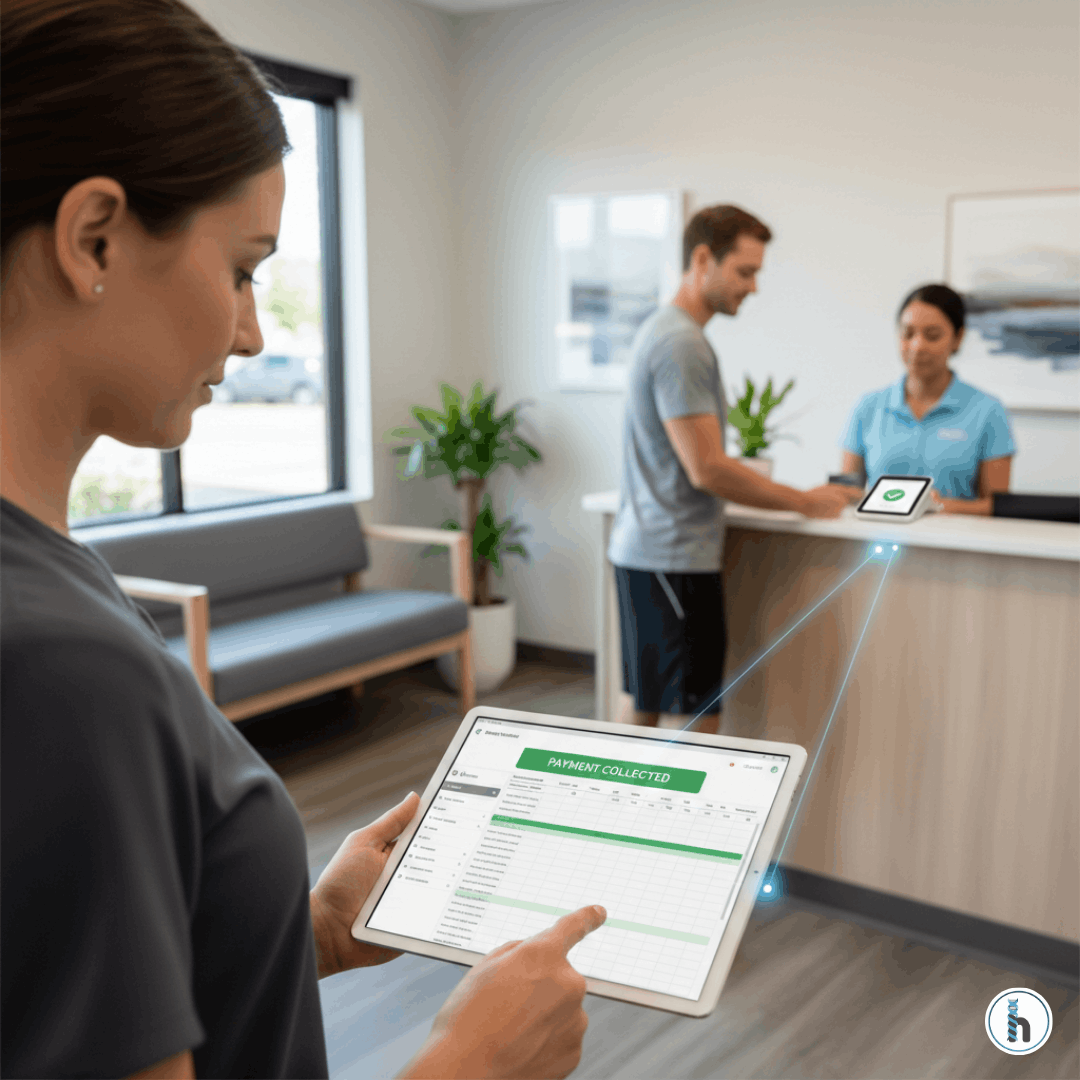
Therapy clinic staff reviewing EMR dashboard while collecting patient payment at the front desk using integrated HelloNote and Fiserv payment processing

Clover Payments Embedded Within Clinical Documentation

One of the most impactful outcomes of the HelloNote–Fiserv collaboration is the direct integration of Clover POS into the HelloNote workflow.

What This Enables for Therapy Clinics

Clinics can now:

    • Trigger copay or balance collection the moment a SOAP note is signed
    • Automatically flag outstanding balances for front-desk follow-up
    • Accept payments in-clinic or via secure email/text links
    • Reduce patient confusion around billing timing
    • Improve point-of-service collection rates

Early use cases show up to a 20% increase in point-of-service collections simply by aligning care delivery with payment collection.

How to Set Up Credit Card Processing in HelloNote

Step 1 – Access the Payments Tab

Step 2 – Open the Credit Card Profile

    • Click Credit Card Profile
    • Securely add, view, and manage stored payment methods

Step 3 – Enrollment & Integration

    • If not enrolled, contact HelloNote Support
    • Complete the Fiserv integration process
    • Receive setup instructions and agreements

Step 4 – Start Collecting Payments

Once activated, clinics can:

    • Store cards securely
    • Run charges at point of care
    • Automate balance collection
    • Support recurring billing where appropriate

All transactions are PCI-compliant and HIPAA-aligned.

Giving Small Practices Big Banking Power

Access to capital is a major growth barrier for many therapy practices. With real-time billing and revenue data flowing through the HelloNote–Fiserv system, clinics unlock new financial opportunities.

Financial Capabilities Enabled by Integration

    • Data-driven credit eligibility
    • Merchant cash advances
    • Financing tied to receivables
    • Revenue-linked financial dashboards

This gives solo and small group practices access to tools traditionally reserved for large healthcare systems.

Disrupting Legacy Systems in Rehab and Behavioral Health

Most EMRs stop at documentation.
Most payment platforms stop at transactions.

HelloNote and Fiserv unify both.

What Makes This Different

    • HIPAA + PCI compliance in one system
    • Unified front desk, clinical, billing, and finance workflows
    • Reduced software sprawl and vendor fatigue
    • Built specifically for PT, OT, SLP, and behavioral health operations

One Dashboard. Total Clarity.

Practice owners can now monitor:

    • Clinical productivity
    • Copay collection rates
    • Billing performance
    • Outstanding balances
    • Therapist-level unit economics

All in one place—without exporting reports or reconciling multiple systems.

The Future Is Already Here

By integrating clinical care delivery with financial infrastructure, HelloNote and Fiserv are empowering the care economy.

Therapy practices gain:

    • Stronger cash flow
    • Better patient experience
    • Reduced operational friction
    • Scalable, future-ready systems

Whether you’re a solo provider or a growing multi-location group, this collaboration is reshaping how modern therapy clinics operate.

Frequently Asked Questions

Q1: What is the HelloNote and Fiserv integration?

It’s a direct integration that embeds Fiserv’s payment processing (including Clover POS) into HelloNote’s EMR, allowing clinics to collect payments inside clinical workflows.

Q2: Is credit card data stored securely in HelloNote?

Yes. All payment data is handled through Fiserv’s PCI-compliant infrastructure and securely integrated into HelloNote.

Q3: Can clinics collect payments at the time of documentation?

Yes. Payments can be triggered when SOAP notes are signed or balances are identified—improving point-of-service collection.

Q4: Who benefits most from this integration?

PT, OT, SLP, and behavioral health clinics—especially small and growing practices that want enterprise-grade financial tools without added complexity.

Q5: Do clinics need additional hardware to use Clover payments?

No. Payments can be collected digitally via email/text links or existing setups, depending on clinic preference.

Ready to Activate Fiserv Payments Inside HelloNote?

Book a HelloNote demo or contact our support team to enable secure, in-session payment collection built for therapists and backed by global fintech infrastructure.

Clearinghouse Switching: A Game-Changer for Therapy Billing and Revenue Cycle Management

Clearinghouse switching is a pivotal feature in the world of therapy billing and revenue cycle management, where efficiency and flexibility are crucial for maintaining steady cash flow and reducing costly claim denials. This capability, which sets advanced EMR solutions apart, allows clinics to seamlessly transition between multiple clearinghouses without disrupting operations, directly impacting the speed and success of getting paid.

For physical therapy, occupational therapy, and speech-language pathology practices, having such flexibility on demand provides greater financial control, faster reimbursements, and fewer claim processing issues. This article explores why the ability to switch intermediaries is a game-changer, how to reduce claim denials in therapy billing using this approach, how it benefits therapy practices, and why it should be a key factor in choosing an EMR system.


Conceptual image: HelloNote EMR transforms stacks of therapy claim denials into approvals, symbolizing improved reimbursements through efficient processes like clearinghouse switching.

What Is Clearinghouse Switching?

A clearinghouse is an intermediary between healthcare providers and insurance payers, helping to submit claims, verify patient eligibility, and detect errors before claims reach insurers. Traditionally, practices lock into a single clearinghouse, limiting flexibility and sometimes leading to delayed reimbursements or avoidable claim denials due to system inefficiencies.

This advanced system allows therapy clinics to:

Choose the best intermediary for their needs (e.g., Inovalon for Medicare, Trizetto for commercial payers) instead of being tied to just one.
Reduce claim rejections by selecting an intermediary with better claim acceptance rates for specific payers.
Adapt quickly if their primary clearinghouse experiences downtime or inefficiencies.
Optimize payment speed by selecting an option known for faster processing times for certain payers.

Instead of being forced into one-size-fits-all billing, having flexible intermediary options gives therapy clinics more control over their revenue cycle and financial health.

Why is the Ability to Switch Clearinghouses Crucial for Therapy Practices?

This operational advantage directly addresses several common frustrations in therapy billing and significantly impacts the bottom line.

1. Eliminates Clearinghouse Lock-In

Many EMR systems restrict therapy practices to a single clearinghouse partner. This can lead to billing inefficiencies and delays if that provider has:

Slow claim processing times
Higher rates of claim rejections
Limited payer connectivity

Having multiple options removes these limitations, allowing therapy practices to select the best partner for different payers, ultimately improving the rate of successful reimbursements.

2. Reduces Claim Denials and Rejections

If a clinic’s current intermediary has high rejection rates for certain payers, selecting another with better acceptance rates for those specific claims can significantly improve cash flow and reduce unpaid claims. This flexibility is key if you’re asking how to reduce claim denials in therapy billing effectively.

For example:

Provider A may process Medicare claims faster with fewer issues, while Provider B has better performance with specific commercial insurers.
With the means to select the optimal route, clinics can direct claims through the most efficient channel, reducing errors and increasing approval rates, leading to fewer frustrating claim denials.

3. Increases Revenue Collection Speed and Reimbursements

A slow clearinghouse can delay payments by weeks or even months, creating cash flow challenges. Changing to an intermediary with faster claim processing for key payers can:

Accelerate revenue collection
Reduce days in accounts receivable
Improve overall financial stability through quicker reimbursements.

For high-volume therapy practices, faster payment cycles are essential for sustainable business growth.

4. Provides Flexibility During Clearinghouse Downtime

Clearinghouses sometimes experience technical issues or processing delays. Being locked into one provider means clinics are stuck waiting, potentially halting their billing operations.

With the option to reroute, therapy practices can immediately send claims to another functional intermediary without significant delays, ensuring more consistent cash flow and uninterrupted billing.

5. Expands Payer Connectivity and Options

Some intermediaries have limited partnerships, restricting clinics from billing certain insurance providers efficiently. Using an EMR that supports multiple connections can:

Allow selection of providers that work optimally with target insurance payers
Increase the number of payers that can be billed smoothly
Maximize opportunities for reimbursements

This is especially beneficial for clinics expanding services or working with a diverse payer mix.

How This Feature Sets Advanced EMRs Apart

Most standard EMR systems force practices into a single clearinghouse agreement. However, advanced EMRs offer this built-in flexibility, empowering clinics to:

Avoid being trapped with a poorly performing provider.
Optimize claim approvals and reduce claim denials by choosing the most effective path for each payer.
Minimize cash flow disruptions by instantly redirecting claims during system downtimes.

Such a capability is particularly valuable for therapy practices needing efficient processing for high patient volumes and diverse payer mixes.

HelloNote EMR: Leveraging Clearinghouse Switching for Fewer Claim Denials

HelloNote EMR integrates robust clearinghouse switching capabilities to give therapy clinics unparalleled billing flexibility and efficiency. With HelloNote EMR, practices can:

Choose from multiple integrated clearinghouses, including Inovalon, Trizetto, and ClaimMD, to ensure maximum claim acceptance.
Benefit from intelligent routing suggestions based on payer performance (where applicable).
Prevent billing interruptions by easily changing intermediaries if one experiences delays.
Enhance the speed of reimbursements by optimizing claim pathways.

This specific function within HelloNote EMR ensures that therapy practices stay in control of their revenue cycle, making billing more efficient and reducing common causes of claim denials.

Looking for an EMR that optimizes billing and helps reduce claim denials? Book a free demo of HelloNote EMR today!

Final Thoughts: Optimizing Reimbursements with Clearinghouse Flexibility

The ability to choose and change claim intermediaries is a powerful tool for therapy practices looking to streamline billing, minimize claim denials, and improve cash flow. By selecting an EMR system with this core function, therapy clinics can:

Eliminate clearinghouse lock-in and maximize payment rates.
Reduce denials by selecting the most effective intermediary for each payer situation.
Maintain financial stability with uninterrupted claim processing for faster reimbursements.

As billing and insurance requirements evolve, therapy practices need control over their revenue cycle. Access to flexible claim submission options is no longer a luxury—it’s essential for financial success.

Creative Ideas on How to Grow Your Therapy Clinic and Expand Your Patient Base

Creative ideas to grow your therapy clinic and expand your patient base. This article covers effective strategies for increasing patient volume, such as offering new services, forming strategic partnerships, and using targeted marketing techniques to drive clinic growth and long-term success.

A hand holding a glowing lightbulb, symbolizing creative ideas and innovation for growth in therapy clinics. The background is dark, highlighting the importance of new strategies for clinic expansion and success.

The healthcare industry is constantly evolving, and for therapy clinics including physical therapy (PT), occupational therapy (OT), and speech-language pathology (SLP) practices—growth and scaling are essential for long-term success. Expanding services, forging strategic partnerships, and increasing your patient base not only ensures sustainability but also drives higher revenue and enhances patient outcomes. 

In this article, we’ll explore why growth and scaling are crucial for therapy clinics, and how clinic owners can effectively manage expansion while maintaining quality care. 

Why Growth and Scaling Matter for Therapy Clinics

While running a small, stable clinic may seem manageable, growth is necessary to remain competitive in the evolving healthcare landscape. Here’s why scaling your therapy practice is important: 

    • Increases Revenue Streams – By offering new services such as telehealth, wellness programs, or corporate partnerships, clinics can generate additional income. 
    • Diversifies Practice Offerings – Expansion allows clinics to introduce specialized therapy services, such as pediatric rehabilitation, sports injury prevention, or cognitive therapy. 
    • Improves Patient Accessibility – Reaching a larger audience through telehealth or satellite locations ensures patients receive care more conveniently. 
    • Strengthens Business Resilience – Diversifying income sources helps mitigate risks associated with seasonal fluctuations or changes in insurance policies. 
    • Enhances Professional Growth – Scaling provides opportunities for therapists to specialize, pursue advanced certifications, and develop leadership roles. 

How to Successfully Grow and Scale Your Therapy Clinic

1. Expand Services with Telehealth and Wellness Programs 

One of the most effective ways to grow a clinic is by adopting telehealth and wellness initiatives. These services can attract a broader patient base and add convenience for existing clients. 

    • Telehealth Appointments – Virtual consultations allow patients to receive therapy from the comfort of their homes. 
    • Wellness Programs – Offer injury prevention, ergonomic assessments, or corporate wellness workshops to cater to non-clinical clients. 
    • Subscription-Based Health Coaching – Develop membership plans for guided home exercises, nutrition coaching, or mental wellness. 

2. Partner with Schools, Gyms, and Community Centers 

Strategic partnerships can increase brand visibility and attract new patients. Consider collaborating with: 

    • Schools & Universities – Offer student screenings, therapy sessions for children with special needs, or ergonomic training for teachers. 
    • Gyms & Fitness Centers – Provide injury prevention seminars, post-workout recovery therapy, or onsite PT consultations. 
    • Corporations & Workplaces – Develop corporate wellness programs, offering ergonomic workplace assessments and injury prevention strategies. 

3. Open Additional Clinic Locations or Mobile Services 

Expanding to new locations or offering mobile therapy services can help reach more patients, especially in underserved areas. 

    • Satellite Clinics – Open smaller locations in nearby neighborhoods to capture a broader market. 
    • Home Therapy Visits – Provide mobile therapy services for seniors, individuals with mobility challenges, or post-surgery patients. 
    • Pop-Up Clinics – Set up temporary therapy stations at community events, marathons, or sports tournaments to increase outreach. 

4. Invest in Marketing and Patient Outreach 

A targeted marketing strategy ensures that your expanding services reach the right audience. 

    • SEO-Optimized Website – Ensure that your website ranks well in local searches for therapy services. 
    • Social Media Engagement – Share patient success stories, educational content, and behind-the-scenes looks at clinic operations. 
    • Referral Programs – Encourage existing patients to refer friends and family through discounts, gift cards, or loyalty rewards. 

5. Optimize Operations with EMR and Automation 

As your clinic grows, managing patient records, scheduling, and billing manually becomes inefficient. Implementing the right technology can streamline processes and enhance patient experience. 

    • EMR Software  – Like HelloNote.  Use a secure, HIPAA-compliant system like Hellonote EMR for scheduling, billing, and documentation. Like HelloNote. 
  • Automated Reminders – Reduce no-shows with SMS and email reminders for appointments. 
    • Online Patient Portals – Allow patients to book appointments, complete paperwork, and access therapy resources online. 

6. Hire and Train a Strong Therapy Team 

Scaling a clinic requires the right team. Hiring and retaining skilled professionals is key to maintaining quality as your practice grows. 

    • Expand Your Staff – Bring in additional therapists, administrative support, or specialists to accommodate increased patient demand. 
    • Continuous Training – Invest in staff development programs, workshops, and certifications to keep your team updated with industry trends. 
    • Foster a Positive Workplace Culture – Ensure your team remains motivated and engaged by offering competitive salaries, incentives, and a supportive work environment. 

Final Thoughts: Position Your Therapy Clinic for Long-Term Success

Growth and scaling are essential for therapy clinics that want to increase revenue, reach more patients, and enhance service offerings. By strategically expanding through telehealth, partnerships, additional locations, and operational optimization, clinics can thrive in a competitive market. 

Ready to improve your practice? Start by evaluating your clinic’s strengths, identifying areas for expansion, and implementing scalable strategies that align with your long-term goals. 

Need help streamlining clinic operations? Explore Hellonote EMR for seamless patient management, billing, and documentation to support your growth journey. 

Product Recommendations to Generate Extra Income for Your Therapy Practice

Discover how therapists can increase their income through product recommendations and affiliate links, enhancing their practice while providing valuable resources to clients.

product recommendations for improving patient care and generating extra income in your therapy practice.

Massagers, walkers, cushions, foam rollers, putty are just some common items that each day you either order or recommend to patients. And likely, your patients are often asking you for all sorts of recommendations on products. In this article, we’ll give you several tips on how to appropriately add extra income to your practice through these equipment recommendations. 

Make sure it’s a product you’ve tested and love!

People trust you, and although not every product works perfectly for each person, you want to be able to confidently know that the product you recommend is one of the best out there. 

If you recommend a product solely based on the profit it may provide for you, that could damage your reputation and the relationship you have with your patients. 

Create a recommended products page on your website

Having a dedicated page on your website is the easiest and best way to recommend products. Each time a patient asks for the best rollator or foam roller, you can simply direct them to your page. 

By using this method, it’s easy and doesn’t feel salesy. 

Create affiliate links using Amazon or other direct sellers

Amazon is one of the quickest and easiest ways to generate what’s called an “affiliate link”. This is a special link that tells Amazon that someone has bought a product through your recommendation, and as a result, you should get a small percentage of the profits. Other companies have these similar links you can use as well, although you may have to email or contact certain companies to find out about their affiliate programs. 

But an affiliate link makes it very easy to generate passive income from your product recommendations. Let’s use Amazon as our example. Go to Amazon and sign up for their affiliate program. Search for a product you love, and click to create a special link. 

Once you have that link copied, you are going to return to your website, and your dedicated equipment page, and paste that link onto the page. You may have to do some small editing to get things to look just how you want them, but that’s it! 

Your patients won’t have to do anything different either. They’ll simply click on the item on your page and purchase, just as if it were a regular purchase. 

Provide “How to” Explainer Videos or Photos

A great way to provide extra value and reason to go to your recommended equipment page may be to include various tips or instructions on how to use the products you recommend. 

Another idea is to also include patient (no names of course unless they’ve consented) examples or testimonials of the product’s benefits. 

Create Personalized Product Recommendations

Every patient’s needs are different, so tailoring your recommendations to their individual recovery journey can make a huge difference. Take a few extra minutes to customize your product suggestions based on their condition or goals. This personalized touch can make your patients feel valued and appreciated. 

Track Your Best-Selling Items

Over time, you’ll notice which products are most popular among your patients. Keep track of the products that have the highest conversion rates so that you can adjust your recommendations accordingly. By consistently recommending products that your patients respond well to, you’ll increase the chances of them making a purchase through your affiliate links. 

Summary

Having a dedicated equipment page saves you time, helps your patient more easily find quality products that could benefit them, and at the same time could earn you extra income. We hope this helps you continue to grow your therapy business! 


Ready to Boost Your Income? 

Start implementing these strategies today to turn your product recommendations into a source of passive income! Create your recommended products page, sign up for affiliate programs, and personalize your suggestions to provide the best value to your patients. 

Looking for more ways to grow your practice and enhance your patient experience? Read more insights here. 

How Can a Therapy Practice Increase Revenue? 4 Creative Strategies

Table of Contents

As a therapy professional, you’re an expert in patient care. But in a world of declining reimbursement rates and rising operational costs, running a successful practice also requires being an expert in business. For many clinic owners, the key challenge is learning how to increase therapy revenue beyond the traditional, session-based model.

To thrive, clinics must explore new, creative revenue streams that diversify income, expand their reach, and build a more resilient and profitable practice. This guide outlines four powerful, ethical, and scalable strategies to do just that.

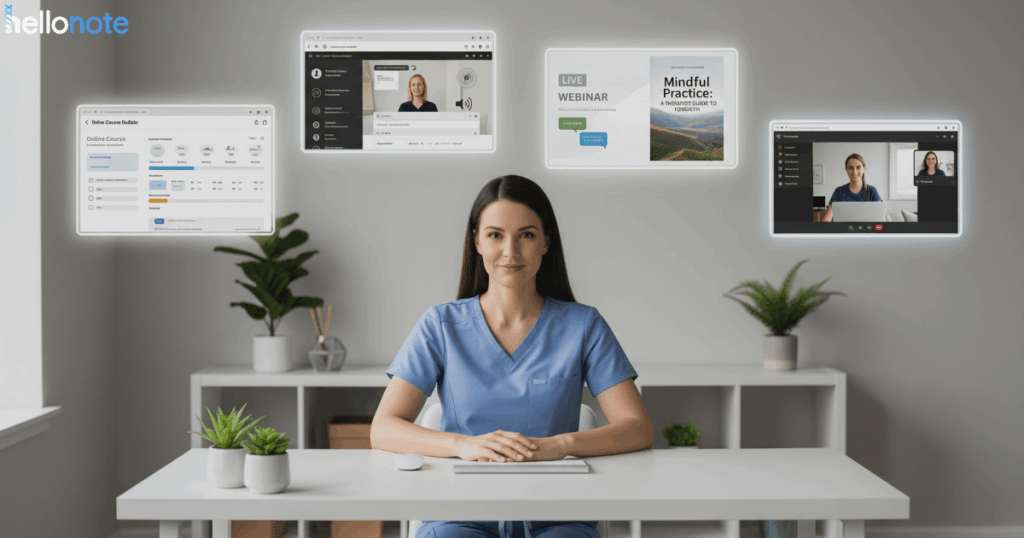
A female therapist visualizes the answer to 'how can a therapy practice increase revenue?' with floating screens showing creative revenue streams like an online course, a webinar, an eBook, and telehealth services.

Part 1: Digital Products - Monetize Your Expertise

Your clinical knowledge is one of your most valuable assets. Packaging it into digital products creates scalable, passive income and establishes you as a thought leader.

1. Create and Sell Online Courses

Share your specialized knowledge with a global audience of other therapists or the public.

    • Find Your Niche: Focus on a topic where you have deep expertise (e.g., pelvic floor rehab, sports taping techniques, pediatric feeding). A targeted course stands out.

    • Offer CEUs: Create a course for other therapists that offers Continuing Education Units (CEUs). This makes it a valuable professional development tool and a highly attractive product.

    • Use the Right Platform: Services like Teachable or Thinkific handle the hosting, payment processing, and student management, making it easy to get started.

    • Promote Your Course: Use email marketing, social media, and partnerships with professional organizations to drive enrollment.

2. Write and Publish an eBook

An eBook is an accessible way to establish authority and generate revenue.

    • Solve a Common Problem: Focus on topics that address your patients’ biggest questions, like “A Therapist’s Guide to Managing Low Back Pain” or “The Ultimate Home Exercise Program.”

    • Make it Actionable: Break down complex information into simple, easy-to-follow steps, checklists, and illustrations.

    • Use as a Lead Magnet: Offer a chapter of your eBook for free on your website to capture email addresses for your marketing list.

    • Distribute Widely: Use platforms like Amazon KDP to publish your eBook and reach a massive audience with minimal upfront cost.

Part 2: Scalable Services - Expand Your Reach

Use technology to deliver your services in new and innovative ways, reaching clients beyond your clinic’s walls.

3. Offer Live Online Classes or Webinars

Engage with your community in real-time to build relationships and generate leads.

    • Host “Hot Topic” Webinars: Address common issues like “Ergonomics for the Home Office” or “Preventing Running Injuries.” This positions you as an expert.

    • Create Specialized Workshops: Offer paid, multi-session workshops on topics like “Managing Chronic Pain” or “Post-Surgical Rehab Prep.”

    • Include a Call to Action (CTA): Always end a session by inviting attendees to schedule a consultation, download a guide, or sign up for your next event.

    • Use Common Platforms: Services like Zoom, Facebook Live, or Instagram Live are perfect for hosting interactive sessions.

4. Integrate a Telehealth Business Model

Telehealth is no longer just an option; it’s an essential part of modern healthcare.

    • Improve Accessibility: Reach patients who can’t visit your clinic due to location, mobility, or scheduling conflicts.

    • Ensure Continuity of Care: Provide ongoing monitoring and follow-up sessions for patients with chronic conditions, improving outcomes and patient engagement.

    • Use an All-in-One System: A HIPAA-compliant EMR like HelloNote is crucial. It should seamlessly integrate video conferencing, scheduling, billing, and documentation into a single, secure platform.

    • Offer a Hybrid Model: Give patients the flexibility to choose between in-person and telehealth visits to best suit their needs.

Frequently Asked Questions About New Revenue Streams

Q1: What are some new revenue streams for a PT clinic?

Beyond traditional patient care, clinics can generate new revenue through digital products like profitable online courses and eBooks, or by offering scalable services like paid webinars and telehealth consultations. These are excellent creative revenue streams for therapists.

Q2: Is selling CEU courses profitable?

Yes, it can be highly profitable. A well-produced course in a high-demand niche that offers certified Continuing Education Units (CEUs) can become a significant source of passive income, as you can sell it to other therapists over and over again with minimal ongoing effort.

Q3: How do I start offering telehealth services?

Start by choosing a HIPAA-compliant EMR system, like HelloNote, that has fully integrated telehealth features. Then, research insurance reimbursement policies for virtual visits and create a plan to educate your existing patients on the benefits and convenience of a telehealth business model for therapists.

Q4: Can therapists make money selling eBooks?

Absolutely. An eBook is a low-cost way to enter the digital product market. By focusing on a common problem and promoting the book through your clinic’s website and social media, you can create a valuable and consistent stream of passive income.

Q5: What is the biggest challenge when adding new revenue streams?

The biggest challenge is often time management and marketing. Creating a course or writing an eBook takes time, and you need a strategy to promote it. This is why starting small (e.g., with a single webinar) and using an efficient EMR to manage your core practice are key to freeing up time for these growth projects.

Conclusion

Adding these strategies is the answer to how can a therapy practice increase revenue while strengthening its brand and professional reach. By sharing your knowledge and offering innovative services, you’re not just growing a business you’re enhancing the lives of a much wider community.

HelloNote not only streamlines your telehealth services but also supports your entire practice with integrated scheduling, billing, and documentation features, giving you more time to focus on these growth strategies.

You've found a hidden discount!

  • 00Hours
  • 00Minutes
  • 00Seconds