



















You've found a hidden discount!

HN Unlock Layer 1
HN Unlock Layer 2
HN Unlock Layer 3
HN Unlock Layer 4
HN Unlock Layer 5
  • 00Hours
  • 00Minutes
  • 00Seconds

Category: billing

Auto Accident Massage Therapy Billing: CPT Codes and ICD-10

Licensed massage therapist applying therapeutic massage to a patient's upper back and cervical spine in a clinical setting for auto accident injury treatment

What CPT codes do massage therapists use to bill auto accident insurance?

The primary CPT code massage therapists use for auto accident billing is 97124 (massage therapy), which covers effleurage, petrissage, tapotement, compression, and percussion billed in 15-minute timed units. CPT 97140 (manual therapy) is used for advanced manual techniques and can be billed in the same session only when applied to a clearly distinct body region. Supporting codes include 97010 (hot/cold packs) and 97112 (neuromuscular reeducation) where clinically applicable. All codes require a physician referral and documented medical necessity.

Key Takeaways

  • Staff productivity in PT clinics is best measured through units per visit and notes-per-hour metrics — not just patient volume
  • Multi-location PT practices need centralized compliance tracking to ensure documentation standards are consistent across all sites
  • Revenue cycle management starts at scheduling — eligibility verification before the first visit prevents the majority of claim denials
  • Inventory and supply management is one of the most overlooked operational costs in outpatient therapy — tracking it reduces waste by up to 20 percent
  • HelloNote centralizes scheduling, documentation, billing, and reporting in one platform so clinic owners spend less time managing systems and more time growing the practice

Table of Contents

Massage therapy billing for auto accident patients is one of the most valuable revenue streams available to licensed massage therapists and one of the most misunderstood.

We had a massage therapist reach out to us not long ago who was treating three auto accident patients a week and getting paid for almost none of them. Not because her work was not good. Not because the injuries were not real. Because her billing was wrong from the first session. Wrong CPT code on one claim. Missing ICD-10 code on another. No physician referral on file for the third. Three patients, three different denial reasons, three weeks of unpaid work.

Auto accident billing is one of the most valuable revenue streams available to licensed massage therapists. Personal injury protection and liability claims cover massage therapy when it is medically necessary, properly documented, and billed with the right codes. The problem is that the process has more moving parts than a standard health insurance claim, and most massage schools do not teach billing at the level this work requires.

This post covers everything a massage therapist needs to get auto accident claims paid correctly the first time: which CPT codes to use, which ICD-10 diagnosis codes to pair with them, how PIP and MedPay billing works, and what a SOAP note has to contain to survive an insurance review. We also cover the specific mistakes that trigger the denials we see most often, so you can avoid them before they cost you.

Why Auto Accident Patients Are a Real Revenue Opportunity for Massage Therapists

Most massage therapists know that traditional health insurance coverage for massage is inconsistent and often limited. But auto accident cases operate under a completely different framework. When a person is injured in a motor vehicle accident, their treatment costs are typically covered by PIP insurance, which is mandatory in no-fault states, or by the at-fault driver’s liability insurance in at-fault states. Both payer types regularly cover massage therapy as part of a documented treatment plan, as long as the work is prescribed, medically necessary, and billed correctly.

The injuries that bring auto accident patients to massage therapists are also the injuries massage therapy is most effective for. Whiplash, cervical muscle strain, soft tissue injury from impact, and low back pain from seat belt compression are among the most common outcomes of motor vehicle accidents. These conditions respond well to therapeutic massage, manual therapy, and neuromuscular work.

The Attorney Referral Pipeline

Auto accident cases often involve attorneys and case managers. When a patient is represented by a personal injury attorney, that attorney has a direct financial interest in ensuring all treatment providers document thoroughly and bill correctly. Attorneys refer clients to providers they trust to keep clean records. Building a reputation as a massage therapist who handles auto accident billing professionally is one of the most effective ways to build a steady referral pipeline in this niche.

The CPT Codes Massage Therapists Use for Auto Accident Billing

Can massage therapists bill CPT 97124 and 97140 in the same session for auto accident patients?

Yes, CPT 97124 and CPT 97140 can be billed in the same session if they are applied to clearly distinct body regions. You cannot bill both codes for the same body area in the same session. When billing both codes on the same date of service, use Modifier 59 to indicate that the services were separate and distinct. Document the specific regions treated under each code in your SOAP note.

Getting the right CPT code on an auto accident claim is not optional. Use the wrong code and the claim comes back denied. Here is a clear breakdown of the codes that apply to massage therapy in auto accident cases.

CPT Code Description Billing Unit Auto Accident Use
97124
Massage Therapy: effleurage, petrissage, tapotement, compression, percussion
15-min timed units
Primary code for therapeutic massage. Most commonly billed code for auto accident soft tissue treatment.
97140
Manual Therapy: mobilization, manipulation, manual lymphatic drainage, manual traction
15-min timed units
Used for advanced manual techniques. Do not bill same region same session as 97124.
97010
Hot/Cold Packs: application of moist heat or cryotherapy
Per session (untimed)
Adjunct code for thermal modalities. Bill once per day maximum.
97112
Neuromuscular Reeducation:
15-min timed units
Appropriate for movement dysfunction from accident injuries.
proprioception, balance, posture, coordination
Requires advanced training. Closely scrutinized by payers.

The 8-Minute Rule for Timed Codes

The 8-minute rule applies to all timed codes. A minimum of 8 minutes of a timed service must be provided to bill one unit.

    • 8 to 22 minutes = 1 unit
    • 23 to 37 minutes = 2 units
    • 38 to 52 minutes = 3 units
    • 53 minutes and above = 4 units

Document the exact start and stop time of each timed service in your SOAP note. Guessing on time is one of the fastest ways to create a compliance problem on an auto accident claim.

Billing Rules for 97124 and 97140 Together

CPT 97124 and 97140 cannot bill for the same region in the same session. To bill both, the services must clearly apply to distinct body areas. Use Modifier 59 to indicate that the services were separate and distinct when billing both codes on the same date of service.

97010 One-Per-Day Limit

Hot or cold packs can only be billed once per day regardless of how many sessions a patient has. If the patient is also seeing a chiropractor or physical therapist that same day and that provider already billed 97010, you cannot bill it again. Coordinate scheduling to avoid this conflict.

ICD-10 Diagnosis Codes That Pair With Auto Accident Massage Treatment

A CPT code tells the payer what you did. The ICD-10 code tells the payer why you did it. If the why is missing, vague, or does not match what the referring physician documented, the claim is denied. The ICD-10 code on your claim must correspond directly to the diagnosis on the physician’s referral or prescription.

ICD-10 Code Condition Auto Accident Context
S13.4XXA
Sprain of ligaments of cervical spine, initial encounter
Clinical code for whiplash. The A suffix indicates initial encounter. Use S13.4XXD for subsequent encounters.
S16.1XXA
Strain of muscle, fascia, and tendon at neck level, initial encounter
Used when cervical injury involves muscle or tendon damage. Common in rear-end impact cases.
M54.2
Cervicalgia (neck pain)
Used for chronic or ongoing neck pain once the acute injury phase has passed.
M54.50
Low back pain, unspecified
Common in accident cases where the patient reports lumbar pain from impact or seat belt compression.
M54.51
Vertebrogenic low back pain
More specific than M54.50. Use when the physician has documented pain as vertebral in origin.
S29.012A
Strain of muscle and tendon of front wall of thorax, initial encounter
Applicable when seat belt injury causes thoracic or chest wall muscle strain.

The 7th Character Rule on S-Codes

Injury codes from the S chapter require a 7th character: A for the initial encounter (active treatment), D for subsequent encounter (routine care after active treatment), and S for sequela. Most of your early sessions with an auto accident patient will use the A suffix. Transitioning to D at the wrong time is a common audit trigger. Follow the physician’s documentation for guidance on when to transition.

When the Diagnosis Does Not Match

If the referring provider’s diagnosis does not include a code that matches the treatment you are providing, contact the referring office before billing. Ask them to clarify the diagnosis on the referral. Do not assume, do not guess, and do not choose a code that seems close. On auto accident claims, where attorneys and adjusters review records closely, a mismatch between the physician’s diagnosis and your billing code creates a credibility problem that goes beyond just the denied claim.

Your documentation is the difference between getting paid and chasing denials.

HelloNote keeps your SOAP notes, CPT codes, and ICD-10 codes organized in one place so your auto accident claims go out clean the first time.

No credit card required • HIPAA Compliant • PT, OT & SLP

How Auto Accident Insurance Billing Actually Works: PIP, MedPay, and Liability

Before you submit a single claim, you need to know which insurance is paying for this patient’s treatment. Auto accident billing does not work like billing a patient’s health plan. The payer, the process, and the timeline are all different depending on the state and the circumstances of the accident.

Personal Injury Protection (PIP)

In no-fault states, every driver’s own auto insurance includes PIP coverage that pays for medical treatment regardless of who caused the accident. Medical benefits are typically up to $10,000 to $15,000 depending on the state, and they cover treatment for up to one year from the accident date in most jurisdictions. Massage therapy is a covered benefit under PIP when it is medically necessary and prescribed by a qualified provider. Oregon, for example, requires PIP to cover massage therapy by law.

MedPay (Medical Payments Coverage)

An optional add-on available in at-fault states. Functions similarly to PIP in that it pays for the policyholder’s medical expenses regardless of fault. Coverage limits are typically lower than PIP, often $1,000 to $5,000. Submit claims directly to the patient’s own auto insurer.

Third-Party Liability Insurance

In at-fault states where the other driver caused the accident, treatment costs may be recovered from the at-fault driver’s liability insurance. This process is slower because liability must often be established before the insurer will pay. Many providers in at-fault cases work on a lien basis, meaning they treat the patient now and agree to be paid from the settlement or judgment later. This requires a signed lien agreement with the patient and often coordination with their attorney.

Working With Case Managers

In auto accident cases where the patient has an attorney, you will frequently interact with a case manager assigned by the insurer. Staying in regular contact with the case manager, providing progress updates, and responding promptly to documentation requests keeps claims moving. Ignoring the case manager is one of the fastest ways to have a patient’s coverage suspended mid-treatment.

Submitting the CMS-1500 Claim Form

Submit claims on the CMS-1500 form. Key fields for auto accident claims:

    • Box 10b: Must indicate Yes for auto accident and include the state where the accident occurred
    • Box 14: Records the date of the accident
    • Box 17 and 17b: Must include the referring provider’s name and NPI number
    • Box 21: Contains the ICD-10 diagnosis codes
    • Box 24D: Contains your CPT codes
    • Box 24G: Contains the number of timed units

READY TO STREAMLINE YOUR CLINIC?

See How HelloNote Handles All of This in One Platform

Managing staff hours, compliance, inventory, and financial reports — all inside one HIPAA-compliant EMR built for PT, OT, and SLP clinics.

No credit card required · HIPAA Compliant · PT, OT & SLP

Documentation That Survives an Insurance Audit: The SOAP Note Standard

We spent the first few years of practice treating documentation as an afterthought. Write the note, sign it, move on. When we started working with patients who had auto accident claims, we learned quickly that documentation is not an afterthought. It is the claim. If your note does not establish medical necessity, the insurer has no obligation to pay, and they will not

What Every SOAP Note Must Contain

Subjective

The patient’s own report of their symptoms since the last session. Include pain location, pain level on a 0-10 scale, functional limitations (difficulty turning head, trouble sleeping, limited shoulder mobility), and any changes since the prior visit. Quote the patient directly when possible. “Patient reports pain level of 6/10 at the cervical spine, down from 7/10 last visit. Reports difficulty looking over right shoulder while driving.” That is a SOAP note. “Patient doing okay” is not.

Objective

Your measurable clinical findings. Range of motion measurements in degrees are the most important objective data point in auto accident cases. Cervical rotation, lateral flexion, and extension measurements before and after treatment show the insurer that you are tracking functional progress. Palpation findings, muscle tone assessment, and postural observations also belong here. Be specific about which regions you treated and what you found.

Assessment

Your clinical interpretation of the subjective and objective data. Is the patient improving, plateauing, or regressing? Connect the findings to the accident diagnosis. Example: “Cervical ROM improvements consistent with resolution of soft tissue injury sustained in motor vehicle accident. Patient continues to demonstrate restriction at right rotation, limiting safe driving ability.”

Plan

What you are doing next. Number of sessions planned, frequency, specific techniques, any changes to the treatment approach. If you are planning to discharge, say so and explain why. If the patient needs a referral back to the physician, document that decision here.

Sample SOAP Note: Auto Accident Patient, Session 4

S:

Patient reports cervical pain 5/10 today, decreased from 7/10 at initial intake. States difficulty with left lateral rotation when checking blind spot while driving. Reports headaches 3 times this week, primarily occipital. Sleep continues to be disrupted by pain when turning head.

O:

Cervical ROM today: flexion 45 degrees (improved from 35 degrees at intake), extension 40 degrees (stable), right rotation 60 degrees (improved from 45 degrees), left rotation 50 degrees (improved from 40 degrees). Palpation reveals moderate tension at bilateral upper trapezius and levator scapulae, left greater than right. Treatment: 30 minutes 97124 (effleurage and petrissage, cervical and upper thoracic), 15 minutes 97140 (myofascial release, cervical soft tissue), 97010 applied to cervical spine post-treatment.

A:

Patient demonstrating measurable ROM improvement consistent with resolution of acute cervical sprain sustained in MVA 11/12/2025 (ICD-10 S13.4XXA). Functional limitation with left lateral rotation persisting and affecting daily activities including driving. Continued treatment indicated.

P:

Continue 2x per week sessions for 3 weeks. Reassess ROM and functional status at session 10. Will submit progress note to referring provider and case manager at session 10 per carrier protocol.

Infographic showing 6 most common auto accident billing mistakes for massage therapists including missing physician referral and incomplete ICD-10 codes

The Most Common Auto Accident Billing Mistakes Massage Therapists Make

We have seen enough denied claims to have a clear picture of where the process breaks down most often. These are the mistakes that cost massage therapists the most money in auto accident billing.

No Physician Referral on File Before Treatment Begins

This is the single most common reason PIP and liability claims are denied outright. Most auto insurance carriers require a prescription or referral from an MD, DO, or chiropractor before they will process any massage therapy claim. Starting treatment before the referral is documented means starting treatment with no guarantee of payment. Get the referral in writing before the first session, every time.

Using the Wrong ICD-10 Code or an Incomplete Code

S-chapter codes (S13.4XXA, S16.1XXA) require a complete 7th character. Submitting S13.4XX without the A results in an automatic denial. Using M54.2 for a patient whose referral says S13.4XXA results in a mismatch that triggers a review. Match the code to the referring provider’s documentation exactly.

Billing 97124 and 97140 for the Same Body Region in the Same Session

These codes cannot be billed for the same area at the same time. If you apply effleurage to the cervical spine (97124) and then perform myofascial release on the same cervical region (97140), you can only bill one code for that region. To bill both, the services must clearly apply to distinct body areas. Document the regions treated for each code specifically.

Looking up more cpt codes?

See 97110, 97530, and 50+ therapy procedure codes – with billing guidance and documentation tips in one place.

SOAP Notes That Do Not Establish Medical Necessity

Notes that say “patient presents with neck pain, massage applied, patient feels better” do not establish medical necessity. They do not show what you measured, what you found, what you did, or how the patient is progressing toward a functional goal. Auto accident insurers and attorneys review these records. Notes that do not tell a clinical story of medically necessary, injury-related treatment get denied.

Billing the Wrong Payer

Billing the patient’s health insurance instead of the auto insurance, or billing PIP when the patient is in a liability-only state, sends the claim to the wrong payer entirely. Verify which insurance is primary for the auto accident before the first session and confirm it in writing.

No Contact With the Case Manager

In auto accident cases managed by an insurer’s case manager, failing to respond to requests, missing required progress report deadlines, or not notifying the case manager of treatment changes can result in the insurer suspending coverage without notice. Build regular case manager communication into your workflow for every auto accident patient.

How HelloNote Supports Massage Therapy Billing for Auto Accident Patients

When we thought about what massage therapists treating auto accident patients actually need from a documentation system, the answer was not complicated: fast SOAP notes that capture the right data, CPT code selection built into the workflow, and ICD-10 diagnosis codes that match referral documentation without requiring a second lookup.

HelloNote is built for the therapist who is treating patients back to back and cannot afford to spend 20 minutes on a SOAP note between sessions. The documentation templates prompt for the specific fields that matter in auto accident billing: pain scale scores, range of motion measurements, techniques applied, regions treated, and treatment duration. Everything the insurer needs to evaluate the claim is built into the note structure.

The CPT code library inside HelloNote includes 97124, 97140, 97010, and 97112 with the documentation prompts that correspond to each code’s requirements. The 8-minute rule is flagged automatically so you are billing the right number of units for the time you spent. And ICD-10 codes from the HelloNote library can be pulled directly from the referring provider’s diagnosis, reducing the risk of a mismatch.

For massage therapists working on a lien basis with personal injury attorneys, the clean documentation trail HelloNote creates also supports the legal case. Attorney referrals go to providers who document well. HelloNote makes that reputation easier to earn and keep.

Frequently Asked Questions

What CPT code do massage therapists use for auto accident billing?

CPT 97124 is the primary code massage therapists use to bill auto accident insurance. It covers therapeutic massage techniques including effleurage, petrissage, tapotement, and compression, billed in 15-minute timed units following the 8-minute rule. CPT 97140 is used when the session includes advanced manual therapy techniques such as myofascial release, joint mobilization, or manual traction. Both codes require a physician referral and documented medical necessity.

Does auto insurance cover massage therapy after a car accident?

Yes, auto insurance covers massage therapy after a car accident when the treatment is medically necessary and prescribed by a physician. In no-fault states, Personal Injury Protection (PIP) pays for massage therapy as part of the insured's medical benefit. In at-fault states, the at-fault driver's liability insurance may cover treatment costs. Verify benefits and authorization requirements before beginning treatment with every auto accident patient.

Do I need a doctor's referral to bill massage therapy for an auto accident patient?

In most auto accident billing situations, yes. Most PIP carriers, MedPay providers, and liability insurers require documented authorization from an MD, DO, or chiropractor before they will process a massage therapy claim. Obtain the referral in writing before the first session, confirm that it specifies the diagnosis and the number of authorized visits, and keep a copy in the patient's file.

rsement for both insurance-based and cash-pay practices.

What ICD-10 code is used for whiplash in massage therapy billing?

ICD-10 code S13.4XXA is the code for a sprain of the ligaments of the cervical spine at the initial encounter, which is the clinical code most commonly used for whiplash injuries from a motor vehicle accident. The 7th character A indicates that this is the initial encounter for active treatment. If the cervical injury involves muscle or tendon damage rather than ligament sprain, the appropriate code is S16.1XXA.

Can I bill CPT 97124 and 97140 in the same session?

CPT 97124 and CPT 97140 can be billed in the same session if they are applied to clearly distinct body regions. You cannot bill both codes for the same body area in the same session. Use Modifier 59 to indicate they were separate and distinct services. Document the specific regions treated under each code in your SOAP note.

How long does it take to get paid for auto accident massage therapy claims?

PIP claims for massage therapy typically take four to eight weeks to process and pay, though timelines vary by carrier and state. Liability claims that depend on establishing fault can take significantly longer. Therapists working on a lien basis with personal injury attorneys are not paid until the case resolves. Prompt, accurate billing from the first session, along with responsive case manager communication, reduces delays on the payer's end.

Medicare Eligibility Verification Failed? The HETS Enrollment Requirement Explained

What is the HETS Enrollment Requirement for Medicare Eligibility Verification?

Beginning May 11, 2026, CMS requires providers and suppliers to maintain active HETS EDI enrollment when Medicare eligibility verification requests are submitted through vendors, clearinghouses, or EMR platforms. Providers without active enrollment may experience rejected Medicare eligibility checks, failed 270/271 eligibility transactions, or AAA Error Code 41. Each NPI submitted through HETS by a vendor or clearinghouse must have its own active enrollment linked to the correct submitter ID. Definition sourced from the Centers for Medicare and Medicaid Services HETS Companion Guide.

Key Takeaways

    • CMS transitioned to a new HETS trading partner management system on May 11, 2026
    • Providers using third-party vendors must link those vendors to their NPI for HETS access
    • AAA Error Code ‘41’ may indicate there is no current valid relationship between the NPI and the third-party vendor
    • Vendors and clearinghouses can support the process, but providers are responsible for completing the required enrollment or attestation
    • Therapy practices may see delays in scheduling, intake, benefits verification, and billing workflows if Medicare eligibility checks fail
    • HelloNote users should verify their clearinghouse relationship, vendor UID, and HETS enrollment status as soon as possible

Table of Contents

For many healthcare providers, Medicare eligibility verification failures appeared suddenly.

Front desk teams could not verify Medicare benefits. Billing teams began seeing rejected eligibility responses. Therapists preparing for evaluations discovered that coverage checks were failing inside their EMR or practice management software.

In many cases, the issue was not caused by an EMR outage. It was tied to CMS enforcement of the new HETS EDI enrollment requirement that became mandatory on May 11, 2026. CMS had previously warned that providers and suppliers without completed EDI enrollment could lose access to HETS data by spring 2026.

This guide explains what changed, why Medicare eligibility checks may be

HelloNote eligibility screen showing Authorization Access restrictions error during Medicare HETS eligibility verification failure

Why Medicare Eligibility Verification Suddenly Failed

CMS moved to a new HETS trading partner management system on May 11, 2026. As part of that transition, providers must maintain active HETS EDI enrollment tied to their NPI and approved vendor or clearinghouse relationships.

Previously, many providers relied on EMR vendors, billing software platforms, clearinghouses, and revenue cycle vendors to submit Medicare eligibility verification requests behind the scenes. Because the process often worked without direct provider action, many organizations assumed no separate enrollment was needed. Now, if the provider NPI is not actively linked to the correct vendor or clearinghouse, Medicare eligibility requests may be rejected.

For PT, OT, SLP, chiropractic, and other outpatient practices, this can quickly affect scheduling, intake, benefits verification, authorizations, and reimbursement timelines.

What Is HETS?

HETS stands for the HIPAA Eligibility Transaction System. CMS uses HETS to allow providers, suppliers, vendors, and clearinghouses to verify Medicare beneficiary eligibility electronically through HIPAA 270/271 eligibility transactions. The CMS HETS Companion Guide explains that HETS operates through a real-time request and response model, where a valid 270 request can return Medicare beneficiary eligibility data in a 271 response.

Healthcare organizations use HETS to help verify active Medicare coverage, beneficiary eligibility, deductible and coinsurance information, Medicare coverage details, eligibility before patient appointments, and information needed to reduce eligibility-related claim issues.

For therapy practices, HETS often works in the background through the EMR or clearinghouse. Front desk teams may not realize HETS is involved until eligibility checks stop working.

Why CMS Changed the Enrollment Rules

CMS has framed the HETS EDI enrollment requirement around stronger oversight of Medicare eligibility data access. The CMS HETS Companion Guide notes that Medicare beneficiary eligibility data is restricted under the Privacy Act and HIPAA, and that providers using healthcare vendors or clearinghouses must complete a valid HETS EDI enrollment or attestation.

The practical goal is to make sure that when a third-party vendor or clearinghouse checks Medicare eligibility, CMS can validate that the vendor is authorized to do so for that provider NPI. That means the provider-vendor relationship must be active, current, and properly linked.

What Changed on May 11, 2026

Beginning May 11, 2026, providers must maintain active HETS EDI enrollment. Each NPI submitted through HETS by a vendor or clearinghouse must have active enrollment. Vendors and clearinghouses must be linked to the provider NPI using the correct unique ID. Eligibility requests without an active enrollment may be rejected.

In practical terms, some practices are discovering that their software vendor or clearinghouse historically handled Medicare eligibility checks, but the provider organization itself still needed to complete HETS enrollment or attestation.

Important: CMS states that without active enrollment, HETS will reject the eligibility request. Multi-location therapy organizations may see inconsistent results if some NPIs were enrolled and others were not.

What does AAA Error Code 41 mean in Medicare eligibility verification?

AAA Error Code 41 is a Medicare HETS eligibility rejection that occurs when CMS cannot validate an active relationship between the provider NPI and the HETS Submitter ID used by the vendor or clearinghouse. It means the NPI may be valid, the vendor may be valid, but CMS does not see a valid active connection between them. That missing connection stops Medicare eligibility verification from working.

In plain language: the NPI may be valid, the vendor may be valid, but CMS does not see a valid active connection between them. That missing connection can stop Medicare eligibility verification from working.

Common Signs Your HETS Enrollment May Be Missing

Your organization may need to verify HETS enrollment if:

    • Medicare eligibility checks suddenly stopped working
    • Eligibility requests return AAA Error Code 41
    • Your clearinghouse requested provider attestation
    • Your vendor sent notices about HETS enrollment
    • Eligibility works for some NPIs but not others
    • You recently changed vendors, clearinghouses, or billing systems
    • Front desk staff can no longer verify Medicare coverage in real time

READY TO STREAMLINE YOUR CLINIC?

See How HelloNote Handles All of This in One Platform

Managing staff hours, compliance, inventory, and financial reports — all inside one HIPAA-compliant EMR built for PT, OT, and SLP clinics.

No credit card required · HIPAA Compliant · PT, OT & SLP

What Therapy Practices Should Do Right Now

If Medicare eligibility verification suddenly stopped working, start with the steps below.

Step 1 — Contact Your Software Vendor or EMR Support Team

Ask your vendor: Was HETS enrollment completed for our organization? Which clearinghouse is submitting Medicare eligibility transactions? What HETS Submitter Unique ID should we use? Which NPIs are currently linked? Are any NPIs missing enrollment or attestation?

CMS instructs providers to work with vendors or clearinghouses to identify the relationships supporting their beneficiary eligibility EDI transactions and obtain the vendor or clearinghouse unique ID.

Step 2 — Verify the Clearinghouse Relationship

Many therapy EMRs and billing platforms use clearinghouses to submit Medicare eligibility requests. Confirm: the correct NPI is being used, the clearinghouse relationship is active, the enrollment references the correct vendor or clearinghouse unique ID, the relationship effective date is correct, and any terminated vendor relationships are updated.

CMS allows more than one vendor or clearinghouse ID to be linked, and additional IDs can be added when needed.

Step 3 — Contact the Correct Medicare Administrative Contractor

CMS explains that providers request HETS access through the same EDI enrollment process used by Medicare Administrative Contractors and CEDI. Providers must create a HETS EDI enrollment with one MAC for which they have an electronic claims EDI enrollment.

Examples of MAC/CEDI organizations include: CEDI, National Government Services, Noridian, Novitas, First Coast Service Options, Palmetto GBA, and WPS. The exact MAC depends on your jurisdiction and Medicare enrollment setup.

Step 4 — Complete Enrollment or Attestation

When enrolling, CMS states that providers may need information such as: authorized signer name, email address, PTAN, individual or group NPI used to bill Medicare claims electronically, vendor or clearinghouse relationship effective date, and termination date if applicable.

CMS also notes that if a provider signed up for electronic claims submission using a group provider number, the same group number must be used for HETS EDI enrollment.

Step 5 — Prepare Front Desk and Billing Teams

Eligibility disruptions can slow scheduling, patient intake, benefits verification, financial responsibility estimates, same-day evaluations, and claim preparation.

Temporary internal adjustments may include manual Medicare portal lookups, additional time for appointment confirmation, a front desk verification checklist, secondary eligibility review before treatment, and clear communication with patients when eligibility cannot be confirmed immediately.

Front desk staff manually verifying Medicare eligibility through MAC portal and EMR system during HETS enrollment disruption

Temporary Medicare Eligibility Workarounds

While enrollment is pending, practices may need to verify Medicare eligibility manually through their Medicare Administrative Contractor’s secure internet portal. CMS states that providers who opt not to enroll may still check eligibility through their MAC’s secure internet portal.

Manual verification is slower because staff may need to search each patient individually, confirm Medicare details manually, document deductible or coverage information separately, re-enter information into the EMR or billing system, and perform secondary checks before submitting claims. For high-volume therapy clinics, this can create scheduling delays and billing bottlenecks.

How This Affects Therapy Practices

Therapy practices depend heavily on eligibility verification because treatment often begins quickly after referral, evaluation, or patient inquiry. When Medicare eligibility verification fails, the impact is not limited to billing. It can affect the entire front-office workflow.

Common operational problems include: delayed evaluations, unclear patient responsibility estimates, more phone calls between front desk and billing teams, manual checks before treatment, higher risk of claim delays, staff frustration from duplicate work, and slower onboarding for Medicare patients.

For PT, OT, and SLP clinics, the front desk is often the first point of failure when eligibility tools stop working. If staff cannot confirm Medicare eligibility quickly, the clinic may delay scheduling decisions, intake completion, or billing preparation.

How HelloNote Helps Therapy Practices Reduce Eligibility Delays

HelloNote helps therapy practices organize the operational workflows around scheduling, documentation, billing, and patient intake. While HETS enrollment itself must be handled through the proper CMS/MAC process, a structured EMR can help clinics respond more effectively when eligibility disruptions happen.

HelloNote supports therapy practices by helping teams:

    • Keep scheduling, intake, and documentation connected in one platform
    • Reduce manual handoffs between front desk and billing staff
    • Maintain organized patient records with eligibility status visible at intake
    • Support cleaner documentation before billing to reduce downstream delays
    • Centralize clinic workflows so eligibility issues do not cascade into documentation errors
    • Improve visibility across administrative and clinical teams during disruptions

For Medicare-based therapy clinics, eligibility verification is only one part of the revenue cycle. The larger goal is to reduce avoidable delays from intake through documentation and billing. HelloNote’s eligibility checker helps practices verify patient coverage before appointments — reducing the manual front desk work that HETS disruptions create. See hellonote.com/eligibility-checker/

Frequently Asked Questions

Why did Medicare eligibility verification suddenly stop working?

Medicare eligibility verification may stop working if a provider does not have active HETS EDI enrollment linked to the vendor or clearinghouse submitting eligibility requests. CMS began requiring active enrollment for each NPI submitted through HETS by vendors or clearinghouses on May 11, 2026.

What is HETS enrollment?

HETS enrollment is the process CMS uses to authorize providers, vendors, and clearinghouses to electronically access Medicare beneficiary eligibility information through HETS EDI transactions.

What does AAA Error Code 41 mean?

AAA Error Code 41 means there is no valid, active HETS EDI enrollment between the provider NPI and the HETS Submitter ID used by the vendor or clearinghouse. CMS states that the Original Medicare provider or supplier must create the attestation.

Can providers still complete HETS enrollment?

Yes. Providers should follow the CMS HETS EDI enrollment process and work with their vendor, clearinghouse, and MAC to complete enrollment and link the correct vendor or clearinghouse ID.

Does this affect physical therapy clinics?

Yes. Physical therapy, occupational therapy, speech therapy, chiropractic, behavioral health, and other outpatient healthcare organizations may be affected if they use Medicare eligibility verification through vendors, clearinghouses, or EMR systems.

Are commercial insurance eligibility checks affected?

This specific HETS enrollment requirement applies to Medicare eligibility transactions submitted through CMS HETS. Commercial insurance eligibility checks are handled through different payer and clearinghouse processes.

Who must complete the HETS attestation?

The provider or supplier must complete the required HETS EDI enrollment or attestation. Vendors and clearinghouses can provide the unique ID and support the process, but the provider relationship must be properly enrolled and validated.

Can providers manually verify Medicare eligibility temporarily?

Yes. CMS states that providers may still check eligibility through their Medicare Administrative Contractor's secure internet portal if they do not enroll or while resolving access issues.


Can providers manually verify Medicare eligibility temporarily?

Yes. CMS states that providers may still check eligibility through their Medicare Administrative Contractor's secure internet portal if they do not enroll or while resolving access issues.

Final Thoughts

The sudden increase in Medicare eligibility verification failures is not necessarily caused by EMR downtime or clearinghouse outages. For many providers, the issue is tied to CMS enforcement of the HETS EDI enrollment requirement that became mandatory on May 11, 2026.

The most important step is to confirm whether each Medicare billing NPI is actively enrolled and properly linked to the correct vendor or clearinghouse ID. For therapy practices, this is also a reminder that billing workflows depend on more than claim submission. Eligibility, intake, documentation, and front desk communication all need to work together.

HelloNote helps PT, OT, and SLP practices keep those workflows organized so teams can spend less time chasing disconnected information and more time running a clear, efficient clinic.

Looking up for cpt & Icd codes guide?

See 97110, 97530, and 50+ therapy procedure codes – with billing guidance and documentation tips in one place.

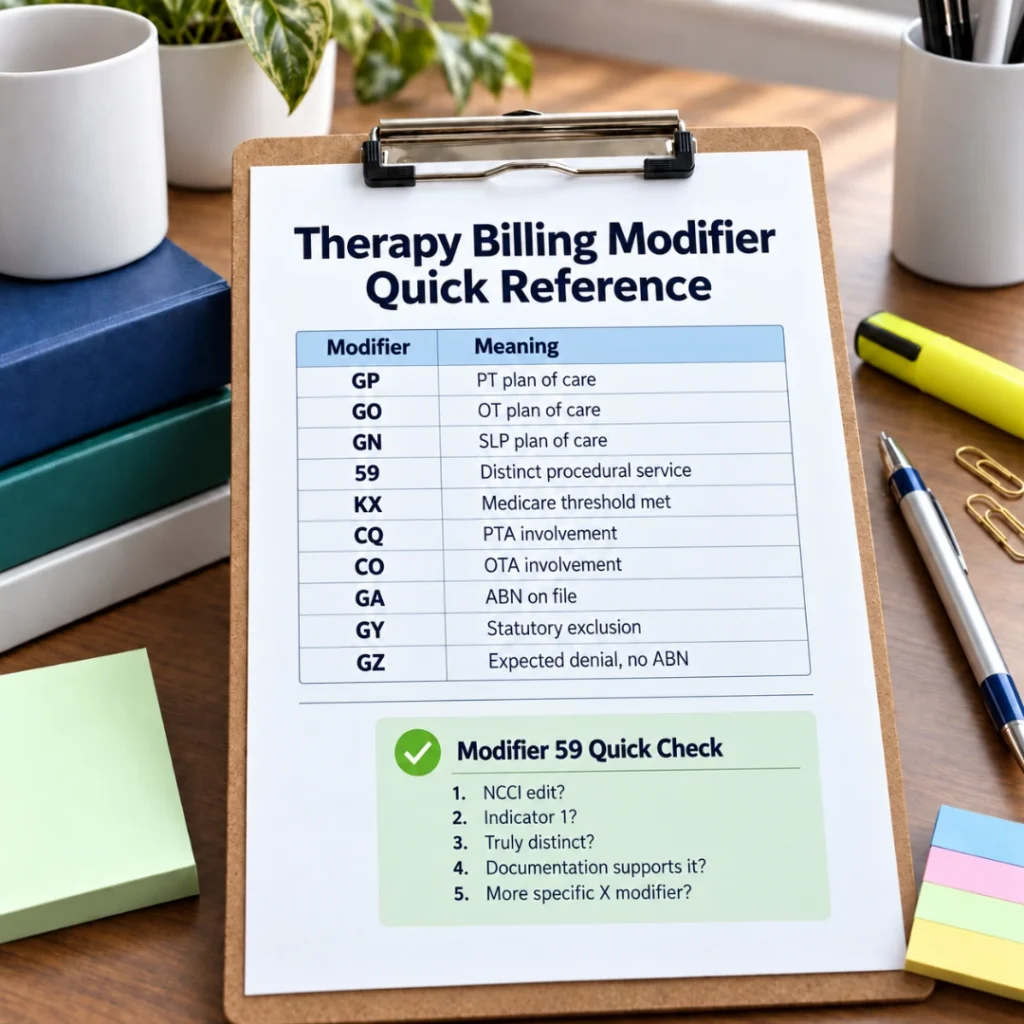
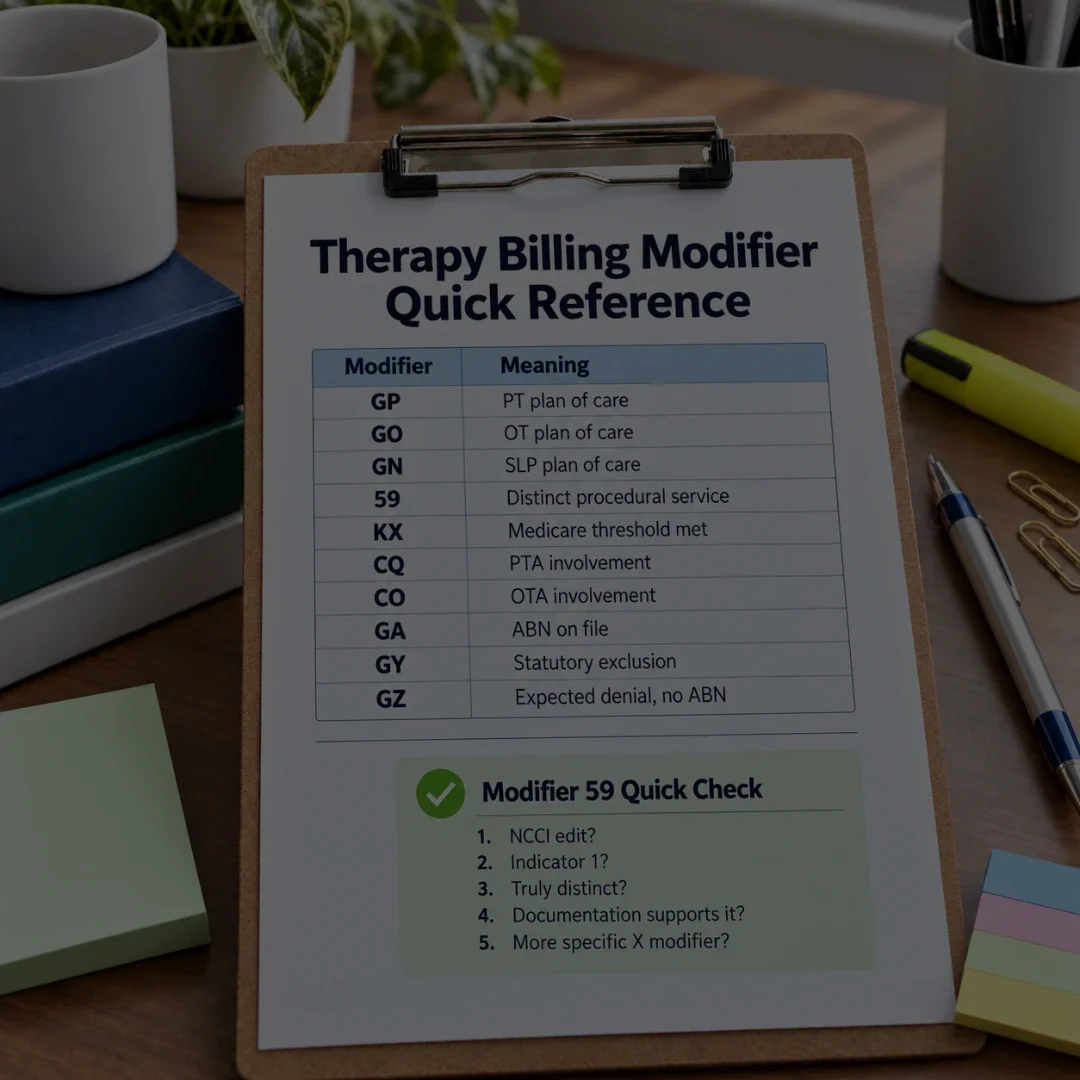
Modifier 59 — What It Is, When to Use It, and How to Document It

What is Modifier 59?

Modifier 59 is a CPT modifier used to indicate that two procedures performed on the same day are distinct and separately identifiable services that would not ordinarily be billed together. It tells the payer that each procedure was medically necessary, clinically separate, and performed during a different patient encounter or anatomical site. In physical therapy and occupational therapy, Modifier 59 is most commonly used when billing CPT 97110 and CPT 97530 on the same day. Definition sourced from the Centers for Medicare and Medicaid Services.

Key Takeaways

  • Staff productivity in PT clinics is best measured through units per visit and notes-per-hour metrics — not just patient volume
  • Multi-location PT practices need centralized compliance tracking to ensure documentation standards are consistent across all sites
  • Revenue cycle management starts at scheduling — eligibility verification before the first visit prevents the majority of claim denials
  • Inventory and supply management is one of the most overlooked operational costs in outpatient therapy — tracking it reduces waste by up to 20 percent
  • HelloNote centralizes scheduling, documentation, billing, and reporting in one platform so clinic owners spend less time managing systems and more time growing the practice

Table of Contents

Modifier 59 is four characters. It appears on a claim in a matter of seconds. And it is responsible for a disproportionate number of billing audits, claim denials, and compliance headaches in outpatient therapy practices across the country. Not because therapists are billing fraudulently — but because Modifier 59 is one of the most misunderstood tools in the billing toolkit, and the consequences of using it incorrectly in either direction are significant.

Use it when you do not need it and you are signaling to a payer that you have intentionally bypassed their bundling edits — which is a compliance flag. Fail to use it when a payer requires it and your same-day claim gets denied or bundled, costing you legitimate revenue. Use it correctly but without documentation that supports it and you are one audit request away from a recoupment demand.

This guide covers what Modifier 59 actually is, when therapy practices need it, how it relates to the X modifiers, what documentation it requires, and the specific mistakes that generate the most audits. For Modifier 59 specific to CPT 97110 and 97530 same-day billing, see our full guide at hellonote.com/97110-vs-97530/

HelloNote superbill showing GP:59 modifier applied to CPT 97140 manual therapy, CPT 97112 neuromuscular reeducation, and CPT 97110 therapeutic exercise on the same day

What Is Modifier 59 and Why It Exists

Modifier 59 was created by the Centers for Medicare and Medicaid Services to address a specific billing reality: sometimes two procedures that would normally be bundled together in a single claim are legitimately performed as separate, distinct services on the same day. Without a mechanism to flag this distinction, payers would automatically bundle or deny the second procedure — even when both were clinically appropriate and medically necessary.

The official CMS definition of Modifier 59 is: Distinct Procedural Service. It is used to indicate that the procedure or service was distinct or independent from other non-E/M services performed on the same day. It is applied to a CPT code to tell the payer that this service, while it might appear to overlap with another service billed on the same claim, was in fact performed separately and independently.

Why Payers Bundle Procedures in the First Place

Payers use National Correct Coding Initiative edits — commonly called NCCI edits — to automatically bundle certain CPT code combinations that are typically performed together as part of a single procedure. When two codes appear on the same claim and an NCCI edit exists between them, the payer automatically bundles them and pays only for the higher-value code. Modifier 59 is the mechanism that overrides that bundling when the clinical circumstances genuinely justify billing both codes separately.

The critical word is genuinely. Modifier 59 was not designed as a blanket override for all bundling situations. It was designed for specific clinical circumstances where two procedures that are normally performed together were legitimately performed as separate and distinct services. Using it outside those circumstances — or without documentation that supports the clinical distinction — is a compliance risk regardless of the clinical reality.

When Modifier 59 Is Clinically Justified

Modifier 59 is justified when the two procedures were performed at a different anatomical site, during a different patient encounter on the same day, as separate procedures not ordinarily performed together, or when they represent distinct services with independent clinical justifications that happen to share a bundling edit. In therapy billing, the most common legitimate use is same-day billing of CPT 97110 and CPT 97530 — where each code targets a distinct clinical goal and the two interventions are documented separately with independent medical necessity.

When Do You Need Modifier 59 in Therapy Billing

When should you use Modifier 59 in physical therapy and occupational therapy?

Use Modifier 59 in therapy billing when two CPT codes on the same claim have an NCCI edit between them and the services were genuinely performed as distinct, separately identifiable procedures. The most common therapy scenario is same-day billing of CPT 97110 (therapeutic exercise) and CPT 97530 (therapeutic activity). Not all payers require Modifier 59 — verify requirements per insurer. When required, the documentation must independently justify each code.

Most Common Therapy Scenarios Requiring Modifier 59

CPT 97110 + CPT 97530 on the same day

The most frequent Modifier 59 situation in outpatient PT and OT. Therapeutic exercise targeting a specific impairment (97110) followed by therapeutic activity practicing the functional task that impairment was limiting (97530). Each code needs separate time documentation and separate clinical justification. Some payers require Modifier 59 appended to one of the codes to confirm they are distinct services.

CPT 97110 + CPT 97112 on the same day

Therapeutic exercise for musculoskeletal strengthening (97110) combined with neuromuscular reeducation for proprioceptive deficits (97112). Different clinical targets, different systems treated, same visit. Modifier 59 may be required depending on payer.

CPT 97140 + CPT 97110 on the same day

Manual therapy to restore joint mechanics (97140) followed by therapeutic exercise to build strength through the restored range (97110). Again — distinct clinical purposes, separate documentation required, Modifier 59 may be needed per payer.

Bilateral procedures at different anatomical sites

When the same procedure is performed on two different body regions or anatomical sites in the same session, Modifier 59 (or the more specific XS modifier) documents the separate anatomical sites to justify billing both.

Payer Verification Is Non-Negotiable

Not every payer requires Modifier 59 for the same code combinations. Medicare has specific NCCI edit policies. Commercial insurers have their own bundling rules. Medicaid requirements vary by state. Before appending Modifier 59 to any claim, verify the specific requirement for that payer, that code combination, and that date of service. Applying Modifier 59 when a payer does not require it is not harmful on its own — but it draws attention to the claim. Applying it when a payer requires documentation you do not have is a compliance risk.

Modifier 59 vs XU, XE, XS, XP — The X Modifiers Explained

What is the difference between Modifier 59 and the X modifiers?

Modifier 59 is the general modifier for distinct procedural services. In 2015 CMS introduced four more specific X modifiers as subsets of Modifier 59: XE (separate encounter), XS (separate structure or anatomical site), XP (separate practitioner), and XU (unusual non-overlapping service). Medicare prefers the X modifiers over Modifier 59 when a more specific modifier applies. Commercial payers vary — many still accept Modifier 59 for all scenarios.

Modifier 59 and X modifiers XE XS XP XU comparison chart showing distinct procedural service definitions for physical therapy and occupational therapy billing

The Four X Modifiers and When Each Applies

XE — Separate Encounter

Use XE when the same procedure was performed twice on the same day but during two completely separate patient encounters — for example, a morning session and an afternoon session. The encounters must be documented separately with distinct start and stop times.

XS — Separate Structure

Use XS when the same procedure was performed on two different anatomical sites or organ systems during the same encounter. Bilateral procedures involving different body regions are the most common therapy application.

XP — Separate Practitioner

Use XP when two different practitioners performed the procedures on the same day. Less common in outpatient therapy but relevant in group practice settings where patients may see more than one clinician in a single day.

XU — Unusual Non-Overlapping Service

Use XU when the service does not overlap with the other procedure as defined by the NCCI edit. This is the closest X modifier to the general use of Modifier 59 and is the one most commonly substituted for Modifier 59 in Medicare claims when a more specific X modifier does not apply.

Which to Use — Modifier 59 or an X Modifier

For Medicare claims, use the most specific X modifier that accurately describes the clinical circumstance. CMS has indicated a preference for the X modifiers over the general Modifier 59 when a specific X modifier applies. For commercial payer claims, check payer-specific guidance — many commercial insurers still accept Modifier 59 for all scenarios and do not require the X modifiers. When in doubt, Modifier 59 is always accepted by Medicare as a fallback when a more specific X modifier is not identified.

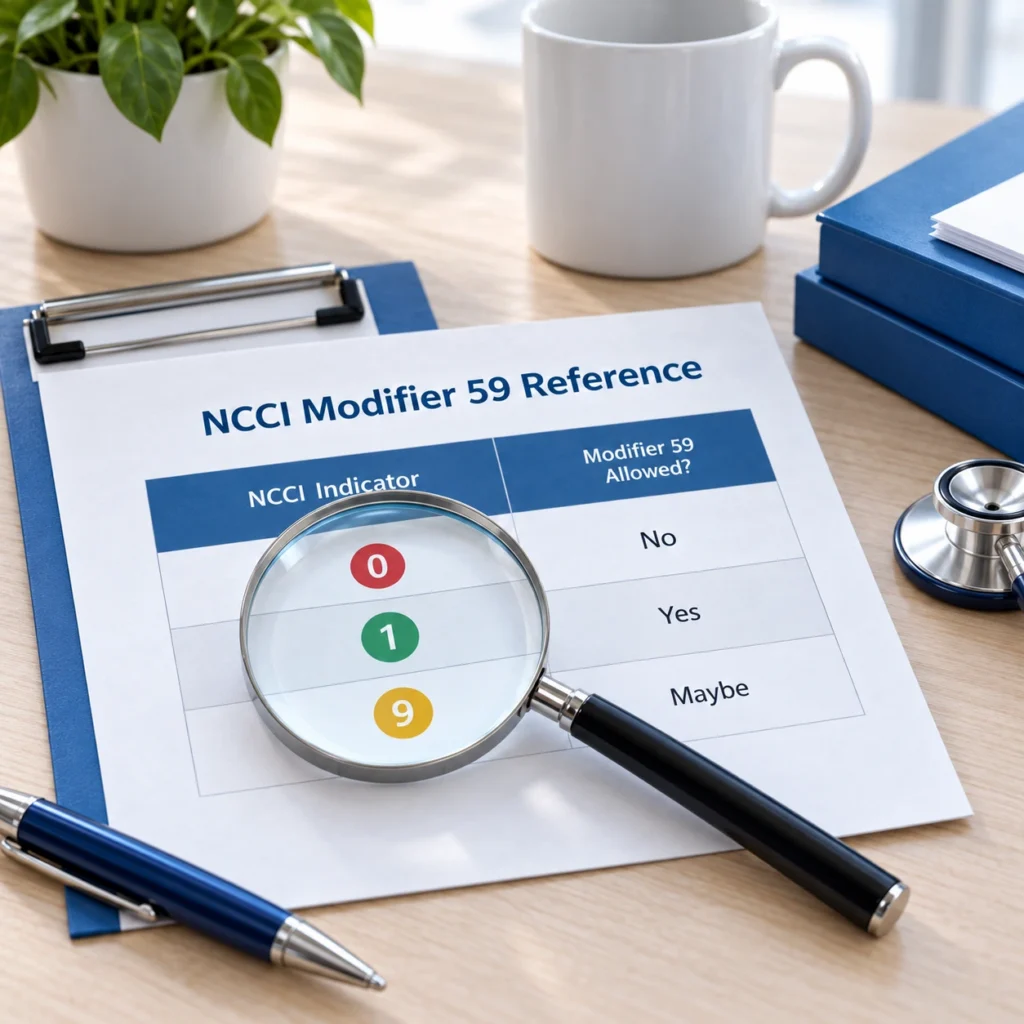
NCCI Edits and Modifier 59 — What Therapists Need to Know

National Correct Coding Initiative edits are the bundling rules that determine which CPT code combinations payers automatically bundle when they appear on the same claim. CMS maintains the NCCI edit table and updates it quarterly. Understanding which code pairs have NCCI edits — and whether those edits can be overridden by Modifier 59 — is the foundation of correct Modifier 59 use.

Column One vs Column Two Codes

NCCI edits are organized into column one and column two pairs. The column one code is the comprehensive code — the one that gets paid. The column two code is the component code — the one that gets bundled. When both codes appear on a claim without a modifier, payers pay only the column one code and deny the column two code as included in the comprehensive service.

Some NCCI edits have an indicator of 1, meaning the edit can be overridden with an appropriate modifier like Modifier 59. Others have an indicator of 0, meaning the edit cannot be overridden regardless of modifiers or documentation. This is a critical distinction — applying Modifier 59 to a code pair with an NCCI indicator of 0 will not result in separate payment and may trigger a compliance review.

How to Check NCCI Edits Before Billing

CMS publishes the full NCCI edit table on the CMS website, updated quarterly. Our team recommends checking the NCCI edit table for any new code combination before billing it with Modifier 59 for the first time. The table is searchable by CPT code pair and shows the indicator, the effective date, and the deletion date for each edit. This 60-second check before submitting a claim has prevented more compliance issues in our practice than any other billing habit we have built.

How to Document for Modifier 59

Modifier 59 is only as strong as the documentation behind it. A modifier on a claim is a signal to the payer. The documentation in the note is the proof. When a payer audits a claim with Modifier 59, they are looking at the notes to verify that the two procedures were genuinely distinct, separately performed, and independently medically necessary. If the notes do not show that — the modifier does not save the claim.

The Four Documentation Requirements for Modifier 59 Claims

  1. Separate time documentation for each code

Each procedure billed on a Modifier 59 claim needs its own start and stop time documented in the note. Not a combined treatment time that gets allocated between codes — actual separate clock times for each distinct service. This is the most fundamental documentation requirement and the most commonly missing element in audited claims.

  1. Separate clinical justification for each code

Each code needs its own documented clinical rationale establishing the distinct therapeutic purpose of that intervention. The note for CPT 97110 must establish the specific impairment being targeted. The note for CPT 97530 must establish the specific functional task being practiced. A combined description that covers both codes without distinguishing their separate clinical purposes does not support Modifier 59.

  1. Functional goal connection for each code

Each procedure must be connected to a documented functional goal in the plan of care. This establishes medical necessity independently for each service. When each code has its own functional goal connection, the claim tells a coherent clinical story: we did this (97110) for this reason, and we did that (97530) for this other reason. Both were medically necessary. Both were separate.

  1. A coherent clinical narrative

The combined documentation across both codes should tell a logical clinical story where the two services are clearly distinct but clinically connected. The impairment addressed in 97110 is the same impairment that was limiting the functional task practiced in 97530. The manual therapy in 97140 restored the mobility that the 97110 exercise then reinforced. When the clinical logic is clear and the documentation reflects it, Modifier 59 claims survive audit.

Modifier 59 documentation comparison showing missing documentation that gets audited versus complete audit-proof documentation with separate time blocks and functional goals for CPT 97110 and 97530

Common Modifier 59 Mistakes and How to Avoid Them

Mistake 1 — Using Modifier 59 as a Blanket Override

The most dangerous Modifier 59 mistake our team has seen is treating it as a universal fix for any bundled claim. Modifier 59 is not a magic modifier that makes any two codes payable together. It is a specific clinical attestation that two services were genuinely distinct. Applying it routinely to all same-day code combinations without verifying clinical circumstances and NCCI edit indicators is a pattern that triggers compliance reviews. Payers audit modifier usage patterns — a practice that applies Modifier 59 on a high percentage of same-day claims is a red flag.

Mistake 2 — Applying Modifier 59 Without Supporting Documentation

The modifier on the claim and the documentation in the note must align. Applying Modifier 59 without documentation that independently establishes the distinct clinical purpose of each service means the modifier is an assertion without proof. When a payer audits, they will look at the notes. If the notes do not support two separately documented, separately justified, separately timed services — the modifier does not protect the claim. The denial or recoupment follows.

Mistake 3 — Not Verifying Payer Requirements

Not all payers require Modifier 59 for the same code combinations. Not all payers accept the X modifiers. Some commercial payers have their own modifier requirements that differ from Medicare. Our clinic spent time in year two systematically checking modifier requirements for our top five payers by volume and documenting them in our billing reference guide. That 90-minute exercise prevented more denials than any other billing process improvement we made that year.

Mistake 4 — Overriding Non-Bypassable NCCI Edits

NCCI edits with an indicator of 0 cannot be overridden by any modifier. Applying Modifier 59 to these code pairs will not result in separate payment and may trigger a compliance flag. Before billing any code combination with Modifier 59 for the first time, check the NCCI edit indicator. If it is 0, the procedures cannot be billed separately on the same date of service regardless of the clinical circumstances.

Mistake 5 — Combined Time Documentation

Documenting total treatment time and then noting which portion was attributable to each code — rather than documenting separate start and stop times for each code — does not meet the documentation standard for Modifier 59 claims. This approach creates audit risk even when the clinical services were genuinely distinct. Separate time blocks, separately documented, is the only defensible approach.

Modifier 59 in Practice — What Our Clinic Does

Our clinic developed a Modifier 59 protocol in our second year of practice after a commercial payer audit identified a pattern of same-day 97110 and 97530 billing without consistent Modifier 59 documentation. The audit did not result in recoupment — our documentation was adequate — but the experience made us build a process that eliminates the uncertainty entirely.

Every therapist on our team follows the same four-step check before billing any same-day code combination. First, check whether the code pair has an NCCI edit. Second, check whether the edit indicator is 0 or 1. Third, verify whether our primary payer for this patient requires Modifier 59 for this specific code combination. Fourth, confirm that the note includes separate time documentation and separate clinical justification for each code before the claim goes out.

For same-day 97110 and 97530 billing specifically, our HelloNote template handles steps one through four automatically. The system flags the Modifier 59 consideration when both codes appear on the same visit note, requires separate time entry for each code, and will not allow sign-off without functional goal linkage for each code independently. The four-step check happens inside the documentation workflow rather than as a separate billing review step.

The result is that our Modifier 59 claims have a clean submission rate that matches our non-modifier claims. The documentation is correct before the claim goes out. There is nothing to question when a payer reviews it.

READY TO STREAMLINE YOUR CLINIC?

See How HelloNote Handles All of This in One Platform

Managing staff hours, compliance, inventory, and financial reports — all inside one HIPAA-compliant EMR built for PT, OT, and SLP clinics.

No credit card required · HIPAA Compliant · PT, OT & SLP

How HelloNote Handles Modifier 59

When our team built the HelloNote billing workflow, Modifier 59 compliance was one of the specific problems we designed around. The documentation mistakes that generate Modifier 59 audits — combined time tracking, missing clinical justifications, absent functional goal connections — are all structural problems that a well-designed template can prevent at the point of care rather than catch after a denial.

    • Modifier 59 flag on same-day code pairs — when CPT codes with common NCCI edits appear on the same visit, HelloNote surfaces a Modifier 59 consideration prompt so the therapist can verify payer requirements before submitting
    • Separate time entry per code — each timed code has its own start and stop time field, preventing combined time documentation that does not support Modifier 59 claims
    • Separate clinical justification fields — each code requires its own intervention description and clinical rationale before the note can be closed
    • Functional goal linkage per code — required before sign-off for each code independently, ensuring medical necessity is documented separately for each service
    • Pre-submission claim scrub — flags missing Modifier 59 documentation elements before the claim is submitted so corrections happen before denial rather than after
    • Payer-specific modifier guidance — HelloNote surfaces modifier requirements based on the patient’s payer so therapists are not making modifier decisions from memory

The goal was to make correct Modifier 59 billing the path of least resistance — not an additional compliance check at the end of a busy day.

Frequently Asked Questions About Modifier 59

When do you use Modifier 59 in physical therapy?

Use Modifier 59 in physical therapy when two CPT codes on the same claim have an NCCI edit between them, the edit indicator is 1 (bypassable), the services were genuinely performed as distinct procedures, and the payer requires the modifier for that specific code combination. The most common PT scenario is same-day billing of CPT 97110 and CPT 97530. Always verify payer-specific requirements before appending the modifier.

What is the difference between Modifier 59 and Modifier XU?

Modifier 59 is the general distinct procedural service modifier. Modifier XU is one of four X modifiers introduced by CMS in 2015 as more specific subsets of Modifier 59. XU stands for Unusual Non-Overlapping Service and is used when the service does not overlap with the companion procedure as defined by the NCCI edit. Medicare prefers XU (or another X modifier) over Modifier 59 when a specific X modifier accurately describes the clinical circumstance. Commercial payers often still accept Modifier 59 for all scenarios.

Can Modifier 59 be used with CPT 97110 and 97530?

Yes. Modifier 59 is commonly used when CPT 97110 and CPT 97530 are billed on the same day, as some payers require it to confirm these are distinct services rather than duplicate billing. Each code must have separate time documentation, separate clinical justification, and a separate functional goal connection in the note. Verify whether your specific payer requires Modifier 59 for this code combination — not all payers do.

What documentation is required when using Modifier 59?

Modifier 59 documentation requires: separate start and stop times for each code, a separate clinical justification establishing the distinct therapeutic purpose of each service, a separate functional goal connection in the plan of care for each code, and a coherent clinical narrative showing the two services were genuinely distinct. The modifier signals the distinction; the documentation proves it. Missing any of these elements creates audit vulnerability regardless of the modifier.

What are NCCI edits and how do they relate to Modifier 59?

NCCI edits are CMS bundling rules that automatically bundle certain CPT code combinations when they appear on the same claim. Each edit has an indicator: 0 means the edit cannot be overridden by any modifier; 1 means the edit can be overridden with an appropriate modifier like Modifier 59. Before using Modifier 59 on any code pair, check the NCCI edit indicator. Applying Modifier 59 to a code pair with an indicator of 0 will not result in separate payment and may trigger a compliance flag.

What triggers a Modifier 59 audit?

Common Modifier 59 audit triggers include: high-frequency use of Modifier 59 across a large percentage of same-day claims, applying Modifier 59 to code pairs with NCCI indicator 0, claims where the notes do not independently document the distinct clinical purpose of each code, combined time documentation that does not separately support each code, and patterns of Modifier 59 use that do not align with the payer’s modifier policy for specific code combinations.

Do all payers require Modifier 59 for same-day 97110 and 97530?

No. Medicare has specific NCCI edit policies for this code combination. Commercial payers have their own bundling rules and modifier requirements that vary by insurer. Some commercial payers do not require Modifier 59 for 97110 and 97530 billed on the same day. Verify requirements with each payer individually. Applying Modifier 59 when not required is not harmful but may draw unnecessary attention to the claim.

Is Modifier 59 the same as the XS modifier?

No. XS (Separate Structure) is one of four X modifiers that are more specific subsets of Modifier 59. XS applies specifically when two procedures were performed on two different anatomical sites or organ systems. Modifier 59 is the general modifier that applies to any distinct procedural service situation. Use XS when the procedures were genuinely performed on different anatomical structures. Use Modifier 59 or XU when the distinction is based on separate clinical purpose rather than separate anatomical site.

How does HelloNote help with Modifier 59 compliance?

HelloNote flags Modifier 59 considerations when same-day codes with common NCCI edits appear on the same visit. The platform requires separate time entry for each code, separate clinical justification fields, and separate functional goal linkage before sign-off. The pre-submission claim scrub checks for missing Modifier 59 documentation elements before the claim is submitted. Payer-specific modifier guidance surfaces based on the patient’s insurance so modifier decisions are informed, not guessed.

Use Modifier 59 Right — Every Time

Modifier 59 is not complicated when you understand what it is for. It is a clinical attestation — a signal that two services were genuinely distinct and separately performed. The documentation is what makes that attestation defensible. When the documentation is correct, Modifier 59 protects your revenue. When it is not, the modifier creates more audit exposure than billing the codes without it would have. Our team built HelloNote to make correct Modifier 59 documentation the automatic outcome of every same-day billing session — not an afterthought.

Looking up more cpt codes?

See 97110, 97530, and 50+ therapy procedure codes – with billing guidance and documentation tips in one place.

CPT 97530 — Therapeutic Activity: Definition, Billing Rules, and Documentation Guide

What is CPT 97530 (Therapeutic Activity)?

CPT 97530 is a timed therapeutic procedure code for therapeutic activities — dynamic, functional tasks that simulate real-life activities of daily life. Billed in 15-minute units, it requires direct one-on-one licensed therapist contact throughout. It applies when the clinical goal is improving functional performance, not an isolated impairment like strength or range of motion.

Key Takeaways

    • CPT 97530 covers functional, multi-outcome activities that simulate real-life tasks — billed in 15-minute units with direct therapist contact required throughout
    • The clinical anchor is functional performance: the activity must resemble what the patient needs to do in their daily life, not target an isolated musculoskeletal impairment
    • 97530 and 97110 serve different clinical purposes and can be billed together — but each requires its own time tracking and its own documented clinical justification
    • HelloNote’s 97530 template enforces the functional goal connection and multi-outcome documentation that payers look for — making the defensible note the default note

Table of Contents

CPT 97530 is the most searched therapy billing code on the HelloNote site. It is also the code our billing team sees questioned most often in payer reviews. Those two facts are not a coincidence — they reflect a gap that runs through outpatient therapy documentation everywhere. Therapists use 97530 constantly because the clinical reality of functional rehabilitation is constantly functional. Payers scrutinize it constantly because the documentation that supports it is rarely as specific as the clinical work it is supposed to describe.

The code is not the problem. The definition is straightforward: dynamic activities to improve functional performance, direct one-on-one contact, 15-minute units. The problem is the space between what happens in the room and what ends up in the note. A therapist guides a patient through a kitchen simulation task that integrates balance, upper extremity coordination, cognitive sequencing, and ADL independence in one twenty-minute session. The note says “functional activity training, 20 minutes.” The clinical work was skilled and complex. The documentation is barely defensible.

This guide is the version of the 97530 conversation that actually helps: what the code requires clinically, what documentation payers need to approve it, how it differs from 97110, and exactly how our team structures every 97530 note so it reflects what we did and withstands what auditors look for. We also address the 97110 vs 97530 comparison at a structural level here — for the full side-by-side breakdown, our complete guide lives at hellonote.com/97110-vs-97530/.

Occupational therapist guiding elderly patient through sit-to-stand therapeutic activity CPT 97530 in outpatient clinic

What Is CPT 97530 — The Clinical Definition That Actually Matters

The AMA defines CPT 97530 as: therapeutic activities, direct (one-on-one) patient contact by the provider, use of dynamic activities to improve functional performance, each 15 minutes. Three words in that definition carry the most clinical weight: dynamic, functional, and direct.

Dynamic

The patient is actively performing movement — not being moved by the therapist. The activity requires patient effort, coordination, and engagement across multiple systems simultaneously. This distinguishes 97530 from manual therapy codes where the therapist does the work.

Functional

The activity mirrors something the patient needs to do in their real life. Not an isolated exercise targeting a single tissue or movement direction — a task with the multi-joint, multi-outcome complexity of daily living. This is the clinical anchor that separates 97530 from 97110.

Direct

The licensed therapist must be present and actively directing the activity for the entire billed duration. Not supervising from across the room. Not setting up and stepping away. Direct contact, direct instruction, direct skilled input throughout. If the activity could be run by a tech or continued as a home program without skilled therapist presence — the documentation needs to explain why it was not.

What CPT 97530 Covers

Therapeutic activities under 97530 include functional mobility training such as sit-to-stand practice, transfer training, stair negotiation, and community ambulation on varied surfaces. ADL task practice including meal preparation simulation, upper extremity reaching and manipulation tasks in functional contexts, dressing and grooming sequences, and home management activities. Work simulation tasks for return-to-work clearance. Sport-specific movement pattern practice for athletic return. Pediatric functional play and developmental activity sequences requiring skilled therapist direction and progressive challenge.

What CPT 97530 Does Not Cover

97530 is not appropriate for isolated therapeutic exercise targeting a single tissue capacity (use 97110). It is not appropriate for gait training as a standalone skilled service (use 97116). It is not appropriate for patient education where the therapist explains or demonstrates rather than directly guides active patient performance. It is not appropriate when the activity is performed without continuous direct therapist contact. The activity has to be functional, the patient has to be doing it, and the therapist has to be directing it throughout.

When to Use CPT 97530: The Functional Performance Standard

The functional performance standard is the clinical test our team applies before every 97530 billing decision. It has two parts. First: does this activity resemble something the patient needs to perform in their daily life? Second: does the therapeutic value of this activity come from its functional, multi-outcome complexity rather than its impact on a single measurable tissue capacity?

If both answers are yes — the code is 97530. If the second answer is no — if the therapeutic value is primarily a strength gain, a ROM increase, or an endurance improvement that happens to occur during a functional-looking activity — the code is 97110, and the documentation needs to reflect that single-outcome intent.

The Multi-Outcome Principle

97530 activities work across multiple systems simultaneously. A sit-to-stand sequence builds lower extremity loading tolerance, reinforces hip and knee proprioception, challenges dynamic balance, practices the movement pattern used in every functional transfer, and advances the documented goal of independent toilet and chair use. Six things changing at once. That is not a 97110 intervention. The multi-outcome nature of the activity is what makes it 97530 — and that multi-outcome nature needs to appear in the documentation.

Populations and Diagnoses That Fit 97530

Post-surgical orthopedic patients transitioning from impairment-level work to functional task practice: hip and knee arthroplasty patients practicing transfers and stair negotiation, shoulder repair patients practicing reaching and lifting in functional contexts, hand patients practicing grip and manipulation tasks in ADL simulations. Neurological patients practicing multi-step ADL sequences: stroke survivors relearning dressing and grooming, TBI patients practicing kitchen tasks, Parkinson’s patients working on functional gait in environmental simulations. Older adults with fall risk practicing functional mobility in community simulation environments. Work injury patients performing job-specific task simulations for return-to-work clearance.

CPT 97530 Documentation Requirements

97530 documentation fails in a predictable pattern. The therapist records the activity accurately and omits the functional goal it was designed to advance. Functional reaching practice, 15 minutes. Step training, 3 sets. Kitchen simulation, direct therapist contact. These notes describe what happened. They do not establish medical necessity, and they do not tell a payer why a licensed therapist needed to direct the activity rather than delegating it to support staff or a home program.

Our team rebuilt our 97530 documentation standard around four required elements. Every 97530 note we write contains all four.

The Four Required Documentation Elements

  1. The specific activity and its multi-outcome components

Name the activity specifically and describe its functional complexity. Not ‘stair training performed’ but ‘reciprocal stair negotiation with handrail, 3 x 8 steps ascending and descending, targeting lower extremity loading tolerance, dynamic balance, and hip extension mechanics required for safe community stair use.’ The multi-outcome description is what makes the note reflect a 97530 activity rather than a 97110 exercise.

  1. The skilled therapist direction throughout

Document the specific cues, modifications, and clinical decisions made during the activity. What did the therapist observe that required skilled input? What cue improved performance? What modification was made in response to the patient’s real-time performance? This element establishes that direct skilled contact occurred and that the intervention required professional direction.

  1. Actual start and stop time

The 8-minute rule applies to 97530 exactly as it does to 97110. One unit requires at least 8 minutes of direct therapist contact. Document actual times, not estimates. When billing 97530 and 97110 on the same visit, each code needs its own time block documented separately.

  1. The functional goal connection sentence

Connect every 97530 activity to a documented functional goal in the plan of care. This sentence establishes medical necessity. Example: ‘Kitchen simulation task practice targeting the patient’s goal of independent hot meal preparation within her home environment following right hip arthroplasty.’ Without this connection the documentation describes an activity program. With it, it establishes a medically necessary skilled rehabilitation service.

CPT 97530 vs CPT 97110: The One Distinction That Protects Your Claims

CPT 97530 vs 97110: What is the difference?

CPT 97110 targets a single musculoskeletal impairment — strength, endurance, ROM, or flexibility — through isolated therapeutic exercise. CPT 97530 targets functional performance through multi-outcome activities that simulate real-life tasks. 97110 changes a tissue capacity. 97530 changes what the patient can do. The distinction is clinical intent, which must be documented explicitly in the note.

The System Being Treated

97110 treats a musculoskeletal impairment. The target is a specific deficit in tissue capacity. The outcome is measured in tissue-level numbers: MMT grade, goniometric degrees, repetitions to fatigue. 97530 treats a functional performance deficit. The target is the patient’s ability to perform a specific task. The outcome is measured in functional terms: the patient can now ascend stairs safely, prepare a meal independently, return to their work duties.

The Sticky Note Test

Our team uses a simple test when code selection is unclear. Ask: if this intervention worked perfectly, what one thing would be different? If the answer is a tissue capacity measurement — the quad is stronger, the shoulder moves further — that is 97110. If the answer is a functional task — the patient can get off the floor independently, return to their job, prepare a meal — that is 97530. Document the answer. That is your code justification.

Billing CPT 97530 on the Same Day as 97110: Rules and Modifier 59

Billing 97110 and 97530 on the same day is appropriate, clinically sound, and common in well-structured outpatient sessions. The sequence is logical: therapeutic exercise builds the impairment-level capacity (97110), and therapeutic activity practices the functional task that capacity enables (97530). Strengthen the quad, then practice the stair negotiation that quad strength supports.

What Makes Same-Day Billing Defensible

Each code needs its own documented time block with separate start and stop times. Each code needs its own clinical justification establishing a distinct therapeutic purpose. The combined documentation should tell a coherent clinical story where the 97110 impairment and the 97530 functional task are clearly connected. When these conditions are met, same-day billing is not an audit flag. It is accurate documentation of a complete rehabilitation session.

Modifier 59 for CPT 97530

Some payers require Modifier 59 when 97110 and 97530 are billed on the same day to confirm they represent distinct and separately identifiable services. When required, the documentation must provide the clinical distinction the modifier signals — the modifier tells the payer these are separate services; the notes prove it. Verify Modifier 59 requirements with each payer as requirements vary by insurer.

Looking up more cpt codes?

See 97110, 97530, and 50+ therapy procedure codes – with billing guidance and documentation tips in one place.

Common Billing Mistakes with CPT 97530

Mistake 1 — Using 97530 for Impairment-Level Exercise

The most common misapplication: applying 97530 to exercises that are 97110 interventions because they happen in a functional position or involve multiple joints. A standing exercise is not automatically a functional activity. The test is always clinical intent: is the therapist targeting tissue capacity (97110) or functional task performance (97530)? If tissue capacity, bill 97110 regardless of how the exercise looks.

Mistake 2 — Missing the Functional Goal Connection

97530 without an explicit functional goal connection describes an activity. Payers cannot determine medical necessity from an activity description alone. The note needs to answer: why was this activity medically necessary for this specific patient on this specific date? That answer lives in the sentence connecting the activity to the documented functional goal. Our team made this a required field — the note cannot close without it.

Mistake 3 — Separate Time Tracking Not Done for Same-Day Codes

When billing 97110 and 97530 together, each code needs its own time block with separate start and stop times. Estimating total treatment time and splitting it between codes creates documentation that will not survive audit. The exercise block has its own time. The functional activity block has its own time. They do not overlap.

Mistake 4 — No Progression Documentation Across Visits

Payer reviewers looking at multiple 97530 visits expect to see documented evidence that the functional challenge is advancing. Identical activity descriptions across four consecutive visits raise a medical necessity flag. Document a progression element at every session: reduced assistance level, increased task complexity, added dual-task loading, or environmental challenge increase.

Mistake 5 — Documenting Instruction Instead of Active Therapy

97530 requires the patient to be performing the functional activity under direct therapist contact. When the documentation describes the therapist explaining, demonstrating, or reviewing a home program, that describes patient education, not skilled therapeutic activity. If the note reads as instruction rather than active therapy, the code is not supported.

CPT 97530 in Practice — What Our Clinic Actually Does

A patient presents at visit six following left total hip arthroplasty at eight weeks. Hip precautions lifted. Strength testing adequate bilaterally. The remaining gap: she cannot safely perform floor-level tasks — loading the lower dishwasher rack, retrieving items from a low cabinet — because controlled descent to and return from low surfaces has not been practiced under skilled therapeutic guidance.

Our therapist documents the pre-treatment functional status before the session begins: patient unable to perform controlled descent below knee height due to apprehension and asymmetric loading pattern. Functional goal: independent home management including low-surface activities. Clock starts.

The session involves progressive controlled descent to low chair, low stool, and 8-inch surface with manual facilitation at the pelvis, verbal cueing for weight distribution symmetry, and functional task integration — patient retrieves items from a low bin, completes a simulated floor-to-standing sequence, and performs a bilateral overhead-to-low reach pattern reflecting her daily home management demands. Specific cues and patient response are documented at each difficulty level. Outcome: controlled descent to 8-inch surface achieved with supervision, 4-inch surface with minimal assist.

The note closes with the functional goal connection sentence: ‘Low-surface functional task practice targeting patient’s goal of independent home management including floor-level activities following left total hip arthroplasty.’ Total 97530 time: 20 minutes, two units. Documentation written in four minutes. Claim goes out clean.

READY TO STREAMLINE YOUR CLINIC?

See How HelloNote Handles All of This in One Platform

Managing staff hours, compliance, inventory, and financial reports — all inside one HIPAA-compliant EMR built for PT, OT, and SLP clinics.

No credit card required · HIPAA Compliant · PT, OT & SLP

How HelloNote Handles CPT 97530

Therapist guiding patient through CPT 97530 therapeutic activity during outpatient rehabilitation session

The HelloNote 97530 template was built around the documentation gap our billing reviews identified most often: functional activity notes that described what happened without establishing why it was a medically necessary skilled service. The template enforces the four required elements as required fields — making correct documentation the default path, not the disciplined one.

    • Functional activity description fields — structured inputs for activity name, the functional task being practiced, patient performance level, and multi-outcome components
    • Skilled therapist direction field — required section for cues, modifications, and clinical decisions made during the activity
    • Start and stop time entry — built into every timed code block with automatic 8-minute rule unit calculation
    • Functional goal linkage — required before sign-off, active plan of care goals populate into a selection field
    • Same-day code pairing guidance — when 97530 is billed with 97110, HelloNote surfaces documentation guidance so each code has its own justification
    • Pre-submission claim scrub — HelloNote checks the 97530 claim against common denial triggers before submission

Frequently Asked Questions About CPT 97530

What does CPT 97530 cover in physical therapy and occupational therapy?

97530 covers functional mobility training (sit-to-stand, transfer training, stair negotiation), ADL task practice (meal preparation simulation, dressing and grooming sequences, home management activities), work simulation for return-to-work clearance, and functional upper extremity tasks in OT. The common thread is multi-outcome functional performance under direct skilled therapist guidance.

What is the 97530 CPT code description?

The official AMA CPT 97530 description is: therapeutic activities, direct one-on-one patient contact by the provider, use of dynamic activities to improve functional performance, each 15 minutes. The activity must be dynamic (patient-performed), functional (resembles real-life tasks), and delivered under direct licensed therapist contact throughout the billed duration.

What are the CPT 97530 billing guidelines for Medicare?

Medicare requires documentation to establish the skilled nature of the service, direct one-on-one therapist contact throughout, and functional medical necessity. The note must identify the specific activity, document the therapist’s skilled direction and clinical decisions, record the patient’s functional performance status, and connect to a documented functional goal. Medicare also requires documented progression across visits.

Can CPT 97110 and 97530 be billed together on the same day?

Yes. Same-day billing is appropriate when each code represents a distinct intervention with separate time tracking and a separate documented clinical justification. 97110 targets the impairment; 97530 practices the functional task that impairment was limiting. Some payers require Modifier 59 — verify payer-specific requirements. Full guide: hellonote.com/97110-vs-97530/

What is Modifier 59 for CPT 97530?

Modifier 59 indicates that two procedures billed on the same day are distinct and separately identifiable services. For 97110 and 97530 billed together, some payers require Modifier 59 to confirm these are not duplicate billings. The modifier signals the separation; the clinical documentation in each note proves it. Never apply Modifier 59 without documentation that clearly establishes the distinct purpose of each code.

How many units of CPT 97530 can I bill per session?

Units are determined by the 8-minute rule: one unit requires at least 8 minutes, two units require at least 23 minutes, three units require at least 38 minutes. Document actual start and stop times, not estimates. When billing 97530 and 97110 together, calculate units for each code from its own separately documented time block.

Is CPT 97530 occupational therapy or physical therapy?

CPT 97530 is used by both occupational therapists and physical therapists. OTs commonly use it for ADL retraining, functional transfer training, and upper extremity task practice. PTs commonly use it for functional gait and transfer training, work simulation, and sport-specific movement practice. The clinical criteria apply identically regardless of discipline.

What triggers an audit or denial for CPT 97530?

Common triggers: high-frequency 97530 billing without documented functional progression, same-day 97110 and 97530 without distinct clinical justifications and separate time documentation, activity descriptions that resemble impairment-level exercise rather than functional task practice, missing functional goal connections, and notes describing therapist instruction rather than patient performance under direct contact.

How does HelloNote help with CPT 97530 billing and documentation?

HelloNote’s 97530 template requires functional activity description with multi-outcome components, skilled therapist direction documentation, start and stop time entry with automatic unit calculation, and functional goal linkage before sign-off. Same-day billing guidance surfaces when 97530 is billed with 97110. Pre-submission claim scrubbing flags missing elements before the claim is submitted.

Start Your Journey to Better CPT 97530 Documentation

The gap between what therapists do in a 97530 session and what ends up in the note is not a clinical gap — it is a documentation habit gap. The clinical work is skilled, complex, and functionally meaningful. The documentation needs to reflect that. Our team built HelloNote to make that reflection automatic, so every 97530 note accurately represents the work and withstands the scrutiny that comes with it.

CPT 97110: Billing, Documentation & Denial Prevention Guide

What is CPT 97110 (Therapeutic Exercise)?

CPT 97110 is a timed therapeutic procedure code for therapeutic exercise targeting a single measurable outcome — strength, endurance, range of motion, or flexibility. Billed in 15-minute units, it requires direct one-on-one licensed therapist contact throughout. It applies when the clinical goal is improving a specific musculoskeletal impairment, not a functional performance deficit.

Key Takeaways

    • 97110 targets one outcome per session — strength, endurance, ROM, or flexibility — and the documentation must establish that single-outcome intent explicitly
    • The four required documentation elements are: specific exercise name and parameters, actual start and stop time, an objective outcome measure, and a functional goal connection sentence
    • The 8-minute rule governs unit billing — track actual time, not estimates, or expect to consistently underbill
    • 97110 is for impairment-level musculoskeletal work; 97530 is for functional activity practice; the distinction is clinical intent and must be documented, not assumed
    • Laterality is required for every unilateral condition — build it into the template so it cannot be omitted
    • Progressive documentation across visits is a billing protection strategy — document what changed, why, and what the next target is at every session

Table of Contents

There is a particular kind of frustration that hits when a claim gets denied for a patient you know you treated correctly. We had a 61-year-old construction foreman last spring — right shoulder, status post rotator cuff repair at eight weeks, progressing well on external rotation strength and doing everything the protocol asked. Three visits in a row came back denied. Not for lack of clinical necessity. Not for missing authorization. For documentation that described exercise without establishing single-outcome therapeutic intent. The insurer could not tell from our notes whether we were running 97110 or 97530. So they decided for us, and they decided wrong.

The thing about CPT 97110 is that it looks deceptively simple. Therapeutic exercise. How complicated can the documentation be? The answer, as anyone who has been through a billing review can tell you, is considerably more complicated than the code definition suggests. The AMA description covers four qualifying outcomes in one sentence. What it does not cover is the audit logic payers use when reviewing claims, the distinction between 97110 and 97530 that trips up experienced therapists, or the specific documentation elements that separate a clean claim from a denial letter.

Our team wants to close that gap in this post. Not the textbook version of 97110 — the version you learn when claims start coming back and you have to figure out why.

CPT 97110 therapeutic exercise — four qualifying outcomes: strength, endurance, range of motion, and flexibility

What Is CPT 97110 and When Do You Use It?

CPT 97110 is a timed therapeutic procedure code for therapeutic exercises designed to address a single measurable impairment: strength, endurance, range of motion, or flexibility. Each unit covers 15 minutes of direct therapist contact. The therapist must be actively involved with the patient for the entire duration — not observing from a distance, not charting at a workstation while the patient runs through a home program.

The clinical boundary that defines 97110 is specificity of target. One impairment. One measurable outcome. One therapeutic direction per session of this code. That is what distinguishes it from 97530 and what makes it defensible when a payer looks at it. When our team trains new clinicians on code selection, the test we use is simple: if you had to describe the goal of this exercise in one word — stronger, more flexible, greater endurance, increased motion — and that one word is accurate and complete, you are in 97110 territory. If you need more than one word to describe what the exercise is trying to accomplish, you likely need 97530.

The Four Qualifying Outcomes in Clinical Practice

    • Strength: progressive resistance exercise targeting a specific muscle group or movement pattern with a documented baseline deficit and a measurable strength target.
    • Endurance: exercise targeting the ability to sustain a muscle contraction or movement pattern over time, typically tied to a specific activity demand the patient needs to return to.
    • Range of motion: structured exercise specifically intended to increase joint or soft tissue mobility, with documented goniometric baseline and target.
    • Flexibility: elongation exercises targeting shortened tissue, with documented limitation and functional impact.

Each of these outcomes has one thing in common: you can measure it at baseline, track it across visits, and demonstrate progress toward a documented goal. That measurability is the backbone of a defensible 97110 claim. If our team cannot put a number on the outcome at the start, we cannot justify the code at the end.

Diagnoses and Presentations That Fit 97110

Post-surgical strengthening following orthopedic repair or replacement. Rotator cuff strengthening after tear or repair. Hip and knee strengthening after arthroplasty. Grip and pinch strengthening following hand fracture or tendon repair. In every case the formula is the same: specific tissue or joint, specific measurable deficit, and a specific single-outcome target.

How to Document CPT 97110 Correctly?

Our clinic has reviewed a lot of 97110 notes that were clinically appropriate and documentational thin. The treatment was justified. The paperwork did not show it. After going through that experience ourselves early in our practice and helping other therapists troubleshoot denial patterns, our team has identified four documentation elements that appear in every clean 97110 claim and are absent in most denied ones

Physical therapist guiding patient through therapeutic exercise using resistance band for CPT 97110 knee strengthening

BUILT FOR PT, OT & SLP

Still spending 20 minutes on every note?

5,000+ PT, OT AND SLP practices use HelloNote to chart faster – with CPT and ICD-10 codes built directly into every note.

No credit card required · HIPAA Compliant · PT, OT & SLP

The Four Non-Negotiable Documentation Elements

  1. Name the exercise with clinical specificity

There is a meaningful difference between “shoulder strengthening performed” and “seated dumbbell external rotation, 3 x 12, 3 lb, pain-free arc 0–90 degrees.” The first tells a payer you did something. The second tells a payer you performed a specific skilled intervention at a documented resistance level targeting a specific movement deficit. Only one of those descriptions belongs in a 97110 note.

  1. Record every parameter

Sets, repetitions, resistance or load, patient position, and any significant modifications. These parameters are the clinical evidence that the exercise was progressive, intentional, and appropriate to the patient’s current status. They also protect you in an audit by showing consistent, documented clinical decision-making across visits.

  1. Track and document actual time

Start time and stop time for every timed code. Not an estimated range. The 8-minute rule is applied by payers whether you have tracked your time or not. If your documentation does not support the units billed, the units get denied. Our team records start and stop times as a non-negotiable standard for every 97110 session, and it has eliminated unit-related denials from our billing record entirely.

  1. Write the functional goal connection

This is the element that establishes medical necessity. Without it, the documentation describes a procedure. With it, the documentation describes a medically necessary skilled service. The sentence looks like this: “Shoulder external rotation strengthening targeting 5/5 strength required for patient’s goal of returning to overhead shelf stocking in her retail position.” That sentence connects the impairment-level work to the patient’s functional life, and it is the difference between a clean claim and a denial.

Why Our Team Stopped Writing Impairment-Only Notes

For the first two years our clinic was open, our therapists documented impairments well and functional connections poorly. Our notes were accurate records of what happened in the room. They were weak arguments for why a licensed therapist needed to make it happen. We had excellent goniometry. We had detailed exercise logs. What we did not consistently have was the sentence that linked the goniometry and the exercise log to something the patient needed to do in their daily life.

The shift happened after a Medicare review flagged a pattern in our billing and a billing consultant walked through our notes line by line. She was not pointing out clinical errors — she was pointing out documentation that told half the story. We updated our templates, retrained our team, and made functional goal connection a required field rather than a recommended one. Our denial rate dropped measurably within the next billing quarter. The clinical work had not changed at all.

CPT 97110 vs 97530 — The Distinction That Determines Your Claim

More therapists get this distinction wrong than any other code selection question our team encounters. The confusion is understandable because the activities genuinely overlap. A patient performing progressive strengthening can look identical to a patient performing functional activity practice from across the room. The difference is not visible. It is clinical and it is documented.

Looking up more cpt codes?

See 97110, 97530, and 50+ therapy procedure codes – with billing guidance and documentation tips in one place.

The System Being Treated

97110 addresses a musculoskeletal impairment — a specific deficit in the contractile or mechanical capacity of tissue. The exercise targets that tissue directly. The measure of success is a change in the tissue’s capacity: stronger, more mobile, better endurance. 97530 addresses a functional performance deficit — the patient’s inability to perform an activity of daily life or work task. The activity simulates or replicates that task. The measure of success is the patient’s ability to perform the functional task.

The Functional Arc Test

Our clinic trains therapists to apply what we call the functional arc test when selecting between 97110 and 97530. Does the activity look like something the patient would do in their daily life? Does it involve multiple joints moving through a functional pattern? Does it require the patient to coordinate movement across body regions simultaneously? If the answers are yes — it is 97530 territory. Does the activity isolate a single muscle group or movement direction? Does it target one specific measurable capacity? Does it function as a building block for functional movement rather than the movement itself? Those answers point to 97110.

A patient performing seated leg press for quadriceps strengthening after knee replacement is 97110. The same patient performing step-up and step-down practice targeting stair negotiation is 97530. The knee is involved in both. The clinical target — tissue capacity versus functional performance — is different in each.

Common Billing Mistakes and How to Avoid Them

These are the five documentation and billing errors our team has seen most often when reviewing denied 97110 claims — in our own practice early on and in conversations with therapists whose billing patterns we have helped troubleshoot.

Mistake 1 — Writing Exercise Descriptions Without Medical Necessity

The most common and most preventable error. A note that describes an exercise program accurately but does not establish why that program was medically necessary for this specific patient on this specific date is a denial waiting to happen. Medical necessity in outpatient therapy means demonstrating that a specific functional limitation exists, that it is caused by a specific impairment, and that the skilled therapeutic exercise being provided is specifically designed to address that impairment in service of that functional goal. All three elements need to be in the note. Exercise descriptions alone satisfy none of them.

Mistake 2 — Estimating Treatment Time

Our team analyzed our billing records during our first year and found that therapists who estimated treatment time were underbilling by an average of 4 to 6 minutes per timed code per session. Under the 8-minute rule, that gap translates to a lost unit on roughly one in four visits. Across a practice seeing 20 patients a week, that is $250 to $350 in unrecovered revenue every week — not from poor clinical work, not from billing errors, but from rounding down on time documentation.

Mistake 3 — Applying 97110 to Multi-Outcome Activities

97110 requires a single therapeutic target. When the documented intent of an exercise spans multiple outcomes — strengthening and coordination, range of motion and balance, endurance and functional movement pattern — the activity has crossed into 97530 territory. Our clinic had a period early on where therapists were defaulting to 97110 for exercises that involved both strength and functional movement components because the documentation template was familiar. The payer pattern review that followed was not something our team wanted to repeat. Code to what you are actually treating, document the single-outcome intent explicitly, and reserve 97110 for interventions where that intent is genuine.

Mistake 4 — Missing Laterality on Unilateral Diagnoses

A claim for shoulder strengthening without documented laterality is a CO-4 denial waiting to happen. Left, right, or bilateral must appear in the documentation for every unilateral condition. This takes two seconds to add and costs three weeks to fix after a denial. Our team built laterality as a required field in every 97110 note template so it cannot be omitted.

Mistake 5 — Not Progressing the Exercise Across Visits

Payers reviewing multiple visits of 97110 expect to see a progression narrative — documented changes in resistance, repetitions, range, or difficulty that demonstrate the skilled therapeutic process is advancing in response to the patient’s improvement. Notes that show identical exercise parameters across four or five visits raise a medical necessity flag. Our team documents progression explicitly at every visit: what changed from last session, why it changed, and what the next target is.

CPT 97110 in Practice — What We Actually Do

Our team’s 97110 workflow is built around three decisions that are made before the intervention begins, not during charting at the end of the day. When those three decisions are documented at the point of care, the note practically writes itself.

    • Decision 1: What is the single outcome we are targeting today?

Strength, endurance, ROM, or flexibility — one of the four, stated explicitly before the intervention begins. If the honest answer involves more than one, we are looking at 97530. This decision is made during the pre-treatment assessment and documented before the first exercise.

    • Decision 2: What is the measurable baseline and target for this session?

We do not begin a 97110 session without a number: current strength grade, current ROM measurement, current repetitions to fatigue. The target for the session is documented alongside the baseline. Without this, the exercise is undirected. With it, the session has a clinical purpose that the note can communicate.

    • Decision 3: Which plan of care goal does this session advance?

The note structure our team follows: specific exercise name, patient position, sets and reps, resistance level, start and stop time, session outcome measure compared to baseline, and the functional goal connection sentence. It takes under four minutes to write and has survived every billing review our clinic has been through.

How HelloNote Handles CPT 97110 Documentation

The 97110 template in HelloNote was built around the failure mode we saw most often in billing reviews: clinically appropriate interventions getting denied because the note did not establish functional goal connection. Our team designed the template so that connection cannot be skipped. The system will not allow sign-off until the exercise has been linked to a plan of care goal. That single structural requirement has reduced 97110 denial rates for our users more than any other feature in the template.

Here is what the 97110 workflow does inside HelloNote:

    • Functional goal linkage — Required before sign-off. The template pulls active plan of care goals into a selection field so the therapist links the exercise to the relevant goal in one click rather than one paragraph.
    • Start and stop time entry — Time fields are built into the timed code section. HelloNote calculates billable units using the 8-minute rule automatically. The therapist enters actual times; the system handles the unit math.
    • Exercise parameter fields — Structured inputs for exercise name, position, sets, reps, and resistance. Structured fields are faster to complete than free text and produce notes that are consistent, specific, and payer-ready.
    • Laterality selector — Built into every unilateral code entry. One click, never omitted.
    • Outcome measure entry — A dedicated field for the session’s objective measurement so baseline-to-current comparison is captured at the point of care, not reconstructed later.
    • Pre-submission claim scrub — HelloNote checks the 97110 claim against common denial triggers before it goes out and flags missing elements for review. The therapist addresses gaps before the claim leaves the building.

The design principle behind every element of the HelloNote 97110 template is that correct documentation should be the path of least resistance. Not an extra step at the end of a long day. The default.

READY TO STREAMLINE YOUR CLINIC?

See How HelloNote Handles All of This in One Platform

Managing staff hours, compliance, inventory, and financial reports — all inside one HIPAA-compliant EMR built for PT, OT, and SLP clinics.

No credit card required · HIPAA Compliant · PT, OT & SLP

Frequently Asked Questions About CPT 97110

What is CPT 97110?

CPT 97110 is a timed therapeutic procedure code used to bill for therapeutic exercise targeting a single outcome — strength, endurance, range of motion, or flexibility. Billed in 15-minute units, it requires direct one-on-one therapist contact throughout the service and is one of the most commonly billed codes in outpatient physical and occupational therapy.

When should I use CPT 97110?

Use 97110 when the therapeutic intent of your exercise is to address a single measurable impairment in one of the four qualifying categories. Building hip abductor strength after hip fracture, increasing shoulder external rotation ROM after repair, improving handgrip endurance for a manual labor return to work — these are 97110. If the exercise serves multiple simultaneous functional purposes or replicates an ADL, 97530 is likely more accurate.

What documentation is required to avoid a 97110 denial?

Every 97110 note needs four elements: the specific exercise name and parameters, actual start and stop time, an objective outcome measure compared to baseline, and a sentence explicitly connecting the exercise to a functional goal in the plan of care. The functional goal connection is the element most often missing from denied claims and the one that establishes medical necessity.

How many units of 97110 can I bill per session?

Units are determined by the 8-minute rule: one unit requires at least 8 minutes, two units require at least 23 minutes, three units require at least 38 minutes, four units require at least 53 minutes. Document actual start and stop times. Estimated durations are not defensible and will not support billing if the claim is reviewed.

What is the difference between 97110 and 97530?

97110 targets a musculoskeletal impairment — the contractile or mechanical capacity of tissue. 97530 targets a functional performance deficit — the patient’s ability to perform an activity of daily life or work task. The same exercise can fall under either code depending on clinical intent and documentation. The distinction must be explicit in the note.

What triggers an audit or denial for 97110?

Common triggers include missing functional goal documentation, time records that do not support the units billed, billing 97110 for multi-outcome activities that should be 97530, missing laterality, and absence of progression documentation across multiple visits. Secondary triggers

How does HelloNote help with 97110 documentation?

HelloNote’s 97110 template requires functional goal linkage before sign-off, includes start and stop time fields with automatic 8-minute rule unit calculation, structures exercise parameters into specific fields, and runs a pre-submission claim scrub. The template makes the four required documentation elements the default path through the note rather than an additional step.

Start Your Journey to Better CPT 97110 Documentation

Every 97110 claim is a record of skilled clinical work. The documentation should reflect that — not because payers demand it, but because your patients and your practice deserve notes that accurately represent what happened in that room and why it mattered. The right documentation habits are the difference between a billing system that protects your revenue and one that erodes it slowly and invisibly.

→ See 97110 and 97530 side by side in the CPT Code Library

2026 RTM Code Update: What Therapy Clinics Need to Know About 98985 & 98979 

Table of Contents

As of January 1, 2026, Medicare has implemented important updates to Remote Therapeutic Monitoring (RTM) billing that directly affect physical therapy, occupational therapy, and speech-language pathology practices.

These updates introduce new HCPCS codes and revise existing ones, changing how clinics document, bill, and get paid for RTM services. For therapy clinics using digital monitoring tools, home exercise tracking, or hybrid care models, these changes are not optional—they directly impact reimbursement, compliance, and audit risk.

This guide breaks down:

    • What changed in the 2026 RTM code update
    • How codes 98985 and 98979 are used
    • What Medicare expects from therapy documentation
    • Common billing pitfalls to avoid
    • How clinics can operationalize RTM correctly in 2026

What Changed in the 2026 RTM Code Update

In late 2025, CMS released Transmittal 13431, updating the Medicare Therapy Code List and expanding RTM-related billing options.

New and Updated RTM Codes for 2026

Physical therapist reviewing a therapy EMR dashboard showing remote therapeutic monitoring (RTM) trends, billing readiness, and compliance checks for Medicare RTM codes 98985 and 98979 in a modern clinic setting.

Medicare now recognizes the following RTM-related HCPCS codes as “Sometimes Therapy” services when billed by therapists:

    • 98985 – RTM device supply for musculoskeletal monitoring, 2–15 days in a 30-day period
    • 98984 – RTM device supply for respiratory monitoring, 2–15 days
    • 98979 – RTM treatment management services, first 10 minutes per calendar month

In addition, existing codes were updated:

    • 98976 / 98977 now cover 16–30 days of monitoring instead of shorter periods

Why “Sometimes Therapy” Classification Matters

When therapists bill these RTM codes, Medicare requires:

  • An active therapy plan of care
  • The correct discipline-specific modifier
    • GP for PT
    • GO for OT
    • GN for SLP
    • Documentation that clearly ties RTM services to skilled therapy intervention

Failure to meet these conditions can result in denials or post-payment audits.

Why the 2026 RTM Update Matters for Therapy Clinics

Clinics that fail to adapt to the 2026 update may face:

    • Claim denials due to invalid or outdated codes
    • Lost revenue from uncompensated services
    • Compliance exposure from missing modifiers or unsupported documentation

Medicare is increasingly strict about RTM claims, especially when services overlap with traditional therapy visits.

Documentation Expectations for RTM Billing in 2026

RTM services must be clearly distinguishable from routine therapy care.

What Medicare Expects to See in RTM Documentation

To support codes like 98985 and 98979, documentation should include:

    • Evidence of device-based monitoring
    • Clear linkage to the therapy plan of care
    • Description of data reviewed (adherence, performance, trends)
    • Therapist interpretation and clinical decision-making
    • Time spent on RTM treatment management (for 98979)

RTM documentation should demonstrate skilled oversight, not passive data collection.

Modifier Requirements for RTM Codes

Correct modifier usage is critical.

RTM Modifier Summary for Therapy Clinics

Code

Description

Required Modifier

98985

MSK RTM device supply (2–15 days)

GP / GO / GN

98979

RTM treatment management (first 10 mins)

GP / GO / GN

98976 / 98977

RTM device supply (16–30 days)

GP / GO / GN

CQ / CO

Assistant involvement

Only when applicable

Missing or incorrect modifiers remain one of the top RTM denial triggers.

Operational Steps Clinics Should Take Now

Even with system support, clinics must align workflows.

1. Educate Clinical and Billing Teams

Ensure therapists understand:

    • When RTM services qualify for billing
    • Which codes apply to which scenarios
    • How documentation supports reimbursement

2. Review RTM Workflows

Confirm that:

    • RTM services are triggered intentionally
    • Goals and outcomes are clearly documented
    • Time-based services are tracked accurately

3. Monitor Early 2026 Claims

During the first quarter of 2026:

    • Track RTM claim approval rates
    • Identify denial patterns early
    • Adjust documentation or modifier use if needed

Example RTM Billing Workflow (PT Scenario)

A physical therapist monitors a patient’s home exercise compliance using a digital MSK device:

    • The therapist assigns RTM monitoring for 10 days
    • RTM data is reviewed and interpreted within the therapy plan
    • 98985 (GP modifier) is billed for device monitoring
    • At month’s end, the therapist spends 10 minutes reviewing trends and adjusting care
    • 98979 (GP modifier) is billed for RTM treatment management

When documented and billed correctly, this workflow supports clean claims and compliant reimbursement.

Frequently Asked Questions (FAQ)

Q1. What is RTM in therapy billing?

Remote Therapeutic Monitoring (RTM) allows therapists to bill for monitoring patient data collected via approved devices between visits, when tied to a therapy plan of care.

Q2. What are the new RTM codes for 2026?

The key additions are 98985 (MSK device supply, 2–15 days) and 98979 (RTM treatment management, first 10 minutes).

Q3. Can PTs, OTs, and SLPs bill RTM codes?

Yes, when RTM services are part of an active therapy plan of care and billed with the correct discipline-specific modifier.

Q4. Do RTM services require time tracking?

Yes. Time must be documented for treatment management services like 98979.

Q5. What is the biggest RTM billing mistake clinics make?

The most common issues are missing modifiers, weak documentation linking RTM to skilled therapy, and using outdated codes.

Final Takeaway for 2026

The 2026 RTM update is not a minor coding change—it represents Medicare’s continued shift toward digitally supported therapy care.

Clinics that adapt early will benefit from:

    • Expanded reimbursable services
    • Stronger continuity of care
    • Reduced billing friction

Clinics that delay risk denials, audits, and unnecessary revenue loss.

PT Insurance Reimbursement in New York City: What Clinics Really Get Paid

Table of Contents

Physical therapy practice owners across New York City ask this question constantly:

What does insurance actually pay for PT in NYC?

The honest answer is nuanced but clearer when grounded in real contract data.

New York City does not publish standardized commercial insurance fee schedules for physical therapy. Reimbursement is contract-driven, varies by payer and plan type, and can differ significantly between clinics even within the same borough.

That said, clinics do see consistent patterns. Below is a PT-focused breakdown of real-world insurance reimbursement levels currently seen in New York City, what insurers expect to see in documentation, and why two clinics can be paid very differently for the same care.

Exterior of a physical therapy clinic in New York City, illustrating the real-world setting where PT insurance reimbursement and payer contracts impact clinic operations.

Important Context Before Reviewing PT Reimbursement Numbers

Before looking at any dollar amounts, it’s important to understand what these figures represent:

    • These are observed reimbursement amounts, not guaranteed rates

    • Payment varies by CPT code mix, not just by payer

    • Contracts differ by borough, plan type, and contract age

    • Legacy contracts often reimburse differently than newer agreements

    • Medicaid, commercial, union, and Workers’ Compensation plans behave very differently

There is no true “average” PT reimbursement rate in New York City—only patterns clinics commonly experience.

Note: New York City does not publish standardized commercial PT fee schedules. The figures below reflect real-world contract data shared by NYC physical therapy clinics and should not be interpreted as universal payer rates.

Real-World PT Reimbursement in New York City (Observed Clinic Contracts)

Below is a PT-specific snapshot aligned with what clinics are actively seeing across New York City insurance plans:

Insurance PlanTypical PT Reimbursement (NYC)Notes
HealthFirst~$50Common for Medicaid & community plans
BCBS NY (JLJ Plans)~$65Union plans often reimburse higher
EmblemHealth (GHI)~$35Frequently lower on older contracts
UHC Community Plan~$55Medicaid-based
1199SEIU Funds~$50Varies by fund structure
Fidelis Care~$78Higher-end contracts, wide variation
MetroPlus~$55NYC-focused Medicaid plans
Aetna~$64.50Strong commercial reimbursement
Cigna~$68Often among higher commercial payers
NY Workers’ Compensation~$114*Fee-schedule based

*Workers’ Compensation follows a state fee schedule and varies by CPT code, borough, and billing structure. It should not be treated as a flat “average.”

Why PT Reimbursement Varies So Much in New York City

Lower reimbursement is not always a payer issue. In most cases, five factors drive the difference.

CPT Code Selection and Pairing

Codes such as 97110, 97530, 97140, and 97535 do not reimburse equally. NYC payers closely monitor how these codes are combined, sequenced, and justified.

Documentation Strength

New York City payers aggressively review:

    • Medical necessity

    • Functional deficits tied to goals

    • Skilled intervention justification

    • Measurable progression

Weak documentation frequently leads to downcoding or denials.

Contract Age

Older PT contracts may be locked into outdated rates. Newer contracts may reimburse better but only if renegotiated and properly structured.

Plan Type

Union plans, Medicaid managed care, Medicare Advantage, and commercial PPOs behave very differently even under the same insurer name.

Audit Exposure

Inconsistent documentation increases post-payment audits and recoupments, reducing what clinics actually collect after services are delivered.

What NYC Insurers Expect to See—and Common Denial Triggers

Across physical therapy claims in New York City, the most common denial and audit triggers include:

    • Treatment that appears maintenance-based

    • Repetitive CPT patterns without documented progression

    • Goals not clearly tied to functional improvement

    • Time-based codes without skilled rationale

    • Poor alignment between evaluation, daily notes, and the plan of care

This is where many clinics lose revenue after care has already been delivered.

Why Documentation Systems Matter More in New York City PT Practices

Reimbursement pressure in New York City is tightening—not easing.

PT clinics that protect reimbursement consistently tend to use systems that support:

    • PT-specific documentation workflows

    • CPT-appropriate note structure

    • Plan-of-care alignment across visits

    • Audit-ready documentation without added administrative burden

An EMR does not raise reimbursement rates—but it can protect the rates your clinic has already earned by reducing denials, downcoding, and recoupments.

Key Takeaways for New York City PT Clinics

    • There is no official “average” PT reimbursement rate in NYC

    • Most commercial plans fall roughly between $50–$75, depending on contract

    • Medicaid plans typically land around $45–$60

    • Workers’ Compensation follows fee schedules, not averages

    • Documentation quality directly impacts what clinics actually collect

Understanding reimbursement is only half the battle. Protecting it is where long-term stability comes from.

Frequently Asked Questions: PT Insurance Reimbursement in New York City

Q1. Is there an average PT reimbursement rate in New York City?

Is there an average PT reimbursement rate in New York City?

Q2. How much does insurance typically pay for PT in NYC?

Based on observed clinic contracts:

  • Commercial plans: roughly $50–$75

  • Medicaid plans: roughly $45–$60
    Actual payment depends on CPT mix and documentation quality.

Q3. Why do two NYC PT clinics get paid differently by the same insurer?

Contract timing, CPT utilization patterns, borough location, and audit history all influence reimbursement.

Q4. Are Workers’ Compensation rates higher than commercial insurance in NYC?

Often yes, but billing rules and documentation standards are stricter and CPT-specific.

Q5. How can PT clinics protect reimbursement in New York City?

How can PT clinics protect reimbursement in New York City?

Is Massage Therapy Covered by Insurance? Billing & Compliance Guide

Table of Contents

Massage therapy plays an important role in rehabilitation, pain management, and functional recovery. Yet for many therapists and clinic owners, one question keeps coming up:

Is massage therapy covered by insurance?

The answer is not a simple yes or no. While massage therapy can be covered by insurance, reimbursement depends far less on the technique itself and far more on medical necessity, documentation, coding accuracy, and compliance.

This guide explains when massage therapy is covered by insurance, why claims are often denied, and what clinics must do to bill correctly and protect revenue.

When Is Massage Therapy Covered by Insurance?

Massage therapy is generally reimbursable only when it is delivered as skilled medical care, not as a wellness service. Most payers look for four core requirements:

    • The service is medically necessary
    • It is part of a formal plan of care
    • It is ordered or supervised by a licensed provider
    • It is documented and billed using appropriate CPT codes

When these conditions are met, massage therapy covered by insurance typically appears in cases such as:

    • Post-surgical rehabilitation involving soft tissue mobilization
    • Treatment of musculoskeletal injuries under a PT, OT, or chiropractic plan
    • Neuromuscular re-education where massage techniques support functional goals

Massage for relaxation, stress relief, or general wellness is not reimbursable.

What Insurance Companies Are Really Looking For

Massage therapist using an EMR to document insurance-covered massage therapy with CPT codes and compliance tools

Insurance payers do not reimburse based on intent they reimburse based on proof. To approve claims involving massage therapy, documentation must clearly demonstrate the following:

Medical Necessity

Your notes must establish:

    • A qualifying diagnosis
    • Functional impairments
    • Clinical rationale explaining why massage therapy is required

Goal-Based Treatment Justification

Each session should connect:

    • Diagnosis
    • Intervention
    • Measurable functional improvement

If progress is not documented clearly, coverage is often denied—even when care is appropriate.

Correct CPT Code Usage

Massage therapy billing most often involves:

    • 97124 – Therapeutic massage
    • 97140 – Manual therapy

Using the wrong code, failing to justify time, or misclassifying the service can quickly invalidate a claim.

Consistent, Defensible Documentation

Payers expect:

    • SOAP notes tied to functional goals
    • Accurate time tracking per service
    • Objective outcome measurements

Without this structure, massage therapy covered by insurance becomes difficult to defend.

Why Massage Therapy Claims Commonly Get Denied

Even clinics delivering high-quality care can experience denials due to workflow breakdowns. The most common reasons include:

    • No clear link between diagnosis and intervention
    • Incorrect CPT codes or missing modifiers
    • Lack of objective progress tracking
    • Vague or incomplete SOAP notes
    • Using a generic EMR not built for rehab billing

When documentation and billing are misaligned, reimbursement risk increases significantly.

How HelloNote Supports Insurance-Covered Massage Therapy

For clinics providing massage therapy as part of PT, OT, or chiropractic care, HelloNote is designed to support compliant, efficient billing workflows.

How HelloNote Helps Clinics Get Paid

Structured SOAP Notes

Each intervention is linked to supported diagnoses through guided workflows.

Audit-Ready Documentation

Notes are time-stamped, goal-driven, and tied directly to the plan of care.

Integrated Billing Prompts

When massage therapy is documented, relevant CPT codes surface automatically reducing errors and missed charges.

By aligning documentation and billing from the start, massage therapy covered by insurance becomes easier to manage and defend.

Clinics That Benefit Most from This Workflow

HelloNote is especially valuable for:

    • PT and OT clinics integrating massage into functional rehab
    • Chiropractic practices using soft tissue modalities
    • Multidisciplinary rehab clinics
    • Medical massage practices treating post-injury or surgical patients

If massage therapy is part of skilled care not just a cash service your EMR must support that level of compliance.

Bottom Line: When Massage Is Medical, Your EMR Must Be Too

Massage therapy can be covered by insurance but only when it is:

    • Documented as skilled medical care
    • Tied to a valid, provider-driven plan of care
    • Billed using compliant codes and modifiers

With HelloNote, clinics gain:

    • Smart CPT and HCPCS code guidance
    • Built-in medical necessity prompts
    • Modifier support
    • Audit-friendly documentation structure

Massage Therapy Insurance Coverage: FAQs

Q1. Is massage therapy covered by insurance?

Yes, when it is medically necessary, part of a provider-supervised plan, and properly documented.

Q2. Which CPT codes are commonly used?

97124 (therapeutic massage) and 97140 (manual therapy), depending on technique and intent.

Q3. Why are massage therapy claims denied?

Most denials stem from poor documentation, incorrect coding, or lack of medical necessity not the service itself.

Q4. Does HelloNote support massage therapy billing?

Yes. HelloNote aligns notes, diagnoses, CPT codes, and modifiers for compliant billing.

Q5. What clinics benefit most from HelloNote?

Any clinic providing massage therapy within a medical rehabilitation model, including PT, OT, chiropractic, and integrated care clinics.

Want to Simplify Billing for Massage Therapy?

HelloNote removes the guesswork from reimbursement so clinics can focus on care—not denials.

Book a demo to see how insurance-ready massage therapy workflows work inside HelloNote.

Getting Paid for Massage Therapy: How Insurance Really Works

Table of Contents

Is Massage Therapy Covered by Insurance?

Massage therapy insurance documentation displayed on a tablet alongside insurance claim forms and a massage treatment table in a clinical setting

What Clinics Must Get Right to Bill, Get Paid, and Stay Compliant

Massage therapy plays an important role in rehabilitation, pain management, and functional recovery. As more therapy clinics integrate hands-on soft tissue work into treatment plans, questions around massage therapy insurance come up more often   especially from practice owners trying to balance patient care with clean reimbursement.

So, is massage therapy covered by insurance?
The answer is sometimes and coverage depends far less on the technique itself and far more on how the service is documented, coded, and justified.

This guide explains how massage therapy insurance coverage works, why claims are often denied, and how therapy-focused EMRs like HelloNote help clinics bill correctly and stay compliant.

When Is Massage Therapy Covered by Insurance?

Massage therapy insurance coverage typically applies only when the service meets medical necessity standards. Most payers require all of the following:

    • The service is medically necessary

    • It is part of an established plan of care

    • It is supervised, ordered, or performed by a licensed provider

    • It is billed under appropriate CPT codes with proper documentation

Common reimbursable scenarios include:

    • Soft tissue work during post-surgical rehabilitation

    • Massage techniques used within physical therapy or chiropractic care

    • Neuromuscular re-education involving manual therapy

Massage provided for relaxation, stress relief, or general wellness is not covered under massage therapy insurance policies.

What Insurance Companies Look for in Massage Therapy Claims

Insurance payers evaluate documentation not intent. For massage therapy insurance claims to be approved, records must clearly support skilled care.

1. Medical Necessity

Documentation should establish:

    • A qualifying diagnosis

    • Functional limitations or impairments

    • Clinical reasoning for including massage therapy

2. Goal-Based Treatment Rationale

Each visit must show a direct connection between:

    • Diagnosis

    • Intervention

    • Measurable functional improvement

3. Proper CPT Code Selection

Massage therapy insurance billing usually involves:

    • 97124 – Therapeutic massage

    • 97140 – Manual therapy (when techniques overlap with joint or connective tissue work)

Incorrect code usage is one of the most common reasons for denial.

4. Defensible Documentation

Payers expect:

    • SOAP notes linked to functional goals

    • Accurate time tracking

    • Objective outcome measures

Without this structure, even medically necessary massage therapy may be denied.

Why Massage Therapy Insurance Claims Get Denied

Many clinics deliver excellent care but still face reimbursement issues. Common problems include:

    • No documented link between diagnosis and intervention

    • Vague or repetitive SOAP notes

    • Incorrect CPT codes or modifiers

    • Lack of objective progress tracking

    • Using EMRs not designed for therapy billing workflows

These gaps make massage therapy insurance claims difficult to defend during audits or reviews.

How HelloNote Supports Massage Therapy Insurance Billing

HelloNote is designed for therapy practices that integrate massage into rehabilitative care not cash only wellness models.

Here’s how HelloNote helps clinics bill massage therapy insurance correctly:

    • Structured SOAP templates that reinforce medical necessity

    • Diagnosis-to-CPT alignment to support payer expectations

    • Time-based documentation prompts for accurate unit billing

    • Audit-ready notes tied to the plan of care

By guiding documentation at the point of care, HelloNote reduces billing errors and improves reimbursement consistency.

Who Benefits Most from Insurance-Based Massage Therapy Workflows?

Massage therapy insurance workflows are especially valuable for:

    • PT and OT clinics incorporating soft tissue interventions

    • Chiropractic clinics using manual therapy techniques

    • Multidisciplinary rehab practices

    • Medical massage clinics treating injury or post-surgical patients

If massage therapy is part of skilled treatment not just a cash add-on your EMR needs to support compliant billing.

Bottom Line: Massage Therapy Coverage Depends on Your System

Massage therapy insurance coverage is possible but only when services are:

    • Clinically justified

    • Properly documented

    • Correctly coded

    • Supported by a defensible plan of care

HelloNote helps clinics remove guesswork by aligning documentation, billing, and compliance in one workflow.

Book a demo to see how HelloNote supports insurance-ready massage therapy billing.

Frequently Asked Questions About Massage Therapy and Insurance

Q1. Is massage therapy covered by insurance for pain management?

Massage therapy may be covered when pain management is medically necessary and tied to a diagnosed condition. Coverage depends on the payer and documentation quality.

Q2. Do massage therapists need to work in a PT or chiropractic clinic for coverage?

Coverage is more common when massage therapy is provided within a licensed clinical setting, such as physical therapy or chiropractic practices.

Q3. What documentation supports insurance reimbursement?

Therapists should document diagnosis, functional limitations, treatment rationale, session details, and measurable progress.

Q4. Can Medicaid cover massage therapy services?

In some states, Medicaid may cover massage therapy when delivered under approved therapy services and documented appropriately.

Q5. How can an EMR help reduce massage therapy claim denials?

An EMR helps standardize documentation, track progress, and ensure treatment aligns with billing requirements reducing errors that lead to denials.

Right Hip Fracture ICD-10: S72.141A Explained

Table of Contents

Right hip fractures are among the most challenging injuries therapists manage not only because of the physical demands of rehabilitation, but also because of the precision required in documentation and coding. With the 2026 ICD-10 updates now in effect, using the correct right hip fracture ICD-10 code is more important than ever. Accurate coding supports clean claims, clear communication across the care team, and fewer reimbursement delays.

One of the most commonly used diagnosis codes in orthopedic and rehabilitation settings is S72.141A, which identifies a displaced intertrochanteric fracture of the right femur during the initial encounter. Understanding when and how to apply this code helps therapists document care confidently while staying compliant with payer requirements.

Understanding ICD-10 Code S72.141A

Physical therapist reviewing right hip fracture ICD-10 documentation with an older adult patient during a rehabilitation session

The ICD-10 code S72.141A describes a very specific injury and encounter type. It refers to a:

    • Displaced fracture

    • Intertrochanteric region

    • Right femur

    • Closed injury

    • Initial encounter (active treatment phase)

This level of specificity is exactly why ICD-10 coding matters. The code communicates not only where the fracture occurred, but also how severe it is and what stage of care the patient is currently in.

Where This Code Fits in the ICD-10 Structure

To understand why accuracy matters, it helps to see how this diagnosis fits within the broader ICD-10 system:

    • Chapter 19: Injury, poisoning, and certain other consequences of external causes

    • S70–S79: Injuries to the hip and thigh

    • S72: Fracture of femur

Within this category, S72.141A provides clarity for payers, providers, and auditors reviewing the patient record.

Why the Seventh Character Matters

The seventh character in ICD-10 coding is one of the most common sources of billing errors. It identifies the encounter type:

    • A – Initial encounter (active treatment)

    • D – Subsequent encounter with routine healing

    • B – Initial encounter for open fracture

Using the wrong seventh character can trigger claim denials, payment delays, or audit scrutiny. For therapists, this makes accurate encounter documentation just as important as the diagnosis itself.

When Therapists Should Use S72.141A

This code should be used when all of the following are true:

    • The fracture is located in the right intertrochanteric region

    • The fracture is displaced

    • The injury is closed

    • Imaging confirms the diagnosis

    • The patient is in the active treatment phase (post-surgical rehab, acute care, or early outpatient therapy)

If the patient has moved into routine healing, the encounter character must be updated accordingly.

Documentation Requirements Therapists Must Capture

Accurate use of the right hip fracture ICD-10 code depends on thorough documentation. Therapy notes should clearly reflect:

    • Laterality (right side)

    • Fracture classification and location

    • Displacement status

    • Closed versus open injury

    • Mechanism of injury (e.g., fall, trauma)

    • Imaging confirmation

    • Phase of care or encounter type

These details support medical necessity and protect against payer requests for additional information.

Exclusions and Coding Rules to Be Aware Of

Certain conditions cannot be coded alongside S72.141A, while others may be appropriate depending on the case.

Excludes1 (never coded together):

    • Traumatic amputation of hip or thigh (S78–)

Excludes2 (may be coded together if applicable):

    • Lower leg fractures (S82–)

    • Foot fractures (S92–)

    • Periprosthetic fractures (M97.0–)

Additional external cause codes or retained foreign body codes should be added when relevant.

Billing and Reimbursement Considerations

ecause S72.141A is both billable and highly specific, it supports:

    • Clean claim submission

    • Proper MS-DRG assignment

    • Reduced denial rates

    • Justification for therapy frequency and intensity

Using unspecified fracture codes increases audit risk and often leads to reimbursement delays. Accurate diagnosis coding protects both patient care and clinic revenue.

Therapist’s Clinical Takeaway

Managing right hip fractures requires coordination across physical therapy, occupational therapy, and interdisciplinary rehab teams. Coding is part of the clinical story, not just an administrative task.

Key reminders for therapists:

    • S72.141A applies only to displaced intertrochanteric fractures of the right femur during active treatment

    • Laterality, fracture detail, and encounter type must always be documented

    • Precise coding supports smoother transitions of care and cleaner reimbursement

Frequently Asked Questions About Right Hip Fracture ICD-10

Q1. What is the correct ICD-10 code for a right hip fracture?

The correct code depends on fracture type and encounter phase. S72.141A is used for a displaced intertrochanteric fracture of the right femur during an initial encounter.

Q2. When should therapists use S72.141A?

This code is appropriate when the patient is in active treatment and imaging confirms a displaced, closed intertrochanteric fracture on the right side.

Q3. What documentation supports accurate ICD-10 coding?

Laterality, fracture classification, displacement status, mechanism of injury, imaging confirmation, and encounter phase are all required.

Q4. Why is the seventh character important in ICD-10 codes?

The seventh character defines the encounter type and directly affects billing accuracy and claim approval.

Q5. How does accurate fracture coding affect reimbursement?

Correct coding reduces denials, supports proper payment, and strengthens audit readiness for therapy practices.

You've found a hidden discount!

  • 00Hours
  • 00Minutes
  • 00Seconds