

















You've found a hidden discount!

HN Unlock Layer 1
HN Unlock Layer 2
HN Unlock Layer 3
HN Unlock Layer 4
HN Unlock Layer 5
  • 00Hours
  • 00Minutes
  • 00Seconds

Category: documentation

Built-In AI Scribe vs Third-Party Tools: Why Native Wins for Therapy Practices

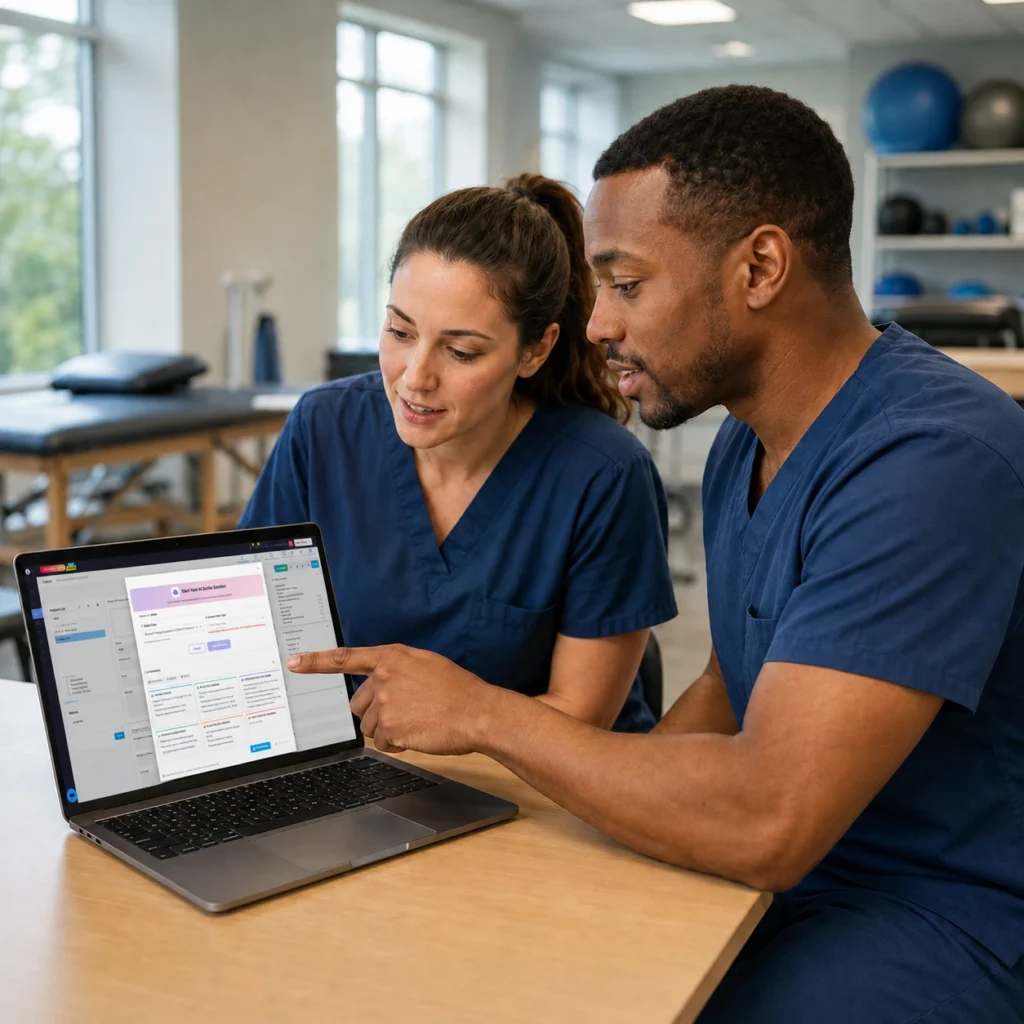
Two physical therapists reviewing an AI scribe interface on a laptop in a therapy clinic

What is the difference between a native AI scribe and a third-party AI scribe in therapy?

A native AI scribe is built directly inside your EMR platform. The note draft is created within the patient record automatically, with no separate app, no copy-paste step, and no workflow gap. A third-party AI scribe is an external tool that records and processes session audio independently, then requires a manual transfer into the EMR. Native integration eliminates the hidden administrative tax that third-party tools create at every step of the documentation workflow.

Key Takeaways

  • Staff productivity in PT clinics is best measured through units per visit and notes-per-hour metrics — not just patient volume
  • Multi-location PT practices need centralized compliance tracking to ensure documentation standards are consistent across all sites
  • Revenue cycle management starts at scheduling — eligibility verification before the first visit prevents the majority of claim denials
  • Inventory and supply management is one of the most overlooked operational costs in outpatient therapy — tracking it reduces waste by up to 20 percent
  • HelloNote centralizes scheduling, documentation, billing, and reporting in one platform so clinic owners spend less time managing systems and more time growing the practice

Table of Contents

We tried a third-party AI scribe before we built our own. We want to be honest about that, because it is relevant to everything, we are about to say.

The tool transcribed accurately enough. The notes it generated were reasonable first drafts. On paper, the workflow made sense: record the session in the scribe app, review the transcript, copy the note into HelloNote, connect it to the right patient, check that the payer information matched, reformat the sections to fit our documentation requirements, then sign. Seven steps where there should be two.

What nobody told us about third-party AI scribes is that the workflow gap between the tool and the EMR is where the time goes. Not in the recording. Not in the AI processing. In the space between a note that exists somewhere else and a finalized record that lives where it needs to live. We called that gap the hidden tax. Every practice using a third-party scribe is paying it, usually without calculating how much it actually costs per patient, per day, per year.

That experience is directly why HelloNote AI Scribe is native. Built inside the EMR, not connected to it from the outside. This post breaks down what that difference actually means in clinical practice, and why it matters more than most therapy practices realize before they make a documentation technology decision.

The Hidden Tax of Stitching Tools Together

How much time does a third-party AI scribe actually cost per session compared to a native tool?

A third-party AI scribe adds four to eight minutes of administrative time per session in copy-pasting, reformatting, and app-switching that a native workflow eliminates entirely. Across ten patients a day, that is 40 to 80 minutes of daily administrative time per therapist. Across a three-therapist practice, that is two to four hours every day that exists solely because the documentation tool and the patient record live in different places.

The word “integration” gets used loosely in healthcare software. Most of the time it means two products have been configured to share some data through an API. That is not the same as native. Integration means two systems talking to each other. Native means one system that does not need to talk to itself.

The Copy-Paste Step Is a Clinical Risk

When a therapist generates a note in a third-party AI scribe tool and then copies it into an EMR, that copy-paste step is not just inconvenient. It is a documentation integrity risk. Formatting gets lost. Sections get misaligned. A note generated for a Tuesday session gets pasted into a Wednesday encounter. Laterality details that were correct in the scribe tool get corrupted in the paste. These are not hypothetical errors. They are the kinds of documentation inconsistencies that show up in audits and payer reviews.

With a native AI scribe, there is no copy-paste step. The draft note is created inside the EMR, attached to the correct patient encounter, with the correct date, the correct case, and the correct payer context already populated. The risk does not exist because the workflow gap does not exist.

Switching Between Apps Costs More Time Than You Think

A therapist who records a session in a third-party scribe app, reviews the transcript, opens the EMR, navigates to the correct patient, pastes the note, reformats it, and then finalizes it has added approximately four to eight minutes of administrative work per session compared to a native workflow. Across ten patients a day, that is 40 to 80 minutes. Across a practice with three therapists, that is two to four hours of daily administrative time that exists solely because the documentation tool and the patient record live in different places.

Training Your Team on Two Systems

Every tool a practice adopts requires onboarding. A third-party AI scribe means training staff on the scribe workflow, the EMR workflow, and the handoff between them. When the scribe tool updates its interface, that is a retraining event. When the EMR updates its structure, the paste workflow may break. Native integration eliminates this category of problem entirely. There is one system, one workflow, one onboarding process.


One system. One workflow. No hidden tax.

HelloNote AI Scribe is built into the EMR, not bolted on from outside. No setup fees. No contracts.

No credit card required • HIPAA Compliant • PT, OT & SLP
What Native Integration Actually Means for Clinical Workflow

Most therapy practices do not discover the cost of third-party integration until they are already inside it. The demo looks seamless. The sales call does not cover the daily friction. What follows is what native integration actually changes in the workflow.

When a native AI scribe is part of the EMR, the session recording is activated from inside the patient encounter. The therapist is already in the correct record before the session begins. The draft note is generated inside that record. The finalized note lives there without any movement. That is not a minor convenience. It is the elimination of an entire category of administrative work.

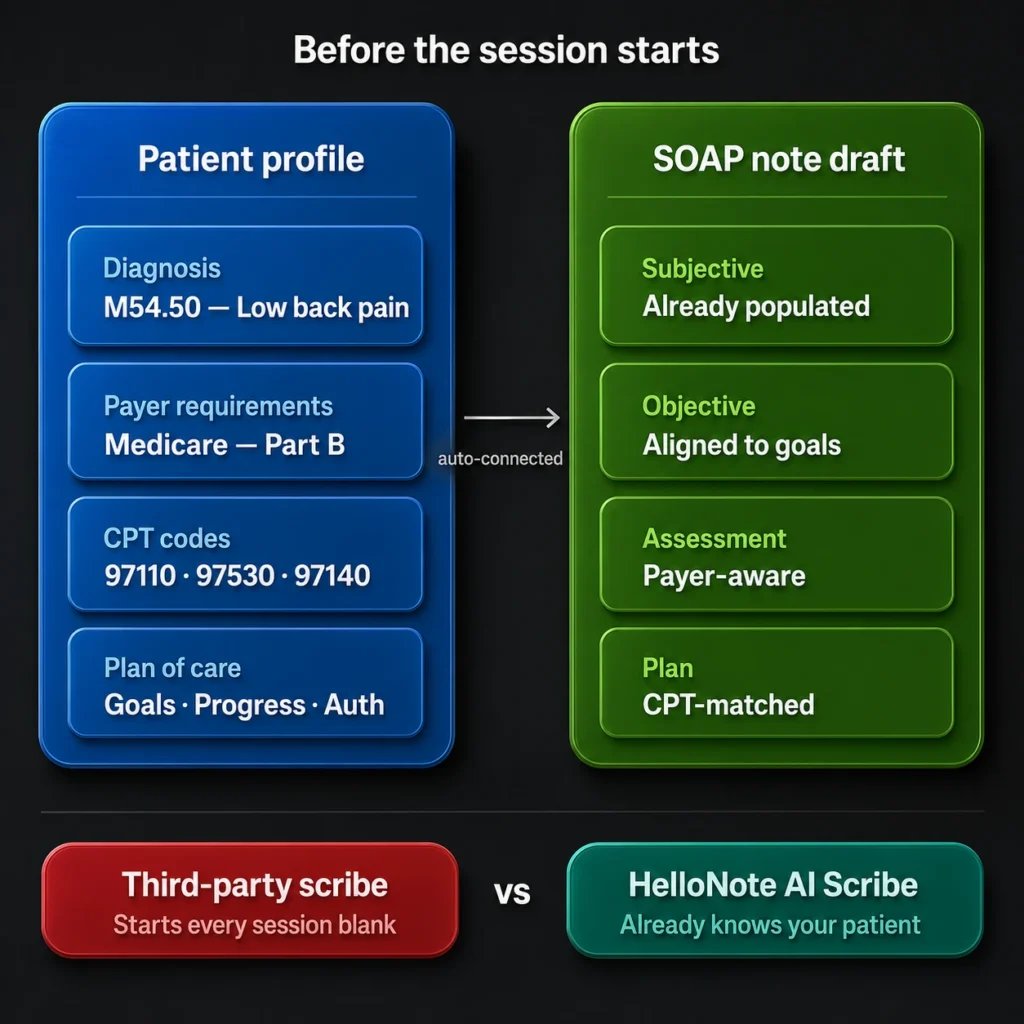
A third-party scribe, by contrast, starts every session as a blank slate. It does not know which patient is being treated. It does not know what payer requirements apply to that case. It does not know what CPT codes are relevant. It captures audio and produces a draft that the therapist must then manually contextualize, connect, and transfer into the record where it actually belongs.

The HIPAA Problem Nobody Talks About With Third-Party Scribes

Do third-party AI scribes require a separate Business Associate Agreement?

Yes. Every third-party AI scribe tool that processes patient session audio is a Business Associate under HIPAA, which means your practice must have a signed Business Associate Agreement with that vendor before the first session is recorded. This creates a second compliance relationship with separate data retention policies, breach notification timelines, and permissible data uses. A native AI scribe solution consolidates this under a single vendor and a single BAA, reducing the compliance surface area of your practice.

Every third-party AI scribe tool that processes patient session audio is a Business Associate under HIPAA. That means your practice needs a signed Business Associate Agreement with that vendor before the first session is recorded. Most practices know this. What fewer practices think through carefully is what happens when you have a BAA with your EMR vendor and a separate BAA with your scribe vendor, and those two agreements have different terms for data retention, breach notification timelines, and permissible uses of protected health information.

Two BAAs Means Two Sets of Obligations

When your AI scribe and your EMR are separate vendors, you are managing two compliance relationships simultaneously. If your scribe vendor has a data breach, your notification obligation runs on their timeline, not your EMR vendor’s. If your scribe vendor decides to update their data retention policy, your compliance posture changes without any action on your part. With a native solution, there is one vendor, one BAA, one set of compliance terms. The surface area of your HIPAA exposure is smaller because the number of vendors handling PHI is smaller.

Where Does the Audio Actually Go?

Third-party AI scribe vendors vary significantly in their audio retention policies. Some delete session recordings within hours of processing. Others retain audio for weeks for quality review. Some use de-identified session data to train and improve their AI models. These are not theoretical concerns. They are policy differences that directly affect how your patients’ health information is handled after every session. With HelloNote AI Scribe, session data stays within the HelloNote platform under a single BAA, with consistent data handling standards across your entire practice workflow.

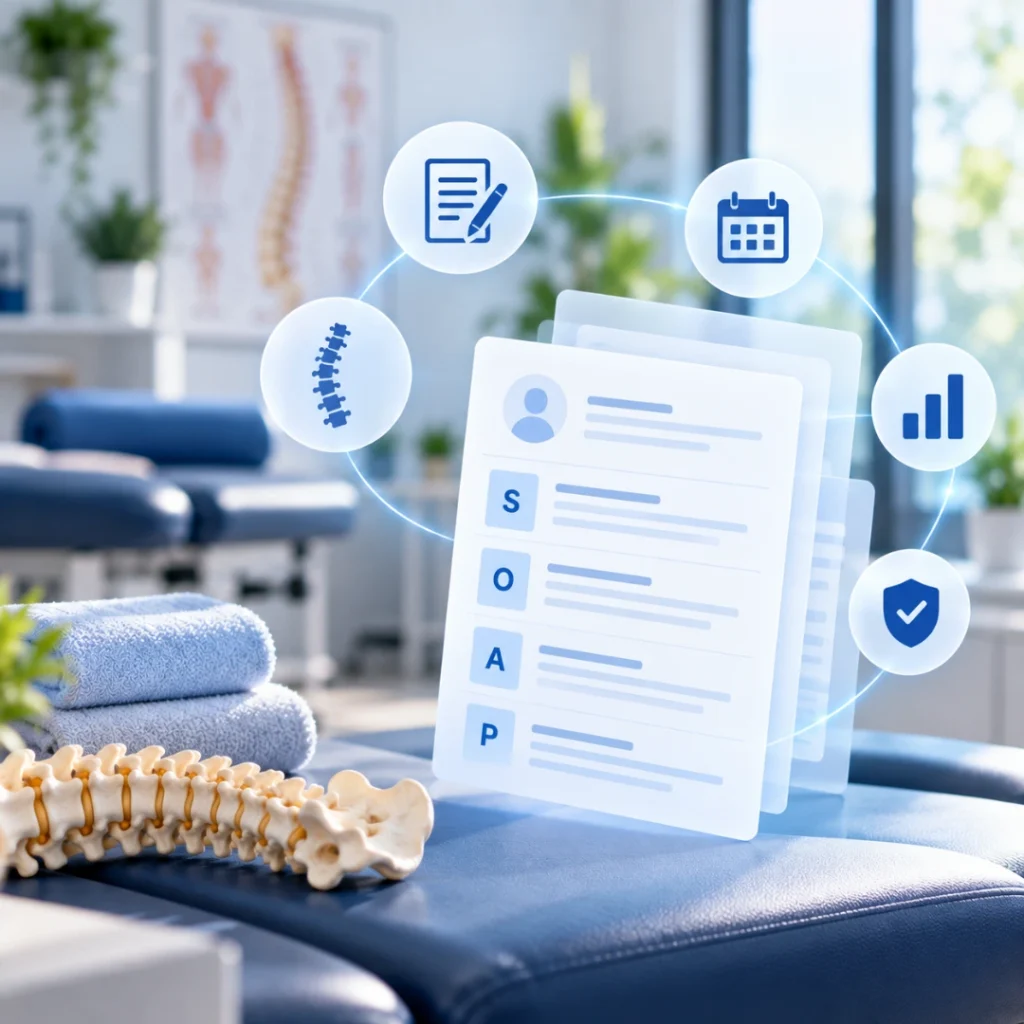
Infographic comparing built-in AI scribe vs third-party scribe showing patient profile data connected to SOAP note draft before the session starts

When the AI Knows Your Patient Before the Session Starts

Here is the capability that only native integration makes possible: before the session begins, HelloNote AI Scribe already knows who the patient is, what their diagnosis is, what their payer requires for documentation, and what CPT codes are relevant to their case. A third-party scribe tool starts every session from scratch. It does not know any of that unless you manually provide it.

Context-Aware Draft Notes

A native AI scribe that has access to the patient record can generate draft notes that are already aligned with the patient’s plan of care, their established goals, and their payer’s documentation requirements. The AI is not just transcribing what was said. It is organizing what was said against the context of what the documentation needs to establish. That is a categorically different quality of draft note than one produced by a tool that sees a therapy session without any patient record context.

CPT Code Suggestions That Know the Case

When HelloNote AI Scribe generates a draft note, it can cross-reference that note against the CPT codes associated with the patient’s case and flag suggestions based on what was documented. A third-party scribe tool that exists outside the EMR does not have access to that billing context. It can suggest codes based on generic documentation patterns, but it cannot account for the specific payer rules, modifier requirements, or prior authorization limitations that live inside the patient record. Native integration makes the difference between a CPT suggestion that is generically accurate and one that is accurate for this specific patient.

Looking up more cpt codes?

See 97110, 97530, and 50+ therapy procedure codes – with billing guidance and documentation tips in one place.

How HelloNote AI Scribe Works as a Native Solution

HelloNote AI Scribe was built into the EMR from the start, not added later through an API partnership with a third-party vendor. Here is what that looks like in the actual clinical workflow.

    • The therapist selects the patient and note type inside HelloNote before the session begins. AI Scribe is activated within the same interface the therapist is already using, not in a separate app.
    • The session is recorded directly within HelloNote. The audio stays within the platform and is never transmitted to a third-party server for processing.
    • The AI generates a transcript and then a structured SOAP note draft. Both are created inside the patient encounter in HelloNote, already connected to the correct record.
    • The therapist reviews and finalizes the note without leaving HelloNote. No copy-paste, no format adjustment, no app switching.
    • The completed note is marked as AI Scribe-generated in the patient record, making it clearly identifiable for review and audit purposes.
    • One BAA covers the entire workflow. The same Business Associate Agreement that governs your HelloNote account covers AI Scribe use. No additional compliance agreements required.

Frequently Asked Questions

What is the difference between a native AI scribe and a third-party AI scribe?

A native AI scribe is built directly into the EMR platform. The note draft is created inside the patient record without any additional tools, logins, or copy-paste steps. A third-party AI scribe is a separate application that records and processes session audio, then requires the therapist to transfer the generated note into the EMR manually. Native integration eliminates the workflow gap that third-party tools create.

Is a third-party AI scribe HIPAA compliant?

Third-party AI scribe tools can be HIPAA compliant, but they require a separate Business Associate Agreement with your practice before any patient audio is processed. This creates a second compliance relationship with different data retention terms, breach notification timelines, and permissible data uses than your EMR vendor's BAA. Native AI scribe solutions consolidate this under a single vendor and a single BAA.

Do third-party AI scribes work with HelloNote?

HelloNote has its own native AI Scribe built into the platform. Because HelloNote AI Scribe is native, it integrates directly with the patient record, case information, and CPT code context inside HelloNote, which are capabilities that third-party scribe tools connecting via API cannot replicate.

Does HelloNote AI Scribe use a third-party AI vendor?

HelloNote AI Scribe is a native feature of the HelloNote platform. Session audio is processed within the HelloNote infrastructure under the same BAA and data handling standards that govern all patient data in HelloNote. Your sessions are not transmitted to a third-party AI vendor for processing.

How much time does a native AI scribe save compared to a third-party tool?

Beyond the documentation time savings AI scribe provides generally, a native workflow eliminates the four to eight minutes per session spent on copy-pasting, reformatting, and app-switching that third-party tools require. Across a full clinical day, that is 40 to 80 minutes of administrative time recovered per therapist.

READY TO STREAMLINE YOUR CLINIC?

See How HelloNote Handles All of This in One Platform

Managing staff hours, compliance, inventory, and financial reports — all inside one HIPAA-compliant EMR built for PT, OT, and SLP clinics.

No credit card required · HIPAA Compliant · PT, OT & SLP

CPT 97112 — Neuromuscular Reeducation: What the Code Actually Requires and How to Document It Right

Physical therapist in navy scrubs providing hands-on gait facilitation and postural cueing to elderly male patient during CPT 97112 neuromuscular reeducation session in physical therapy clinic

Key Takeaways

  • Staff productivity in PT clinics is best measured through units per visit and notes-per-hour metrics — not just patient volume
  • Multi-location PT practices need centralized compliance tracking to ensure documentation standards are consistent across all sites
  • Revenue cycle management starts at scheduling — eligibility verification before the first visit prevents the majority of claim denials
  • Inventory and supply management is one of the most overlooked operational costs in outpatient therapy — tracking it reduces waste by up to 20 percent
  • HelloNote centralizes scheduling, documentation, billing, and reporting in one platform so clinic owners spend less time managing systems and more time growing the practice

We had a 72-year-old patient two winters ago — six weeks post-left total knee replacement, strength testing adequate bilaterally, no significant pain, cleared for full weight bearing. By every standard outpatient orthopedic metric, he should have been progressing to functional activity and planning discharge. In the gym, watching him walk, something was clearly not right. His gait was asymmetric in a way that had nothing to do with strength or pain. He was weight-shifting late to the surgical side, shortening his single-leg stance time on the left, and compensating at the trunk in a pattern our team recognized immediately: he did not trust that knee.

His motor cortex had not caught up to his musculoskeletal recovery. The hardware was intact. The quadriceps were functional. The proprioceptive feedback loop between the knee and the central nervous system — disrupted by surgery, anesthesia, and weeks of altered loading — had not been restored. This was not a 97110 problem. This was a 97112 problem. And recognizing that distinction, not just clinically but in documentation, is what this post is about.

Our team has seen more avoidable 97112 denials than any other code in our outpatient billing record. Not because the interventions were wrong. Because the documentation described activities without establishing the neuromotor impairment that made those activities a skilled clinical intervention rather than a supervised exercise session. That gap is what we want to close here. In this guide we break down exactly what CPT 97112 covers, how it differs from 97110 and 97530, how to document it correctly, and the billing mistakes that trigger the most denials.

What Is CPT 97112 and When Do You Use It

CPT 97112 is a timed therapeutic procedure code for neuromuscular reeducation of movement, balance, coordination, kinesthetic sense, posture, and proprioception, billed in 15-minute units. It is billable when the patient has a specific, measurable neuromotor deficit documented in the sensorimotor system. It requires direct one-on-one licensed therapist contact throughout and cannot be billed for balance activities alone without an identified neuromotor impairment.

The AMA defines CPT 97112 as neuromuscular reeducation of movement, balance, coordination, kinesthetic sense, posture, and/or proprioception for sitting and/or standing activities, each 15 minutes. It is a timed code requiring direct one-on-one licensed therapist contact throughout. The definition covers a wide range of clinical presentations intentionally, because neuromotor impairment presents differently across populations, diagnoses, and stages of recovery.

The clinical thread that runs through every legitimate 97112 indication is a disruption in the nervous system’s ability to sense and regulate movement. That disruption can be central — stroke, TBI, cerebral palsy, multiple sclerosis — or peripheral — proprioceptive loss from ligamentous injury, post-surgical sensory disruption, peripheral neuropathy. It can be a primary diagnosis or a secondary consequence of orthopedic injury or surgery. What it cannot be is simply ‘difficulty with balance’ without an identified neuromotor mechanism. The deficit has to be there and documented.

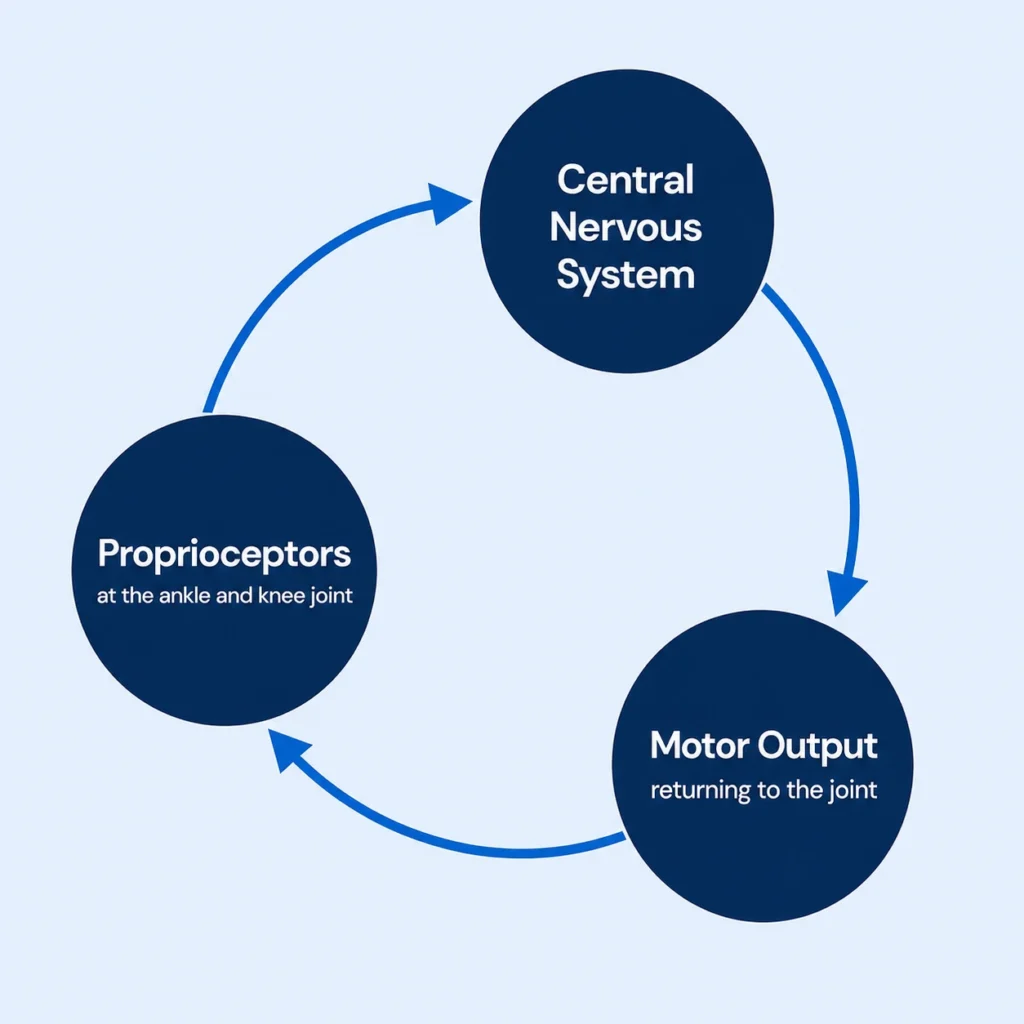
Sensorimotor feedback loop diagram showing proprioceptors at the ankle and knee joint sending signals to the central nervous system and motor output returning to the joint, illustrating the neuromotor system targeted by CPT 97112 neuromuscular reeducation

The Neuromotor System, Defined Simply

97112 targets the sensorimotor feedback loop: the system by which the body senses position and movement through proprioceptors, skin mechanoreceptors, vestibular organs, and visual input, and translates that sensory information into regulated, coordinated motor output. When this system is working well, movement is automatic and accurate. When it is disrupted, movement becomes effortful, asymmetric, compensatory, and unsafe. Reeducating that system requires skilled progressive challenge — manipulating the sensory environment, progressing instability, managing feedback, and cueing motor pattern correction in real time. That is why 97112 requires a licensed therapist.

Clinical Presentations That Warrant 97112

    • Post-stroke patients with motor pattern asymmetry, altered proprioception, and impaired postural control
    • Post-surgical orthopedic patients with disrupted kinesthetic sense around the operated joint — particularly ankle ligament repair, knee arthroplasty, hip arthroplasty, and shoulder instability surgery
    • Vestibular disorders with balance and spatial orientation deficits
    • Peripheral neuropathy with sensory substitution needs and compensatory balance strategy training
    • Traumatic brain injury affecting postural control and motor coordination
    • Developmental coordination disorders in pediatric patients
    • Chronic ankle instability with documented proprioceptive deficits
    • Older adults with age-related decline in proprioception and elevated fall risk
    • Sports medicine patients with residual proprioceptive deficits following ligamentous injury


The clinical test our team applies before billing 97112 is this: can we identify a specific, measurable neuromotor deficit — not just difficulty with an activity, but a documented impairment in the sensorimotor system — that the intervention is specifically designed to remediate? If yes, 97112 is appropriate. If the patient struggles with balance because of generalized deconditioning or weakness, that is a musculoskeletal problem and 97110 or 97530 is the more accurate code.

How to Document CPT 97112 Correctly

Deficit-first documentation is the standard for CPT 97112. The specific neuromotor finding must be established with objective measurement before any activity is documented. The note then connects the activity to the deficit, records the skilled therapist input provided during the session, captures the measurable neuromotor response, and links to a functional goal in the plan of care. Activity-forward notes that describe what the patient did without identifying the neuromotor impairment are the most common 97112 denial source.

The documentation failure that generates most 97112 denials is activity-forward documentation: the note opens with what the patient did rather than why they needed skilled neuromuscular reeducation to do it. Single-leg stance on foam, 3 x 30 seconds. Balance board training, 10 minutes. Perturbation activities, standing, therapist-assisted. These notes accurately describe interventions that may have been entirely appropriate clinically. They do not tell a payer why a licensed therapist — rather than a tech, a home program, or a supervised gym session — was required to deliver them.

Our team shifted to deficit-first documentation for all 97112 notes after a Medicare review flagged a cluster of our claims for missing medical necessity support. The interventions were not questioned. The documentation framework was. We rewrote our neuromuscular reeducation template around the principle that the neuromotor deficit drives every element of the note — the activity follows from the deficit, not the other way around.

The Five Elements of Deficit-First 97112 Documentation

1. The Specific Neuromotor Deficit, Measured and Documented First

Before any activity is entered, the note establishes the neuromotor finding. Not ‘balance deficits’ but ‘Berg Balance Scale 38/56 indicating high fall risk; joint position sense threshold right ankle 7 degrees (normal ≤2 degrees); single-leg stance right 6 seconds versus left 24 seconds.’ The deficit is the clinical justification for everything that follows.

2. The Activity and the Neuromotor Rationale Connecting It to the Deficit

Describe the activity and explain why it specifically addresses the documented neuromotor deficit. Not ‘foam pad standing performed’ but ‘progressive foam surface training to reduce dependence on plantar mechanoreceptors and shift sensory weighting toward vestibular and proprioceptive inputs, targeting the identified ankle proprioceptive deficit.’

3. The Skilled Therapist Input Provided During the Activity

Document the specific cues, hands-on facilitation, and clinical decisions your team made during the intervention. Tactile facilitation at the pelvis to cue weight shifting. Verbal cueing for motor pattern correction during stance. Manual perturbation applied to challenge reactive postural activation. This element demonstrates that the intervention required a licensed clinician in active attendance, not passive supervision.

4. The Measurable Neuromotor Response

Document what changed within the session and what your team’s objective measures showed. Stance time on foam improved from 8 to 15 seconds. Joint position sense error reduced from 7 to 4 degrees. Gait symmetry index improved from 0.68 to 0.79 during session. These numbers demonstrate that the skilled intervention produced measurable neuromotor change.

5. The Functional Goal This Reeducation Advances

Connect the neuromotor work to the patient’s documented functional goals. Proprioceptive ankle retraining advancing the goal of safe ambulation on uneven outdoor surfaces. Balance reeducation supporting the goal of returning to independent community mobility without assistive device. The functional connection is the medical necessity anchor.

The Deficit-Activity-Response Note Structure in Practice

Sample 97112 Note — Deficit-Activity-Response Structure:

Pre-treatment objective: Berg Balance Scale 38/56 (high fall risk); single-leg stance right 6 seconds vs. left 24 seconds; joint position sense threshold right ankle 7 degrees (normal ≤2 degrees).  Intervention: Progressive foam surface training (15 min, 97112) targeting documented ankle proprioceptive deficit. Therapist provided tactile facilitation at pelvis for weight shift cueing; verbal motor pattern correction during stance; manual perturbation to challenge reactive postural activation. Progression at 4 min: advance to foam surface after stable 12-second hold on firm surface.  Response: Stance time on foam improved from 8 to 15 seconds within session. Joint position sense error reduced from 7 to 4 degrees.  Goal: Proprioceptive and dynamic balance retraining advancing patient goal of safe community ambulation on uneven surfaces without assistive device.

Every 97112 note our team writes follows the same three-part architecture: deficit, activity, response. When the note is built around that architecture, the clinical justification for 97112 is structural and complete — not dependent on whether the therapist remembered to add the medical necessity language at the end of a long day.

Still losing 97112 claims to documentation?

CPT 97112 targets the sensorimotor system: proprioception, motor patterning, and vestibular function. CPT 97110 targets the musculoskeletal system: strength, endurance, ROM, and flexibility. CPT 97530 targets functional performance: ADL and task execution. All three can be billed on the same visit when each has its own documented clinical justification, separate time tracking, and distinct outcome measures.

The confusion between 97112, 97110, and 97530 is more legitimate than the confusion between most code pairs our team encounters. All three codes can involve standing activities. All three can involve progressive challenge. All three can involve the same joint or body region. The distinctions are not visible in the activity. They are clinical, they are intentional, and they must be documented.

CPT 97112 CPT 97110 CPT 97530
Full Name
Neuromuscular Reeducation
Therapeutic Exercise
Therapeutic Activity
System targeted
Sensorimotor system
Musculoskeletal system
Functional task performance
Clinical indication
Proprioceptive deficit, impaired motor patterning, vestibular dysfunction
Strength, endurance, ROM, flexibility deficit
Inability to perform ADL, work task, or functional movement
Outcome measure
Balance score, joint position sense, gait symmetry index
MMT grade, goniometric measure, reps to fatigue
Task performance quality, functional independence level
Bill same day?
Yes — with separate documented justification

Using All Three on the Same Visit

Our team treats patients who appropriately receive all three codes in a single session regularly. A post-ACL reconstruction athlete receives therapeutic exercise targeting quad strength (97110), neuromuscular reeducation targeting the proprioceptive deficit at the knee (97112), and therapeutic activity targeting the sport-specific movement patterns required for return to play (97530). Each code has its own documented clinical justification, its own time tracking, and its own outcome measure. The combined documentation tells the story of a complete rehabilitation session where each intervention served a distinct clinical purpose.

Still losing 97112 claims to documentation?

HelloNote’s team is built by therapists who’ve navigated every denial pattern in this guide. Start free and see how we handle neuromuscular reeducation documentation for PT, OT, SLP, and Chiro.

No credit card required • HIPAA Compliant • PT, OT & SLP
Common Billing Mistakes and How to Avoid Them

The five most common 97112 denial triggers are: billing based on activity alone without a documented neuromotor deficit, activity-forward documentation that describes the intervention without the deficit, imprecise time tracking that misses billable direct contact time, no progression documentation across visits, and applying 97112 to populations with musculoskeletal rather than neuromotor balance deficits.

Mistake 1 — Billing 97112 Based on Activity Alone

Do not bill 97112 when:

The note documents a balance activity without identifying a specific, measurable neuromotor deficit. Balance activities do not justify 97112. The code requires a documented neuromotor impairment in the sensorimotor system — not just difficulty with an activity.

Our team has reviewed notes where every activity in the session was clinically appropriate neuromuscular reeducation — and every claim was denied because the documentation did not establish the neuromotor impairment that made those activities a skilled intervention. The payer cannot infer the deficit from the activity. The deficit has to be in the note, measured and specific, before the activity is documented.

Mistake 2 — Activity-Forward Documentation

Notes that open with what the patient did rather than why they needed skilled reeducation to do it are the most common 97112 documentation failure our clinic has encountered. ‘Foam balance training, 10 minutes. Perturbation activities, standing.’ These notes describe procedures without clinical context. A payer reviewing them cannot determine whether the activities required a licensed clinician or could have been supervised by a tech or performed independently from a home program. The neuromotor deficit and the therapeutic rationale connecting it to the activity are what establish skilled clinical necessity.

Mistake 3 — Imprecise Time Tracking

97112 sessions frequently include time spent in clinical decision-making between activity repetitions — assessing the patient’s motor response, grading the next challenge level, providing specific corrective cueing — that therapists often do not count as billable direct contact time. Our team found during a billing review that our 97112 sessions were consistently losing 5 to 8 minutes of legitimate billable time through informal time estimation. At 8-minute rule thresholds, that loss represented a full missed unit on approximately one in three sessions. Across a solo outpatient practice that volume adds up to meaningful unrecovered revenue every month.

Mistake 4 — No Progression Documentation Across Visits

Payer reviewers looking at multiple 97112 visits expect to see evidence that the neuromotor challenge is advancing in response to the patient’s documented improvement. Notes that show the same activity at the same difficulty level across four consecutive visits without documented rationale raise a medical necessity flag for continued skilled services. Our team documents a specific progression decision at every 97112 session: what changed in the challenge level, why, and what the next progression target is.

Mistake 5 — Applying 97112 to Populations Without Neuromotor Deficits

Not every patient who struggles with balance has a neuromotor deficit that justifies 97112. A patient who is deconditioned and has difficulty with single-leg stance because of generalized weakness has a musculoskeletal problem. A patient who avoids weight-bearing because of pain has a pain management problem. Neither of these presentations justifies 97112 without a documented impairment in the sensorimotor system. The assessment findings determine the code, not the activity chosen for treatment.

CPT 97112 in Practice — What We Actually Do

A 97112 session starts with pre-treatment objective neuromotor assessment: balance scores, joint position sense testing, gait symmetry measurement. The intervention is selected based on the documented deficit, with specific skilled therapist cues, hands-on facilitation, and real-time clinical decisions documented throughout. The session closes with post-treatment outcome measures and a documented functional goal connection. The deficit-activity-response structure is the documentation framework.

Our team wants to walk through a 97112 session from clinical decision to documentation completion, because the code makes much more practical sense when you can see the deficit-activity-response structure operating in a real clinical encounter.

A patient presents at visit three following ankle ligament reconstruction. Our therapist’s pre-treatment assessment: single-leg stance on firm surface, right 7 seconds versus left 26 seconds. Star excursion balance test: anterior reach 71 percent limb symmetry index, posteromedial reach 68 percent. Joint position sense testing: right ankle threshold error 6 degrees, left 2 degrees. These findings are documented in the objective section before the intervention begins. The clinical picture is clear: adequate strength returning, neuromotor system still significantly impaired.

Our therapist selects the first intervention: eyes-closed single-leg stance on firm surface targeting the identified proprioceptive deficit without visual compensation, beginning 8-minute block. Specific cues: verbal cuing for weight distribution, manual contact at the pelvis for safety and tactile feedback facilitation. Progression decision at four minutes: patient demonstrates stable 12-second hold, advance to foam surface for increased mechanoreceptor challenge. Post-block response: 18-second stance on foam, patient reports increased confidence with loading.

Second intervention: star excursion balance test as therapeutic activity, targeting the anterior and posteromedial reach deficits identified on assessment, 7-minute block. Therapist cues for hip hinging pattern during anterior reach, verbal feedback on trunk control during posteromedial reach. Post-block outcome: anterior reach improved to 79 percent LSI, posteromedial to 74 percent LSI. Our team documents total 97112 time: 15 minutes, one unit.

The note closes with the functional goal connection: proprioceptive and dynamic balance retraining advancing patient’s goal of returning to trail running within four months, with limb symmetry targets of 90 percent LSI and 20-second single-leg stance on firm and foam surfaces. The clinical reasoning is complete. The medical necessity is documented. The payer has everything needed to adjudicate the claim correctly.

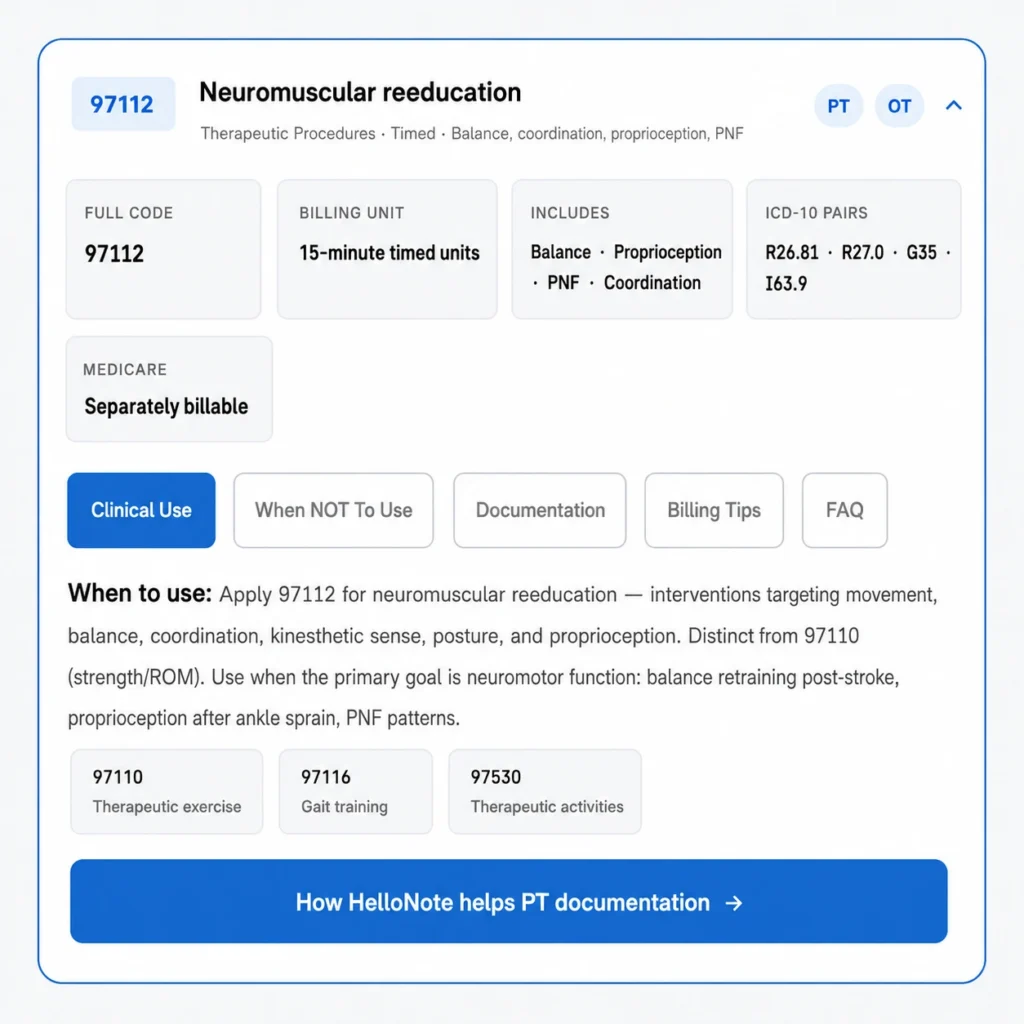
HelloNote CPT 97112 neuromuscular reeducation code card showing billing unit, ICD-10 pairs, clinical use tab and how HelloNote helps PT documentation

How HelloNote Handles CPT 97112 Documentation

HelloNote’s 97112 template requires deficit documentation before the activity section opens, includes a neuromotor rationale prompt for each activity, provides a skilled therapist input field, structured neuromotor outcome measure fields, 8-minute rule unit calculation from actual start and stop times, and required functional goal linkage before sign-off. Deficit-first documentation is the default workflow, not a documentation discipline requirement that competes with end-of-day charting pressure.

The HelloNote 97112 template was built around one clinical truth our team learned from billing reviews: the documentation structure determines whether the note captures the skilled clinical work or just the activities. When the template requires deficit documentation before activities can be entered, the clinical rationale is embedded in the note by default. When it does not, the rationale gets skipped — not from negligence, but from workflow pressure at the end of a busy clinical day.

Here is what the 97112 workflow inside HelloNote does for your team:

    • Deficit documentation required first. The neuromotor finding field must be completed before the activity section opens. Deficit-first documentation is enforced by the template structure, not by therapist discipline under time pressure.
    • Activity with rationale prompt. After each activity is entered, the template prompts the therapist to enter the neuromotor rationale connecting the activity to the documented deficit. This takes under thirty seconds and eliminates the most common 97112 denial trigger.
    • Skilled therapist input field. A dedicated section for the specific cues, manual facilitation, and real-time clinical decisions made during the session. Required before the note can be closed.
    • Neuromotor outcome measures. Structured fields for pre- and post-session neuromotor measurements: balance scores, joint position sense data, gait symmetry index, perturbation response quality. Measurements populate automatically into the visit-to-visit progress record.
    • Time tracking with unit calculation. Actual start and stop time fields for every 97112 block. HelloNote calculates billable units using the 8-minute rule. No estimation, no rounding, no unit math.
    • Functional goal linkage. Required before sign-off. The template connects the neuromuscular reeducation session to the active plan of care goals so every 97112 claim carries its medical necessity anchor.

The HelloNote 97112 template does not add documentation steps. It reorganizes the documentation sequence so that deficit-first becomes the natural path through the note rather than an intentional act of documentation discipline that competes with end-of-day charting fatigue.

Looking up more cpt codes?

See 97110, 97530, and 50+ therapy procedure codes – with billing guidance and documentation tips in one place.

Frequently Asked Questions About CPT 97112

What is CPT 97112?

CPT 97112 is a timed therapeutic procedure code for neuromuscular reeducation of movement, balance, coordination, kinesthetic sense, posture, and proprioception for sitting and standing activities. It requires direct one-on-one licensed therapist contact throughout, is billed in 15-minute units, and applies when the patient has a documented neuromotor deficit that requires skilled intervention to remediate.

What clinical conditions justify CPT 97112?

CPT 97112 is appropriate for post-stroke motor and proprioceptive deficits, post-surgical orthopedic patients with disrupted kinesthetic sense around the operated joint, vestibular disorders affecting balance and spatial orientation, peripheral neuropathy requiring sensory substitution training, traumatic brain injury affecting postural control and coordination, developmental coordination disorders, ligamentous injuries with residual proprioceptive deficits, and older adults with documented age-related proprioceptive decline and fall risk. The common requirement is a documented impairment in the sensorimotor system, not just difficulty with balance activities.

How do I document CPT 97112 to avoid denials?

Use deficit-first documentation: establish the specific neuromotor finding with objective measurement before documenting any activity. Then describe the activity and the rationale connecting it to the deficit. Document the skilled therapist input provided during the session. Record the measurable neuromotor response. Connect to a functional goal in the plan of care. Activity-forward documentation — describing the intervention without establishing the neuromotor deficit — is the most common denial source.

What is the difference between CPT 97112 and CPT 97110?

CPT 97112 targets the sensorimotor system: the nervous system's ability to sense and regulate movement through proprioception, vestibular input, and motor cortex patterning. CPT 97110 targets the musculoskeletal system: the contractile and mechanical capacity of tissue. A patient rebuilding quadriceps strength is 97110. The same patient retraining knee proprioception and motor control after surgery is 97112. Both can be billed on the same day when each has its own documented clinical justification.

Can CPT 97112, 97110, and 97530 be billed on the same day?

Yes, and in many outpatient sessions this combination is clinically appropriate. Each code requires separate time tracking, its own documented clinical justification, and distinct outcome measures. Payers audit same-day billing of these codes. Documentation specificity is essential when billing all three on the same visit.

What triggers an audit or denial for CPT 97112?

Common triggers include: activity-forward documentation without a neuromotor deficit finding, absence of measurable neuromotor outcome data, identical activity documentation across multiple visits without progression evidence, billing 97112 for populations with musculoskeletal rather than neuromotor balance deficits, and imprecise time documentation that does not support the units billed.

How does HelloNote help with CPT 97112 documentation?

HelloNote's 97112 template requires deficit documentation before the activity section opens, includes a neuromotor rationale prompt for each activity, provides a skilled therapist input field, structured neuromotor outcome measure fields, 8-minute rule unit calculation from actual start and stop times, and required functional goal linkage before sign-off. Deficit-first documentation is the default workflow.

Start Your Journey to Better Neuromuscular Reeducation Documentation

The patients who benefit most from 97112 are often the ones whose deficits are least visible on a standard assessment — the post-surgical patient whose strength has returned but whose movement is still unsafe, the neurological patient whose motor patterns are emerging but not yet reliable, the fall-risk elder whose proprioceptive system needs skilled progressive challenge to rebuild its regulatory capacity. Our team built HelloNote to make sure the documentation for these patients accurately reflects the skilled clinical work being done — and that the billing record protects the practice that is delivering it.

READY TO STREAMLINE YOUR CLINIC?

See How HelloNote Handles All of This in One Platform

Managing staff hours, compliance, inventory, and financial reports — all inside one HIPAA-compliant EMR built for PT, OT, and SLP clinics.

No credit card required · HIPAA Compliant · PT, OT & SLP

Speech to Text Therapy Documentation: How AI Scribe Changes the Way You Chart

Why We Built AI Scribe Into HelloNote's Therapy Documentation

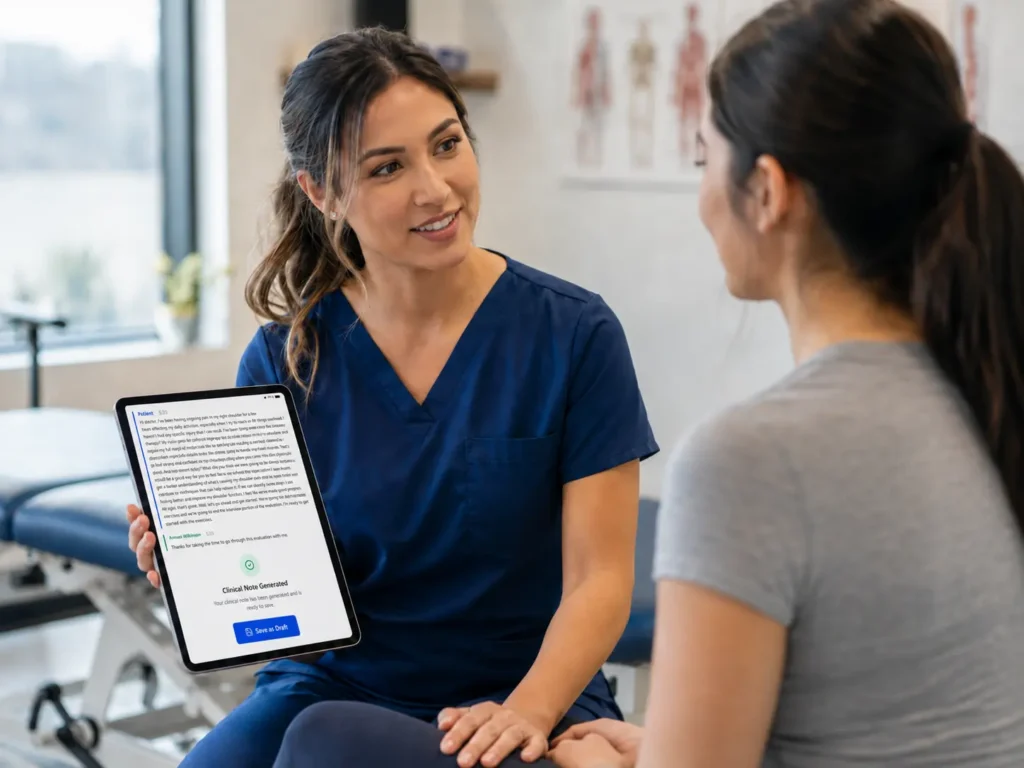
Physical therapist in blue scrubs holding a tablet showing HelloNote AI Scribe clinical note generated screen while sitting with a patient in a therapy clinic

Key Takeaways

  • Staff productivity in PT clinics is best measured through units per visit and notes-per-hour metrics — not just patient volume
  • Multi-location PT practices need centralized compliance tracking to ensure documentation standards are consistent across all sites
  • Revenue cycle management starts at scheduling — eligibility verification before the first visit prevents the majority of claim denials
  • Inventory and supply management is one of the most overlooked operational costs in outpatient therapy — tracking it reduces waste by up to 20 percent
  • HelloNote centralizes scheduling, documentation, billing, and reporting in one platform so clinic owners spend less time managing systems and more time growing the practice

Table of Contents

Why did HelloNote build AI Scribe for therapy documentation?

HelloNote AI Scribe was built by licensed therapists who spent years charting after hours and reconstructing patient encounters from memory. The tool records the session, generates a transcript, and turns that transcript into a structured SOAP note draft inside the EMR. The goal was to start documentation during the clinical encounter, not two hours after it ends.

When we launched HelloNote, the premise was straightforward: build an EMR by people who had actually used one. Clinicians who had charted at 9pm. Who had dealt with claim denials that traced back to documentation language that was technically accurate but clinically vague. Who had spent more time than we want to admit reconstructing patient encounters from memory into note fields that never quite fit what actually happened in the room.

That was the founding frustration. It is still the problem we build for every day.

As a licensed Occupational Therapist and clinic owner, we have documented thousands of patient encounters: evaluations, treatment sessions, re-evaluations, discharges. We know what it feels like to walk out of a strong clinical session and sit down at a screen that has no idea what just happened in that room. The blank note does not know your patient had a rotator cuff repair six weeks ago and teared up when she reached overhead without pain for the first time. It does not know the clinical reasoning you worked through in real time. It just waits. And you rebuild it from scratch.

HelloNote AI Scribe is the most direct answer we have ever built to that specific experience. It records the session conversation (the same conversation that is already happening), generates a transcript, and turns that transcript into a structured clinical draft inside HelloNote. Subjective, Objective, Assessment, Plan. Connected to the right patient, the right case, the right note type. Ready for your clinical review, not your reconstruction.

This is not a generic AI feature bolted onto an existing platform. It is a documentation workflow built by clinicians who have sat in the chair, treated the patient, and then faced the note. That difference matters, and it is exactly what we want to walk you through in this post.

How Speech to Text Therapy Documentation Has Changed

How has speech to text therapy documentation evolved beyond basic transcription?

Basic speech-to-text gives therapists a raw transcript of their session. Modern AI scribe tools go further: they take that transcript and organize it into a structured SOAP note with the Subjective, Objective, Assessment, and Plan sections populated from the actual session content. For therapy documentation, that distinction matters because a single evaluation session captures pain reports, functional limitations, short and long-term goals, prior level of function, and clinical reasoning, none of which a raw transcript can organize on its own.

Basic voice dictation has been around for years, and most therapists who have tried it know its limits. It can capture words accurately enough. What it cannot do is turn those words into a usable clinical draft. It gives you a transcript. It does not give you a note.

That distinction matters more in therapy than in almost any other clinical setting. A therapy evaluation captures pain reports, functional limitations, onset history, prior level of function, short and long-term goals, treatment recommendations, and clinical reasoning, all in a single session that is also conversational, relational, and fast-moving. Asking a clinician to transcribe all of that from memory into a structured SOAP note after the visit is where documentation quality and completeness start to break down.

Speech to text therapy documentation has moved through three distinct stages. Stage one was basic dictation: the therapist spoke words, a program typed them. Stage two was structured dictation: templates and commands helped organize content into sections. Stage three, where we are now, is AI scribe: the system records the encounter, processes the conversation, and produces a structured clinical draft that the therapist reviews rather than writes from scratch.

HelloNote AI Scribe is built for stage three. It takes the recorded session conversation and turns it into a structured clinical draft with the Subjective, Objective, Assessment, and Plan sections populated from the actual encounter content. The therapist does not start from a blank screen. They start from a draft that reflects what actually happened in the room.

The Workflow in Practice

The AI Scribe workflow inside HelloNote follows a clear clinical path:

    • The therapist selects the patient, the case, and the note type before the session begins.
    • AI Scribe records the encounter.
    • After the session, the system generates a transcript of the conversation.
    • From that transcript, it produces a structured clinical note draft with evaluation-relevant content pulled into the appropriate SOAP sections.
    • The therapist reviews the draft, edits for clinical accuracy and personal voice, and finalizes the note.
    • The completed note is clearly marked as created with AI Scribe so it is always identifiable in the record.
  •  
  • That is not a shortcut. That is a better workflow, one that starts documentation during the clinical encounter, not two hours after it ends.

Ambient AI Scribe vs Dictation: Which Mode Is Right for Your Practice?

What is the difference between ambient AI scribe and dictation scribe for therapy?

Ambient AI scribe records the live conversation between therapist and patient during the session. Dictation scribe captures what the therapist speaks into the tool after the session ends. Ambient mode produces the most complete drafts because it captures the full clinical conversation as it happens. Dictation mode works better for hands-on treatment sessions where a live recording is less practical. HelloNote AI Scribe supports both modes.

Not every therapy session has the same documentation needs. A 60-minute evaluation involves extensive patient dialogue: history-taking, symptom reports, functional goal discussions, and clinical reasoning explained out loud. A 45-minute manual therapy treatment session is mostly hands-on with limited verbal exchange. A single speech-to-text tool that cannot account for that difference will frustrate you within the first week. HelloNote AI Scribe is built to support both of the primary ways therapists interact with documentation.

Ambient AI Scribe: Records the Live Session Conversation

Ambient AI scribe means the tool is active and listening during the patient encounter itself. The therapist activates AI Scribe before the session begins, and the tool captures the natural conversation between therapist and patient in real time. This mode is especially powerful for evaluation sessions where significant clinical dialogue is happening: history-taking, patient-reported symptoms, functional goal discussions, and clinical reasoning explained out loud.

Ambient mode produces the most complete drafts because it captures the full clinical conversation, not just what the therapist chooses to dictate afterward. It is the mode that most directly reduces the cognitive load of post-visit documentation because the session itself becomes the documentation source. The therapist is fully present with the patient instead of mentally composing the note they will write later.

Dictation Scribe: Therapist Speaks Notes After the Session

Dictation mode means the therapist speaks their clinical observations into the tool after the session ends. It is a faster, smarter version of voice-to-text where the AI organizes what is spoken into a structured note rather than producing a raw transcript.

This mode works better for hands-on treatment sessions where ambient recording may not be practical: manual therapy, gait training, and exercise sessions where the therapist is physically engaged with the patient. Dictation lets the therapist capture clinical observations immediately after the session while everything is still fresh, without requiring a live recording of the encounter.

Which Mode Should You Use?

In our clinic, we use ambient mode for evaluations and re-evaluations where clinical dialogue drives the session, and dictation mode for treatment sessions where we are more hands-on. Both modes feed into the same AI Scribe workflow inside HelloNote. The output is a structured draft note the therapist reviews and finalizes. The difference is only in how the source content is captured.

The practical rule: if your session sounds like a clinical conversation, use ambient mode. If your session looks like physical work with brief verbal check-ins, use dictation mode immediately after.

Still charting after your last patient?

HelloNote’s team is built by therapists who’ve lived this exact problem. Start free and see how AI Scribe handles therapy documentation for PT, OT, SLP, and Chiro.

No credit card required • HIPAA Compliant • PT, OT & SLP
What Makes HelloNote AI Scribe Different From Ordinary Dictation

How is HelloNote AI Scribe different from a regular speech-to-text or dictation tool?

A dictation tool produces text. HelloNote AI Scribe produces a structured SOAP note draft connected to the right patient and case inside the EMR, ready for clinical review and finalization without leaving the platform. It is trained on therapy-specific documentation language for PT, OT, SLP, and Chiro, understands functional goal language and skilled care rationale, and operates entirely within HelloNote so there is no third-party app, separate login, or copy-paste step involved.

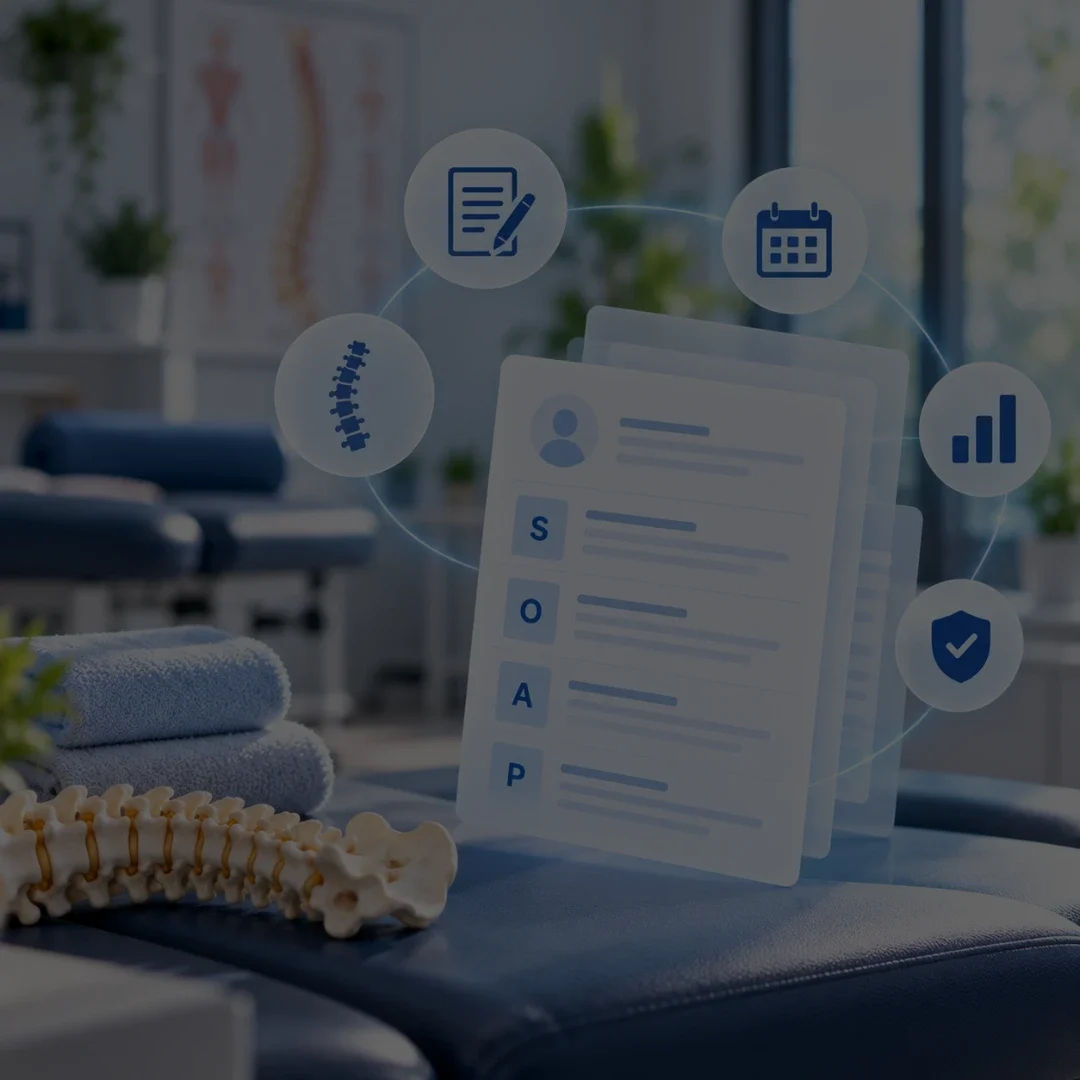
The difference between a transcription tool and an AI scribe is where the output ends up. A transcription tool gives you text. HelloNote AI Scribe gives you a clinical draft: a SOAP note with the right sections populated, connected to the right patient and case inside your EMR, ready for your clinical review.

This is a workflow difference, not just a feature difference. A transcription tool adds a step between documentation and your EMR. HelloNote AI Scribe removes that step entirely.

It Understands Therapy-Specific Documentation

Generic AI tools built for physician documentation produce notes that read like medical records, not therapy records. They do not know the difference between CPT 97110 and CPT 97530. They do not understand functional goal language, skilled care rationale, or the documentation specificity that Medicare and commercial payers require for therapy services.

HelloNote AI Scribe is trained for therapy documentation: the clinical language PT, OT, SLP, and Chiro practices actually use. It understands ROM measurements, functional outcome language, treatment unit documentation, and the distinction between impairment-based and function-based documentation that determines whether a claim gets paid.

It Stays Inside the EMR

One of the biggest friction points with third-party AI tools is the workflow gap. The note gets created somewhere else and then has to be copied, pasted, formatted, and connected to the right patient record manually. Every extra step is a place where documentation quality can slip and where therapist time disappears.

HelloNote AI Scribe is built directly into the EMR. The draft note is created inside HelloNote, connected to the patient and case automatically, and available for review and finalization without leaving the platform. No third-party app. No separate login. No copy-paste.

The Therapist Is Always in Control

Looking up more cpt codes?

See 97110, 97530, and 50+ therapy procedure codes – with billing guidance and documentation tips in one place.

Every note generated by HelloNote AI Scribe is a draft. The therapist reads it, edits it, applies clinical judgment, and signs it. The AI does not finalize anything. It does not submit claims. It does not make clinical decisions. It generates a significantly better starting point than a blank screen, and the licensed clinician does the rest.

That is not a limitation of the technology. That is the right way to use it. A 2025 randomized controlled trial published in NEJM AI found that AI scribes reduced documentation time and improved clinician burnout scores, but also identified that clinicians who reviewed AI-generated notes carefully produced better outcomes than those who accepted drafts passively. The draft is the tool. Your clinical judgment is the product.

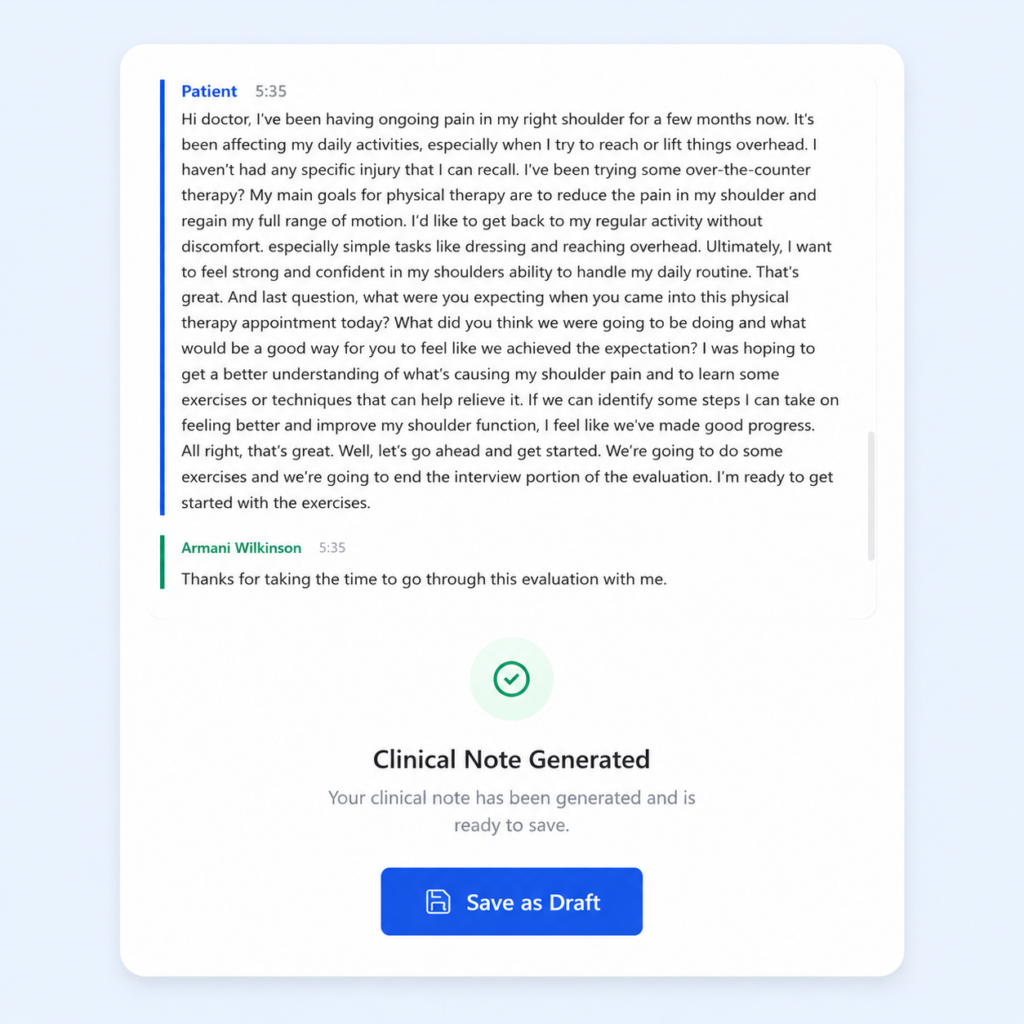
HelloNote AI Scribe real-time session transcription showing patient conversation captured and clinical note generated ready to save as draft

Why Documentation Pressure Is Getting Worse Before It Gets Better

Why is documentation pressure increasing for therapy practices?

Documentation pressure in therapy practices is rising because payer documentation requirements have increased while clinician time has not. A therapist seeing ten patients a day who spends twenty minutes per note on manual documentation spends more than three hours daily on charting alone. That is time not available for patient care, clinical education, or staff development. Studies published in JAMA and NEJM AI have confirmed that this documentation burden is the primary driver of clinician burnout across outpatient therapy and medical settings.

The demand for better speech to text therapy documentation tools is not coming from a technology trend. It is coming from a workforce reality. Documentation pressure, clinician exhaustion, and the administrative burden on therapy practices have been building for years. What we are seeing now, in our own clinic and in conversations with practices across the country, is that the expectation has shifted. Clinicians are no longer willing to accept documentation that takes as long as the clinical session itself. And they should not have to.

The math is not complicated. A therapist seeing ten patients a day who spends twenty minutes per note on manual documentation is spending more than three hours a day on charting alone. That is not time available for patient care. It is not time available for clinical education or staff development. It is time that goes directly to turning clinical memory into text, and nothing else.

A 2025 quality improvement study published in JAMA Network Open found that clinicians using ambient AI scribes saw burnout rates drop from 51.9% to 38.8% after 30 days. The same study reported significant improvements in cognitive task load, time spent documenting after hours, and focused attention on patients. The documentation burden is not a personality problem. It is a systems problem. And it is solvable.

We built HelloNote because we were therapists first. We treated patients, ran a clinic, dealt with claim denials, and charted at 9pm just like everyone reading this. AI Scribe is the most direct answer we have ever built to the problem that pushed us to build an EMR in the first place.

How HelloNote AI Scribe Works in Your Practice

When we built AI Scribe into HelloNote, we made decisions based on what we actually needed as clinicians, not what looked impressive in a demo. Here is what that looks like in practice:

    • Session recording with patient and note type pre-selected. AI Scribe knows the context before the session starts, which means the draft note is connected to the right record automatically. No post-session data entry to link the documentation.
    • Transcript generation from the session conversation. The full clinical dialogue is captured and processed, giving the AI the source material it needs to produce a structured note rather than working from a brief dictation.
    • Structured SOAP note draft. The AI organizes transcript content into Subjective, Objective, Assessment, and Plan sections based on what was actually said during the session. The draft reflects the real encounter, not a generic template.
    • AI Scribe marking on completed drafts. Every note created with AI Scribe is clearly labeled in HelloNote so you always know how documentation was generated. This is important for audit readiness and for the therapist reviewing and signing the note.
    • Therapist review and finalization inside the EMR. The entire workflow stays inside HelloNote. No third-party app. No copy-pasting. No separate login. From session start to signed note, everything is in one place.
    • HIPAA-compliant on every plan. Session content is handled with the same security standards as all patient data in HelloNote, with a Business Associate Agreement available for every account including the free plan.

Frequently Asked Questions

What is speech to text therapy documentation?

Speech to text therapy documentation is the process of using voice recognition technology to capture and convert spoken clinical content into written patient records. In its most basic form, it produces a raw transcript of what was said. In its most advanced form, an AI scribe takes that transcript and organizes it into a structured clinical note with SOAP sections populated from the actual session content, ready for the therapist to review and finalize.

The distinction matters because a raw transcript is not a note. A 45-minute evaluation session generates thousands of words of conversation. An AI scribe reduces that to a usable SOAP draft. The therapist reviews and signs rather than writing from scratch.

How does ambient AI scribe work for therapy sessions?

Ambient AI scribe for therapy works by recording the natural conversation between the therapist and patient during the session. The therapist activates the tool before the encounter begins. The system captures the full clinical dialogue in real time, including patient-reported symptoms, history, functional goals, and clinical reasoning spoken aloud by the therapist.

After the session, the AI processes the transcript and generates a structured clinical note draft with Subjective, Objective, Assessment, and Plan sections organized from the session content. The therapist reviews the draft, edits as needed, and signs the note. In HelloNote, this entire workflow takes place inside the EMR without a separate app or copy-paste step.

What is the best speech to text software for physical therapists?

The best speech to text software for physical therapists is one that does more than transcribe. It should produce a structured SOAP note draft from the session recording, understand PT-specific terminology including ROM measurements, CPT codes, functional outcome language, and the documentation requirements Medicare requires for skilled therapy services.

HelloNote AI Scribe is built specifically for PT, OT, SLP, and Chiro documentation. It is built into the EMR so the draft note is automatically connected to the right patient and case, with no copy-paste step required. It supports both ambient mode (for evaluations) and dictation mode (for treatment sessions). It is HIPAA-compliant on every plan including the free plan.

Can AI scribe generate SOAP notes for occupational therapy?

Yes. AI scribe can generate SOAP note drafts for occupational therapy documentation when the tool is trained on OT-specific clinical language. Generic AI tools built for physician documentation often do not understand OT terminology, functional goal language, activity of daily living frameworks, or the documentation specificity that Medicare requires for OT services.

HelloNote AI Scribe is trained across PT, OT, SLP, and Chiro documentation. It understands ADL-based functional goals, OT evaluation frameworks, and the clinical language OT practices actually use when writing notes that need to demonstrate medical necessity to payers.

How much time does AI scribe save therapists on documentation?

Time savings from AI scribe for therapists vary by practice and implementation, but controlled research shows meaningful results. A 2025 randomized controlled trial published in NEJM AI found a 9.5% reduction in note-writing time among physicians using ambient AI scribe. A 2025 JAMA Network Open study found significant reductions in after-hours charting and cognitive task load after 30 days of AI scribe use.

For therapy practices, the bigger impact is often not the time per note but the elimination of after-hours charting. Therapists who use AI Scribe consistently report completing notes during or immediately after sessions rather than catching up at 9pm. That shift changes the entire rhythm of the clinical day.

Does AI scribe replace the therapist in documentation?

No. AI scribe generates a draft note that the licensed therapist reviews, edits, and signs. Clinical judgment, accuracy, and professional responsibility for the final note remain entirely with the clinician. The AI handles the first draft. The therapist handles everything that matters clinically.

This is not a limitation of the technology. It is the correct clinical and legal framework for using AI in therapy documentation. Every HelloNote AI Scribe draft is reviewed and signed by the licensed clinician before it becomes a finalized record. The AI does not submit claims, make treatment decisions, or finalize anything without therapist approval.

Is speech to text documentation HIPAA compliant for therapy practices?

Speech to text therapy documentation tools must meet HIPAA requirements when they process protected health information. This includes data encryption, secure storage, and a signed Business Associate Agreement between the practice and the technology vendor.

HelloNote AI Scribe is HIPAA-compliant on every plan, including the free plan. A Business Associate Agreement is available for every HelloNote account. Session audio is processed with the same security standards as all protected health information in HelloNote. Therapists should confirm HIPAA compliance and BAA availability with any AI documentation tool before using it in clinical practice.

What is the difference between ambient AI scribe and dictation scribe for therapy?

Ambient AI scribe records the live conversation between therapist and patient during the session. The tool listens in real time and captures the full clinical encounter as it happens. Ambient mode is best for evaluations and re-evaluations where significant patient-therapist dialogue drives the session.

Dictation scribe captures what the therapist speaks into the tool after the session ends. This is a smarter version of voice-to-text that organizes the therapist's spoken observations into a structured note rather than producing a raw transcript. Dictation mode is better for hands-on treatment sessions where ambient recording during the encounter is less practical. HelloNote AI Scribe supports both modes within the same EMR workflow.

Does AI scribe work for speech-language pathology documentation?

Yes, when the AI scribe is trained on SLP-specific documentation. Generic medical scribes often fail for speech-language pathology because they do not understand SLP terminology, goal tracking structures, articulation and language documentation frameworks, or the ASHA-aligned documentation standards that payers require for SLP services.

HelloNote AI Scribe is built for therapy documentation across PT, OT, SLP, and Chiropractic disciplines. SLP therapists using HelloNote AI Scribe get structured SOAP drafts that reflect the clinical language SLP practices actually use, connected to the right patient and case inside the EMR without a separate app or workflow.

Does HelloNote AI Scribe work with the free plan?

Yes. HelloNote AI Scribe is available on every HelloNote plan, including the free plan. HIPAA compliance and Business Associate Agreement availability apply to every account regardless of plan tier. There is no extra subscription required to access AI Scribe within HelloNote.

The free plan supports up to two active patients. For solo therapists or practices evaluating HelloNote before committing to a paid plan, the free tier gives full access to AI Scribe functionality to test the documentation workflow before scaling.

READY TO STREAMLINE YOUR CLINIC?

See How HelloNote Handles All of This in One Platform

Managing staff hours, compliance, inventory, and financial reports — all inside one HIPAA-compliant EMR built for PT, OT, and SLP clinics.

No credit card required · HIPAA Compliant · PT, OT & SLP

What Is an AI Scribe for Therapy? A PT, OT & SLP Guide

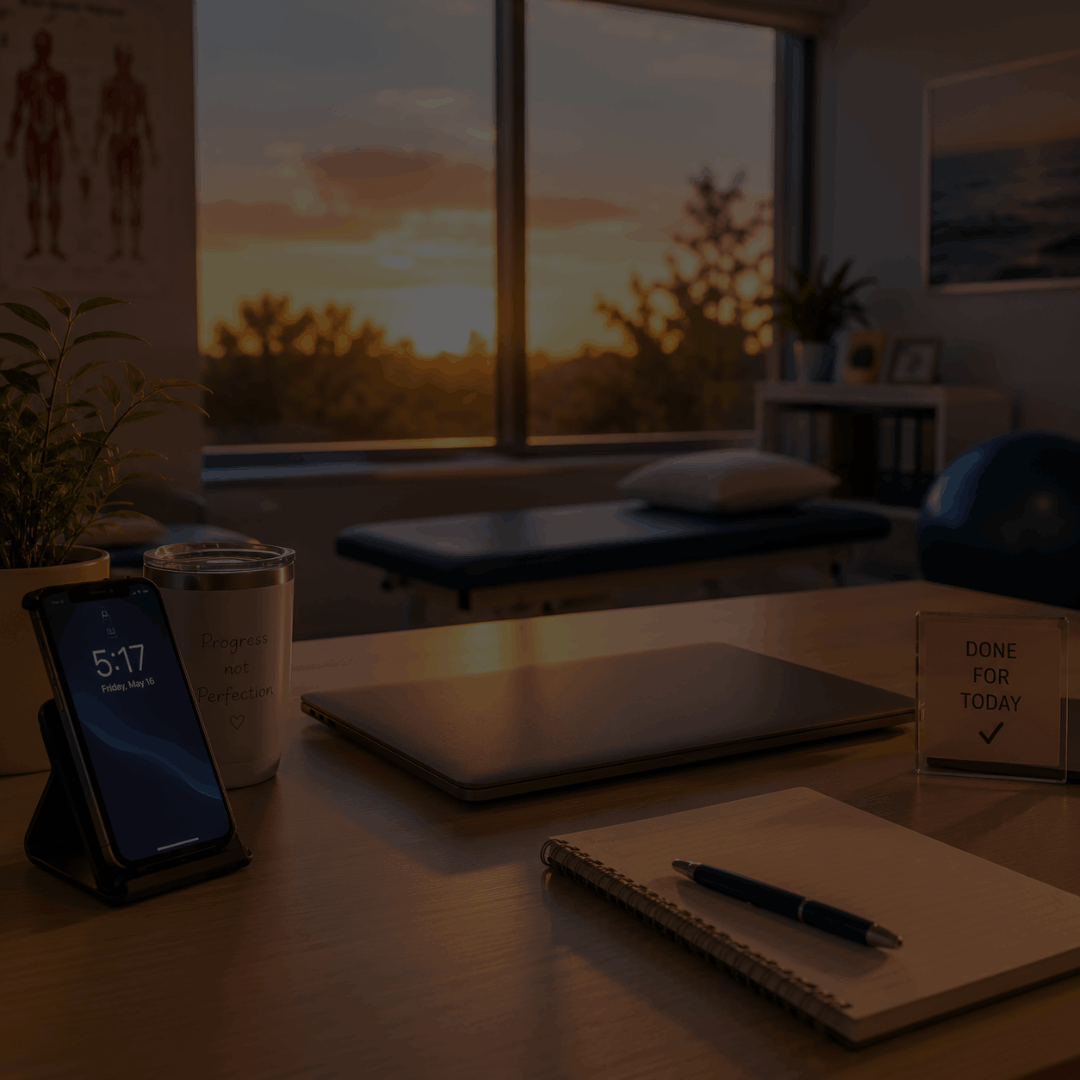
Physical therapy clinic desk at end of day showing closed laptop and done for today sign — AI scribe for therapy practices

Table of Contents

Key Takeaways

    • An AI medical scribe listens to your therapy session in real time and converts the conversation into a structured SOAP note — without you typing a single word.
    • ✓  The best AI scribes for PT, OT, and SLP understand therapy-specific terminology: MMT, ROM, ADLs, CPT codes, and payer documentation requirements.
    • ✓  HIPAA compliance is non-negotiable — any AI scribe you use must sign a Business Associate Agreement (BAA) and handle protected health information securely.
    • ✓  HelloNote’s AI Scribe is built into the EMR — no third-party app, no copy-pasting notes, no extra subscription to manage.
    • ✓  Therapy-specific AI scribes trained on PT, OT, and SLP language produce dramatically better documentation than general medical scribes.
    • ✓  Check your state’s recording consent laws — some states require all-party consent before you activate ambient listening.

The Note That Almost Broke Us

We had a patient in our clinic a few years back — 64-year-old bilateral total knee replacement, three weeks post-op — who was doing everything right. Motivated, compliant, showing measurable functional gains every session. But our documentation was a disaster. Not clinically inaccurate — just slow. Our therapists were spending 35 to 45 minutes per patient writing notes after clinic hours. By 9pm we had six or seven notes still open in the EMR, and our team was exhausted before the next morning even started.

That specific problem — not the clinical work, but the documentation burden — is what drove us to think differently about how therapy practices handle charting. And it is why, when AI scribe technology became clinically viable for therapy settings, we paid close attention.

In this post we are going to break down exactly what an AI medical scribe is, how it works in a PT, OT, or SLP practice, what to look for before you adopt one, and how HelloNote built this directly into the EMR so you never have to manage a separate tool. Whether you are considering AI scribe for the first time or you have tried one and been disappointed, this is the guide we wish we had when we started.

What Is an AI Medical Scribe?

An AI medical scribe is a voice-powered documentation tool that listens to your patient session, processes what is said, and generates a structured clinical note — typically a SOAP note, DAP, or discipline-specific format — for you to review and sign. In practice, it is the difference between finishing your notes during the session versus at 9pm on your couch.

That is the textbook definition. Here is the clinical one: it is the difference between finishing your notes during the session versus at 9pm on your couch.

How It Actually Works in a Therapy Session

The typical workflow looks like this. You start your session, activate the AI scribe (usually a tap on your phone or EMR), and treat your patient the way you always have. The scribe runs quietly in the background, capturing the conversation. After the session — or sometimes in real time — it generates a draft SOAP note that you review, edit, and sign. Most platforms that are properly built for therapy take two to five minutes to generate a complete note.

The critical word in that sentence is ‘properly built for therapy.’ Generic AI transcription tools designed for physicians will generate notes that sound like a medical record, not a therapy record. They do not understand the difference between 97110 and 97530. They do not know what MMT grading means. They cannot contextualize a gait deviation or a sensory processing observation. A therapy-specific AI scribe — trained on PT, OT, and SLP clinical language — is categorically different.

Ambient Listening vs Dictation — Which Is Right for Therapists?

There are two primary modes most AI scribes use. Ambient listening means the tool captures the actual conversation between you and the patient in real time, live during the session. Dictation means you speak your notes into the tool after the session — essentially a smarter, faster version of voice-to-text.

Both have a place in therapy practice. Ambient listening is ideal for evaluation sessions where there is significant patient-therapist dialogue. Dictation is often better for hands-on treatment sessions where you are physically assisting the patient and cannot have a phone recording the encounter. HelloNote’s AI Scribe supports both modes — because the reality of a therapy day does not fit one workflow.

What Makes an AI Scribe Work for PT, OT, and SLP Specifically

Not all AI scribes are built for therapy. A therapy-specific AI scribe must understand discipline-specific terminology — MMT grades, ROM values, ADL and IADL performance, dysphagia protocols — and generate SOAP note structures that meet Medicare and commercial payer documentation requirements, not just generic medical record formats.

Not all AI scribes are created equal for therapy. Here is what we look for when we evaluate whether a tool actually understands rehab therapy documentation versus just medical documentation in general.

Therapy-Specific Clinical Vocabulary

A good AI scribe for physical therapy needs to understand goniometry, manual muscle testing grades, functional mobility terminology, exercise prescription language, and CPT-relevant documentation phrasing. For occupational therapy, it needs to distinguish between ADL and IADL performance, occupation-based goal language, sensory processing observations, and functional cognition documentation. For SLP, it needs to handle fluency assessments, articulation scoring, dysphagia protocols, and language sampling documentation.

We have tested AI scribes that transcribed ‘MMT 4/5 bilateral hip abductors’ as ’empty empty 45 bilateral hip abductors.’ That is not a clinical documentation tool. That is a liability.

SOAP Note Structure That Matches Payer Expectations

Medicare and commercial payers have specific expectations for how therapy notes are structured. The Subjective section needs to capture patient-reported symptoms and functional limitations. The Objective section needs measurable data — ROM, strength, functional scores. The Assessment needs to demonstrate skilled clinical reasoning, not just what you did. The Plan needs to tie directly back to measurable goals.

An AI scribe that generates grammatically correct but clinically vague SOAP notes is not protecting you in an audit. We have seen AI-generated notes that read well but would fail a Medicare focused review because the skilled care rationale was missing. HelloNote’s AI Scribe is trained specifically on documentation patterns that support medical necessity — because that is what actually matters for your reimbursement.

CPT Code Suggestions Based on What Was Documented

This is the feature that separates functional AI scribes from transformative ones. When the AI listens to your session and generates the note, it should also be reading the note it just created and suggesting the most appropriate CPT codes based on what was actually documented — not what you think you billed. We have seen therapists consistently underbill because they forget to capture all the timed units in a busy session. An AI scribe that suggests CPT codes from the documented content is a billing accuracy tool, not just a time-saving one.

Looking up more cpt codes?

See 97110, 97530, and 50+ therapy procedure codes – with billing guidance and documentation tips in one place.

HIPAA Compliance — The Question You Must Answer Before You Record Anything

Before activating any AI scribe in a patient session, therapy practices must have three things in place: a signed Business Associate Agreement (BAA) with the vendor, verification of your state’s recording consent laws, and a patient disclosure process. Without all three, recording patient sessions creates legal exposure regardless of how the AI handles the data afterward.

Every therapist we talk to asks this question first, and it is the right question. Before you let any tool record a patient session, you need to have three things in place.

Business Associate Agreement (BAA)

If an AI scribe vendor processes patient audio or transcripts, they are handling protected health information on your behalf. That makes them a Business Associate under HIPAA, and they are legally required to sign a Business Associate Agreement with your practice before you use their tool. If a vendor will not sign a BAA, do not use their product. Full stop. This includes free trials.

State Recording Consent Laws

HIPAA establishes the federal floor, but state laws vary significantly. Some states require all-party consent before recording a conversation — meaning both you and the patient must explicitly consent. Others require only one-party consent. If you practice in California, Florida, Pennsylvania, or several other states, you need to verify your state’s recording consent requirements before activating ambient listening in any session. This is not optional and it is not covered by your HIPAA BAA.

Patient Disclosure and Opt-Out

Even in one-party consent states, best practice is to inform patients that a documentation tool is being used during their session. A simple verbal disclosure at the start of the visit — ‘I use an AI documentation assistant during sessions to help me chart faster and spend more time with you’ — covers your bases both ethically and legally. Patients consistently respond well to this when it is framed correctly.

HelloNote’s AI Scribe documentation includes consent language templates and a written BAA for every account. We also do not use session audio to train our AI model — patient PHI stays in your practice.

AI Scribe vs Manual Documentation — The Real Math

A therapist seeing 10 patients per day who spends 20 minutes per note on manual documentation is spending 3.3 hours per day on charting — more than two full workdays per week. AI scribe reduces per-note time to 5 minutes or less, returning 2.5 hours of clinical or personal time per day per therapist.


We did this calculation in our own clinic before we built AI Scribe into HelloNote, and the numbers were uncomfortable to look at.

The Time Cost

A therapist seeing 10 patients per day who spends 20 minutes per note on manual documentation is spending 3.3 hours per day on charting. At 5 days a week, that is 16.5 hours per week — more than two full workdays — going to documentation alone. Cut that to 5 minutes per note with AI scribe and you reclaim 2.5 hours per day. Across a practice with three therapists, that is 7.5 hours of clinical capacity returned every single day.

The Revenue Math

Documentation errors cost practices money in ways that do not always show up on a denial report. Undertimed units, missing laterality, vague functional goal language, unsupported skilled care rationale — these are documentation quality issues that either generate denials or, worse, pass through claims processing and create audit exposure. A 2024 study found that AI scribes used for more than 40 percent of appointments were associated with a 29 percent decrease in documentation time per session and a 7 percent increase in monthly appointments seen. That is not a documentation story. That is a revenue story.

The Burnout Reality

This one does not show up in a spreadsheet, but it is the one that matters most to us. Therapists do not leave the profession because of difficult patients. They leave because of what comes after the patients go home. A UCLA Health study published in late 2025 found that AI scribe use was associated with meaningful reductions in clinician burnout scores across specialties. We built HelloNote because we were therapists who were sick of the administrative work eating the clinical work. AI Scribe is the most direct version of that commitment we have ever built.

READY TO STREAMLINE YOUR CLINIC?

See How HelloNote Handles All of This in One Platform

Managing staff hours, compliance, inventory, and financial reports — all inside one HIPAA-compliant EMR built for PT, OT, and SLP clinics.

No credit card required · HIPAA Compliant · PT, OT & SLP

Frequently Asked Questions

What is an AI medical scribe for physical therapy?

An AI medical scribe for physical therapy is a voice-powered documentation tool that listens to your therapy session and automatically generates a structured SOAP note. Unlike generic dictation software, a therapy-specific AI scribe understands clinical terminology like MMT, ROM, ADL performance, and CPT coding requirements specific to PT, OT, and SLP practice.

Is AI scribe HIPAA compliant for therapy practices?

AI scribes can be HIPAA compliant, but compliance requires the vendor to sign a Business Associate Agreement (BAA) with your practice before use. The BAA legally commits the vendor to handling your patients' protected health information responsibly. Always request and sign a BAA before activating any AI documentation tool in your practice.

How long does it take to generate a SOAP note with AI scribe?

With a properly built therapy AI scribe, a complete SOAP note draft typically generates within two to five minutes after the session ends. Initial drafts require clinician review and editing before signing. Most therapists report spending five to eight minutes total on a note that previously took twenty to thirty minutes.

Can AI scribe suggest CPT codes for physical therapy documentation?

Yes — AI scribes that are designed for therapy billing can analyze the generated note and suggest appropriate CPT codes based on what was documented. This is one of the most clinically valuable features, as it reduces underbilling and helps therapists capture all billable units from a session.

Will AI scribe replace physical therapy documentation?

No. AI scribe assists documentation — it generates a draft that a licensed clinician reviews, edits, and signs. The clinical judgment, accuracy, and professional responsibility for every note remains entirely with the therapist. AI scribe handles the typing. The clinician handles the clinical reasoning.

Does HelloNote's AI Scribe work for OT and SLP too?

Yes. HelloNote's AI Scribe is designed for PT, OT, SLP, and Chiropractic practices. The AI is trained on discipline-specific clinical language for all four specialties, and the documentation templates reflect payer expectations for each discipline.

AI Scribe for Physical Therapists: Beyond Saving Time

What Are the Real Benefits of AI Scribe for Therapists?

The biggest benefits of AI scribe for therapists are improved clinical presence, more complete documentation, reduced cognitive fatigue, fewer after-hours notes, and better billing accuracy. Instead of reconstructing sessions from memory at the end of the day, AI scribe captures the clinical encounter in real time so therapists can stay focused on the patient while generating more consistent documentation.

AI scribe for physical therapists recording a patient interview session in a modern therapy clinic using a tablet

Table of Contents

Key Takeaways

    • The most underreported benefit of AI scribe is not speed – it is the return of full clinical presence during patient sessions.
    • Therapists using AI scribe report lower end-of-day cognitive fatigue, not just shorter charting sessions – the mental load of parallel documentation tracking disappears.
    • HelloNote AI Scribe gives clinicians the specific benefit of context-aware drafts – the note already knows the patient, the case, and the payer before the session starts.

What Clinicians Actually Lose Every Day Before AI Scribe

We want to start this post differently than every other AI scribe benefits article you have read. Not with what therapists gain. With what they lose.

We had a patient a few years back – bilateral shoulder dysfunction, complex history, a lot of layers to track. Midway through the evaluation, while she was explaining how her symptoms had changed since her last flare, our therapist caught herself doing something she had trained herself not to do: mentally filing details for the note instead of fully listening to the patient. Onset timeline. Bilateral vs unilateral presentation. The exact phrase the patient used about reaching across her body. Two tracks running simultaneously – one clinical, one documentary. The patient was still talking. Our therapist was still nodding. But part of her attention had already left the room.

That split is so normalized in therapy practice that most clinicians do not notice it anymore. It is just how documentation works. You treat and you file. You listen and you catalog. You stay present and you prepare the reconstruction. And at the end of the day, when the last patient has left and the notes still need to be finished, you find out how much of that mental filing actually held.

AI scribe does not just save documentation time. It closes the split. And everything that follows in this post is a consequence of that one change.

The Presence Benefit - Being Fully in the Room

Clinical presence – the quality of being fully attentive and engaged with the patient – is not just a therapeutic nice-to-have. It is a clinical instrument. A therapist who is fully present catches the wince the patient tries to suppress. Hears the hesitation before they describe their pain level. Notices the compensatory movement pattern that only appears when the patient forgets they are being observed. These are diagnostic signals that a divided attention misses.

The Parallel Processing Tax

Every experienced therapist has developed some version of parallel processing – the ability to treat and mentally document simultaneously. It is a skill born of necessity, not preference. And like all divided attention states, it has a cost. The cost is paid in clinical granularity – the small observations that fall through the gap between the track that is treating and the track that is filing.

When AI scribe takes over the documentation track entirely, clinicians consistently report noticing more during sessions. Not because their clinical skills improved. Because the cognitive bandwidth that was split between treating and documenting is now fully allocated to treating. That is the presence benefit, and it shows up in note quality, patient rapport, and clinical outcome in ways that are hard to quantify but easy to recognize once you have experienced it.

What Patients Notice Too

Patients are perceptive. A therapist who is writing between patient responses, mentally composing sentences while asking the next question, or glancing at a template while listening to a symptom description communicates something about the quality of attention in the room. Patients may not name it, but they feel it. AI scribe removes the competing demand on the clinician’s attention so that the patient gets the version of their therapist who is entirely there.

Looking for cpt and icd codes guide?

See 97110, 97530, and 50+ therapy procedure codes – with billing guidance and documentation tips in one place.

The Quality Benefit - Notes Written From the Session, Not From Memory

Documentation quality in therapy is not just about compliance – it is about clinical communication, audit protection, and the continuity of care across providers and payers. A note written from memory two hours after a session is structurally different from a note generated from the actual session conversation. Both can be accurate. But they are not equally complete.

Memory Is Selective. Transcripts Are Not.

Human memory prioritizes significance. When a therapist reconstructs a session from memory, they document what stood out – the measurable findings, the primary complaints, the clinical decisions. What frequently gets compressed or omitted is the clinical context: the specific language the patient used, the sequence in which symptoms were reported, the observation that was noted but not immediately acted on. These details matter in an audit. They matter when a different clinician sees the patient. They matter when a payer reviewer is deciding whether continued treatment is medically necessary.

Consistency Across the Caseload

Documentation quality in manual charting is inversely correlated with patient volume and end-of-day fatigue. The tenth note of the day is almost always less complete than the first. AI scribe removes that variable. Every session generates a transcript of equal completeness. Every draft note starts from the same quality of source material regardless of whether the patient was seen at 8am or 5pm. For practices trying to maintain documentation standards across a busy caseload, that consistency is a meaningful clinical benefit.

The Burnout Benefit - Removing the Hidden Cognitive Load

Clinician burnout in therapy is well-documented. What is less well-understood is the specific mechanism by which documentation contributes to it. It is not simply the hours spent charting – though those matter. It is the sustained dual-processing demand that documentation imposes across an entire clinical day.

The Cognitive Cost of Parallel Documentation Tracking

Every session a therapist conducts without AI scribe involves some degree of parallel cognitive processing – treating in the foreground, filing for documentation in the background. By the end of a ten-patient day, the therapist has not only treated ten patients. They have also maintained ten parallel documentation tracks simultaneously, each requiring active mental management throughout the session and reconstruction afterward. That sustained load is a significant contributor to the end-of-day exhaustion that precedes burnout.

A 2025 UCLA Health study found that AI scribe use was associated with meaningful reductions in clinician burnout scores. The mechanism is not mysterious: when the documentation track is handled by the AI, the mental load of the clinical day decreases even when the patient volume stays the same. Therapists who have used AI scribe consistently report feeling less depleted at the end of the day – not because they treated fewer patients, but because each session required less of them cognitively.

Getting the Evening Back

After-hours documentation is one of the most cited contributors to therapy burnout. A therapist who finishes clinic at 5pm and spends until 7pm finishing notes has not had a workday that ended at 5pm. AI scribe does not just compress the documentation time within clinic hours. For many practices, it eliminates the after-hours documentation requirement entirely. The note that used to be written at 9pm on the couch is now a reviewed and finalized draft by 5:15.

AI scribe for physical therapists integrated inside an EMR platform with focus on the AI Scribe button during patient documentation workflow

The Billing Accuracy Benefit - Capturing What Actually Happened

Documentation accuracy has a direct financial dimension that is easy to underestimate. Undertimed units, missing laterality, vague functional goal language, and unsupported skilled care rationale are all documentation quality failures that cost practices money – either through claim denials, audit repayments, or the silent revenue loss of consistent underbilling.

AI scribe captures session time in real time. It captures the specific interventions as they are described during the session. It captures the clinical reasoning the therapist articulates out loud. When that captured content is used to generate the draft note, the documentation reflects what actually happened with a fidelity that manual post-session charting rarely achieves consistently. For practices using HelloNote AI Scribe with integrated CPT code suggestions, the billing accuracy benefit extends to code selection – with the AI reading the drafted note and suggesting the most appropriate codes based on what was documented.

How HelloNote AI Scribe Delivers These Benefits in Practice

The benefits described in this post are not hypothetical. They are the outcomes of a documentation workflow that starts with the session itself rather than a blank screen. Here is how HelloNote AI Scribe delivers them specifically.

    • Full clinical presence – AI Scribe handles documentation capture during the session so the therapist’s full attention stays on the patient, not split between treating and filing.
    • Session-accurate drafts – the note is built from a transcript of the actual encounter, not reconstructed from memory, producing more complete and consistent documentation across the entire caseload.
    • Reduced end-of-day cognitive load – the parallel documentation tracking that contributes to clinician fatigue across the day is removed from the therapist’s cognitive demand.
    • After-hours documentation reduction – draft notes are available for review immediately after the session, eliminating the primary driver of after-hours charting for most practices.
    • Billing accuracy support – integrated CPT code suggestions based on documented note content help practices capture all billable units accurately from every session.

READY TO STREAMLINE YOUR CLINIC?

See How HelloNote Handles All of This in One Platform

Managing staff hours, compliance, inventory, and financial reports — all inside one HIPAA-compliant EMR built for PT, OT, and SLP clinics.

No credit card required · HIPAA Compliant · PT, OT & SLP

Frequently Asked Questions About AI Sribe.

What are the main benefits of AI scribe for physical therapists?

The primary benefits of AI scribe for physical therapists are improved clinical presence during sessions, more complete and consistent documentation, reduced end-of-day cognitive fatigue, elimination of after-hours charting, and improved billing accuracy through real-time session capture. The presence benefit - therapists being fully attentive rather than mentally filing for notes - is often reported as the most significant change in clinical practice.

Does AI scribe improve documentation quality or just speed?

Both, but quality improvement is often the more significant benefit. Because AI scribe generates notes from a transcript of the actual session rather than from memory reconstruction, the resulting documentation is typically more complete, more consistent across the caseload, and more accurate in capturing clinical details that would otherwise be compressed or omitted in manual charting.

Can AI scribe help reduce therapist burnout?

Yes. A 2025 UCLA Health study found meaningful reductions in clinician burnout associated with AI scribe use. The mechanism involves removing the sustained cognitive demand of parallel documentation tracking across the clinical day and eliminating the after-hours documentation that is one of the most cited burnout contributors in therapy practice.

How does AI scribe improve billing accuracy for therapy practices?

AI scribe captures session content in real time, including the specific interventions performed, time allocations, and clinical reasoning articulated during the session. This produces documentation that more accurately reflects what happened than manual post-session charting, reducing undertimed units, missing laterality, and vague clinical language that lead to claim denials and audit exposure.

What is the difference between AI scribe benefits for OT vs PT vs SLP?

The core benefits apply across all therapy disciplines, but the clinical presence and documentation quality benefits manifest differently by discipline. For OTs, improved presence means better observation of functional performance and occupational behavior. For PTs, it means more complete capture of movement analysis and functional mobility data. For SLPs, it means more accurate documentation of communication and swallowing observations that are difficult to reconstruct from memory.

CPT 97110: Billing, Documentation & Denial Prevention Guide

What is CPT 97110 (Therapeutic Exercise)?

CPT 97110 is a timed therapeutic procedure code for therapeutic exercise targeting a single measurable outcome — strength, endurance, range of motion, or flexibility. Billed in 15-minute units, it requires direct one-on-one licensed therapist contact throughout. It applies when the clinical goal is improving a specific musculoskeletal impairment, not a functional performance deficit.

Key Takeaways

    • 97110 targets one outcome per session — strength, endurance, ROM, or flexibility — and the documentation must establish that single-outcome intent explicitly
    • The four required documentation elements are: specific exercise name and parameters, actual start and stop time, an objective outcome measure, and a functional goal connection sentence
    • The 8-minute rule governs unit billing — track actual time, not estimates, or expect to consistently underbill
    • 97110 is for impairment-level musculoskeletal work; 97530 is for functional activity practice; the distinction is clinical intent and must be documented, not assumed
    • Laterality is required for every unilateral condition — build it into the template so it cannot be omitted
    • Progressive documentation across visits is a billing protection strategy — document what changed, why, and what the next target is at every session

Table of Contents

There is a particular kind of frustration that hits when a claim gets denied for a patient you know you treated correctly. We had a 61-year-old construction foreman last spring — right shoulder, status post rotator cuff repair at eight weeks, progressing well on external rotation strength and doing everything the protocol asked. Three visits in a row came back denied. Not for lack of clinical necessity. Not for missing authorization. For documentation that described exercise without establishing single-outcome therapeutic intent. The insurer could not tell from our notes whether we were running 97110 or 97530. So they decided for us, and they decided wrong.

The thing about CPT 97110 is that it looks deceptively simple. Therapeutic exercise. How complicated can the documentation be? The answer, as anyone who has been through a billing review can tell you, is considerably more complicated than the code definition suggests. The AMA description covers four qualifying outcomes in one sentence. What it does not cover is the audit logic payers use when reviewing claims, the distinction between 97110 and 97530 that trips up experienced therapists, or the specific documentation elements that separate a clean claim from a denial letter.

Our team wants to close that gap in this post. Not the textbook version of 97110 — the version you learn when claims start coming back and you have to figure out why.

CPT 97110 therapeutic exercise — four qualifying outcomes: strength, endurance, range of motion, and flexibility

What Is CPT 97110 and When Do You Use It?

CPT 97110 is a timed therapeutic procedure code for therapeutic exercises designed to address a single measurable impairment: strength, endurance, range of motion, or flexibility. Each unit covers 15 minutes of direct therapist contact. The therapist must be actively involved with the patient for the entire duration — not observing from a distance, not charting at a workstation while the patient runs through a home program.

The clinical boundary that defines 97110 is specificity of target. One impairment. One measurable outcome. One therapeutic direction per session of this code. That is what distinguishes it from 97530 and what makes it defensible when a payer looks at it. When our team trains new clinicians on code selection, the test we use is simple: if you had to describe the goal of this exercise in one word — stronger, more flexible, greater endurance, increased motion — and that one word is accurate and complete, you are in 97110 territory. If you need more than one word to describe what the exercise is trying to accomplish, you likely need 97530.

The Four Qualifying Outcomes in Clinical Practice

    • Strength: progressive resistance exercise targeting a specific muscle group or movement pattern with a documented baseline deficit and a measurable strength target.
    • Endurance: exercise targeting the ability to sustain a muscle contraction or movement pattern over time, typically tied to a specific activity demand the patient needs to return to.
    • Range of motion: structured exercise specifically intended to increase joint or soft tissue mobility, with documented goniometric baseline and target.
    • Flexibility: elongation exercises targeting shortened tissue, with documented limitation and functional impact.

Each of these outcomes has one thing in common: you can measure it at baseline, track it across visits, and demonstrate progress toward a documented goal. That measurability is the backbone of a defensible 97110 claim. If our team cannot put a number on the outcome at the start, we cannot justify the code at the end.

Diagnoses and Presentations That Fit 97110

Post-surgical strengthening following orthopedic repair or replacement. Rotator cuff strengthening after tear or repair. Hip and knee strengthening after arthroplasty. Grip and pinch strengthening following hand fracture or tendon repair. In every case the formula is the same: specific tissue or joint, specific measurable deficit, and a specific single-outcome target.

How to Document CPT 97110 Correctly?

Our clinic has reviewed a lot of 97110 notes that were clinically appropriate and documentational thin. The treatment was justified. The paperwork did not show it. After going through that experience ourselves early in our practice and helping other therapists troubleshoot denial patterns, our team has identified four documentation elements that appear in every clean 97110 claim and are absent in most denied ones

Physical therapist guiding patient through therapeutic exercise using resistance band for CPT 97110 knee strengthening

BUILT FOR PT, OT & SLP

Still spending 20 minutes on every note?

5,000+ PT, OT AND SLP practices use HelloNote to chart faster – with CPT and ICD-10 codes built directly into every note.

No credit card required · HIPAA Compliant · PT, OT & SLP

The Four Non-Negotiable Documentation Elements

  1. Name the exercise with clinical specificity

There is a meaningful difference between “shoulder strengthening performed” and “seated dumbbell external rotation, 3 x 12, 3 lb, pain-free arc 0–90 degrees.” The first tells a payer you did something. The second tells a payer you performed a specific skilled intervention at a documented resistance level targeting a specific movement deficit. Only one of those descriptions belongs in a 97110 note.

  1. Record every parameter

Sets, repetitions, resistance or load, patient position, and any significant modifications. These parameters are the clinical evidence that the exercise was progressive, intentional, and appropriate to the patient’s current status. They also protect you in an audit by showing consistent, documented clinical decision-making across visits.

  1. Track and document actual time

Start time and stop time for every timed code. Not an estimated range. The 8-minute rule is applied by payers whether you have tracked your time or not. If your documentation does not support the units billed, the units get denied. Our team records start and stop times as a non-negotiable standard for every 97110 session, and it has eliminated unit-related denials from our billing record entirely.

  1. Write the functional goal connection

This is the element that establishes medical necessity. Without it, the documentation describes a procedure. With it, the documentation describes a medically necessary skilled service. The sentence looks like this: “Shoulder external rotation strengthening targeting 5/5 strength required for patient’s goal of returning to overhead shelf stocking in her retail position.” That sentence connects the impairment-level work to the patient’s functional life, and it is the difference between a clean claim and a denial.

Why Our Team Stopped Writing Impairment-Only Notes

For the first two years our clinic was open, our therapists documented impairments well and functional connections poorly. Our notes were accurate records of what happened in the room. They were weak arguments for why a licensed therapist needed to make it happen. We had excellent goniometry. We had detailed exercise logs. What we did not consistently have was the sentence that linked the goniometry and the exercise log to something the patient needed to do in their daily life.

The shift happened after a Medicare review flagged a pattern in our billing and a billing consultant walked through our notes line by line. She was not pointing out clinical errors — she was pointing out documentation that told half the story. We updated our templates, retrained our team, and made functional goal connection a required field rather than a recommended one. Our denial rate dropped measurably within the next billing quarter. The clinical work had not changed at all.

CPT 97110 vs 97530 — The Distinction That Determines Your Claim

More therapists get this distinction wrong than any other code selection question our team encounters. The confusion is understandable because the activities genuinely overlap. A patient performing progressive strengthening can look identical to a patient performing functional activity practice from across the room. The difference is not visible. It is clinical and it is documented.

Looking up more cpt codes?

See 97110, 97530, and 50+ therapy procedure codes – with billing guidance and documentation tips in one place.

The System Being Treated

97110 addresses a musculoskeletal impairment — a specific deficit in the contractile or mechanical capacity of tissue. The exercise targets that tissue directly. The measure of success is a change in the tissue’s capacity: stronger, more mobile, better endurance. 97530 addresses a functional performance deficit — the patient’s inability to perform an activity of daily life or work task. The activity simulates or replicates that task. The measure of success is the patient’s ability to perform the functional task.

The Functional Arc Test

Our clinic trains therapists to apply what we call the functional arc test when selecting between 97110 and 97530. Does the activity look like something the patient would do in their daily life? Does it involve multiple joints moving through a functional pattern? Does it require the patient to coordinate movement across body regions simultaneously? If the answers are yes — it is 97530 territory. Does the activity isolate a single muscle group or movement direction? Does it target one specific measurable capacity? Does it function as a building block for functional movement rather than the movement itself? Those answers point to 97110.

A patient performing seated leg press for quadriceps strengthening after knee replacement is 97110. The same patient performing step-up and step-down practice targeting stair negotiation is 97530. The knee is involved in both. The clinical target — tissue capacity versus functional performance — is different in each.

Common Billing Mistakes and How to Avoid Them

These are the five documentation and billing errors our team has seen most often when reviewing denied 97110 claims — in our own practice early on and in conversations with therapists whose billing patterns we have helped troubleshoot.

Mistake 1 — Writing Exercise Descriptions Without Medical Necessity

The most common and most preventable error. A note that describes an exercise program accurately but does not establish why that program was medically necessary for this specific patient on this specific date is a denial waiting to happen. Medical necessity in outpatient therapy means demonstrating that a specific functional limitation exists, that it is caused by a specific impairment, and that the skilled therapeutic exercise being provided is specifically designed to address that impairment in service of that functional goal. All three elements need to be in the note. Exercise descriptions alone satisfy none of them.

Mistake 2 — Estimating Treatment Time

Our team analyzed our billing records during our first year and found that therapists who estimated treatment time were underbilling by an average of 4 to 6 minutes per timed code per session. Under the 8-minute rule, that gap translates to a lost unit on roughly one in four visits. Across a practice seeing 20 patients a week, that is $250 to $350 in unrecovered revenue every week — not from poor clinical work, not from billing errors, but from rounding down on time documentation.

Mistake 3 — Applying 97110 to Multi-Outcome Activities

97110 requires a single therapeutic target. When the documented intent of an exercise spans multiple outcomes — strengthening and coordination, range of motion and balance, endurance and functional movement pattern — the activity has crossed into 97530 territory. Our clinic had a period early on where therapists were defaulting to 97110 for exercises that involved both strength and functional movement components because the documentation template was familiar. The payer pattern review that followed was not something our team wanted to repeat. Code to what you are actually treating, document the single-outcome intent explicitly, and reserve 97110 for interventions where that intent is genuine.

Mistake 4 — Missing Laterality on Unilateral Diagnoses

A claim for shoulder strengthening without documented laterality is a CO-4 denial waiting to happen. Left, right, or bilateral must appear in the documentation for every unilateral condition. This takes two seconds to add and costs three weeks to fix after a denial. Our team built laterality as a required field in every 97110 note template so it cannot be omitted.

Mistake 5 — Not Progressing the Exercise Across Visits

Payers reviewing multiple visits of 97110 expect to see a progression narrative — documented changes in resistance, repetitions, range, or difficulty that demonstrate the skilled therapeutic process is advancing in response to the patient’s improvement. Notes that show identical exercise parameters across four or five visits raise a medical necessity flag. Our team documents progression explicitly at every visit: what changed from last session, why it changed, and what the next target is.

CPT 97110 in Practice — What We Actually Do

Our team’s 97110 workflow is built around three decisions that are made before the intervention begins, not during charting at the end of the day. When those three decisions are documented at the point of care, the note practically writes itself.

    • Decision 1: What is the single outcome we are targeting today?

Strength, endurance, ROM, or flexibility — one of the four, stated explicitly before the intervention begins. If the honest answer involves more than one, we are looking at 97530. This decision is made during the pre-treatment assessment and documented before the first exercise.

    • Decision 2: What is the measurable baseline and target for this session?

We do not begin a 97110 session without a number: current strength grade, current ROM measurement, current repetitions to fatigue. The target for the session is documented alongside the baseline. Without this, the exercise is undirected. With it, the session has a clinical purpose that the note can communicate.

    • Decision 3: Which plan of care goal does this session advance?

The note structure our team follows: specific exercise name, patient position, sets and reps, resistance level, start and stop time, session outcome measure compared to baseline, and the functional goal connection sentence. It takes under four minutes to write and has survived every billing review our clinic has been through.

How HelloNote Handles CPT 97110 Documentation

The 97110 template in HelloNote was built around the failure mode we saw most often in billing reviews: clinically appropriate interventions getting denied because the note did not establish functional goal connection. Our team designed the template so that connection cannot be skipped. The system will not allow sign-off until the exercise has been linked to a plan of care goal. That single structural requirement has reduced 97110 denial rates for our users more than any other feature in the template.

Here is what the 97110 workflow does inside HelloNote:

    • Functional goal linkage — Required before sign-off. The template pulls active plan of care goals into a selection field so the therapist links the exercise to the relevant goal in one click rather than one paragraph.
    • Start and stop time entry — Time fields are built into the timed code section. HelloNote calculates billable units using the 8-minute rule automatically. The therapist enters actual times; the system handles the unit math.
    • Exercise parameter fields — Structured inputs for exercise name, position, sets, reps, and resistance. Structured fields are faster to complete than free text and produce notes that are consistent, specific, and payer-ready.
    • Laterality selector — Built into every unilateral code entry. One click, never omitted.
    • Outcome measure entry — A dedicated field for the session’s objective measurement so baseline-to-current comparison is captured at the point of care, not reconstructed later.
    • Pre-submission claim scrub — HelloNote checks the 97110 claim against common denial triggers before it goes out and flags missing elements for review. The therapist addresses gaps before the claim leaves the building.

The design principle behind every element of the HelloNote 97110 template is that correct documentation should be the path of least resistance. Not an extra step at the end of a long day. The default.

READY TO STREAMLINE YOUR CLINIC?

See How HelloNote Handles All of This in One Platform

Managing staff hours, compliance, inventory, and financial reports — all inside one HIPAA-compliant EMR built for PT, OT, and SLP clinics.

No credit card required · HIPAA Compliant · PT, OT & SLP

Frequently Asked Questions About CPT 97110

What is CPT 97110?

CPT 97110 is a timed therapeutic procedure code used to bill for therapeutic exercise targeting a single outcome — strength, endurance, range of motion, or flexibility. Billed in 15-minute units, it requires direct one-on-one therapist contact throughout the service and is one of the most commonly billed codes in outpatient physical and occupational therapy.

When should I use CPT 97110?

Use 97110 when the therapeutic intent of your exercise is to address a single measurable impairment in one of the four qualifying categories. Building hip abductor strength after hip fracture, increasing shoulder external rotation ROM after repair, improving handgrip endurance for a manual labor return to work — these are 97110. If the exercise serves multiple simultaneous functional purposes or replicates an ADL, 97530 is likely more accurate.

What documentation is required to avoid a 97110 denial?

Every 97110 note needs four elements: the specific exercise name and parameters, actual start and stop time, an objective outcome measure compared to baseline, and a sentence explicitly connecting the exercise to a functional goal in the plan of care. The functional goal connection is the element most often missing from denied claims and the one that establishes medical necessity.

How many units of 97110 can I bill per session?

Units are determined by the 8-minute rule: one unit requires at least 8 minutes, two units require at least 23 minutes, three units require at least 38 minutes, four units require at least 53 minutes. Document actual start and stop times. Estimated durations are not defensible and will not support billing if the claim is reviewed.

What is the difference between 97110 and 97530?

97110 targets a musculoskeletal impairment — the contractile or mechanical capacity of tissue. 97530 targets a functional performance deficit — the patient’s ability to perform an activity of daily life or work task. The same exercise can fall under either code depending on clinical intent and documentation. The distinction must be explicit in the note.

What triggers an audit or denial for 97110?

Common triggers include missing functional goal documentation, time records that do not support the units billed, billing 97110 for multi-outcome activities that should be 97530, missing laterality, and absence of progression documentation across multiple visits. Secondary triggers

How does HelloNote help with 97110 documentation?

HelloNote’s 97110 template requires functional goal linkage before sign-off, includes start and stop time fields with automatic 8-minute rule unit calculation, structures exercise parameters into specific fields, and runs a pre-submission claim scrub. The template makes the four required documentation elements the default path through the note rather than an additional step.

Start Your Journey to Better CPT 97110 Documentation

Every 97110 claim is a record of skilled clinical work. The documentation should reflect that — not because payers demand it, but because your patients and your practice deserve notes that accurately represent what happened in that room and why it mattered. The right documentation habits are the difference between a billing system that protects your revenue and one that erodes it slowly and invisibly.

→ See 97110 and 97530 side by side in the CPT Code Library

Avoid These 5 SOAP Note Mistakes to Improve Clinical Defensibility in 2026

Table of Contents

High-quality SOAP notes are the foundation of clinical defense and reimbursement. In 2026, the most common documentation mistakes include vague subjective reporting, non-standard objective data, and over-reliance on unverified AI output. By applying the “Red Thread” principle and SMART planning, therapists can improve clinical defensibility and reduce administrative burnout.

Understanding the SOAP Note Structure

A SOAP note organizes patient information into four structured, logical sections that create a clear narrative of the patient’s condition and recovery:

    • Subjective (S): The patient’s report of symptoms, limitations, or progress.

    • Objective (O): Measurable clinical findings (strength, ROM, functional tests, vitals).

    • Assessment (A): The clinician’s interpretation of findings and clinical reasoning.

    • Plan (P): Future treatment strategy, interventions, and follow-ups.

5 Common SOAP Note Mistakes (and How to Fix Them)

A physical therapist using HelloNote software to complete a clinical SOAP note on a tablet in a modern rehabilitation clinic.

Mistake #1: Surface-Level Subjective Documentation

The Problem: Vague statements like “Patient feels better today” lack the clinical depth to support medical necessity. 2026 Best Practice: Use specific patient statements and validated Outcome Measures (PROMs).

    • Example: “Patient reports reduced stiffness getting out of bed and states, ‘I can now carry grocery bags without the sharp pulling sensation in my shoulder.’ QuickDASH score improved from moderate to mild impairment.”

Mistake #2: Missing or Non-Standard Objective Data

The Problem: Using non-measurable phrases like “WNL,” “Strength improved,” or “Mobility better.” 2026 Best Practice: Use standardized, reproducible metrics such as TUG tests, Five Times Sit-to-Stand, or hand grip dynamometry.

    • Example: “Timed Up and Go completed in 11.4 seconds with improved stability compared to prior visit. Lumbar flexion measured via inclinometer shows increased movement without symptom reproduction.”

Mistake #3: Diagnostic Leaps in the Assessment

The Problem: Restating the diagnosis without explaining the why behind your clinical reasoning. 2026 Best Practice: Follow the “Red Thread” principle—connect your subjective report to your objective findings to justify your assessment.

    • Example: “Patient reports improved tolerance for overhead reaching (S). Observation during resisted external rotation shows improved motor control and reduced guarding (O). Findings are consistent with recovery from rotator cuff tendinopathy.”

Mistake #4: The AI Documentation Oversight

The Problem: Signing AI-generated notes that contain inaccuracies, such as incorrect laterality, auto-populated vitals, or tests not actually performed. 2026 Best Practice: Treat AI as an assistant, not an author. Always verify laterality (left vs. right) and ensure clinical negations are correct (e.g., “denies numbness”).

Mistake #5: Vague Treatment Plans

The Problem: Plans stating “Continue treatment” or “Exercises as tolerated” fail to demonstrate skilled care. 2026 Best Practice: Use SMART planning (Specific, Measurable, Actionable, Relevant, Time-bound).

    • Example: “Introduce resisted hip abduction with loop band to address lateral hip weakness. Provide instruction on step-down mechanics for stair negotiation. Reassess dynamic balance using single-leg stance during next visit.”

How Technology Supports Modern Documentation

Modern platforms like HelloNote provide structured documentation templates that guide therapists through the SOAP process. These systems help clinicians:

    • Maintain consistent note structure.

    • Document timed procedures correctly for billing.

    • Track outcome measures automatically over time.

    • Ensure the “Red Thread” logic is present in every note.

Frequently Asked Questions

Q1. Why is the "Red Thread" principle important for SOAP note audits?

The “Red Thread” principle ensures that every clinical decision is traceable. If an auditor cannot clearly link a patient’s complaint to your clinical reasoning and treatment plan, the session may be denied as “not medically necessary.”

Q2. How can I verify the accuracy of AI-generated notes effectively?

Always perform a “Targeted Audit” on every AI note: check the laterality (left/right side), ensure the vitals match your clinical notes, and double-check any “denied pain” statements against your physical examination.

Q3. What is the benefit of SMART planning in therapy documentation?

SMART planning transforms your documentation from a generic description into a measurable, clinical roadmap. It provides clear evidence of “skilled care,” which is essential for justifying continued treatment to payers.

Q4. Can structured templates reduce my charting time?

Yes. By using a template that forces structured input, you reduce the time spent deciding how to write a note, allowing you to focus on what the clinical findings actually mean.

Q5. Should I include PROMs in every patient encounter?

While not every single encounter requires a full PROM, consistent use throughout a plan of care is the gold standard for tracking objective progress and justifying continued services.

Medicare Billing Guide for PT & OT: 2026 Compliance & Documentation Updates

Table of Contents

Introduction

Navigating Medicare’s intricate billing and documentation requirements for physical therapy (PT) and occupational therapy (OT) services can often feel like a complex maze for even the most seasoned therapy practices. Staying current with updates and adhering to best practices is crucial not only for compliance but also for ensuring accurate billing and timely reimbursement. This guide, drawing on insights from recent Medicare updates and expertise from the Billing team, aims to be your go-to Medicare Billing Guide for Therapy Practices. We will cover essential topics such as medical necessity, comprehensive Medicare Documentation Requirements PT OT, therapy caps, coding guidelines, and key Therapy Medicare Compliance 2026 updates to help your practice thrive. For practices utilizing an EMR, understanding how your system, like HelloNote EMR Medicare Billing features, can support these processes is invaluable.

Key Takeaways for 2026

  • 2026 KX Threshold: The threshold has increased to $2,480 for PT/SLP combined and $2,480 for OT.
  • General Supervision: Outpatient private practices can now use general supervision for PTAs and OTAs, providing significant staffing flexibility.
  • RTM Flexibility: New codes 98985 and 98984 now allow billing for monitoring periods of only 2–15 days, down from the previous 16-day requirement.
  • Physician Fee Schedule (PFS): While the conversion factor saw a slight increase, net reimbursement for many therapy codes remains largely stagnant due to RVU adjustments.
Four physical therapy professionals in a modern clinic reviewing a digital dashboard displaying the 2026 Medicare KX modifier threshold of $2,480 and 8-minute rule billing chart.

Medical Necessity & The Critical Role of the Plan of Care

What is Medical Necessity in Therapy?

At its core, Medicare defines medical necessity as services that are reasonable and necessary for the diagnosis or treatment of an illness or injury, or to improve the functioning of a malformed body member. For therapy services, this means the treatment must be of a level of complexity and sophistication that requires the skills of a licensed therapist. Your documentation must clearly show that the patient’s condition requires skilled intervention and that they are making—or have the potential to make—functional progress.

Essential Plan of Care (POC) Requirements

A valid, comprehensive Plan of Care is the bedrock of Medicare billing for therapy services. According to Medicare guidelines, a POC must be established before treatment begins and must include:

  • Diagnoses: Specific to the condition being treated.
  • Long-term Treatment Goals: Must be measurable and functional.
  • Type, Amount, Duration, and Frequency: Clearly defined (e.g., Therapeutic Exercise 2x/week for 8 weeks).
  • Signature & Date: The therapist who established the plan must sign and date it immediately.

Navigating Certifications, Recertifications & Authorizations

Initial Certification Nuances

Medicare mandates that the initial Plan of Care be certified by a physician or NPP within 30 calendar days of the therapy evaluation. While a written order or referral is helpful, it does not replace the need for a signed POC. 2026 Pro-Tip: CMS now allows for an “exception to signature” if you have documented evidence that the POC was sent to the MD/NPP within 30 days and you are awaiting the return, provided a referral is already on file.

Recertification Timing

The POC needs to be recertified at least every 90 calendar days from the date of the initial certification. However, if there is a significant change in the patient’s condition or the treatment goals, a new certification should be obtained immediately to remain compliant.

Mastering Medicare Billing & Coding Guidelines

Timed vs. Untimed CPT Codes

Correctly differentiating and documenting timed versus untimed codes is fundamental.

    • Untimed Codes (Service-Based): These include evaluations (97161-97163) and certain modalities like unattended E-stim. You bill one unit regardless of how long the service takes.
    • Timed Codes (Time-Based): These include therapeutic exercise (97110) and manual therapy (97140). These follow the 8-Minute Rule.

The Medicare Therapy Cap & Proper KX Modifier Use

Understanding the 2026 Thresholds

Technically, the “Therapy Cap” was repealed, but it was replaced by the KX Modifier Threshold. For 2026, the threshold is $2,480 for PT and SLP combined, and $2,480 for OT.

    • The KX Modifier: By appending this modifier, you are attesting that the services are medically necessary and justified by your documentation.
    • Medical Review Threshold: Once a patient exceeds $3,000 in spend, they enter the “Targeted Medical Review” zone. While not an automatic audit, these claims are more likely to be scrutinized by Medicare Administrative Contractors (MACs).

2026 Update: Remote Therapeutic Monitoring (RTM)

Medicare has expanded digital health flexibilities for 2026 to help clinics capture more revenue from home-based care.

    • New Code 98985: Device supply for musculoskeletal monitoring for 2–15 days in a 30-day period. (Previously, only 16+ days were billable).
    • New Code 98979: RTM treatment management for the first 10 minutes of therapist time in a month.
    • Documentation Requirement: You must document the specific device used and the therapist’s clinical interpretation of the data transmitted.

Frequently Asked Question

Q1. What is the Medicare KX modifier threshold for 2026?

The threshold is $2,480 for PT/SLP combined and $2,480 for OT.

Q2. Can PTAs and OTAs be supervised virtually in 2026?

Yes. CMS has permanently authorized General Supervision in outpatient private practices. The supervising therapist must be available but is not required to be on-site.

Q3. How often are progress reports required?

Medicare requires a progress report at least once every 10 treatment days. This report must be completed by a licensed therapist, not an assistant.

Q4. Is the 16-day data requirement still in place for RTM?

For the original RTM codes, yes. However, new 2026 codes (98985) allow for billing musculoskeletal monitoring with as little as 2–15 days of data.

Q5. When is a re-evaluation (97164/97168) billable?

A re-evaluation is only billable when there is a significant change in the patient’s functional status or if a new clinical condition arises that requires a revised Plan of Care.

Re-Evaluation, Re-Certification, and Progress Notes in Therapy: What PT, OT, and SLPs Must Know

Table of Contents

As therapy documentation requirements continue to tighten in 2026, re-evaluation, re-certification, and progress notes remain three of the most closely reviewed components across physical therapy (PT), occupational therapy (OT), and speech-language pathology (SLP) practices.

These aren’t just documentation checkpoints. They directly impact medical necessity, compliance, reimbursement, and audit risk.

Physical therapist completing a progress note and re-evaluation documentation using an EMR system in a therapy clinic setting

What Is a Re-Evaluation in Therapy?

A re-evaluation in therapy is a formal reassessment of a patient’s condition, progress, and response to treatment. Unlike daily treatment notes, a re-evaluation looks at the broader clinical picture and determines whether the current plan of care remains appropriate.

When Is a Re-Evaluation Required?

Re-evaluations are typically required when there is a significant change in patient status, including:

    • Slower-than-expected progress or plateau
    • New symptoms, diagnoses, or complications
    • Regression in functional ability
    • The need to modify goals or treatment approach
    • Therapy extending beyond the original plan

In 2026, payers increasingly expect re-evaluations to reflect skilled clinical reasoning, not duplicated evaluation content.

How Re-Evaluations Affect Frequency of Care

A re-evaluation often results in changes to frequency or duration of care, such as:

    • Increasing visits when progress slows
    • Reducing frequency as goals near completion
    • Extending care to address new impairments

All changes must be clinically justified and consistently documented.

Revising Goals During a Re-Evaluation

Re-evaluations are the appropriate time to:

    • Discontinue goals that have been met
    • Modify goals that are no longer appropriate
    • Establish new short-term or long-term goals

Goals should remain functional, measurable, and patient-centered.

Why Re-Evaluations Matter for Compliance

From a compliance perspective, re-evaluations demonstrate that care is skilled, responsive, and medically necessary, rather than maintenance based.

What Is Re-Certification in Therapy?

Re-certification confirms that continued therapy remains medically necessary after the plan of care (POC) expires. It is commonly required for Medicare and Medicare Advantage patients

When Is Re-Certification Required?

Re-certification is required when:

    • The plan of care reaches its expiration date
    • Long-term goals extend beyond the original certification period
    • Therapy must continue due to delayed or complex recovery

In 2026, payers expect re-certification notes to clearly justify why care must continue.

Adjusting Frequency and Goals During Re-Certification

Re-certification may involve:

    • Updating visit frequency
    • Extending the duration of care
    • Modifying goals based on progress

Changes must align with functional need and objective findings.

The Role of ICD-10 and CPT Codes in Re-Certification

    • Ongoing medical necessity
    • Skilled intervention justification
    • Claim approval and audit defense

Why Re-Certification Matters

Without proper re-certification, clinics risk denials, payment delays, and retroactive recoupments.

What Are Progress Notes in Therapy?

Progress notes summarize a patient’s response to care over time and assess whether treatment goals are being achieved.

They focus on trends, outcomes, and clinical judgment, not individual treatment details.

When Are Progress Notes Required?

Common payer requirements include:

    • Medicare: At least once every 10 visits
    • Commercial plans: Often at authorization expiration

Progress notes are a frequent target during audits.

What Should Progress Notes Include in 2026?

Effective progress notes should document:

    • Functional improvement toward goals
    • Objective outcome measures
    • Skilled clinical reasoning
    • Any changes to the plan of care

Generic or repetitive notes increase audit risk.

How Re-Evaluations, Re-Certifications, and Progress Notes Work Together

These three documentation elements form a continuous clinical narrative that demonstrates:

    • Why therapy began
    • How the patient is progressing
    • Why continued care is medically necessary

Consistency across documents is critical in 2026.

How Modern Therapy Practices Manage These Requirements

Clinics that remain compliant long-term typically rely on systems that support:

    • Discipline-specific documentation workflows
    • Goal-driven progress tracking
    • Plan-of-care alignment across visits
    • Audit-ready documentation without added administrative burden

Frequently Asked Questions (FAQ)

Q1. What is the difference between re-evaluation and re-certification?

A re-evaluation reassesses progress and clinical direction. Re-certification confirms continued medical necessity after the plan of care expires.

Q2. Are re-evaluations required for all patients?

They are required when there is a significant change in condition or need to adjust the plan of care.

Q3. How often are progress notes required?

Medicare requires them at least every 10 visits. Commercial plans vary by authorization rules.

Q4. Can poor documentation lead to denials?

Yes. Inconsistent goals, weak medical necessity, and repetitive language are common denial triggers.

Q5. How can clinics stay compliant in 2026?

By maintaining clear clinical reasoning, accurate coding, consistent documentation, and therapy-specific workflows.

How Therapists Choose the Right Electronic Medical Record Without Wasting Time or Money

Table of Contents

Choosing an electronic medical record is no longer just an IT decision it’s a clinical, operational, and financial one. For therapy practices, the wrong system doesn’t just slow things down. It adds documentation stress, creates billing risk, and pulls therapists away from patient care.

An electronic medical record for therapists should support how care is actually delivered not force clinicians to work around software limitations. Yet many practices still rely on platforms built for general medicine, not rehab-focused workflows.

This guide breaks down what therapists should realistically expect from an EMR and how to avoid costly mistakes when choosing one.

Why the EMR Decision Matters More for Therapy Practices

Therapy documentation is fundamentally different from primary care. Goals evolve session by session. Progress needs to be measurable. Billing depends heavily on time, modifiers, and medical necessity.

When an EMR isn’t designed for this reality, practices experience:

    • Longer documentation times after hours

    • Increased claim denials and delayed payments

    • Missed reassessments and compliance gaps

    • Burnout among clinicians and support staff

An effective EMR doesn’t just store notes it actively supports care delivery, compliance, and business health.

A modern therapy clinic workspace showing a tablet with an EMR dashboard, illustrating how an EMR for therapists supports documentation, care plans, and billing workflows.

What Therapists Actually Need From an EMR

Not every feature advertised by EMR vendors matters. What does matter is how the system supports daily clinical and administrative work.

1. Therapy-Specific Documentation Workflows

Therapists need tools built around evaluations, daily notes, progress reports, and plans of care not generic SOAP notes.

A strong EMR should allow you to:

    • Link goals directly to daily treatment notes

    • Track objective progress over time

    • Reuse structured language without copy-paste errors

    • Complete notes efficiently during or immediately after sessions

When documentation mirrors clinical reasoning, notes become clearer and faster to complete.

2. Integrated Billing and Coding Supportc

Documentation and billing should not live in separate systems or separate mental processes.

A therapist-friendly EMR helps by:

    • Aligning CPT codes with documented services

    • Prompting for medical necessity where required

    • Supporting payer-specific rules and modifiers

    • Reducing manual rework between clinical and billing teams

This alignment is critical for protecting reimbursement and reducing audit risk.

3. Compliance Without Extra Work

Compliance shouldn’t rely on memory or sticky notes. The right system builds safeguards into the workflow.

Key compliance support includes:

    • Plan of care and progress note reminders

    • Time-stamped documentation trails

    • Secure patient communication tools

    • Audit-ready records without manual assembly

An electronic medical record for therapists should make compliance feel automatic—not stressful.

4. Visibility Across the Practice

Therapists, front desk staff, billers, and owners all rely on the EMR but for different reasons.

A well-designed system provides:

    • Clear dashboards showing what’s due or missing

    • Alerts for incomplete documentation or billing issues

    • Shared visibility without duplicated effort

When everyone works from the same system, fewer things fall through the cracks.

The Hidden Cost of the Wrong EMR

Many practices stay with outdated systems simply because switching feels risky. But the cost of staying is often higher.

Hidden costs include:

    • Lost clinician time spent correcting documentation

    • Revenue leakage from preventable denials

    • Higher staff turnover due to frustration

    • Limited ability to scale services or locations

Over time, these inefficiencies compound making growth harder and margins thinner.

How Modern EMRs Support Practice Growth

Today’s best EMRs are no longer passive record-keeping tools. They actively support smarter operations.

Modern platforms help practices:

    • Handle higher patient volume without adding staff

    • Launch new service lines confidently

    • Make data-informed business decisions

    • Improve therapist satisfaction and retention

This is where the EMR shifts from an expense to a strategic asset.

Making the Right Choice Without the Guesswork

When evaluating options, therapists should ask practical questions:

    • Does this system reflect how therapy is actually delivered?

    • Will it reduce time spent documenting not increase it?

    • Does it support billing accuracy and compliance by default?

    • Can it grow with the practice over time?

An electronic medical record for therapists should simplify work, not complicate it.

Final Thoughts

Therapists don’t need more software. They need better support for the work they already do every day.

The right EMR respects clinical judgment, protects reimbursement, and gives therapists their time back. When chosen thoughtfully, it becomes a foundation for better care, healthier teams, and sustainable growth.

If your current system feels like a barrier instead of a partner, it may be time to rethink what your EMR should actually be doing for you.

Frequently Asked Questions About Electronic Medical Records for Therapists

Q1. What is an electronic medical record for therapists?

An electronic medical record for therapists is a digital system designed specifically to support physical therapy, occupational therapy, speech-language pathology, and other rehab disciplines. Unlike general medical EMRs, it focuses on therapy documentation, goal tracking, plans of care, and time-based billing workflows.

Q2. How is a therapy EMR different from a general medical EMR?

Therapy EMRs are built around functional outcomes, progressive goals, and frequent documentation updates. General medical EMRs are often visit-based and problem-focused, which can make therapy documentation slower and less intuitive.

Q3. Do small therapy practices really need a specialized EMR?

Yes. Small practices often feel the impact of inefficient documentation and billing more quickly. A therapy-specific EMR helps reduce admin time, minimize claim errors, and keep workflows manageable without adding staff.

Q4. How does an EMR help with therapy billing and compliance?

A well-designed EMR supports compliant documentation by linking services to goals, prompting for medical necessity, and aligning CPT codes with treatment notes. This reduces denials and makes audits easier to manage.

Q5. When should a therapy practice consider switching EMR systems?

Practices should consider switching if documentation takes too long, billing errors are frequent, compliance feels stressful, or the system doesn’t support growth. These are signs the EMR is working against the practice instead of supporting it.

You've found a hidden discount!

  • 00Hours
  • 00Minutes
  • 00Seconds