




















You've found a hidden discount!

HN Unlock Layer 1
HN Unlock Layer 2
HN Unlock Layer 3
HN Unlock Layer 4
HN Unlock Layer 5
  • 00Hours
  • 00Minutes
  • 00Seconds

Category: healthcare Compliance

PTA Supervision Requirements in New York: Home Care Rules Through 2030

New York PTA supervision requirements illustrated with one PT supervising two PTAs for home care through 2030

PTA supervision requirements in New York remain especially important for home-care practices after A11368 extended the existing supervision exception through June 30, 2030.

Assembly Bill A11368 was signed on June 26, 2026 as Chapter 151. The law did not create independent practice authority for PTAs and did not eliminate PT supervision. Instead, it extended an existing home-care framework that allows qualified PTAs to provide assigned treatment without the supervising physical therapist being physically present at every qualifying visit.

For New York PT practices, the practical issue is broader than whether a PTA can treat without the PT on-site. Practices also need to understand the physical therapist assistant supervision requirements that apply to the setting, the PTA supervision ratio, how often the PT must return, and which clinical responsibilities remain with the supervising PT.

What Are PTA Supervision Requirements in New York Home Care?

Under New York’s current home-care exception, a qualified PTA with at least two years of direct clinical experience may provide assigned treatment without the supervising PT physically present at every visit. The PT retains responsibility for evaluation, goals, the plan of care, periodic treatment and evaluation, and the final evaluation. One PT may supervise no more than two PTAs under this specific exception, and the PT must provide treatment and evaluation no later than every six patient visits or 30 days, whichever occurs first.

Table of Contents

Key Takeaways

    • Target physicians whose patient populations align with your therapy services.
    • Clearly communicate what conditions and patient needs your practice addresses.
    • Make the referral and scheduling process easy.
    • Build relationships with office staff as well as physicians.
    • Follow up appropriately after receiving referrals.
    • Stay visible without constantly asking for patients.
    • Track physician referral sources to see which relationships are working.

What Are the PTA Supervision Requirements in New York Home Care?

As of August 2026, New York Education Law §6738(c) establishes specific physical therapist assistant supervision requirements for qualifying home-care services.

Requirement Current Home-Care Rule
PTA experience
At least 2 years of direct clinical experience
PT physical presence
Not required at every qualifying home-care visit
Evaluation and goals
Supervising PT responsibility
Initial joint visit
Required under current law
Plan of care
Established by the supervising PT
Periodic PT treatment and evaluation
Based on patient need, but no later than every 6 patient visits or 30 days, whichever occurs first
Final evaluation
Supervising PT responsibility
PTA-to-PT ratio
Maximum 2 PTAs per supervising PT
Early intervention
Excluded from this exception

The key distinction is that flexibility in physical presence does not transfer clinical responsibility from the PT to the PTA.

PTAs continue to provide assigned services under PT supervision and do not assume responsibility for evaluation, interpretation, planning, or modification of the patient’s plan of care.

Does This Apply to Every PT Visit in a Patient's Home?

No. A therapy visit taking place in a patient’s home does not automatically mean the §6738(c) exception applies.

The statute specifically applies to PTA services provided in a “home care services setting” as defined under Article 36 of the New York Public Health Law.

That distinction matters for practices using mobile, concierge, or other home-based treatment models.

Before relying on the exception, a practice should confirm that its service arrangement falls within the applicable New York statutory framework rather than assuming that the physical location of the visit alone determines eligibility.

When there is uncertainty about whether a particular practice model qualifies, the practice should seek guidance from NYSED, legal counsel, or another qualified compliance professional.

Which PTAs Qualify for the Exception?

The home-care exception is not available to every PTA automatically.

The PTA must have at least two years of direct clinical experience before the exception can be used.

For practice owners and clinical directors, this makes credentialing part of the supervision workflow.

    • The PTA’s licensure status
    • Required clinical experience
    • The assigned supervising PT
    • The PTA-to-PT supervision ratio
    • The patient’s eligibility for the applicable home-care workflow

A scheduling system may show who is treating the patient, but the practice also needs documentation supporting why that supervision arrangement is permitted.

How Many PTAs Can a PT Supervise in New York?

Under New York’s home-care exception, one supervising PT may supervise no more than two PTAs.

This is the PTA supervision ratio for the specific home-care exception under Education Law §6738(c). Practices should not assume that the same two-PTA limit applies automatically to every New York practice setting. The applicable setting, state law, and payer requirements should be reviewed separately.

How Often Must the Supervising PT See the Patient?

The supervising PT must provide periodic treatment and evaluation according to patient need and the plan of care.

However, New York law establishes a maximum interval:

The interval cannot exceed every six patient visits or 30 days, whichever occurs first.

For example, if six PTA visits occur before 30 days have passed, the six-visit threshold becomes relevant first.

If fewer than six visits occur during a 30-day period, the 30-day threshold still applies.

This makes accurate visit history and supervision tracking particularly important for practices using PTAs in qualifying home-care settings.

Does the Exception Apply to Early Intervention?

No.

New York Education Law §6738(c) specifically excludes early intervention services from this home-care exception.

A practice should therefore not apply the home-care supervision exception across every service simply because treatment occurs in the patient’s home.

Organizations providing both home-care physical therapy and early intervention services should maintain clearly differentiated supervision workflows.

How Are New York PTA Supervision Requirements Different From Medicare?

New York professional practice law and Medicare payment policy are separate layers of regulation.

Beginning January 1, 2025, CMS changed Medicare’s supervision policy for PTAs and OTAs working under therapists in private practice from direct supervision to general supervision for applicable services.

That Medicare change does not replace New York law.

A New York practice may need to evaluate:

  1. What New York professional practice law allows
  2. What the patient’s payer requires
  3. Whether Medicare supervision, modifier, payment, or documentation requirements apply
  4. Whether the specific care setting has additional requirements

Practices should follow the most applicable requirements for the service and setting rather than assuming that one supervision rule governs every situation.

What Should New York PT Practices Review Now?

Because A11368 extends an existing rule, practices may not need to redesign their workflows. The extension does provide a useful reason to audit them.

Consider reviewing whether your practice can consistently:

    • Verify that PTAs using the exception meet the two-year experience requirement
    • Document the PT evaluation and plan of care
    • Document the required initial joint visit
    • Track PTA visits accurately
    • Identify when the six-visit or 30-day PT evaluation threshold is approaching
    • Confirm the two-PTA supervision ratio is not exceeded under this home-care exception
    • Keep final evaluation and plan-of-care decisions with the supervising PT
    • Separate state supervision requirements from payer-specific requirements
    • Distinguish qualifying home-care services from early intervention services

The biggest operational risk is often not misunderstanding the rule. It is having the correct policy but failing to track the required checkpoints consistently.

Other New York PTA Supervision Changes to Watch in 2026

A11368 is not the only New York PTA supervision development this year.

A separate law, Chapter 549 of the Laws of 2025, is scheduled to take effect on November 21, 2026. It changes the broader supervision language in Education Law §6738(a), providing that PT supervision is continuous but does not necessarily require the PT’s physical presence where services are being performed. The supervising PT must also remain available for consultation within a reasonable amount of time.

The home-care provisions of §6738(c), including their specific supervision requirements and two-PTA ratio, remain a distinct part of the statute.

Legislative Watch

As of August 2026, S9997/A11220 has also advanced through the New York Legislature. The proposal would modify the definition of continuous supervision in home-care and school settings, including removal of the initial joint-visit requirement.

As of this update, the legislation is still listed as active rather than signed into law. Practices should therefore continue following the current statute unless and until a new law takes effect.

How HelloNote Can Support PT and PTA Coordination

An EMR does not make a therapy practice compliant by itself.

What technology can do is make important supervision-related information easier for the practice to see and manage.

When supervision requirements depend on who treated the patient, when the supervising PT last evaluated the patient, what the plan of care requires, and how visits were documented, disconnected systems can make oversight more difficult.

HelloNote brings scheduling, clinical documentation, provider information, visit history, plans of care, and billing workflows together in one system.

For practices using PTAs, having those records connected can make it easier for clinical and administrative teams to review the patient’s care history and coordinate required PT involvement.

Practices remain responsible for following New York law, NYSED requirements, payer policies, and their own compliance procedures.

Keep PT and PTA Workflows Connected

Managing therapist schedules, visit documentation, plans of care, and billing across separate systems creates more information for your team to reconcile.

No credit card required • HIPAA Compliant • PT, OT & SLP

Add Your Heading Text Here

What is New York A11368?

New York A11368 is a 2026 law that extended the existing PTA home-care supervision exception through June 30, 2030. It was signed on June 26, 2026 as Chapter 151. The legislation extended the sunset date rather than creating an entirely new PTA supervision model.

Did New York eliminate supervision requirements for PTAs in home care?

No. Qualified PTAs may provide assigned services without the supervising PT physically present at every qualifying home-care visit, but the PT retains responsibility for evaluation, goals, the plan of care, periodic treatment and evaluation, supervision, and final evaluation.

How often must the supervising PT see a home-care patient?

The supervising PT must provide periodic treatment and evaluation according to patient need, with no interval longer than every six patient visits or 30 days, whichever occurs first.

How many PTAs can a PT supervise in New York?

Under New York's specific home-care exception, one PT may supervise no more than two PTAs. This two-PTA ratio applies to the home-care exception under Education Law §6738(c) and should not be assumed to govern every New York practice setting.

Does the New York PTA home-care exception apply to early intervention?

No. Early intervention services are specifically excluded from the home-care exception in Education Law §6738(c).

Is New York A11368 the same as Medicare's PTA supervision rule?

No. A11368 concerns New York state professional practice law for the specified home-care setting. Medicare's PTA supervision requirements are federal payment rules and should be evaluated separately. CMS moved applicable PTA services under PTs in private practice to general supervision beginning in 2025.

What This Means for New York Therapy Practices

A11368 gives qualifying New York home-care PT practices continuity through June 30, 2030, but the PTA supervision requirements remain specific and do not create independent practice authority for PTAs.

For practice owners and clinical leaders, the practical priority is making sure the PTA supervision ratio, required PT evaluations, visit thresholds, staffing assignments, and documentation are consistently reflected across the care workflow.

The law is also continuing to evolve. With broader New York PTA supervision changes taking effect later in 2026 and additional legislation still under consideration, practices should periodically verify the current statutory requirements rather than relying on an older policy or workflow.


Pediatric Occupational Therapy CPT Codes: What to Use, How to Document, and How to Get Paid

Pediatric Occupational Therapy CPT Codes and Billing Documentation

Billing for pediatric occupational therapy is rarely straightforward. A single session may include play-based intervention, sensory-motor work, fine motor tasks, caregiver education, self-care training, and functional skill development.

That is why understanding pediatric occupational therapy CPT codes matters. The CPT code should reflect the skilled service provided, while the documentation should explain why that service was medically necessary, how it connects to the child’s plan of care, and how time was used during the session.

For 2026, pediatric OT practices should pay close attention to payer-specific coding rules, timed-unit documentation, caregiver training requirements, and audit-ready notes. Accurate coding does not guarantee reimbursement, but it can reduce avoidable denials, billing rework, and compliance risk.

What are pediatric occupational therapy CPT codes?

Pediatric occupational therapy CPT codes are billing codes used to describe OT evaluation, treatment, self-care training, neuromuscular reeducation, therapeutic activities, caregiver training, and other skilled services provided to children. The correct code depends on the service performed, payer rules, the child’s plan of care, and the documentation supporting medical necessity.

Table of Contents

Key Takeaways

    • Target physicians whose patient populations align with your therapy services.
    • Clearly communicate what conditions and patient needs your practice addresses.
    • Make the referral and scheduling process easy.
    • Build relationships with office staff as well as physicians.
    • Follow up appropriately after receiving referrals.
    • Stay visible without constantly asking for patients.
    • Track physician referral sources to see which relationships are working.

Why Pediatric OT Coding Matters in 2026

Pediatric OT documentation has to do more than list what happened during the visit. It needs to show why the service required the skill of an occupational therapy professional and how the intervention supports the child’s functional goals.

Payers commonly review whether the documentation answers these questions:

    • What service was provided?
    • Why was it medically necessary?
    • Was the service skilled?
    • How did the intervention relate to the plan of care?
    • How much time was spent on each billable service?
    • Did the child’s response support continued therapy?

AOTA notes that CPT codes provide a uniform language for reporting medical services, including occupational therapy, and publishes a 2026 list of frequently used CPT and HCPCS codes for occupational therapy practitioners. AOTA also cautions that code acceptance may vary by payer, Medicare policy, and state rules.

This is why pediatric OT practices should avoid one-size-fits-all coding habits. The same play-based activity may support different codes depending on the purpose of the intervention, the skill involved, and the functional goal being addressed.

Common Pediatric Occupational Therapy CPT Codes

The most common pediatric occupational therapy CPT codes usually fall into three groups:

    • Evaluation codes
    • Timed treatment codes
    • Caregiver or self-management training codes

The exact code used should always depend on the service provided, payer rules, and the child’s plan of care. The following codes are frequently seen in pediatric OT settings, but clinics should verify current policy by payer and state.

Code

Common Use

Pediatric OT Documentation Focus

97165

Occupational therapy evaluation, low complexity

Initial OT evaluation with relatively limited clinical decision-making.

97166

Occupational therapy evaluation, moderate complexity

Evaluation with multiple performance deficits and moderate clinical decision-making.

97167

Occupational therapy evaluation, high complexity

Evaluation with complex presentation, comorbidities, and higher-level clinical decision-making.

97110

Therapeutic exercise

Strength, endurance, range of motion, flexibility, or motor control tied to function.

97112

Neuromuscular reeducation

Posture, coordination, balance, proprioception, motor planning, or movement control.

97530

Therapeutic activities

Dynamic functional activities such as fine motor, visual-motor, sequencing, and play-based functional skills.

97535

Self-care/home management training

ADLs, self-care routines, adaptive strategies, caregiver instruction, and home program training.

97550, 97551, 97552

Caregiver training services

Caregiver training may apply when payer policy and documentation requirements are met.

Treatment Codes Used in Pediatric OT

97530: Therapeutic Activities

CPT 97530 is commonly used in pediatric OT when the intervention involves dynamic, functional activities designed to improve performance.

Examples may include fine motor skill activities, functional play-based tasks, bilateral coordination, visual-motor integration, task sequencing, transitional movement related to function, and school-readiness activities tied to functional goals.

The key is not simply that the child was playing. The documentation should show why the activity was skilled, what functional outcome it targeted, and how the therapist graded or modified the task.

97110: Therapeutic Exercise

CPT 97110 may apply when the intervention focuses on strength, endurance, range of motion, flexibility, or motor control.

In pediatric OT, this may include structured exercises designed to improve upper extremity strength, postural endurance, hand strength, or motor control when those impairments affect functional participation.

Documentation should avoid generic phrasing like “completed exercises.” Instead, explain the body area, therapeutic purpose, level of assistance, progression, and functional connection.

97112: Neuromuscular Reeducation

CPT 97112 may apply when the session targets neuromuscular control, coordination, balance, posture, proprioception, or motor planning.

In pediatric OT, this may be relevant for children with sensory-motor, neurological, developmental, or coordination-related needs.

The documentation should make clear that the focus was neuromuscular reeducation, not simply a general therapeutic activity.

97535: Self-Care and Home Management Training

CPT 97535 may apply when the service focuses on activities of daily living, self-care routines, home management, caregiver instruction, or adaptive strategies.

In pediatric OT, this may include dressing skills, feeding routines, toileting-related independence, grooming, use of adaptive equipment, home program instruction, and caregiver strategies connected to the child’s plan of care.

This code is especially relevant when the treatment goal is functional independence in daily routines.

Caregiver Training Codes to Know

Caregiver education is a major part of pediatric OT. In 2026, practices should be aware of caregiver training codes, especially when training is provided to caregivers without the patient present.

AOTA states that caregiver training can be a reimbursable part of goal carryover within the occupational therapy plan of care, and that CPT codes exist for caregiver training provided with or without the patient present. CMS added caregiver training codes 97550, 97551, and 97552 as sometimes therapy services beginning in 2024.

Common caregiver training codes to review include:

    • 97550 for the initial caregiver training time
    • 97551 for each additional 15 minutes when applicable
    • 97552 for group caregiver training when applicable

These codes should be used carefully. Clinics should confirm payer policy, patient presence rules, caregiver training requirements, plan-of-care connection, documentation standards, and whether the payer recognizes the code in the setting where care is delivered.

Can pediatric OT practices bill for caregiver training?

Pediatric OT practices may be able to bill caregiver training in certain situations, but the rules depend on the payer, setting, patient presence, medical necessity, and documentation. Practices should verify payer-specific policy before using caregiver training codes.

Time-Based Coding and the 8-Minute Rule

Many pediatric OT treatment codes are billed in 15-minute units. This makes time documentation critical.

CMS guidance explains that the total number of timed treatment minutes must support the units billed and that untimed evaluation minutes should not be included when calculating timed-code units. CMS also notes that documentation must support the CPT codes and units billed.

For pediatric OT notes, document:

    • Total treatment time
    • Total timed-code treatment minutes
    • Time spent by intervention
    • Code tied to each intervention
    • Untimed services separately, when applicable
    • Start and stop times if required by payer or clinic policy

Do not assume every 15-minute block automatically becomes a billable unit. The billed units must match the payer’s time-counting rules and the documentation in the medical record.

Documentation Tips for Cleaner Pediatric OT Billing

Strong pediatric OT documentation should clearly connect the code to the child’s functional needs. A clean note should include:

    • The skilled intervention provided
    • The reason the intervention was medically necessary
    • The functional goal addressed
    • The child’s response to treatment
    • Level of assistance, cueing, or modification
    • Progression from prior sessions
    • Time spent per coded service
    • Any caregiver training provided
    • Plan for next visit

Weak example:

Child completed fine motor activity for 15 minutes.

Stronger example:

Therapist provided graded fine motor intervention using bilateral hand coordination and pincer grasp tasks to support dressing fasteners and classroom tool use. Child required moderate verbal and tactile cues for task sequencing and sustained attention. Activity was progressed by reducing visual prompts from prior session.

The stronger version is more defensible because it shows skilled intervention, functional relevance, therapist involvement, and progression.

Common Coding Mistakes to Avoid

1. Choosing the code based on reimbursement

The selected code should reflect the service actually provided and the treatment goal. Do not choose a CPT code only because it has a better reimbursement rate.

2. Using 97530 for every play-based activity

Many pediatric OT activities look like play, but the code depends on therapeutic intent. A functional play-based task may support 97530, while a strength-focused activity may support 97110, and a postural control or motor planning intervention may support 97112.

3. Missing time documentation

Time-based codes need accurate time support. Missing or inconsistent treatment time can create denial risk.

4. Repeating the same note language

Repeated documentation makes it harder to prove skilled progression. Notes should show what changed, how the child responded, and what the therapist adjusted.

5. Mixing evaluation and treatment time incorrectly

Untimed evaluation minutes should be separated from timed treatment-code minutes when calculating billable timed units under CMS guidance.

6. Billing caregiver education without checking payer rules

Caregiver training is important in pediatric OT, but coding requirements can vary. Verify whether the payer covers the code, whether the patient may be present, and what documentation is required.

Looking up more cpt codes?

See 97110, 97530, and 50+ therapy procedure codes – with billing guidance and documentation tips in one place.

How HelloNote Supports Pediatric OT Billing Workflows

Pediatric OT billing becomes easier when documentation, CPT codes, goals, treatment time, and billing workflows are connected.

HelloNote helps therapy practices organize:

    • Pediatric OT evaluations
    • Treatment notes
    • CPT code selection
    • Goal tracking
    • Time documentation
    • Caregiver education notes
    • Billing workflows
    • Progress documentation
    • Insurance and authorization information

When therapists document in the same system used for billing and practice management, it becomes easier to keep the clinical story connected from evaluation to claim submission.

Have questions about pediatric OT CPT codes and billing documentation?

HelloNote helps pediatric OT practices connect CPT codes, treatment time, goals, and documentation in one EMR, so billing is easier to support and notes are clearer to review.

No credit card required • HIPAA Compliant • PT, OT & SLP

Frequently Asked Questions

What are the most common pediatric occupational therapy CPT codes?

Common pediatric occupational therapy CPT codes include 97165, 97166, and 97167 for OT evaluations, plus treatment codes such as 97530 for therapeutic activities, 97110 for therapeutic exercise, 97112 for neuromuscular reeducation, and 97535 for self-care and home management training. Some pediatric OT practices may also use caregiver training codes when payer policy allows.

What CPT code is used most often for pediatric OT activities?

CPT 97530 is commonly used for therapeutic activities in pediatric OT when the session involves dynamic, functional tasks. This may include fine motor activities, task sequencing, play-based functional skills, visual-motor tasks, and activities tied to daily participation goals. The documentation should clearly connect the activity to a functional goal.

When should pediatric OT use CPT 97110?

Pediatric OT may use CPT 97110 when treatment focuses on therapeutic exercise, such as strength, endurance, range of motion, flexibility, or motor control. The note should explain the exercise performed, the skilled purpose, the child's response, and how the activity supports functional progress.

When should pediatric OT use CPT 97112?

Pediatric OT may use CPT 97112 when the intervention focuses on neuromuscular reeducation, such as postural control, balance, coordination, motor planning, proprioception, or movement control. Documentation should show why the service required skilled therapy and how it relates to the child's goals.

When should pediatric OT use CPT 97535?

Pediatric OT may use CPT 97535 when treatment focuses on self-care, home management, activities of daily living, adaptive strategies, or caregiver instruction related to daily routines. Examples may include dressing, feeding, grooming, toileting routines, home program training, or use of adaptive equipment.

Can pediatric occupational therapy bill caregiver training codes?

Pediatric OT practices may be able to bill caregiver training codes such as 97550, 97551, and 97552 when payer rules allow and the service meets documentation requirements. Clinics should verify whether the payer covers caregiver training, whether the patient must be absent or present, and how the training must connect to the plan of care.

Are pediatric occupational therapy CPT codes billed in 15-minute units?

Many pediatric occupational therapy treatment codes are billed in 15-minute units, but not every OT code is timed. Evaluation codes are generally untimed. Clinics should separate timed treatment minutes from untimed services and follow payer-specific time-counting rules.

How can an EMR help with pediatric OT billing?

A therapy-focused EMR can help pediatric OT practices document treatment time, select CPT codes, connect interventions to goals, track progress, manage authorizations, and keep billing information organized. This can reduce missing documentation, coding inconsistencies, and avoidable billing rework.

Final Thoughts

Pediatric occupational therapy coding is not just a billing task. It is part of telling the child’s clinical story clearly and defensibly.

In 2026, pediatric OT practices should focus on accurate CPT code selection, strong medical necessity documentation, clear time tracking, and payer-specific compliance. The more clearly the note connects the child’s goals, skilled intervention, treatment time, and response to care, the easier it is to support clean billing.

HelloNote gives pediatric OT practices a structured way to document care, manage billing workflows, and keep clinical and administrative teams aligned.

Is AI Scribe HIPAA Compliant? What Every PT, OT, and SLP Practice Must Know Before Recording

Physical therapist explaining AI scribe consent to a patient before a therapy session in a clinic

Do therapy practices need a Business Associate Agreement before using an AI scribe?

Yes. Any AI scribe vendor that records, transcribes, or processes patient session audio is a Business Associate under HIPAA and must sign a Business Associate Agreement with your practice before you use their service. A BAA is not a formality. It is a binding legal contract specifying how the vendor can use your patients’ protected health information, what security standards they must maintain, and what happens if there is a breach. No BAA means no legal authorization to process PHI.

Table of Contents

Key Takeaways

    • AI scribes are not automatically HIPAA compliant. You must confirm the vendor will sign a Business Associate Agreement before using their tool.
    • State recording consent laws vary significantly. Some states require all-party consent before recording any clinical conversation.
    • Your AI scribe vendor’s audio retention policy matters. Ask how long the recording is kept and whether it can be used to train their AI model.
    • HelloNote AI Scribe includes a signed BAA on every plan, does not use session audio to train AI models, and includes patient consent language templates.

Before a single therapist we talk to asks about features or pricing, they ask this: Is AI scribe actually HIPAA compliant? The question is exactly right. In a practice that handles protected health information every single day, adopting any technology that touches patient data without verifying compliance is not just a policy failure. It is a legal and ethical one.

What frustrates us about how this question usually gets answered is that vendors say “yes, we are HIPAA compliant” and call it done. That answer is incomplete. HIPAA compliance is not a certification issued by the government. It is a set of required behaviors and safeguards that vary based on what data is processed, how it is stored, and what happens to it afterward. The right question is not just “are you HIPAA compliant?” It is “what exactly does that mean for my patient’s audio recording?”

This post answers that question completely. We are not attorneys. If you have specific legal questions about your practice’s compliance situation, consult a healthcare attorney. But we have gone through this process ourselves building HelloNote’s AI Scribe, and we want to share what we learned.

The Compliance Question We Get Before Every Demo

What does HIPAA compliance actually mean for an AI scribe in a therapy practice?

HIPAA compliance for an AI scribe means the vendor has signed a Business Associate Agreement with your practice, maintains appropriate security safeguards for electronic protected health information, and has clear policies for how patient audio is stored, retained, and used. It is not a government certification. Every therapy practice is responsible for verifying those safeguards before activating any AI documentation tool that touches patient data.

We hear this question in every single demo we run, and we think that is exactly how it should be. A therapy practice that does not ask about HIPAA compliance before adopting an AI documentation tool is taking a risk it may not fully understand. The question is not paranoid. It is professional due diligence.

The problem is that “yes, we are HIPAA compliant” is not a complete answer. It is the beginning of a conversation, not the end of one. What compliance actually means depends on how the vendor handles audio, how long they retain it, what they do with it, and whether they have put their obligations in writing in a Business Associate Agreement. Every one of those details matters.

The Business Associate Agreement — Non-Negotiable

Why the BAA Matters for AI Scribe

Under HIPAA, any company that handles protected health information on behalf of your practice is defined as a Business Associate. An AI scribe vendor that records, transcribes, or processes patient session audio is handling PHI. That means they are legally required to sign a Business Associate Agreement with your practice before you use their service.

A BAA is not a marketing document or a formality. It is a binding legal contract that specifies exactly how the vendor is allowed to use your patients’ health information, what security standards they must maintain, and what they must do if there is a breach. If a vendor will not sign a BAA, they are either not designed for healthcare use or are choosing not to accept the legal responsibilities that come with handling PHI. Either way — do not use them.

Questions to Ask Every AI Scribe Vendor Before Signing

  1. Will you sign a HIPAA Business Associate Agreement before we use your service, including during a free trial?
  2. Where is patient audio stored, and for how long? Is it deleted after processing?
  3. Is session audio used to train your AI model? Can patients or practices opt out?
  4. Who at your company can access session recordings, and under what circumstances?
  5. What is your breach notification process, and how quickly will you notify us if patient data is compromised?
  6. Are you SOC 2 Type II certified in addition to HIPAA compliant?

State Recording Consent Laws — The Gap HIPAA Does Not Cover

Which states require patient consent before using an AI scribe to record a therapy session?

All-party consent states require that every person in a recorded conversation provide explicit consent before recording begins. These states include California, Florida, Pennsylvania, Maryland, Michigan, Connecticut, and several others. In these states, activating ambient AI listening during a patient session without explicit patient consent may violate state law regardless of HIPAA compliance. One-party consent states allow recording if one party consents, which in a clinical setting means the therapist. However, best practice is to disclose AI scribe use and document patient consent in every state.

Here is the compliance piece that very few AI scribe vendors explain clearly, and it is the one with the most legal risk for individual therapy practices. HIPAA is a federal law. Recording consent is a state law. And those two layers of regulation address completely different questions.

HIPAA Is Federal. Recording Consent Laws Are State.

HIPAA establishes the national floor for protecting patient health information in electronic form. But recording consent — the question of whether you can legally record a conversation between you and a patient — is governed by state law, not federal law. And state laws vary dramatically.

One-Party vs All-Party Consent States

One-party consent states allow recording if one party to the conversation consents, which means you can record your own session without the patient’s explicit consent, though best practice is still to disclose. All-party consent states require that every person in the recorded conversation consent before recording begins. These states include California, Florida, Pennsylvania, Maryland, Michigan, Connecticut, and several others.

If you practice in an all-party consent state and activate ambient AI listening in a patient session without explicit patient consent, you may be in violation of state law regardless of your HIPAA compliance. We are not attorneys and this is not legal advice. But this is a real risk that therapy practices in affected states need to understand and address.

What We Recommend for All Practices

Regardless of your state’s recording consent requirements, we recommend a simple verbal disclosure at the start of every session where AI scribe is activated. Something like: “I use an AI documentation assistant during sessions that helps me focus on you instead of typing. It generates a draft note that I review and sign. Is it okay if I use it today?” This covers you in all-party consent states and builds patient trust in every state.

HelloNote’s AI Scribe includes consent language templates that practices can use at intake and verbally during sessions. We built these in because we knew therapists needed them and no vendor was providing them.

Every HelloNote Plan Includes a Signed BAA — Before Your First Session

No setup fees. No contracts. HIPAA compliant documentation
built for PT, OT, and SLP practices.

No credit card required • HIPAA Compliant • PT, OT & SLP

Audio Retention — What Happens to the Recording After the Session

The Question Most Therapists Do Not Ask

When the session ends and your AI scribe generates the SOAP note, what happens to the audio recording? This question matters for two distinct reasons: patient privacy and AI training data.

Privacy: How Long Is the Audio Kept?

Different vendors have very different audio retention policies. Some delete the audio within hours of processing. Others retain it for weeks or months for quality review. Some archive it indefinitely. The HIPAA minimum necessary standard requires that PHI, including audio, is not retained longer than necessary for the purpose it was collected. For AI scribe documentation, that purpose is generating a clinical note. After the note is generated and approved, there is no clinical reason to retain the audio.

AI Training: Is My Patient's Voice Training Someone's Model?

This is the question that keeps getting missed. Some AI scribe vendors use session recordings to improve and train their AI models. Depending on the terms of your BAA and the vendor’s privacy policy, your patients’ voices and clinical conversations may be contributing to a commercial AI model’s development. Patients generally have not consented to this use.

Review your vendor’s terms carefully and specifically ask whether session data is used for AI model training. HelloNote does not use session audio for AI model training.

Frequently Asked Questions

Is AI scribe HIPAA compliant for therapy practices?

AI scribes can be HIPAA compliant, but only if the vendor signs a Business Associate Agreement with your practice and maintains appropriate safeguards for electronic PHI. HIPAA compliance is not certified by the government. You must verify the vendor's security practices and BAA terms before use.

Do I need patient consent to use AI scribe in my therapy sessions?

This depends on your state. In all-party consent states, you legally require patient consent before recording any clinical conversation. In one-party consent states, you are the consenting party. Regardless of your state, best practice is to disclose AI scribe use to every patient and document their consent.

What is a Business Associate Agreement and why does it matter for AI scribe?

A BAA is a legally binding contract that any company handling your patients' protected health information must sign under HIPAA. It specifies how the vendor can use PHI, what security standards they must maintain, and their breach notification obligations. If an AI scribe vendor will not sign a BAA, they cannot legally process your patients' health information.

Can AI scribe vendors use my patients' session recordings to train their AI?

Some can and do. It depends on the vendor's privacy policy and BAA terms. Always ask specifically whether session audio or transcripts are used to train AI models, and whether practices or patients can opt out of this use. HelloNote does not use patient session audio for AI model training.

What states require all-party consent for recording therapy sessions?

All-party consent states include California, Florida, Pennsylvania, Maryland, Michigan, Connecticut, and several others. In these states, every person in the recorded conversation must consent before recording begins. If you practice in one of these states, you must obtain explicit patient consent before activating AI scribe during a session. We recommend consulting a healthcare attorney for state-specific guidance.

READY TO STREAMLINE YOUR CLINIC?

See How HelloNote Handles All of This in One Platform

Managing staff hours, compliance, inventory, and financial reports — all inside one HIPAA-compliant EMR built for PT, OT, and SLP clinics.

No credit card required · HIPAA Compliant · PT, OT & SLP

Medicare Billing Guide for PT & OT: 2026 Compliance & Documentation Updates

Table of Contents

Introduction

Navigating Medicare’s intricate billing and documentation requirements for physical therapy (PT) and occupational therapy (OT) services can often feel like a complex maze for even the most seasoned therapy practices. Staying current with updates and adhering to best practices is crucial not only for compliance but also for ensuring accurate billing and timely reimbursement. This guide, drawing on insights from recent Medicare updates and expertise from the Billing team, aims to be your go-to Medicare Billing Guide for Therapy Practices. We will cover essential topics such as medical necessity, comprehensive Medicare Documentation Requirements PT OT, therapy caps, coding guidelines, and key Therapy Medicare Compliance 2026 updates to help your practice thrive. For practices utilizing an EMR, understanding how your system, like HelloNote EMR Medicare Billing features, can support these processes is invaluable.

Key Takeaways for 2026

  • 2026 KX Threshold: The threshold has increased to $2,480 for PT/SLP combined and $2,480 for OT.
  • General Supervision: Outpatient private practices can now use general supervision for PTAs and OTAs, providing significant staffing flexibility.
  • RTM Flexibility: New codes 98985 and 98984 now allow billing for monitoring periods of only 2–15 days, down from the previous 16-day requirement.
  • Physician Fee Schedule (PFS): While the conversion factor saw a slight increase, net reimbursement for many therapy codes remains largely stagnant due to RVU adjustments.
Four physical therapy professionals in a modern clinic reviewing a digital dashboard displaying the 2026 Medicare KX modifier threshold of $2,480 and 8-minute rule billing chart.

Medical Necessity & The Critical Role of the Plan of Care

What is Medical Necessity in Therapy?

At its core, Medicare defines medical necessity as services that are reasonable and necessary for the diagnosis or treatment of an illness or injury, or to improve the functioning of a malformed body member. For therapy services, this means the treatment must be of a level of complexity and sophistication that requires the skills of a licensed therapist. Your documentation must clearly show that the patient’s condition requires skilled intervention and that they are making—or have the potential to make—functional progress.

Essential Plan of Care (POC) Requirements

A valid, comprehensive Plan of Care is the bedrock of Medicare billing for therapy services. According to Medicare guidelines, a POC must be established before treatment begins and must include:

  • Diagnoses: Specific to the condition being treated.
  • Long-term Treatment Goals: Must be measurable and functional.
  • Type, Amount, Duration, and Frequency: Clearly defined (e.g., Therapeutic Exercise 2x/week for 8 weeks).
  • Signature & Date: The therapist who established the plan must sign and date it immediately.

Navigating Certifications, Recertifications & Authorizations

Initial Certification Nuances

Medicare mandates that the initial Plan of Care be certified by a physician or NPP within 30 calendar days of the therapy evaluation. While a written order or referral is helpful, it does not replace the need for a signed POC. 2026 Pro-Tip: CMS now allows for an “exception to signature” if you have documented evidence that the POC was sent to the MD/NPP within 30 days and you are awaiting the return, provided a referral is already on file.

Recertification Timing

The POC needs to be recertified at least every 90 calendar days from the date of the initial certification. However, if there is a significant change in the patient’s condition or the treatment goals, a new certification should be obtained immediately to remain compliant.

Mastering Medicare Billing & Coding Guidelines

Timed vs. Untimed CPT Codes

Correctly differentiating and documenting timed versus untimed codes is fundamental.

    • Untimed Codes (Service-Based): These include evaluations (97161-97163) and certain modalities like unattended E-stim. You bill one unit regardless of how long the service takes.
    • Timed Codes (Time-Based): These include therapeutic exercise (97110) and manual therapy (97140). These follow the 8-Minute Rule.

The Medicare Therapy Cap & Proper KX Modifier Use

Understanding the 2026 Thresholds

Technically, the “Therapy Cap” was repealed, but it was replaced by the KX Modifier Threshold. For 2026, the threshold is $2,480 for PT and SLP combined, and $2,480 for OT.

    • The KX Modifier: By appending this modifier, you are attesting that the services are medically necessary and justified by your documentation.
    • Medical Review Threshold: Once a patient exceeds $3,000 in spend, they enter the “Targeted Medical Review” zone. While not an automatic audit, these claims are more likely to be scrutinized by Medicare Administrative Contractors (MACs).

2026 Update: Remote Therapeutic Monitoring (RTM)

Medicare has expanded digital health flexibilities for 2026 to help clinics capture more revenue from home-based care.

    • New Code 98985: Device supply for musculoskeletal monitoring for 2–15 days in a 30-day period. (Previously, only 16+ days were billable).
    • New Code 98979: RTM treatment management for the first 10 minutes of therapist time in a month.
    • Documentation Requirement: You must document the specific device used and the therapist’s clinical interpretation of the data transmitted.

Frequently Asked Question

Q1. What is the Medicare KX modifier threshold for 2026?

The threshold is $2,480 for PT/SLP combined and $2,480 for OT.

Q2. Can PTAs and OTAs be supervised virtually in 2026?

Yes. CMS has permanently authorized General Supervision in outpatient private practices. The supervising therapist must be available but is not required to be on-site.

Q3. How often are progress reports required?

Medicare requires a progress report at least once every 10 treatment days. This report must be completed by a licensed therapist, not an assistant.

Q4. Is the 16-day data requirement still in place for RTM?

For the original RTM codes, yes. However, new 2026 codes (98985) allow for billing musculoskeletal monitoring with as little as 2–15 days of data.

Q5. When is a re-evaluation (97164/97168) billable?

A re-evaluation is only billable when there is a significant change in the patient’s functional status or if a new clinical condition arises that requires a revised Plan of Care.

The 2026 Medicare Telehealth Extension: A Compliance Guide for PT, OT, and SLP Providers

Table of Contents

As of February 3, 2026, the legislative uncertainty surrounding Medicare telehealth has been resolved. President Trump signed H.R. 7148 (the Consolidated Appropriations Act, 2026) into law, ending a brief technical lapse in coverage. The law officially extends expanded Medicare telehealth flexibilities through December 31, 2027, with full retroactive coverage for services rendered during the lapse.

Current Legislative Status: Reinstated and Extended

The “telehealth cliff” those practitioners and patients faced on January 31, 2026, has been successfully bridged. While the previous waivers briefly expired due to a budget deadlock in the Senate, the final passage of H.R. 7148 restores stability to the virtual care landscape.

Crucially, this legislation was drafted with a retroactive clause. This means that any telehealth services provided during the four-day lapse (January 31 – February 3) will be recognized by Medicare as if the lapse never occurred. Providers who followed the professional recommendation to hold claims can now proceed with billing.

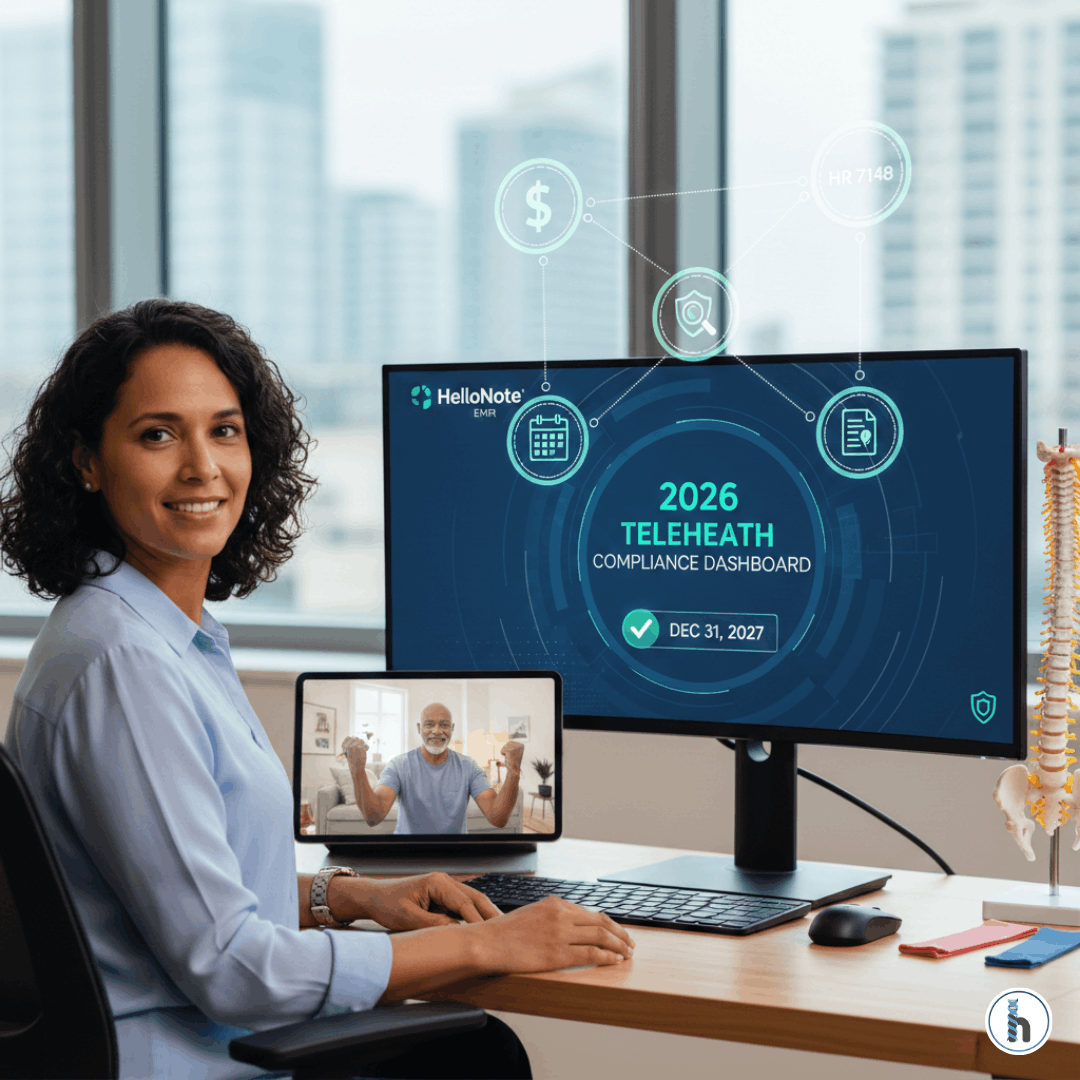
Female therapist using HelloNote EMR dashboard showing 2026 Medicare telehealth compliance updates and H.R. 7148 extension through Dec 31, 2027.

Quick Status: 2026-2027 Compliance Checklist

Feature 

New Status / Action Required 

New Expiration Date 

December 31, 2027 

Medicare Part B Status 

Fully Restored. The “rural-only” and facility-based restrictions remain waived. 

Originating Site Rules 

Patients may continue to receive telehealth services from any location, including their homes. 

Provider Eligibility 

PTs, OTs, SLPs, and Audiologists remain fully eligible to provide and bill for Medicare telehealth. 

Audio-Only Services 

Coverage for audio-only telehealth is extended for both behavioral and non-behavioral health through 2027. 

In-Person Requirements 

The requirement for an in-person visit within six months of a mental health telehealth service remains suspended. 

Strategic Clinical Pivot: The Hybrid Care Anchor

During the brief lapse, many clinics successfully utilized a Hybrid Care Model to maintain revenue. While virtual-only billing was temporarily in legal limbo, in-person care remained the stable “anchor” of the care plan. Moving forward, practitioners should view the hybrid model not just as a backup, but as a clinical best practice for rehabilitation.

Action Item: Re-integrate Manual Therapy

Now that the extension is signed, use this stability to plan your “Clinical Pivot.” If you shifted patients to in-person sessions to address manual therapy needs—such as joint mobilization or addressing tight calf muscles—you can now transition them back to a hybrid schedule. This allows for:

    • Tactile Correction: Use in-person visits for manual techniques that improve movement quality.

    • Virtual Validation: Use telehealth follow-ups to ensure the patient is performing their Home Exercise Program (HEP) correctly in their own environment.

Deep-Dive Compliance: Protecting Your Revenue Cycle

While the law is signed, the administrative machinery of CMS and its MACs may take several days to update systems. To ensure a clean revenue cycle:

1. Releasing Held Claims

Action Item: If you followed previous guidance to HOLD CLAIMS, you should now begin processing and submitting them for the period starting February 1, 2026.

Pro-Tip: Monitor your Remittance Advice (RA) closely. If you see denials for Jan 31–Feb 3, contact your MAC, as they may need to manually re-trigger the retroactive logic.

2. The Advance Beneficiary Notice (ABN) Update

Action Item: You may now stop issuing “Mandatory” ABNs related to the legislative lapse. Keep the signed copies from the lapse window in your records as a legal safety net.

3. Medicare Advantage & Private Payers

This extension is a massive relief for Medicare Part B (Fee-for-Service). For Medicare Advantage (Part C) providers, the landscape is even more stable.

  • Action Item: Verify individual policies, but most Advantage plans have already aligned their 2026-2027 benefits with this federal extension.

Looking Ahead: The Hospital-at-Home Evolution

A significant win in H.R. 7148 is the five-year extension for the Acute Hospital Care at Home waiver program through September 30, 2030. This signals a major policy shift: the federal government is viewing “at-home” acute care as a permanent fixture. For therapists, this means a growing market for high-acuity home health and rehabilitation services over the next five years.

The Push for Permanence

While we celebrate the relief that comes with a deadline of December 31, 2027, the push for permanent reform continues. Advocacy groups like the AOTA, APTA, and ASHA indicate this two-year window will be the “final evaluation period.” Between now and 2027, Congress will look for data on reimbursement parity and quality of outcomes.

Legislative leaders have indicated that this two-year window will be the “final evaluation period.” Between now and 2027, Congress will be looking for data on: 

  1. Reimbursement Parity: Does virtual care cost the system more or less than in-person care? 
  1. Quality of Outcomes: Are OTs and PTs achieving the same functional gains via telehealth? 
  1. Fraud Prevention: Ensuring that the removal of geographic restrictions doesn’t lead to “tele-marketing” abuses of the Medicare system. 

Frequently Asked Questions (FAQs)

Q1: Did the Medicare telehealth extension actually passes?

Yes. The extension was signed into law on February 3, 2026, as part of H.R. 7148. It extends current flexibilities through December 31, 2027.

Q2: Can I bill for telehealth services provided during the shutdown (Jan 31 – Feb 3)?

Yes. The law includes a retroactive clause. Medicare will process and pay for claims during that four-day window as if the lapse never occurred.

Q3: Are Physical Therapists still eligible to provide telehealth?

Yes. Under the new 2026-2027 extension, PTs, OTs, and SLPs remain authorized providers for Medicare telehealth services.

Q4: Does this extension cover audio-only visits?

Yes. Audio-only telehealth coverage for both behavioral and non-behavioral health has been extended through the end of 2027.

Future-Proofing Your Practice

While this extension buys time, the real solution is a system that stays ahead of the rules for you.

Book a Hellonote Demo See how our automated compliance engine and built-in telehealth features handle Medicare modifiers and retroactive billing automatically, so you can focus on your patients, not the legislation.

Legal Disclaimer: This update is for educational purposes only and does not constitute legal, financial, or medical billing advice. Healthcare providers should consult with their compliance officers and Medicare Administrative Contractors (MACs).

HIPAA Compliance: How to Ensure Your Therapy Practice is HIPAA Compliant

Table of Contents

Editor’s Note: This guide was originally published on August, 2022. It was comprehensively revised and updated on January 2026, to include the latest HHS regulations, the new February 2026 NPP requirements, and modernized encryption standards for rehab clinics.

Making sure you are following all the rules and regulations regarding HIPAA compliance as a new therapy practice owner can be stressful and confusing! In this article, we’ll go over the main policies of HIPAA compliance and the updated tools you can use to maintain regulations within your physical, occupational, or speech therapy practice.

HIPAA compliance for therapy practices

What is HIPAA and Why Is It Important?

The Health Insurance Portability and Accountability Act (HIPAA) was created in 1996 and requires covered entities to protect patient health information.

As therapists and assistants, we are subject to HIPAA requirements. While the core mission of protecting ePHI (electronic Protected Health Information) remains the same as it was in 2022, 2026 updates place a much heavier emphasis on patient data autonomy and cybersecurity transparency.

What penalties could you face in 2026?

The Office for Civil Rights (OCR) has increased enforcement focus. While they still offer a “correction period” for unintentional errors, the fines for willful neglect (such as not having a signed BAA or failing to perform a Risk Assessment) have risen with inflation:

    • Minimum Fine: ~$140 per violation for reasonable compliance.

    • Maximum Fine: Up to $2.1 million annually for systemic neglect.

The takeaway? Government organizations understand HIPAA is complex, but in 2026, they expect you to have a documented digital defense.

Key HIPAA Compliance Steps for 2026

1. The Mandatory Risk Assessment Plan

It is mandatory to create a plan for protecting your patients’ information. You must document:

    • Your Risks: Where is your data vulnerable? (e.g., mobile tablets, old backup drives).

    • Your Procedures: How do you handle a request for records?

    • Your Policies: Are your staff trained annually?

    • 2026 Requirement: You must now explicitly document how you protect sensitive records, including Substance Use Disorder (SUD) data and reproductive health info.

2. Encryption: Moving from "Addressable" to "Required"

In our original 2022 guide, encryption was often seen as an “extra” step. In 2026, it is essentially mandatory.

    • Communication: Standard texting is a violation. HelloNote includes secure, encrypted messaging within its EMR platform to keep your patient chats private.

    • Data at Rest: Any records stored on your computer or cloud must be encrypted using at least 256-bit standards.

3. Secure Record Storage & Password Management

Action Required: By February 16, 2026, all therapy practices must update their NPP. This is a significant change from our 2022 guide. Your updated notice must now:

    • Clearly explain protections for SUD records (42 CFR Part 2 alignment).

    • Inform patients of their right to opt out of certain data uses.

    • Provide a statement regarding the potential for data re-disclosure.

What to do if you discover a breach?

If you have a breach, notification within 60 days is required.

    • Update for 2026: If your Business Associates (like a billing company) experience a breach, they are now often required to notify you within 24 hours.

    • You must provide a description of the breach, the type of PHI involved, and the steps the individual should take to protect themselves.

Frequently Asked Questions

Q1: What is the biggest HIPAA change for my practice in 2026?

The most urgent update is the February 16, 2026, deadline to revise your Notice of Privacy Practices (NPP). You must update your NPP to reflect new protections for sensitive data, specifically alignment with 42 CFR Part 2 regarding Substance Use Disorder (SUD) records and new “Right of Access” timelines.

Q2: Do solo practitioners really need to do a Risk Assessment?

Yes. In 2026, the OCR is strictly enforcing the Security Risk Analysis (SRA). Even if you are a solo provider, you must document your asset inventory (laptop, tablet, EMR) and your plan to mitigate risks like data loss or unauthorized access.

Q3: Is standard SMS texting finally banned for patient communication?

While not explicitly “banned,” using standard unencrypted SMS for clinical communication in 2026 is considered high-risk and non-compliant unless the patient has signed a very specific “unencrypted communication waiver.” It is highly recommended to use the HelloNote Secure Messaging Portal instead.

Q4: How has the "Right of Access" changed for my patients?

Patients now expect faster access to their digital records. While the federal limit is still generally 30 days, 2026 best practices (and proposed rule changes) encourage providers to fulfill digital requests within 15 days whenever possible to avoid “Information Blocking” complaints.

Q5: Can I use AI-powered transcription or "Scribes" for my therapy notes?

Yes, but only if you have a signed Business Associate Agreement (BAA) with the AI vendor. In 2026, you must also ensure the AI tool does not use your patient’s ePHI to train its general models, as this could lead to an impermissible disclosure.

Summary

HIPAA compliance is a journey, not a destination. While the policies change every year, many standards can be met easily with a robust EMR system. HelloNote is happy to help you navigate these 2026 updates so you can focus on what matters most: your patients.

Is your clinic ready for the February 2026 deadline? Schedule a HelloNote Demo to see how our EMR automates your compliance.

Avoiding Therapy Claim Denials: Common CPT Code Mistakes and How to Fix Them

Table of Contents

Therapy claim denials are one of the most expensive and time-consuming problems therapy clinics face. Whether you run a physical therapy, occupational therapy, or speech therapy practice, claim denials disrupt cash flow, increase administrative workload, and slow down patient care.

Most therapy claim denials don’t happen because care was inappropriate. They happen because of CPT coding mistakes, documentation gaps, or misalignment between notes and billing. The good news is that many of these issues are preventable with the right workflows and tools.

This guide breaks down the most common CPT code mistakes that lead to therapy claim denials and what clinics can do to reduce denials, protect reimbursement, and stay compliant.

Physical therapist reviewing a denied insurance claim on a laptop in a therapy clinic, highlighting common CPT code mistakes that lead to therapy claim denials.

Why Therapy Claim Denials Are So Costly for Clinics

Every denied claim creates a ripple effect across your practice.

Common consequences include:

    • Delayed or lost reimbursement
    • Increased staff time spent on rework and appeals
    • Higher audit risk
    • Strained relationships with payers and patients

Over time, frequent therapy claim denials can significantly impact clinic profitability and staff morale. Preventing denials at the documentation and coding stage is far more effective than appealing them later.

The Most Common CPT Code Mistakes That Lead to Denials

Medical Necessity Is Not Clearly Supported

Why it happens
Payers often deny claims when documentation does not clearly demonstrate why skilled therapy services are required.

How to fix it

    • Tie every intervention directly to a diagnosis and functional limitation
    • Document why skilled therapy is needed instead of self-directed care
    • Show how the treatment addresses measurable deficits

Example
Instead of:
“Manual therapy performed.”

Document:
“Manual therapy performed to improve joint mobility and reduce pain limiting independent transfers.”

Inadequate or Vague Documentation

Why it happens
Notes may describe what was done, but not why it was done or how it impacts function.

How to fix it

    • Link each CPT code to a functional goal
    • Document measurable progress or lack of progress
    • Show skilled decision-making in every session

Clear documentation is one of the strongest defenses against therapy claim denials.

Duplicate Billing and Overlapping CPT Codes

Why it happens
Some therapy CPT codes overlap in intent, such as:

If the distinction is not clear, payers may deny one or more codes.

How to fix it

    • Clearly differentiate the purpose of each code in documentation
    • Use modifiers appropriately when required
    • Avoid billing multiple codes for the same activity

Exceeding Frequency or Utilization Limits

Why it happens
Re-evaluations, modalities, or specific interventions may be billed too frequently without adequate justification.

How to fix it

    • Understand payer-specific frequency limits
    • Justify additional services with clear clinical rationale
    • Document changes in status that require reassessment

Incorrect Coding for Emerging or Specialized Therapies

Why it happens
Some treatments are considered experimental or have limited coverage depending on the payer.

How to fix it

    • Verify coverage before providing the service
    • Obtain authorization when required
    • Document why standard treatments were insufficient

Failing to do this increases the risk of therapy claim denials and post-payment audits.

How to Appeal Therapy Claim Denials Effectively

Even with strong workflows, some denials still happen. A structured appeal process makes a significant difference.

Step 1 – Identify the Exact Denial Reason

Review the Explanation of Benefits (EOB) carefully to determine whether the issue is coding-related, documentation-related, or authorization-related.

Step 2 – Strengthen the Clinical Narrative

Include:

    • Detailed treatment notes
    • Functional progress data
    • Letters of medical necessity when appropriate

Step 3 – Submit Appeals on Time

Most payers enforce strict deadlines. Late appeals are often automatically denied.

Step 4 – Track Denial Patterns

Recurring denial reasons often point to workflow or documentation issues that need system-level fixes.

How Technology Helps Reduce Therapy Claim Denials

HelloNote is designed specifically for therapy workflows, helping clinics reduce CPT coding mistakes and documentation gaps before claims are submitted.

Key support areas include:

    • CPT-linked documentation templates
    • Modifier prompts based on discipline (PT, OT, SLP)
    • Medical necessity alignment within notes
    • Billing and documentation consistency across visits
    • Audit-ready reporting and compliance support

The result is fewer denials, less rework, and more predictable reimbursement.

Frequently Asked Questions (FAQs)

Q1. What causes most therapy claim denials?

The most common causes are CPT coding errors, lack of documented medical necessity, overlapping codes, missing modifiers, and incomplete progress documentation.

Q2. How can clinics reduce CPT coding mistakes?

By using standardized documentation workflows, understanding payer rules, and leveraging therapy-specific EMR systems that align notes with billing.

Q3. Are therapy claim denials always final?

No. Many denials can be overturned through appeals when supported by strong documentation and medical necessity justification.

Q4. Does better documentation really improve reimbursement?

Yes. Clear, functional, and goal-driven documentation significantly reduces denials and audit risk.

Q5. How does HelloNote help prevent therapy claim denials?

HelloNote supports accurate CPT coding, modifier usage, documentation alignment, and compliance—reducing errors before claims are submitted.

Key Takeaways for Therapy Clinics

    • Most therapy claim denials are preventable
    • CPT coding mistakes are a leading cause of lost revenue
    • Documentation quality directly impacts reimbursement
    • Clear workflows reduce administrative burden
    • A therapy-focused EMR helps protect the revenue you earn

Avoiding therapy claim denials starts long before claims are submitted. It begins with how care is documented, coded, and aligned with payer expectations.

What Telehealth Rules Will Actually Look Like for Therapy Clinics in 2026

Table of Contents

Telehealth has gone through more changes in the past few years than most therapy clinics expected. Temporary waivers, pandemic-era flexibilities, and shifting Medicare policies made it possible to deliver care remotely in ways that were once unthinkable.

As we move closer to Telehealth 2026, many therapy practice owners are asking the same questions:
What stays? What goes away? And what do we actually need to prepare for?

This article breaks down the most important telehealth updates affecting physical therapy, occupational therapy, speech-language pathology, and multidisciplinary rehab clinics without legal jargon or unnecessary speculation.

Secure telehealth platform interface illustrating Telehealth 2026 compliance and Medicare virtual care requirements

Why Telehealth Rules Matter More Than Ever

Telehealth is no longer an “extra” service. For many clinics, it’s become a core part of access, continuity of care, and patient engagement.

But the reality is this: telehealth is governed by policy, not preference. Reimbursement, compliance, and documentation rules determine what clinics can safely and sustainably offer.

As regulatory flexibility tightens, clinics that understand the rules early will be in a much stronger position than those reacting after denials or audits appear.

What’s Changing With Telehealth in 2026

Medicare Location Requirements Are Tightening

Through January 30, 2026, Medicare beneficiaries can generally receive telehealth services regardless of geographic location. After that date, most non–behavioral health telehealth services will once again be tied to rural locations and approved medical facilities.

This means:

    • Home-based telehealth will become more limited for certain services

    • Clinics must be precise about where the patient is located

    • Documentation must clearly support eligibility

Behavioral health services remain an important exception, with more flexibility continuing beyond early 2026.

Who Can Furnish Telehealth Services Is Narrowing

During the extended flexibility period, a wide range of providers were allowed to furnish telehealth services under Medicare.

Starting January 31, 2026:

will no longer be able to independently furnish Medicare telehealth services under standard Medicare rules.

This change is significant for therapy clinics that relied heavily on remote sessions and hybrid care models.

What This Means for Therapy Clinics

Telehealth Won’t Disappear But It Will Be More Regulated

Telehealth in 2026 is not about elimination it’s about precision.

Clinics will need to:

    • Clearly identify which services remain eligible

    • Track patient location accurately

    • Distinguish Medicare rules from commercial payer policies

    • Avoid assumptions based on past flexibilities

Documentation Will Matter More Than Ever

When telehealth rules tighten, documentation becomes your first line of defense.

Strong documentation should clearly show:

    • Medical necessity

    • Service type and duration

    • Patient location

    • Provider eligibility

    • Compliance with payer-specific rules

This is where many clinics struggle not clinically, but operationally.

Audio-Only Telehealth: What Still Applies

Audio-only telehealth services may continue for certain behavioral health services, particularly when:

    • The provider is capable of video

    • The patient cannot or does not consent to video

    • Documentation supports the clinical appropriateness

However, audio-only is not a blanket substitute for video-based care and must be used carefully.

Place of Service Codes Clinics Need to Know

Accurate coding remains critical for reimbursement.

    • POS 02 – Telehealth provided other than in the patient’s home

    • POS 10 – Telehealth provided in the patient’s home

Medicare continues to pay non-facility rates for telehealth services provided in the patient’s home, making correct POS selection essential.

How Technology Can Reduce Telehealth Risk

EMRs Must Do More Than Store Notes

As telehealth rules evolve, clinics need systems that actively support compliance not just record visits.

An effective EMR should help clinics:

    • Track patient location automatically

    • Prompt correct place of service selection

    • Align documentation with billing rules

    • Generate audit-ready records

    • Flag eligibility issues before claims are submitted

Without this support, telehealth becomes a financial and compliance liability.

Preparing Your Clinic for Telehealth 2026

Step 1: Audit Your Current Telehealth Usage

Understand which services, payers, and patient populations you’re serving remotely.

Step 2: Separate Medicare From Commercial Payer Rules

Commercial payers may continue telehealth coverage even as Medicare rules change.

Step 3: Strengthen Documentation Standards

Ensure every telehealth visit clearly supports medical necessity and eligibility.

Step 4: Use Systems Built for Therapy Workflows

Generic EMRs often miss therapy-specific nuances. Therapy-focused systems help reduce risk as regulations evolve.

Final Thoughts: Telehealth Requires Strategy, Not Guesswork

Telehealth 2026 represents a shift from emergency flexibility to long-term structure. Clinics that treat telehealth as a regulated service rather than a convenience will be best positioned to adapt.

With the right workflows, documentation practices, and technology in place, therapy clinics can continue using telehealth responsibly, compliantly, and confidently without exposing themselves to unnecessary risk.

Frequently Asked Questions About Telehealth 2026

Q1. Will telehealth still be allowed for therapy clinics in 2026?

Yes, but with more restrictions—especially for Medicare patients and non–behavioral health services.

Q2. Can PTs, OTs, and SLPs bill Medicare for telehealth after January 2026?

Clear documentation, correct coding, accurate patient location tracking, and payer-specific workflows are key.

Q3. Does this affect private insurance telehealth coverage?

Not necessarily. Commercial payer rules may differ and should be reviewed individually.

Q4. Are behavioral health telehealth services still allowed at home?

Yes. Behavioral health continues to have expanded flexibility beyond early 2026.

Clear documentation, correct coding, accurate patient location tracking, and payer-specific workflows are key.

Better Rehab Outcomes Through EMR-Facilitated Care Plans Using Care Plan Software

Table of Contents

Care plans shape every decision therapists make in rehab. They are your roadmap defining goals, guiding interventions, tracking progress, and ensuring payer compliance. But in many clinics, care plans become stagnant documents buried inside the EMR instead of active tools that drive outcomes.

This is where modern care plan software makes the difference.

Physical therapist showing a patient progress charts on a tablet using care plan software during a rehab session.

A strong EMR shouldn’t just store your plan of care. It should activate it bringing goals, progress, and interventions into your daily workflow. That’s exactly how HelloNote is designed: to help therapists build better care plans, document with intention, and support real-time decision-making.

Why the Care Plan Matters in Rehab

Across PT, OT, and SLP settings, the care plan provides the foundation for:

    • Setting measurable, meaningful goals

    • Ensuring each session builds toward functional change

    • Documenting medical necessity for payers

    • Supporting communication with caregivers and providers

    • Improving transparency for families, schools, and case managers

But when care plans aren’t supported by effective care plan software, therapists run into predictable obstacles:

    • Notes become disconnected from goals

    • Progress isn’t consistently tracked

    • Reassessments get missed

    • Documentation becomes reactive instead of strategic

This not only affects workflow it affects patient outcomes.

The Problem EMRs That Don’t Support the Care Plan

Many therapists still work in systems that:

❌ Hide the care plan in a disconnected module
❌ Make goal review time-consuming
❌ Don’t offer real-time progress visibility
❌ Require double documentation for billing

Without supportive care plan software, therapists are left juggling spreadsheets, sticky notes, and duplicated entries just to stay organized

How HelloNote Activates the Care Plan (Not Just Stores It)

Modern clinics need care plan software that integrates into workflow does not add friction. HelloNote was built to solve that problem.

1. Care Plans That Stay Visible and Accessible

In HelloNote, goals never get buried. You can:

    • Pin the most important goals

    • View objectives within daily notes

    • Update progress with one tap

    • Track CPT alignment alongside goals

The care plan becomes a living tool that shapes each session.

2. Templates Designed for Rehab Disciplines

HelloNote’s templates are made specifically for:

    • Physical therapists

    • Occupational therapists

    • Speech therapists

Including:

    • Functional goals

    • GAS scoring

    • Pediatric and developmental milestones

    • IEP-aligned structures

This is caring plan software designed by clinicians, not generic developers.

3. Real-Time Progress Tracking for Better Decisions

Instead of digging through old charts, HelloNote provides:

    • Progress percentages

    • Stagnant-goal indicators

    • Visual charts for parents and payers

    • Alerts for reassessment deadlines

Therapists gain confidence because their data is instantly available.

4. Integrated Billing + Compliance Support

HelloNote connects billing and care planning:

    • Align goals with CPT codes

    • Document medical necessity using built-in prompts

    • Produce audit-ready notes instantly

    • Maintain compliance across funding sources

This is where care plan software helps protect revenue and reduce denials.

5. Better Patient & Family Engagement

Care plans influence more than treatment they guide communication. HelloNote makes this easy:

    • Share updated goals

    • Attach home programs

    • Provide secure updates

    • Coordinate with teachers and case managers

When families understand the “why,” adherence improves and so do outcomes.

Real-World Example: Care Plan Software in Action

An SLP working on expressive language can:

    • Select goals from templates

    • Track trials live

    • View automatic progress bars

    • Generate complete reports with one click

That is efficient care plan software at work faster, clearer, and clinically stronger.

The Business Impact for PT, OT, and SLP Clinics

HelloNote’s care plan features help owners and administrators achieve:

    • 25–40% less documentation time

    • Lower denial rates

    • Higher therapist retention

    • Better team collaboration

    • Cleaner audit trails

Better care plans → Better outcomes → Better business.

Making the Switch to HelloNote

If your EMR hides your care plan or forces double documentation, upgrading to care plan software that actually supports your workflow is the next step.

HelloNote offers:

    • Customized onboarding

    • Discipline-specific templates

    • Smooth data migration

    • Workflow training for all team members

Final Thoughts

Care plans shouldn’t get buried they should guide every treatment decision. HelloNote keeps care plans visible, measurable, and integrated into your daily workflow.

Ready to see these features in action?
Schedule a HelloNote Demo Today.

FAQs About Care Plan Software

Q1. What is care plan software in rehabilitation?

Care plan software helps therapists create, monitor, and document individualized plans of care while integrating goals into their daily workflow.

Q2. How does care plan software improve therapist efficiency?

It eliminates double documentation, keeps goals visible during note writing, and updates progress in real time.

Q3. Can care plan software reduce insurance denials?

Yes. Integrated medical-necessity prompts and goal-to-CPT mapping help ensure cleaner, defensible notes.

Q4. Does HelloNote include care plan software tools?

Yes. HelloNote includes built-in care planning, goal tracking, progress visualization, and billing alignment.

Q5. Who benefits most from care plan software?

PTs, OTs, SLPs, pediatric therapists, mobile clinicians, and multi-location practices all benefit from streamlined care planning.

Choosing the Best EMR for Medicaid: A Guide for Therapy Practices

Table of Contents

Navigating Medicaid billing can be one of the most challenging parts of running a therapy practice. For clinics relying heavily on Medicaid reimbursement, selecting the best EMR for Medicaid is not simply a software preference it’s a business survival decision. Between state-specific rules, evolving fee schedules, strict medical necessity standards, and time-sensitive authorizations, the right EMR determines whether your claims get paid the first time or fall into denial cycles that drain cash flow.

Therapist using a tablet with Medicaid-related EMR tools while pediatric therapy sessions take place in the background, illustrating features of the best EMR for Medicaid workflows.

This guide walks through the biggest Medicaid billing challenges and what features truly define the best EMR for Medicaid for PT, OT, and SLP therapy practices.

Why Medicaid Billing Is So Complex for Therapy Clinics

Medicaid billing requires significantly more precision than private insurance. Before evaluating options for the best EMR for Medicaid, it’s important to understand the core challenges therapy practices face.

State-Specific Rules and Variability

Medicaid operates differently in every state. A CPT code allowed in one state may require modifiers or prior authorization in another. Many generic EMRs aren’t designed to manage these variations, causing preventable denials.

Frequent Policy Changes

Medicaid fee schedules and billing manuals are updated often. Clinics using EMRs without automatic Medicaid rule updates typically underbill, overbill, or unknowingly violate new submission requirements.

Prior Authorization Complexity

Pediatric, adult rehab, and medically complex cases often require detailed treatment plans, measurable goals, functional justifications, and progress reports. Without Medicaid-optimized workflows, therapists wind up duplicating documentation.

High Audit Risk

Medicaid documentation is held to a higher standard. Notes must clearly show medical necessity, functional goals, and skilled interventions. The best EMR for Medicaid builds this structure directly into the workflow.

Essential Features of the Best EMR for Medicaid

If your practice relies on Medicaid, these features are non-negotiable. They directly influence clean claims, reimbursement speed, and audit protection.

1. State-Specific Medicaid Rules and Code Validation

The best EMR for Medicaid includes:

    • Automated alerts for incompatible CPT/ICD-10 combinations

    • Modifier prompts based on state requirements

    • Unit limit checks

    • Automatic benefit verification

    • Real-time eligibility status

This prevents denials before claims ever leave your clinic.

2. Built-In Prior Authorization Tools

A top requirement for the best EMR for Medicaid is advanced authorization management:

    • Auto-generated requests pulling from evals and plans of care

    • Progress report templates aligned with Medicaid language

    • Alerts for upcoming expirations

    • Visit count tracking

Therapists avoid duplicate documentation and billers reduce rework.

3. Medicaid-Optimized Documentation Templates

To satisfy medical necessity requirements, the EMR must support:

    • Functional, goal-linked treatment documentation

    • Required fields for referrals, minutes, and skilled intervention descriptions

    • Audit-ready formatting

    • Medicaid-compliant progress reports

This ensures defensible notes every time.

4. Automated Medicaid Fee Schedule Updates

The best EMR for Medicaid automatically:

    • Loads the correct Medicaid fee schedule

    • Updates rates when the state publishes changes

    • Calculates co-pays where applicable

    • Ensures correct reimbursement for every claim

No more billing at outdated rates.

How the Best EMR for Medicaid Strengthens Your Operations

Choosing the right system does more than improve billing accuracy. It transforms the entire practice workflow.

For Therapists

    • No more guessing what needs to be included in Medicaid notes

    • Goal-linked documentation improves clarity and compliance

    • Reduced after-hours documentation

    • Faster, cleaner progress reporting

For Billers and Administrators

    • Fewer denials and resubmissions

    • Clear visibility into authorization and visit limits

    • Automatic checks for Medicaid rule compliance

    • Faster reimbursement cycles

For Owners and Directors

    • Predictable revenue

    • Lower audit risk

    • Higher clinical productivity

    • Confident Medicaid caseload management

This is the operational foundation the best EMR for Medicaid should provide.

How HelloNote Supports Medicaid-Focused Therapy Practices

HelloNote was designed with Medicaid-heavy clinics in mind. It incorporates the essential components that define the best EMR for Medicaid, including:

State-Specific Rule Sets

Automatic checks for modifiers, diagnosis compatibility, unit limits, and code edits—built directly into documentation and billing.

Integrated Authorization Tracking

The system monitors approved visits, expiration dates, and requirements so providers never overshoot authorized limits.

Documentation Built for Medical Necessity

Each intervention ties back to functional goals, supporting Medicaid’s strict skilled-care standards.

Automated Fee Schedule Management

HelloNote helps maintain correct rates and payer-specific rules, reducing billing errors.

Medicaid-Optimized Notes for PT, OT, and SLP

Templates support pediatric and adult therapy workflows, ensuring compliance for diverse populations.

For clinics whose caseloads depend on Medicaid reimbursement, HelloNote provides structure, accuracy, and confidence.

Conclusion: Choosing the Best EMR for Medicaid Sets Your Practice Up for Success

Therapy practices serving Medicaid populations need more than basic billing tools they need a Medicaid-aligned workflow that protects revenue, ensures compliance, and supports high-quality patient care. The best EMR for Medicaid minimizes errors, simplifies documentation, and handles the complexity that Medicaid requires.

HelloNote helps therapy practices operate confidently and efficiently so your team can focus on delivering care instead of navigating paperwork.

If you’re ready to see how a Medicaid-aware EMR can transform your workflow, schedule a demo and explore how HelloNote can support your clinic’s Medicaid needs.

FAQ: Best EMR for Medicaid Billing

Q1. What is the best EMR for Medicaid billing?

The best EMR for Medicaid billing is one that includes state-specific rules, automatic code validation, integrated prior authorization tools, and Medicaid-optimized documentation templates. These features help therapists submit clean claims, avoid denials, and stay compliant with changing Medicaid requirements.

Q2. How does an EMR help reduce Medicaid claim denials?

A Medicaid-friendly EMR prevents denials by flagging missing modifiers, incorrect CPT units, expired authorizations, and incomplete documentation. Automated rule engines ensure every claim meets state Medicaid requirements before submission.

Q3. What features should therapists look for in the best EMR for Medicaid?

Therapists should look for state-specific billing rules, prior authorization management, Medicaid-compliant documentation templates, eligibility/benefit verification, and automated fee schedule updates. These tools reduce administrative burden and ensure compliance.

Q4. Does Medicaid require special documentation in an EMR?

Yes. Medicaid requires detailed justification that links treatments to functional goals and medical necessity. A Medicaid-optimized EMR provides prompts, mandatory fields, and structured templates that guide therapists through compliant documentation.

Q5. Can an EMR help manage Medicaid prior authorizations?

Absolutely. The best EMRs for Medicaid can auto-populate authorization requests using evaluation data, track visit limits, alert therapists when authorizations are expiring, and generate compliant progress reports for renewals.

You've found a hidden discount!

  • 00Hours
  • 00Minutes
  • 00Seconds