




















Billing is one of the biggest operational pressure points for therapy practices. For PT, OT, and SLP clinics, the problem is rarely just claim submission. Billing issues often begin earlier, when patient information is incomplete, eligibility is not verified, authorizations are missed, documentation does not support the service, or modifiers are not tracked correctly.
In 2026, streamlining billing processes means building a cleaner workflow from the first patient touchpoint to final payment. The goal is not only to submit claims faster. The real goal is to reduce preventable denials, improve billing visibility, protect cash flow, and help the team spend less time fixing avoidable billing problems.
A stronger billing workflow connects intake, eligibility, documentation, CPT coding, modifiers, claim submission, payment posting, denial review, and reporting. When those steps are disconnected, even a busy clinic with strong clinical care can lose time and revenue to administrative rework.
How can therapy practices streamline billing processes?
Therapy practices can streamline billing by verifying eligibility early, keeping documentation connected to CPT codes, tracking authorizations and modifiers, submitting cleaner claims, monitoring denials by root cause, and using an EMR that connects clinical and billing workflows.
Table of Contents
Key Takeaways
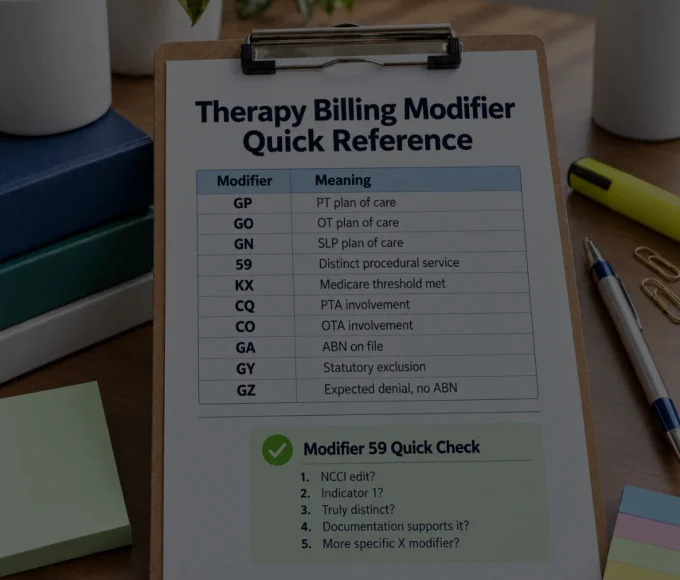
- GP, GO, and GN identify services under PT, OT, and SLP plans of care.
- Modifier 59 should only be used when an NCCI edit permits a modifier and the documentation supports a genuinely distinct service.
- The 2026 Medicare KX threshold is $2,480 for PT and SLP combined and $2,480 for OT.
- CQ and CO identify qualifying services furnished in whole or in part by a PTA or OTA under Medicare’s assistant rules.
- GA, GY, and GZ describe different Medicare beneficiary-liability and coverage situations.
- Commercial payers may not follow Medicare modifier rules exactly.
Why Therapy Billing Gets Complicated
Therapy billing involves more than sending a claim to insurance. A clean claim depends on accurate demographics, active insurance coverage, authorization details, CPT codes, diagnosis codes, modifiers, treatment time, medical necessity, provider information, timely filing, and payer-specific rules.
If one part of that workflow breaks, the result may be a rejected claim, denied claim, delayed payment, or extra billing work. A rejection may happen before the payer processes the claim because of missing or invalid data. A denial usually happens after payer review and may require correction, appeal, or additional documentation.
For PT, OT, and SLP practices, common billing challenges include eligibility changes between visits, expired authorizations, missing modifiers, Medicare therapy thresholds, weak medical necessity language, inconsistent treatment time documentation, and poor visibility into unpaid claims.
Start With Eligibility and Patient Information
The billing process should begin before the visit. Eligibility verification helps the practice confirm whether coverage is active and whether the plan has limits, authorization rules, deductible responsibilities, copays, or visit restrictions that may affect care.
Eligibility checks do not guarantee payment, but they help reduce avoidable surprises. Practices should confirm patient demographics, subscriber details, payer information, plan type, visit limits, authorization requirements, and patient responsibility as early as possible.
This front-end step matters because many billing problems come from preventable intake errors. A wrong subscriber ID, outdated insurance card, missing authorization, or inactive plan can delay payment even when the therapy service itself was appropriate.
Connect Documentation to Billing
Clean billing depends on clear documentation. The therapy note should explain what service was provided, why it was medically necessary, how it connects to the plan of care, and how the patient responded. For timed therapy codes, the note should also support the time billed.
For Medicare therapy services, practices should also monitor modifier requirements. CMS lists the 2026 KX modifier threshold at $2,480 for PT and SLP services combined and $2,480 for OT services. CMS also states that services above the KX threshold require the KX modifier when continued therapy is medically necessary and supported by documentation.
Documentation and billing should not live in separate silos. A billing team should be able to see the service, CPT code, modifier, treatment time, provider, plan of care, and supporting note without chasing information across disconnected tools.
Looking up more cpt codes?
See 97110, 97530, and 50+ therapy procedure codes – with billing guidance and documentation tips in one place.
Use Electronic Billing and Claim Tracking
CMS describes electronic billing and EDI transactions as part of the electronic exchange of claims and related billing information. CMS also notes that clearinghouses and billing services may help providers submit or receive transactions from Medicare fee-for-service contractors.
For therapy practices, electronic billing is useful because it helps reduce manual submission work and improves claim visibility. However, electronic billing does not fix poor data, missing documentation, or incorrect code selection by itself.
A streamlined billing process should track each claim after submission. Teams should know whether a claim was accepted, rejected, denied, paid, partially paid, or still pending. Without claim tracking, practices may not notice recurring payer issues until cash flow slows down.
Reduce Denials by Fixing Root Causes
Denial prevention should be part of the billing workflow, not a cleanup project that happens after payment is delayed. Instead of only asking which claims were denied, practices should identify why the denials happened and where the workflow broke down.
Common root causes include inactive coverage, missing authorization, unsupported CPT codes, modifier errors, documentation gaps, timely filing issues, payer-specific edits, and patient responsibility confusion. Once the root cause is clear, the team can fix the process instead of correcting the same problem claim by claim.
A useful denial review process should group denials by payer, reason, provider, location, code, and workflow step. This makes it easier to see whether the issue is a training problem, documentation problem, payer rule problem, or front-office intake problem.
Build a Cleaner Therapy Billing Workflow
A practical billing workflow for therapy practices should include these steps:
- Verify patient demographics and insurance information before the visit.
- Check eligibility, benefits, copays, deductibles, visit limits, and authorization requirements.
- Document the visit clearly, including medical necessity, skilled intervention, patient response, and treatment time when applicable.
- Review CPT codes, diagnosis codes, modifiers, provider information, and payer-specific claim requirements.
- Submit claims electronically through the appropriate billing or clearinghouse workflow.
- Track claim status, rejections, denials, payments, adjustments, and patient responsibility.
- Review denial trends and update workflows based on root causes.
What is the most important step in improving therapy billing?
The most important step is connecting documentation, eligibility, coding, modifiers, and claim follow-up in one consistent workflow. Faster claim submission helps, but cleaner front-end data and stronger documentation usually have a bigger impact on reducing avoidable billing rework.
How HelloNote Helps Streamline Therapy Billing
HelloNote helps therapy practices organize billing workflows by keeping documentation, scheduling, eligibility, CPT codes, modifiers, claims, patient information, and reporting connected.
With a connected EMR, teams can reduce duplicate entry, keep clinical notes closer to billing details, and improve visibility into what needs follow-up. This is especially helpful for PT, OT, SLP, and Chiro practices that need documentation, billing, scheduling, and reporting to work together.
HelloNote supports therapy practices with documentation workflows, billing organization, eligibility tracking, claim and payment visibility, CPT code and modifier support, reporting, and patient information management.
Make therapy billing easier from intake to payment.
HelloNote helps PT, OT, SLP, and Chiro practices connect documentation, eligibility, billing workflows, claim tracking, and reporting in one organized EMR.
No credit card required • HIPAA Compliant • PT, OT & SLP
Frequently Asked Questions
What does streamlining billing mean for a therapy practice?
Streamlining billing means creating a cleaner workflow from patient intake to final payment. It includes eligibility checks, accurate documentation, correct CPT coding, modifier tracking, claim submission, denial follow-up, and reporting.
What causes billing delays in therapy practices?
Billing delays are often caused by missing insurance information, eligibility issues, authorization gaps, coding errors, modifier mistakes, weak documentation, claim rejections, or slow denial follow-up.
How can therapy practices reduce claim denials?
Therapy practices can reduce claim denials by verifying eligibility early, documenting medical necessity clearly, using correct CPT codes and modifiers, tracking authorizations, and reviewing denial trends by payer and root cause.
Why is documentation important for therapy billing?
Documentation supports the claim. It should show what service was provided, why it was medically necessary, how it connects to the plan of care, and how time or modifiers were supported.
How does eligibility verification help therapy billing?
An EMR can improve billing workflows by connecting patient information, documentation, CPT codes, eligibility, claims, payments, and reporting in one system. This reduces manual work and gives teams better billing visibility.
How can an EMR improve therapy billing workflows?
An EMR can improve billing workflows by connecting patient information, documentation, CPT codes, eligibility, claims, payments, and reporting in one system. This reduces manual work and gives teams better billing visibility.
Final Thoughts
Streamlining billing processes for therapy practices in 2026 is about reducing preventable friction. The strongest billing workflows begin before the claim is submitted and continue until payment is fully resolved.
By improving eligibility checks, documentation, modifier tracking, claim follow-up, and denial management, therapy practices can reduce billing rework and protect cash flow.
HelloNote helps therapy practices keep clinical and billing workflows connected, so teams can spend less time chasing billing issues and more time supporting patient care.

AboutHellonote Expert
The HelloNote Expert Research Team publishes educational resources for physical therapy, occupational therapy, speech therapy, and rehabilitation practices. Their content focuses on documentation workflows, Medicare operations, billing processes, clinician efficiency, AI-assisted charting, and therapy practice management. Articles are developed using healthcare industry research, CMS resources, operational workflow analysis, and therapy-focused EMR expertise.