




















Billing can slow down even the most organized therapy practice. PT, OT, and SLP clinics often deal with payer rules, eligibility checks, authorizations, CPT codes, modifiers, claim edits, and payment follow-up.
A clearinghouse helps simplify one part of that process. It connects your practice, EMR, or billing system to insurance payers so claims can be submitted electronically, checked for basic errors, routed to the correct payer, and tracked more easily.
When connected with a therapy-focused EMR like HelloNote, clearinghouse workflows can help billing teams reduce avoidable rework, improve claim visibility, and keep documentation closer to the claim.
What is a clearinghouse for therapy billing?
A clearinghouse for therapy billing is a third-party service that helps PT, OT, and SLP practices submit electronic claims to insurance payers. It can format claims, check for missing or invalid information, route claims, return rejection messages, and help billing teams track claim activity.
Table of Contents
Key Takeaways
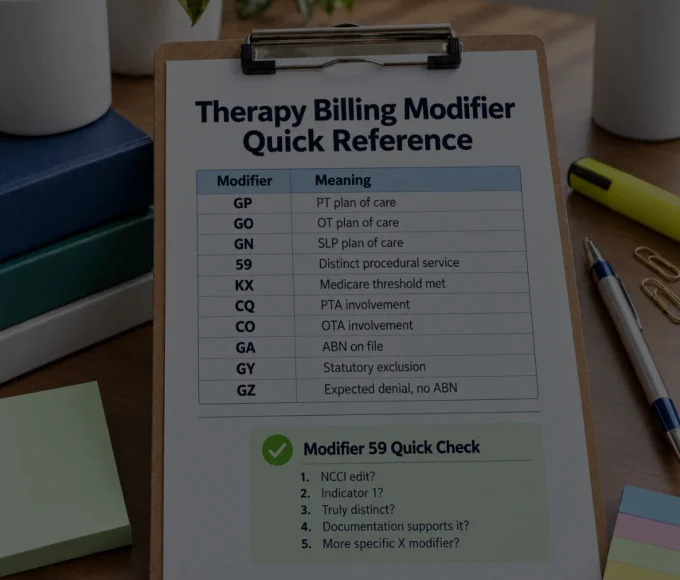
- GP, GO, and GN identify services under PT, OT, and SLP plans of care.
- Modifier 59 should only be used when an NCCI edit permits a modifier and the documentation supports a genuinely distinct service.
- The 2026 Medicare KX threshold is $2,480 for PT and SLP combined and $2,480 for OT.
- CQ and CO identify qualifying services furnished in whole or in part by a PTA or OTA under Medicare’s assistant rules.
- GA, GY, and GZ describe different Medicare beneficiary-liability and coverage situations.
- Commercial payers may not follow Medicare modifier rules exactly.
What Is a Clearinghouse in Medical Billing?
A clearinghouse is an intermediary between a healthcare provider and insurance payers. In a therapy practice, it usually sits between the EMR or billing system and the payer network.
CMS describes Electronic Data Interchange, or EDI, as the automated transfer of data in a specific format between a provider and Medicare or another health plan. CMS also notes that this transfer may happen with the help of a clearinghouse or billing service.
For a therapy practice, the clearinghouse helps move claim information from your billing workflow to the payer in a structured electronic format. It does not replace clinical documentation, coding judgment, payer policy review, or medical necessity support.
Does a clearinghouse guarantee payment?
No. A clearinghouse can help reduce preventable claim errors and route claims to payers, but it does not guarantee payment. Claims may still be denied because of eligibility issues, authorization problems, documentation gaps, coding errors, medical necessity concerns, or payer-specific rules.
How a Clearinghouse Works
A typical clearinghouse workflow looks like this:
- The therapist completes documentation in the EMR.
- The billing team reviews patient, payer, provider, CPT, diagnosis, modifier, and authorization details.
- The claim is created and sent electronically to the clearinghouse.
- The clearinghouse checks the claim for basic formatting or required-field issues.
- The claim is either accepted for forwarding or returned for correction.
- The payer processes the claim and returns status, payment, denial, or remittance details, depending on the workflow.
This process helps billing teams find certain issues earlier instead of waiting for payer delays.
Key Clearinghouse Functions for Therapy Practices
Electronic Claim Submission
A clearinghouse helps practices submit claims electronically to multiple payers through a more centralized workflow.
Claim Formatting
Claims must follow specific electronic formats and data rules. A clearinghouse helps convert claim data into payer-ready formats, reducing technical submission issues.
Claim Scrubbing
Claim scrubbing checks for missing, invalid, or inconsistent information before a claim reaches the payer. This may include missing patient details, invalid subscriber information, missing provider data, missing diagnosis codes, or missing modifiers.
Rejection and Status Visibility
A clearinghouse may return rejection messages when a claim fails a required data check. This allows the billing team to correct and resubmit faster. Some clearinghouses also support claim status tracking and electronic remittance workflows.
Eligibility and Benefits Transactions
Some clearinghouses support eligibility and benefits transactions, depending on payer connections and setup. Eligibility checks help practices confirm coverage details, but they do not guarantee payment.
Common Clearinghouse Examples
Common clearinghouse or clearinghouse-related vendors include TriZetto Provider Solutions, Inovalon, Claim.MD, Availity, and Change Healthcare/Optum, depending on payer connections and practice needs.
The best fit depends on payer mix, EDI enrollment requirements, ERA/EFT setup, reporting needs, support quality, pricing, and EMR integration. Before naming a preferred partner, confirm which clearinghouses HelloNote currently supports.
What a Clearinghouse Can Help With
- Electronic claim submission
- Basic claim checks
- Claim formatting
- Claim routing
- Rejection management
- Claim status visibility
- ERA workflows, depending on setup
- Eligibility transactions, depending on setup
What a Clearinghouse Cannot Fully Fix
- Poor clinical documentation
- Incorrect CPT or diagnosis code selection
- Missing medical necessity
- Expired or missing authorization
- Incorrect provider credentialing
- Payer-specific coverage exclusions
- Timely filing problems
- Claims requiring clinical review or appeal
This is why a clearinghouse should be part of a complete billing workflow, not the entire billing strategy.
Therapy Billing Challenges a Clearinghouse Can Help With
Claim Rejections
A clearinghouse can catch some preventable issues before a claim reaches the payer. This helps reduce time spent correcting basic submission errors.
Payer-Specific Requirements
Different payers may require different claim details. A clearinghouse can help with formatting and routing, but practices should still verify payer-specific billing rules.
Therapy Thresholds and the KX Modifier
For Medicare outpatient therapy, the KX modifier is tied to annual therapy thresholds and documentation supporting medical necessity. CMS states that use of the KX modifier means the clinician attests that services at and above the therapy threshold are medically necessary and reasonable, with justification documented in the medical record.
A clearinghouse can help submit the modifier when it is entered correctly, but it does not determine whether the service is medically necessary. That support must come from the clinical documentation.
ERA and Payment Follow-Up
Electronic remittance workflows can help billing teams review payments, adjustments, denials, and patient responsibility more efficiently. This supports better revenue cycle visibility.
What is the difference between a clearinghouse rejection and a payer denial?
A clearinghouse rejection usually means the claim failed a technical or data check before payer adjudication. A payer denial means the payer processed the claim and did not pay it, or did not pay it as submitted. Rejections usually require correction and resubmission, while denials may require appeal, documentation, or payer follow-up.
How HelloNote Supports Clearinghouse Billing Workflows
HelloNote helps therapy practices connect clinical documentation, CPT codes, patient information, eligibility, billing workflows, and reporting in one EMR.
For PT, OT, and SLP practices, this matters because claims are only as strong as the information behind them. When documentation and billing live closer together, teams can reduce duplicate entry, improve claim visibility, and respond faster when something needs follow-up.
HelloNote can help organize patient demographics, insurance information, eligibility checks, therapy notes, CPT codes, diagnosis information, billing workflows, claim tracking, and reporting.
Confirm the current clearinghouse partners and available billing features before publishing this section.
Have questions about clearinghouses and therapy billing?
HelloNote helps PT, OT, SLP, and Chiro practices connect documentation, eligibility, CPT codes, billing workflows, and claim follow-up in one organized EMR.
No credit card required • HIPAA Compliant • PT, OT & SLP
How to Choose a Clearinghouse for Your Therapy Practice
When comparing clearinghouses, ask practical billing questions instead of focusing only on price.
- Does it support your major payers?
- Does it integrate with your EMR or billing system?
- Does it support eligibility, claim status, ERA, and EFT workflows?
- How are rejections returned and explained?
- Are there payer-specific fees or enrollment steps?
- What setup support is available?
- What reporting tools are included?
- How responsive is support when claims stall?
Frequently Asked Questions
What is a clearinghouse in therapy billing?
A clearinghouse in therapy billing is a third-party service that helps PT, OT, and SLP practices submit electronic claims to insurance payers. It can help format claims, check for missing information, route claims, return rejection messages, and support claim tracking.
Do therapy practices need a clearinghouse?
Many therapy practices use a clearinghouse because it simplifies electronic claims submission across multiple payers. It is especially useful for practices that manage insurance billing, eligibility checks, claim follow-up, and payer-specific requirements.
Does a clearinghouse reduce claim denials?
A clearinghouse can help reduce preventable claim errors and rejections, but it does not eliminate denials. Claims may still be denied because of coverage issues, authorization problems, coding errors, documentation gaps, or payer rules.
What is claim scrubbing?
Claim scrubbing is the process of checking a claim for missing, invalid, or inconsistent information before it is sent to the payer.
What is the difference between a rejection and a denial?
A rejection usually happens before payer adjudication because the claim failed a technical or data check. A denial usually happens after payer review and may require appeal, documentation, or payer follow-up.
Can a clearinghouse check patient eligibility?
Some clearinghouses support eligibility and benefits transactions, depending on payer connections and setup. Eligibility checks can help confirm coverage details, but they do not guarantee payment.
How does HelloNote help with clearinghouse billing workflows?
HelloNote helps therapy practices connect documentation, CPT codes, patient information, eligibility, billing workflows, and reporting so teams have better visibility into what supports cleaner claims and follow-up.
Final Thoughts
A clearinghouse can make therapy billing more organized, but it works best when paired with strong documentation, accurate coding, eligibility checks, authorization tracking, and active claim follow-up.
For PT, OT, and SLP practices, the goal is not just to submit claims faster. The goal is to create a billing workflow where the clinical record, claim details, payer requirements, and payment follow-up are easier to manage.
HelloNote helps therapy practices keep those pieces connected, giving clinical and billing teams a clearer way to manage revenue cycle workflows.

AboutHellonote Expert
The HelloNote Expert Research Team publishes educational resources for physical therapy, occupational therapy, speech therapy, and rehabilitation practices. Their content focuses on documentation workflows, Medicare operations, billing processes, clinician efficiency, AI-assisted charting, and therapy practice management. Articles are developed using healthcare industry research, CMS resources, operational workflow analysis, and therapy-focused EMR expertise.