



















You've found a hidden discount!

HN Unlock Layer 1
HN Unlock Layer 2
HN Unlock Layer 3
HN Unlock Layer 4
HN Unlock Layer 5
  • 00Hours
  • 00Minutes
  • 00Seconds

Category: Blogs

97110 vs 97530: How to Choose the Right CPT Code for Therapy Billing

CPT 97110 vs 97530 — What is the difference?

CPT 97110 is for therapeutic exercise targeting a single musculoskeletal impairment — strength, endurance, range of motion, or flexibility — billed in 15-minute units. CPT 97530 is for therapeutic activities that are functional, multi-outcome, and simulate real-life tasks — also billed in 15-minute units. 97110 changes a tissue capacity. 97530 changes what the patient can do. Both can be billed on the same day when each has separate time tracking and a distinct documented clinical justification.

Key Takeaways

    • 97110 targets a single musculoskeletal impairment through isolated therapeutic exercise — 97530 targets functional performance through multi-outcome activities that simulate daily life
    • The clinical test is simple: if the intervention changes a tissue capacity, bill 97110 — if it changes what the patient can do, bill 97530
    • Both codes can be billed on the same day and often should be — but each needs its own time tracking and its own documented clinical justification
    • Modifier 59 may be required by some payers for same-day 97110 and 97530 billing — verify per payer before submitting
    • HelloNote’s templates enforce separate clinical justifications for each code so same-day billing is always documented correctly

Table of Contents

Every therapist knows these two codes. Every therapist has questioned them at some point. 97110 and 97530 sit at the center of outpatient PT and OT billing, they often appear on the same claim, and they are the source of more documentation confusion — and more claim denials — than almost any other code pair in the therapy billing system.

The distinction between them is not complicated once you understand it. But understanding it in theory and applying it correctly in a busy clinic with back-to-back patients are two different things. The pressure to chart quickly, the habit of defaulting to familiar codes, the instinct to describe what you did rather than why you did it — these are the conditions that produce billing patterns payers flag and auditors investigate.

This guide is the practical version of the 97110 vs 97530 conversation — the one that covers the clinical distinction, the documentation requirements, the same-day billing rules, and the specific mistakes that generate denials. For the full individual code guides see: hellonote.com/cpt-97110/ and hellonote.com/therapeutic-activity-cpt-code-97530/

CPT 97110 therapeutic exercise versus CPT 97530 therapeutic activity showing resistance band exercise and functional overhead reaching in outpatient clinic

CPT 97110 vs 97530 — The Core Clinical Distinction

The distinction between 97110 and 97530 is not about the activity. It is about the clinical target. Two therapists can run their patients through exercises that look nearly identical from across the gym. One is billing 97110 correctly. The other is billing 97530 correctly. The difference is not visible in the room — it is documented in the note.

97110 targets a musculoskeletal impairment. The clinical question is: what specific tissue capacity are we trying to change? Strength, endurance, range of motion, or flexibility — one of those four, targeted directly through therapeutic exercise. 97530 targets a functional performance deficit. The clinical question is: what specific task can the patient not perform, and how do we practice and improve that performance? The answer is always a functional activity — something that resembles what the patient needs to do in their daily life.

The One Question That Resolves Every Code Selection Decision

When our team is deciding between 97110 and 97530, we ask one question: if this intervention worked perfectly, what would be different? If the answer is a tissue measurement — the quad tests at 5/5, the shoulder reaches 150 degrees of flexion, grip strength is 45 pounds — that is 97110. If the answer is a functional task — the patient can get off the floor, climb the stairs to their bedroom, return to their construction job, prepare their own meals — that is 97530. Document the answer to that question. That is your code justification and your medical necessity statement in one sentence.

What is CPT 97110?

What is CPT 97110 (Therapeutic Exercise)?

CPT 97110 is a timed therapeutic procedure code for therapeutic exercise targeting a single measurable outcome — strength, endurance, range of motion, or flexibility. Billed in 15-minute units, it requires direct one-on-one licensed therapist contact throughout. It applies when the clinical goal is improving a specific musculoskeletal impairment, not a functional performance deficit. Definition sourced from the American Medical Association CPT code set.

The Four Qualifying Outcomes for 97110

Strength

Progressive resistance exercise targeting a specific muscle group or movement pattern with a documented baseline deficit and measurable strength target. MMT grade, dynamometer reading, or pounds of force.

Endurance

Exercise targeting the ability to sustain a muscle contraction or movement pattern over time, tied to a specific activity demand the patient needs to return to.

Range of Motion

Structured exercise specifically intended to increase joint or soft tissue mobility, with documented goniometric baseline and target degrees.

Flexibility

Elongation exercises targeting shortened tissue with documented limitation and functional impact. Outcome measured in degrees or functional reach distance.

What 97110 Does Not Cover

97110 does not apply to multi-outcome functional activities (use 97530), gait training (use 97116), neuromuscular reeducation targeting proprioceptive or motor control deficits (use 97112), or any exercise performed without continuous direct therapist contact. The code requires a single measurable target and active therapist involvement throughout.

What Is CPT 97530

What is CPT 97530 (Therapeutic Activity)?

CPT 97530 is a timed therapeutic procedure code for therapeutic activities — dynamic, functional tasks that simulate real-life activities of daily life. Billed in 15-minute units, it requires direct one-on-one licensed therapist contact throughout. It applies when the clinical goal is improving functional performance through multi-outcome activities, not an isolated musculoskeletal impairment. Definition sourced from the American Medical Association CPT code set.

The Three Clinical Requirements for 97530

Dynamic

The patient is actively performing movement — not being moved by the therapist. The activity requires patient effort and coordination across multiple systems simultaneously.

Functional

The activity mirrors something the patient needs to do in their real life — a task with the multi-joint, multi-outcome complexity of daily living. Not an isolated exercise targeting a single tissue.

Direct

The licensed therapist must be present and actively directing the activity for the entire billed duration. Not supervising from across the room. Direct contact, direct instruction, direct skilled input throughout.

What 97530 Does Not Cover

97530 does not apply to isolated therapeutic exercise targeting a single tissue capacity (use 97110), standalone gait training (use 97116), patient education where the therapist explains or demonstrates rather than directly guiding active patient performance, or any activity performed without continuous direct therapist contact throughout the billed duration.

Side-by-Side Comparison: CPT 97110 vs 97530

CPT 97110 — Therapeutic Exercise CPT 97530 — Therapeutic Activity
Target: Single musculoskeletal impairment Target: Functional performance deficit
System: Contractile tissue, joint mechanics System: Functional movement system
Outcome: MMT grade, degrees ROM, pounds force Outcome: Functional task performance
Activity: Isolated exercise, single outcome Activity: Dynamic multi-outcome functional task
Patient role: Performs the exercise Patient role: Performs the functional task
Billing unit: 15-minute timed units Billing unit: 15-minute timed units
Direct contact: Required throughout Direct contact: Required throughout
Example: Seated shoulder ER with resistance band Example: Overhead reaching practice for kitchen tasks
Documentation: Functional goal connection sentence required Documentation: Functional goal connection sentence required
Same-day billing: Yes — with 97530 Same-day billing: Yes — with 97110
Modifier 59: May be required by payer Modifier 59: May be required by payer

When to Bill 97110 and 97530 on the Same Day

Billing 97110 and 97530 together on the same day is not just acceptable — it is often the most clinically accurate way to represent a complete outpatient rehabilitation session. The sequence makes clinical sense: therapeutic exercise addresses the specific impairment (97110), then therapeutic activity practices the functional task that impairment was limiting (97530). Build the quad. Practice the stairs. Restore shoulder ROM. Practice the overhead reach. The two codes work as a clinical pair.

The Three Requirements for Defensible Same-Day Billing

  1. Separate time blocks for each code

Each code needs its own start and stop time documented separately. The exercise block has its own time. The functional activity block has its own time. They do not overlap. Total timed minutes for each code independently satisfies the 8-minute rule.

  1. Separate clinical justification for each code

The note for 97110 must establish the specific impairment being targeted. The note for 97530 must establish the specific functional task being practiced. Each code needs its own medical necessity statement. Combined or vague documentation that covers both codes with one description is not defensible.

  1. A coherent clinical narrative connecting both codes

The combined documentation should tell a logical clinical story: we built this capacity (97110) so the patient could practice this functional task (97530). The impairment addressed under 97110 is the same impairment that was limiting the functional task practiced under 97530. When this connection is clear in the note, same-day billing is not an audit flag — it is complete documentation.

Modifier 59 for CPT 97110 and 97530

When do you need Modifier 59 for CPT 97110 and 97530?

Modifier 59 is required by some payers when CPT 97110 and 97530 are billed on the same day to confirm they represent distinct and separately identifiable services. Not all payers require it — verify requirements per insurer before submitting. When required, the documentation must provide the clinical distinction the modifier signals: the modifier tells the payer these are separate services; the notes prove it.

Modifier 59 does not protect a poorly documented claim. It signals to the payer that two codes on the same claim represent separate procedures — but if the clinical notes do not clearly establish the distinct purpose of each code, the modifier alone will not prevent a denial or audit. The modifier and the documentation work together. Never apply Modifier 59 without documentation that independently justifies each code.

Documentation Requirements for Each Code

What Every 97110 Note Must Include

    • Specific exercise name and description — not ‘strengthening exercises’ but ‘seated resisted shoulder external rotation, 3 x 12, 3 lb, pain-free arc 0–90 degrees’
    • Exercise parameters — sets, repetitions, resistance or load, patient position
    • Actual start and stop time — not an estimate, the real clock times
    • Objective outcome measure — the session’s result compared to baseline
    • Functional goal connection sentence — the one sentence connecting the impairment-level work to a functional goal in the plan of care

What Every 97530 Note Must Include

    • Specific activity name and its multi-outcome components — not ‘functional activity training’ but ‘reciprocal stair negotiation, 3 x 8 steps, targeting loading tolerance, dynamic balance, and hip extension mechanics’
    • Skilled therapist direction throughout — specific cues provided, modifications made, clinical decisions during the activity
    • Actual start and stop time — separate from the 97110 time block
    • Functional goal connection sentence — connecting the activity to the documented functional goal in the plan of care
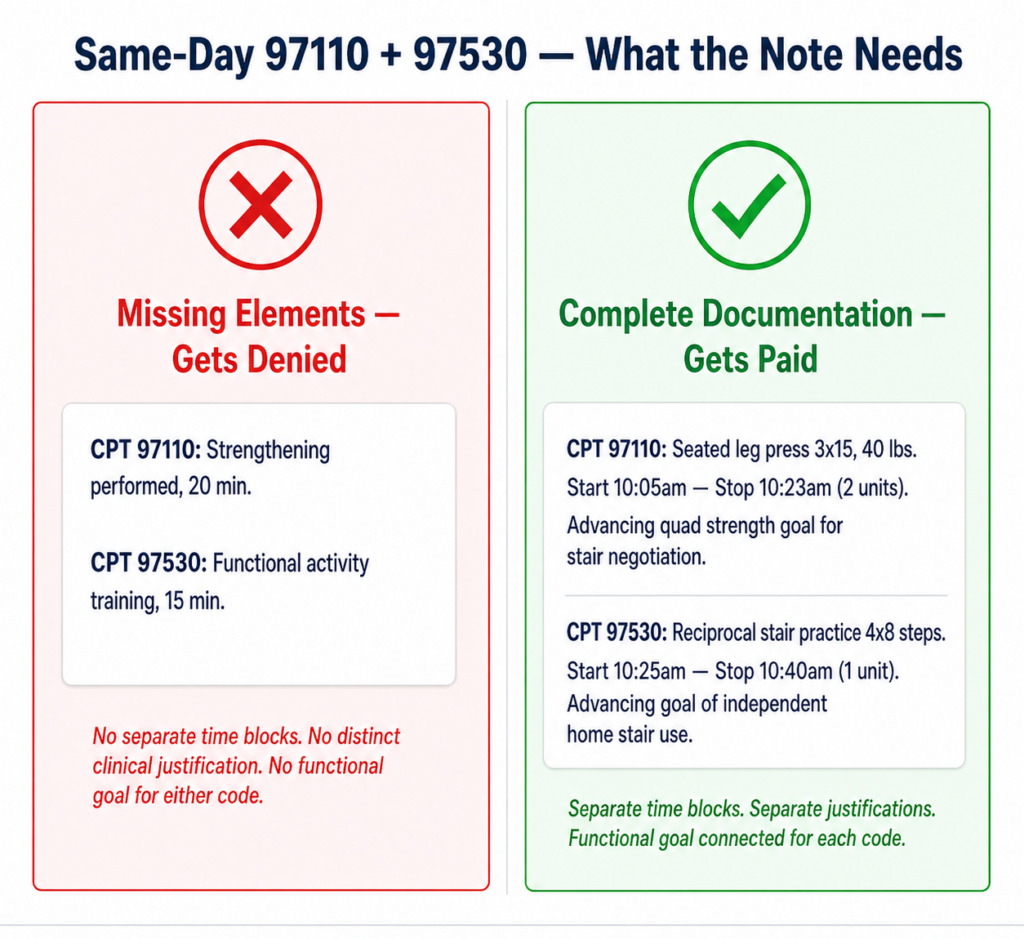
Same-day CPT 97110 and 97530 documentation comparison showing denied note with missing elements versus paid note with separate time blocks and functional goal connections

Common Coding Mistakes and How to Avoid Them

Mistake 1 — Using 97530 for Impairment-Level Exercise

Applying 97530 to exercises that are genuinely 97110 interventions because they happen in a functional position or involve multiple joints. A standing exercise is not automatically a functional activity. Code to the clinical intent: if the therapeutic goal is a tissue capacity, the code is 97110 regardless of the exercise position or the number of joints involved.

Mistake 2 — Using 97110 for Multi-Outcome Functional Activities

Defaulting to 97110 for activities that involve multiple simultaneous clinical outcomes and resemble daily life tasks. Sit-to-stand practice, stair negotiation, kitchen simulation, and work task replication are 97530 activities regardless of the strength component involved. If the activity is functional and multi-outcome, the code is 97530.

Mistake 3 — Combined Time Documentation for Same-Day Codes

Estimating total treatment time and splitting it between 97110 and 97530 without separate documented time blocks. Each code needs its own start and stop time. When payers audit same-day billing, separate time documentation is the first thing they verify. If it is not there, the claim is vulnerable regardless of how appropriate the clinical interventions were.

Mistake 4 — Missing the Functional Goal Connection on Both Codes

Documenting the exercise or activity accurately while omitting the sentence that connects it to a functional goal in the plan of care. This is the most common denial reason for both codes. Medical necessity is not established by describing the intervention — it is established by connecting the intervention to a documented functional outcome that justifies why the patient needs skilled therapy to achieve it.

Mistake 5 — Applying Modifier 59 Without Supporting Documentation

Using Modifier 59 on same-day 97110 and 97530 claims without documentation that independently justifies each code. Modifier 59 signals separate services — the notes prove it. If both codes share a single combined description in the note, Modifier 59 will not prevent a denial.

CPT 97110 vs 97530 in Practice — What Our Clinic Does

A patient presents at visit four following right knee arthroplasty. Assessment this session: quadriceps strength 3+/5 right versus 5/5 left, active knee extension lacking 15 degrees compared to the uninvolved side, and single-leg stance time 8 seconds right versus 22 seconds left. The patient’s documented goal is returning to independent stair use in his two-story home within six weeks.

Our team’s session plan: therapeutic exercise first targeting the quad strength and knee extension deficit (97110), followed by therapeutic activity practicing the stair negotiation pattern the patient needs to achieve his functional goal (97530).

The 97110 block runs 18 minutes: seated leg press 3 x 15 at 40 lbs targeting knee extension strength, terminal knee extensions 3 x 20 with theraband targeting quad recruitment in terminal range. Start time 10:05am, stop time 10:23am. Two units. Note documents the specific exercises, parameters, resistance, and the outcome measure: active knee extension improved from −15 to −10 degrees by end of session. Functional goal connection: ‘Quad strengthening targeting 5/5 strength required for safe reciprocal stair negotiation per patient’s goal of independent stair use in his home.’

The 97530 block runs 15 minutes: reciprocal stair negotiation on 4-step training stairs, 4 sets ascending and descending, with therapist cuing weight distribution symmetry and controlled knee flexion loading on descent. Start time 10:25am, stop time 10:40am. One unit. Note documents the activity, cues provided, patient response, and the functional goal connection: ‘Stair negotiation practice advancing patient’s goal of independent two-story home stair use without handrail assist.’

Two codes. Separate time blocks. Separate clinical justifications. A coherent clinical story where the 97110 impairment work directly supports the 97530 functional task practice. This is same-day billing done correctly.

READY TO STREAMLINE YOUR CLINIC?

See How HelloNote Handles All of This in One Platform

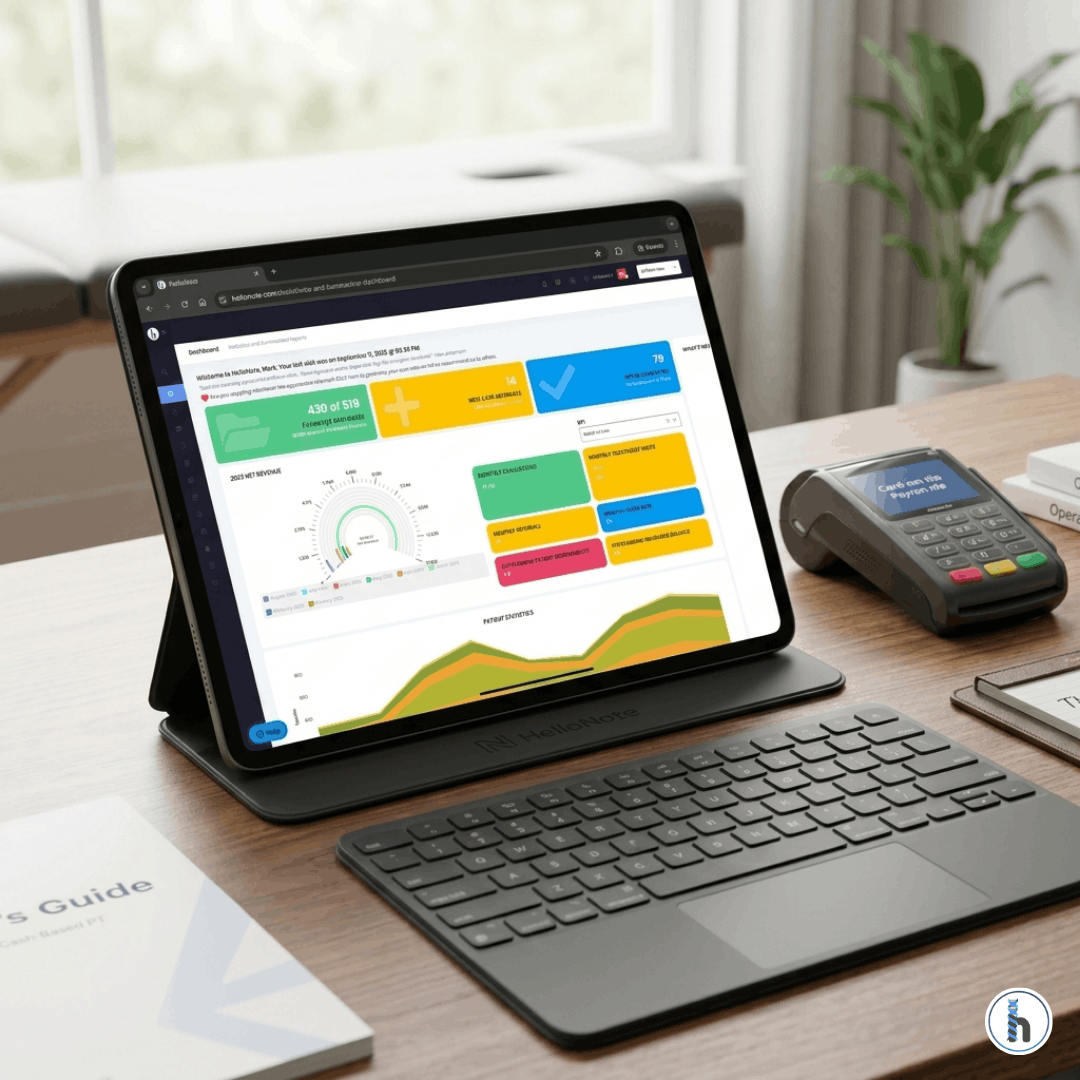
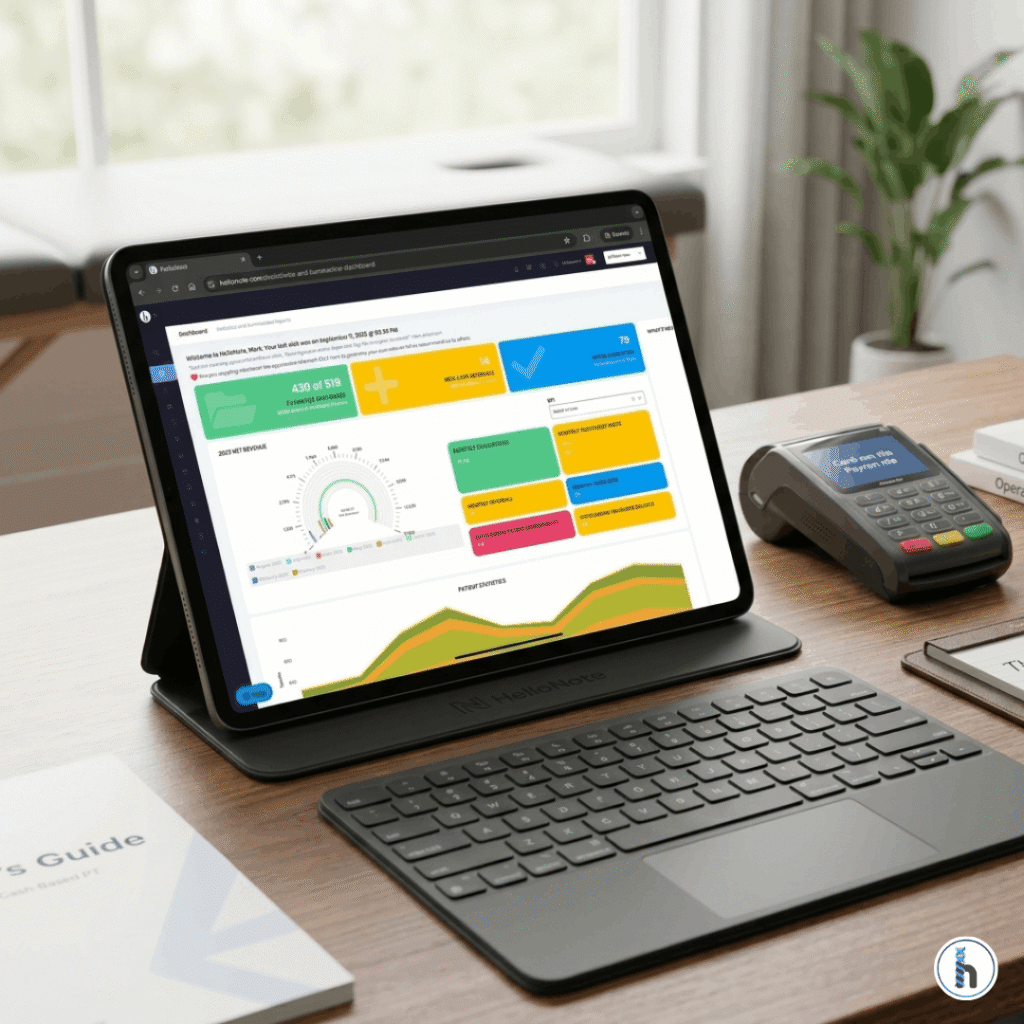
Managing staff hours, compliance, inventory, and financial reports — all inside one HIPAA-compliant EMR built for PT, OT, and SLP clinics.

No credit card required · HIPAA Compliant · PT, OT & SLP

How HelloNote Handles CPT 97110 and 97530

When our team built the HelloNote documentation templates, the 97110 vs 97530 distinction drove several core design decisions. The two most important: each code has its own separate time entry field, and each code requires its own functional goal linkage before the note can be closed. These two structural requirements eliminate the most common same-day billing mistakes before the claim is ever submitted.

    • Separate time entry per code — start and stop times are entered independently for each timed code block. HelloNote calculates units for each code separately using the 8-minute rule. There is no combined time field that gets split between codes.
    • Separate functional goal linkage — each code must be connected to a plan of care goal before sign-off. The 97110 goal and the 97530 goal are documented independently. The note cannot close until both connections are made.
    • Same-day code pairing guidance — when 97110 and 97530 appear on the same visit, HelloNote surfaces documentation guidance so the clinical distinction between the two codes is captured in the note structure.
    • Pre-submission claim scrub — before the claim goes out, HelloNote checks both codes against common denial triggers and flags missing elements for review.
    • Modifier 59 reminder — when 97110 and 97530 are billed together, HelloNote flags the Modifier 59 consideration so the therapist can verify payer requirements before submission.

Frequently Asked Questions — CPT 97110 vs 97530

What is the difference between CPT 97110 and CPT 97530?

CPT 97110 is for therapeutic exercise targeting a single musculoskeletal impairment — strength, endurance, range of motion, or flexibility. CPT 97530 is for therapeutic activities that are functional, multi-outcome, and simulate real-life tasks. 97110 changes a tissue capacity. 97530 changes what the patient can do. The distinction is clinical intent, which must be documented explicitly in the note for both codes.

Can you bill CPT 97110 and 97530 on the same day?

Yes. Same-day billing of 97110 and 97530 is appropriate when each code represents a distinct intervention with separate time tracking and a separate documented clinical justification. 97110 addresses the musculoskeletal impairment; 97530 practices the functional task that impairment was limiting. Some payers require Modifier 59 for same-day billing — verify payer-specific requirements before submitting.

When should I use 97110 instead of 97530?

Use 97110 when the therapeutic goal is to change a single tissue capacity: strengthen a specific muscle group, increase ROM in a specific direction, improve endurance for a specific demand, or increase flexibility in shortened tissue. If the intervention targets one measurable impairment through isolated exercise, bill 97110. If the activity is functional, multi-outcome, and resembles a daily life task, bill 97530.

When should I use 97530 instead of 97110?

Use 97530 when the therapeutic goal is to improve a patient’s ability to perform a specific functional task — sit-to-stand, stair negotiation, meal preparation, transfer training, work simulation, sport-specific movement. The activity must be dynamic (patient-performed), functional (resembles real-life tasks), and delivered under direct therapist contact throughout the billed duration.

What is Modifier 59 for 97110 and 97530?

Modifier 59 indicates that two procedures billed on the same day are distinct and separately identifiable services. Some payers require it when 97110 and 97530 are both billed on the same claim to confirm they are not duplicate billings of the same service. The modifier signals separation; the clinical documentation in each note proves it. Never apply Modifier 59 without documentation that clearly establishes the distinct clinical purpose of each code.

How many units of 97110 and 97530 can I bill per session?

Units for each code are determined independently by the 8-minute rule. One unit requires at least 8 minutes of direct therapist contact, two units require at least 23 minutes, three units require at least 38 minutes. Calculate units for 97110 from its own documented time block and units for 97530 from its own separate time block. The total combined time determines neither — each code stands on its own time documentation.

Is CPT 97110 or 97530 used in occupational therapy?

Both codes are used in occupational therapy and physical therapy. OTs commonly bill 97110 for isolated upper extremity strengthening, grip and pinch strengthening, and ROM exercises following hand or shoulder conditions. OTs commonly bill 97530 for ADL retraining, functional upper extremity task practice, home management simulation, and work task replication. The clinical criteria apply identically regardless of discipline.

What triggers an audit for same-day 97110 and 97530 billing?

Common audit triggers include: combined time documentation that gets split between codes rather than separately tracked, notes where both codes share a single clinical description without distinct justifications, high-frequency same-day billing without documented clinical rationale for both codes in every visit, and Modifier 59 applied without supporting documentation that establishes the separate nature of each service.

How does HelloNote help with 97110 and 97530 same-day billing?

HelloNote’s templates require separate time entry and separate functional goal linkage for each code before the note can be closed. Same-day code pairing guidance surfaces when both codes appear on the same visit. The pre-submission claim scrub checks both codes against common denial triggers. Modifier 59 is flagged for payer verification when 97110 and 97530 are billed together.

Bill Both Codes Right — Every Session

The 97110 vs 97530 distinction is not a compliance technicality. It is a clinical documentation practice that accurately represents the work being done and protects the revenue that work generates. When both codes are documented correctly — with separate time blocks, separate clinical justifications, and clear functional goal connections — same-day billing is not a risk. It is an accurate billing record of a complete, skilled rehabilitation session.

Looking up more cpt codes?

See 97110, 97530, and 50+ therapy procedure codes – with billing guidance and documentation tips in one place.


CPT 97530 — Therapeutic Activity: Definition, Billing Rules, and Documentation Guide

What is CPT 97530 (Therapeutic Activity)?

CPT 97530 is a timed therapeutic procedure code for therapeutic activities — dynamic, functional tasks that simulate real-life activities of daily life. Billed in 15-minute units, it requires direct one-on-one licensed therapist contact throughout. It applies when the clinical goal is improving functional performance, not an isolated impairment like strength or range of motion.

Key Takeaways

    • CPT 97530 covers functional, multi-outcome activities that simulate real-life tasks — billed in 15-minute units with direct therapist contact required throughout
    • The clinical anchor is functional performance: the activity must resemble what the patient needs to do in their daily life, not target an isolated musculoskeletal impairment
    • 97530 and 97110 serve different clinical purposes and can be billed together — but each requires its own time tracking and its own documented clinical justification
    • HelloNote’s 97530 template enforces the functional goal connection and multi-outcome documentation that payers look for — making the defensible note the default note

Table of Contents

CPT 97530 is the most searched therapy billing code on the HelloNote site. It is also the code our billing team sees questioned most often in payer reviews. Those two facts are not a coincidence — they reflect a gap that runs through outpatient therapy documentation everywhere. Therapists use 97530 constantly because the clinical reality of functional rehabilitation is constantly functional. Payers scrutinize it constantly because the documentation that supports it is rarely as specific as the clinical work it is supposed to describe.

The code is not the problem. The definition is straightforward: dynamic activities to improve functional performance, direct one-on-one contact, 15-minute units. The problem is the space between what happens in the room and what ends up in the note. A therapist guides a patient through a kitchen simulation task that integrates balance, upper extremity coordination, cognitive sequencing, and ADL independence in one twenty-minute session. The note says “functional activity training, 20 minutes.” The clinical work was skilled and complex. The documentation is barely defensible.

This guide is the version of the 97530 conversation that actually helps: what the code requires clinically, what documentation payers need to approve it, how it differs from 97110, and exactly how our team structures every 97530 note so it reflects what we did and withstands what auditors look for. We also address the 97110 vs 97530 comparison at a structural level here — for the full side-by-side breakdown, our complete guide lives at hellonote.com/97110-vs-97530/.

Occupational therapist guiding elderly patient through sit-to-stand therapeutic activity CPT 97530 in outpatient clinic

What Is CPT 97530 — The Clinical Definition That Actually Matters

The AMA defines CPT 97530 as: therapeutic activities, direct (one-on-one) patient contact by the provider, use of dynamic activities to improve functional performance, each 15 minutes. Three words in that definition carry the most clinical weight: dynamic, functional, and direct.

Dynamic

The patient is actively performing movement — not being moved by the therapist. The activity requires patient effort, coordination, and engagement across multiple systems simultaneously. This distinguishes 97530 from manual therapy codes where the therapist does the work.

Functional

The activity mirrors something the patient needs to do in their real life. Not an isolated exercise targeting a single tissue or movement direction — a task with the multi-joint, multi-outcome complexity of daily living. This is the clinical anchor that separates 97530 from 97110.

Direct

The licensed therapist must be present and actively directing the activity for the entire billed duration. Not supervising from across the room. Not setting up and stepping away. Direct contact, direct instruction, direct skilled input throughout. If the activity could be run by a tech or continued as a home program without skilled therapist presence — the documentation needs to explain why it was not.

What CPT 97530 Covers

Therapeutic activities under 97530 include functional mobility training such as sit-to-stand practice, transfer training, stair negotiation, and community ambulation on varied surfaces. ADL task practice including meal preparation simulation, upper extremity reaching and manipulation tasks in functional contexts, dressing and grooming sequences, and home management activities. Work simulation tasks for return-to-work clearance. Sport-specific movement pattern practice for athletic return. Pediatric functional play and developmental activity sequences requiring skilled therapist direction and progressive challenge.

What CPT 97530 Does Not Cover

97530 is not appropriate for isolated therapeutic exercise targeting a single tissue capacity (use 97110). It is not appropriate for gait training as a standalone skilled service (use 97116). It is not appropriate for patient education where the therapist explains or demonstrates rather than directly guides active patient performance. It is not appropriate when the activity is performed without continuous direct therapist contact. The activity has to be functional, the patient has to be doing it, and the therapist has to be directing it throughout.

When to Use CPT 97530: The Functional Performance Standard

The functional performance standard is the clinical test our team applies before every 97530 billing decision. It has two parts. First: does this activity resemble something the patient needs to perform in their daily life? Second: does the therapeutic value of this activity come from its functional, multi-outcome complexity rather than its impact on a single measurable tissue capacity?

If both answers are yes — the code is 97530. If the second answer is no — if the therapeutic value is primarily a strength gain, a ROM increase, or an endurance improvement that happens to occur during a functional-looking activity — the code is 97110, and the documentation needs to reflect that single-outcome intent.

The Multi-Outcome Principle

97530 activities work across multiple systems simultaneously. A sit-to-stand sequence builds lower extremity loading tolerance, reinforces hip and knee proprioception, challenges dynamic balance, practices the movement pattern used in every functional transfer, and advances the documented goal of independent toilet and chair use. Six things changing at once. That is not a 97110 intervention. The multi-outcome nature of the activity is what makes it 97530 — and that multi-outcome nature needs to appear in the documentation.

Populations and Diagnoses That Fit 97530

Post-surgical orthopedic patients transitioning from impairment-level work to functional task practice: hip and knee arthroplasty patients practicing transfers and stair negotiation, shoulder repair patients practicing reaching and lifting in functional contexts, hand patients practicing grip and manipulation tasks in ADL simulations. Neurological patients practicing multi-step ADL sequences: stroke survivors relearning dressing and grooming, TBI patients practicing kitchen tasks, Parkinson’s patients working on functional gait in environmental simulations. Older adults with fall risk practicing functional mobility in community simulation environments. Work injury patients performing job-specific task simulations for return-to-work clearance.

CPT 97530 Documentation Requirements

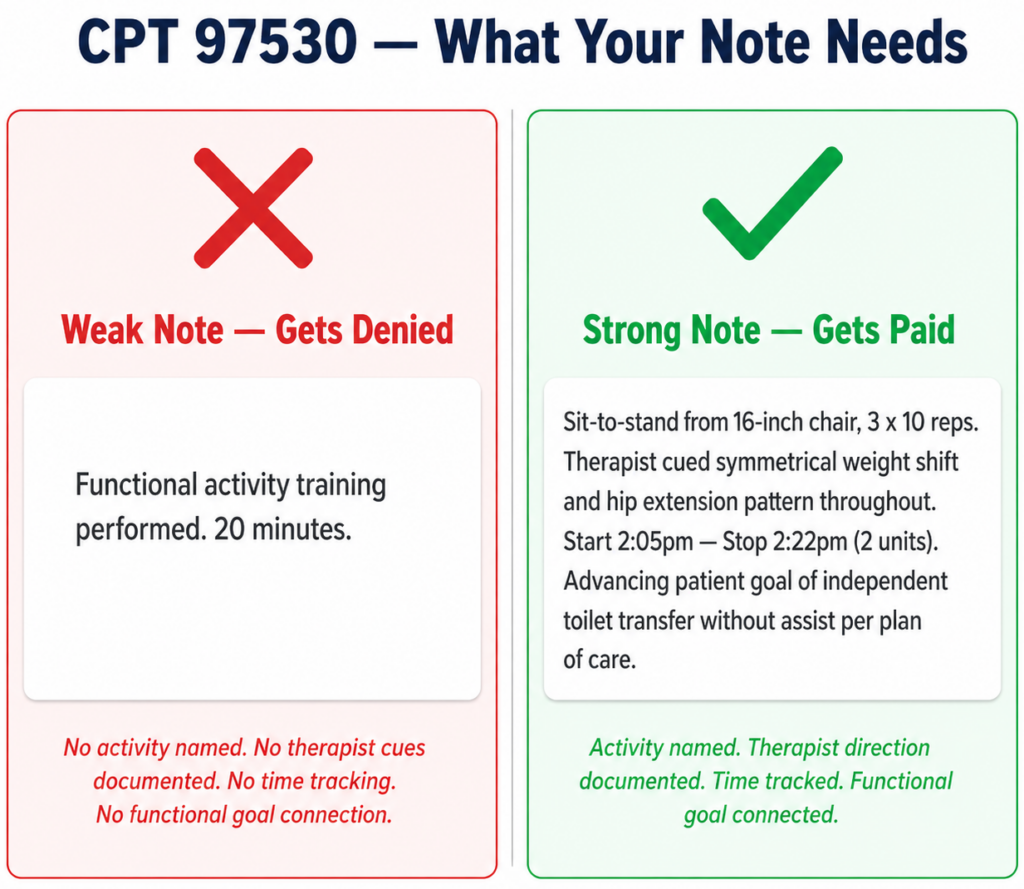
97530 documentation fails in a predictable pattern. The therapist records the activity accurately and omits the functional goal it was designed to advance. Functional reaching practice, 15 minutes. Step training, 3 sets. Kitchen simulation, direct therapist contact. These notes describe what happened. They do not establish medical necessity, and they do not tell a payer why a licensed therapist needed to direct the activity rather than delegating it to support staff or a home program.

Our team rebuilt our 97530 documentation standard around four required elements. Every 97530 note we write contains all four.

The Four Required Documentation Elements

  1. The specific activity and its multi-outcome components

Name the activity specifically and describe its functional complexity. Not ‘stair training performed’ but ‘reciprocal stair negotiation with handrail, 3 x 8 steps ascending and descending, targeting lower extremity loading tolerance, dynamic balance, and hip extension mechanics required for safe community stair use.’ The multi-outcome description is what makes the note reflect a 97530 activity rather than a 97110 exercise.

  1. The skilled therapist direction throughout

Document the specific cues, modifications, and clinical decisions made during the activity. What did the therapist observe that required skilled input? What cue improved performance? What modification was made in response to the patient’s real-time performance? This element establishes that direct skilled contact occurred and that the intervention required professional direction.

  1. Actual start and stop time

The 8-minute rule applies to 97530 exactly as it does to 97110. One unit requires at least 8 minutes of direct therapist contact. Document actual times, not estimates. When billing 97530 and 97110 on the same visit, each code needs its own time block documented separately.

  1. The functional goal connection sentence

Connect every 97530 activity to a documented functional goal in the plan of care. This sentence establishes medical necessity. Example: ‘Kitchen simulation task practice targeting the patient’s goal of independent hot meal preparation within her home environment following right hip arthroplasty.’ Without this connection the documentation describes an activity program. With it, it establishes a medically necessary skilled rehabilitation service.

CPT 97530 vs CPT 97110: The One Distinction That Protects Your Claims

CPT 97530 vs 97110: What is the difference?

CPT 97110 targets a single musculoskeletal impairment — strength, endurance, ROM, or flexibility — through isolated therapeutic exercise. CPT 97530 targets functional performance through multi-outcome activities that simulate real-life tasks. 97110 changes a tissue capacity. 97530 changes what the patient can do. The distinction is clinical intent, which must be documented explicitly in the note.

The System Being Treated

97110 treats a musculoskeletal impairment. The target is a specific deficit in tissue capacity. The outcome is measured in tissue-level numbers: MMT grade, goniometric degrees, repetitions to fatigue. 97530 treats a functional performance deficit. The target is the patient’s ability to perform a specific task. The outcome is measured in functional terms: the patient can now ascend stairs safely, prepare a meal independently, return to their work duties.

The Sticky Note Test

Our team uses a simple test when code selection is unclear. Ask: if this intervention worked perfectly, what one thing would be different? If the answer is a tissue capacity measurement — the quad is stronger, the shoulder moves further — that is 97110. If the answer is a functional task — the patient can get off the floor independently, return to their job, prepare a meal — that is 97530. Document the answer. That is your code justification.

Billing CPT 97530 on the Same Day as 97110: Rules and Modifier 59

Billing 97110 and 97530 on the same day is appropriate, clinically sound, and common in well-structured outpatient sessions. The sequence is logical: therapeutic exercise builds the impairment-level capacity (97110), and therapeutic activity practices the functional task that capacity enables (97530). Strengthen the quad, then practice the stair negotiation that quad strength supports.

What Makes Same-Day Billing Defensible

Each code needs its own documented time block with separate start and stop times. Each code needs its own clinical justification establishing a distinct therapeutic purpose. The combined documentation should tell a coherent clinical story where the 97110 impairment and the 97530 functional task are clearly connected. When these conditions are met, same-day billing is not an audit flag. It is accurate documentation of a complete rehabilitation session.

Modifier 59 for CPT 97530

Some payers require Modifier 59 when 97110 and 97530 are billed on the same day to confirm they represent distinct and separately identifiable services. When required, the documentation must provide the clinical distinction the modifier signals — the modifier tells the payer these are separate services; the notes prove it. Verify Modifier 59 requirements with each payer as requirements vary by insurer.

Looking up more cpt codes?

See 97110, 97530, and 50+ therapy procedure codes – with billing guidance and documentation tips in one place.
Common Billing Mistakes with CPT 97530

Mistake 1 — Using 97530 for Impairment-Level Exercise

The most common misapplication: applying 97530 to exercises that are 97110 interventions because they happen in a functional position or involve multiple joints. A standing exercise is not automatically a functional activity. The test is always clinical intent: is the therapist targeting tissue capacity (97110) or functional task performance (97530)? If tissue capacity, bill 97110 regardless of how the exercise looks.

Mistake 2 — Missing the Functional Goal Connection

97530 without an explicit functional goal connection describes an activity. Payers cannot determine medical necessity from an activity description alone. The note needs to answer: why was this activity medically necessary for this specific patient on this specific date? That answer lives in the sentence connecting the activity to the documented functional goal. Our team made this a required field — the note cannot close without it.

Mistake 3 — Separate Time Tracking Not Done for Same-Day Codes

When billing 97110 and 97530 together, each code needs its own time block with separate start and stop times. Estimating total treatment time and splitting it between codes creates documentation that will not survive audit. The exercise block has its own time. The functional activity block has its own time. They do not overlap.

Mistake 4 — No Progression Documentation Across Visits

Payer reviewers looking at multiple 97530 visits expect to see documented evidence that the functional challenge is advancing. Identical activity descriptions across four consecutive visits raise a medical necessity flag. Document a progression element at every session: reduced assistance level, increased task complexity, added dual-task loading, or environmental challenge increase.

Mistake 5 — Documenting Instruction Instead of Active Therapy

97530 requires the patient to be performing the functional activity under direct therapist contact. When the documentation describes the therapist explaining, demonstrating, or reviewing a home program, that describes patient education, not skilled therapeutic activity. If the note reads as instruction rather than active therapy, the code is not supported.

CPT 97530 in Practice — What Our Clinic Actually Does

A patient presents at visit six following left total hip arthroplasty at eight weeks. Hip precautions lifted. Strength testing adequate bilaterally. The remaining gap: she cannot safely perform floor-level tasks — loading the lower dishwasher rack, retrieving items from a low cabinet — because controlled descent to and return from low surfaces has not been practiced under skilled therapeutic guidance.

Our therapist documents the pre-treatment functional status before the session begins: patient unable to perform controlled descent below knee height due to apprehension and asymmetric loading pattern. Functional goal: independent home management including low-surface activities. Clock starts.

The session involves progressive controlled descent to low chair, low stool, and 8-inch surface with manual facilitation at the pelvis, verbal cueing for weight distribution symmetry, and functional task integration — patient retrieves items from a low bin, completes a simulated floor-to-standing sequence, and performs a bilateral overhead-to-low reach pattern reflecting her daily home management demands. Specific cues and patient response are documented at each difficulty level. Outcome: controlled descent to 8-inch surface achieved with supervision, 4-inch surface with minimal assist.

The note closes with the functional goal connection sentence: ‘Low-surface functional task practice targeting patient’s goal of independent home management including floor-level activities following left total hip arthroplasty.’ Total 97530 time: 20 minutes, two units. Documentation written in four minutes. Claim goes out clean.

READY TO STREAMLINE YOUR CLINIC?

See How HelloNote Handles All of This in One Platform

Managing staff hours, compliance, inventory, and financial reports — all inside one HIPAA-compliant EMR built for PT, OT, and SLP clinics.

No credit card required · HIPAA Compliant · PT, OT & SLP

How HelloNote Handles CPT 97530

Therapist guiding patient through CPT 97530 therapeutic activity during outpatient rehabilitation session

The HelloNote 97530 template was built around the documentation gap our billing reviews identified most often: functional activity notes that described what happened without establishing why it was a medically necessary skilled service. The template enforces the four required elements as required fields — making correct documentation the default path, not the disciplined one.

    • Functional activity description fields — structured inputs for activity name, the functional task being practiced, patient performance level, and multi-outcome components
    • Skilled therapist direction field — required section for cues, modifications, and clinical decisions made during the activity
    • Start and stop time entry — built into every timed code block with automatic 8-minute rule unit calculation
    • Functional goal linkage — required before sign-off, active plan of care goals populate into a selection field
    • Same-day code pairing guidance — when 97530 is billed with 97110, HelloNote surfaces documentation guidance so each code has its own justification
    • Pre-submission claim scrub — HelloNote checks the 97530 claim against common denial triggers before submission

Frequently Asked Questions About CPT 97530

What does CPT 97530 cover in physical therapy and occupational therapy?

97530 covers functional mobility training (sit-to-stand, transfer training, stair negotiation), ADL task practice (meal preparation simulation, dressing and grooming sequences, home management activities), work simulation for return-to-work clearance, and functional upper extremity tasks in OT. The common thread is multi-outcome functional performance under direct skilled therapist guidance.

What is the 97530 CPT code description?

The official AMA CPT 97530 description is: therapeutic activities, direct one-on-one patient contact by the provider, use of dynamic activities to improve functional performance, each 15 minutes. The activity must be dynamic (patient-performed), functional (resembles real-life tasks), and delivered under direct licensed therapist contact throughout the billed duration.

What are the CPT 97530 billing guidelines for Medicare?

Medicare requires documentation to establish the skilled nature of the service, direct one-on-one therapist contact throughout, and functional medical necessity. The note must identify the specific activity, document the therapist’s skilled direction and clinical decisions, record the patient’s functional performance status, and connect to a documented functional goal. Medicare also requires documented progression across visits.

Can CPT 97110 and 97530 be billed together on the same day?

Yes. Same-day billing is appropriate when each code represents a distinct intervention with separate time tracking and a separate documented clinical justification. 97110 targets the impairment; 97530 practices the functional task that impairment was limiting. Some payers require Modifier 59 — verify payer-specific requirements. Full guide: hellonote.com/97110-vs-97530/

What is Modifier 59 for CPT 97530?

Modifier 59 indicates that two procedures billed on the same day are distinct and separately identifiable services. For 97110 and 97530 billed together, some payers require Modifier 59 to confirm these are not duplicate billings. The modifier signals the separation; the clinical documentation in each note proves it. Never apply Modifier 59 without documentation that clearly establishes the distinct purpose of each code.

How many units of CPT 97530 can I bill per session?

Units are determined by the 8-minute rule: one unit requires at least 8 minutes, two units require at least 23 minutes, three units require at least 38 minutes. Document actual start and stop times, not estimates. When billing 97530 and 97110 together, calculate units for each code from its own separately documented time block.

Is CPT 97530 occupational therapy or physical therapy?

CPT 97530 is used by both occupational therapists and physical therapists. OTs commonly use it for ADL retraining, functional transfer training, and upper extremity task practice. PTs commonly use it for functional gait and transfer training, work simulation, and sport-specific movement practice. The clinical criteria apply identically regardless of discipline.

What triggers an audit or denial for CPT 97530?

Common triggers: high-frequency 97530 billing without documented functional progression, same-day 97110 and 97530 without distinct clinical justifications and separate time documentation, activity descriptions that resemble impairment-level exercise rather than functional task practice, missing functional goal connections, and notes describing therapist instruction rather than patient performance under direct contact.

How does HelloNote help with CPT 97530 billing and documentation?

HelloNote’s 97530 template requires functional activity description with multi-outcome components, skilled therapist direction documentation, start and stop time entry with automatic unit calculation, and functional goal linkage before sign-off. Same-day billing guidance surfaces when 97530 is billed with 97110. Pre-submission claim scrubbing flags missing elements before the claim is submitted.

Start Your Journey to Better CPT 97530 Documentation

The gap between what therapists do in a 97530 session and what ends up in the note is not a clinical gap — it is a documentation habit gap. The clinical work is skilled, complex, and functionally meaningful. The documentation needs to reflect that. Our team built HelloNote to make that reflection automatic, so every 97530 note accurately represents the work and withstands the scrutiny that comes with it.

CPT 97110: Billing, Documentation & Denial Prevention Guide

What is CPT 97110 (Therapeutic Exercise)?

CPT 97110 is a timed therapeutic procedure code for therapeutic exercise targeting a single measurable outcome — strength, endurance, range of motion, or flexibility. Billed in 15-minute units, it requires direct one-on-one licensed therapist contact throughout. It applies when the clinical goal is improving a specific musculoskeletal impairment, not a functional performance deficit.

Key Takeaways

    • 97110 targets one outcome per session — strength, endurance, ROM, or flexibility — and the documentation must establish that single-outcome intent explicitly
    • The four required documentation elements are: specific exercise name and parameters, actual start and stop time, an objective outcome measure, and a functional goal connection sentence
    • The 8-minute rule governs unit billing — track actual time, not estimates, or expect to consistently underbill
    • 97110 is for impairment-level musculoskeletal work; 97530 is for functional activity practice; the distinction is clinical intent and must be documented, not assumed
    • Laterality is required for every unilateral condition — build it into the template so it cannot be omitted
    • Progressive documentation across visits is a billing protection strategy — document what changed, why, and what the next target is at every session

Table of Contents

There is a particular kind of frustration that hits when a claim gets denied for a patient you know you treated correctly. We had a 61-year-old construction foreman last spring — right shoulder, status post rotator cuff repair at eight weeks, progressing well on external rotation strength and doing everything the protocol asked. Three visits in a row came back denied. Not for lack of clinical necessity. Not for missing authorization. For documentation that described exercise without establishing single-outcome therapeutic intent. The insurer could not tell from our notes whether we were running 97110 or 97530. So they decided for us, and they decided wrong.

The thing about CPT 97110 is that it looks deceptively simple. Therapeutic exercise. How complicated can the documentation be? The answer, as anyone who has been through a billing review can tell you, is considerably more complicated than the code definition suggests. The AMA description covers four qualifying outcomes in one sentence. What it does not cover is the audit logic payers use when reviewing claims, the distinction between 97110 and 97530 that trips up experienced therapists, or the specific documentation elements that separate a clean claim from a denial letter.

Our team wants to close that gap in this post. Not the textbook version of 97110 — the version you learn when claims start coming back and you have to figure out why.

CPT 97110 therapeutic exercise — four qualifying outcomes: strength, endurance, range of motion, and flexibility

What Is CPT 97110 and When Do You Use It?

CPT 97110 is a timed therapeutic procedure code for therapeutic exercises designed to address a single measurable impairment: strength, endurance, range of motion, or flexibility. Each unit covers 15 minutes of direct therapist contact. The therapist must be actively involved with the patient for the entire duration — not observing from a distance, not charting at a workstation while the patient runs through a home program.

The clinical boundary that defines 97110 is specificity of target. One impairment. One measurable outcome. One therapeutic direction per session of this code. That is what distinguishes it from 97530 and what makes it defensible when a payer looks at it. When our team trains new clinicians on code selection, the test we use is simple: if you had to describe the goal of this exercise in one word — stronger, more flexible, greater endurance, increased motion — and that one word is accurate and complete, you are in 97110 territory. If you need more than one word to describe what the exercise is trying to accomplish, you likely need 97530.

The Four Qualifying Outcomes in Clinical Practice

    • Strength: progressive resistance exercise targeting a specific muscle group or movement pattern with a documented baseline deficit and a measurable strength target.
    • Endurance: exercise targeting the ability to sustain a muscle contraction or movement pattern over time, typically tied to a specific activity demand the patient needs to return to.
    • Range of motion: structured exercise specifically intended to increase joint or soft tissue mobility, with documented goniometric baseline and target.
    • Flexibility: elongation exercises targeting shortened tissue, with documented limitation and functional impact.

Each of these outcomes has one thing in common: you can measure it at baseline, track it across visits, and demonstrate progress toward a documented goal. That measurability is the backbone of a defensible 97110 claim. If our team cannot put a number on the outcome at the start, we cannot justify the code at the end.

Diagnoses and Presentations That Fit 97110

Post-surgical strengthening following orthopedic repair or replacement. Rotator cuff strengthening after tear or repair. Hip and knee strengthening after arthroplasty. Grip and pinch strengthening following hand fracture or tendon repair. In every case the formula is the same: specific tissue or joint, specific measurable deficit, and a specific single-outcome target.

How to Document CPT 97110 Correctly?

Our clinic has reviewed a lot of 97110 notes that were clinically appropriate and documentational thin. The treatment was justified. The paperwork did not show it. After going through that experience ourselves early in our practice and helping other therapists troubleshoot denial patterns, our team has identified four documentation elements that appear in every clean 97110 claim and are absent in most denied ones

Physical therapist guiding patient through therapeutic exercise using resistance band for CPT 97110 knee strengthening

BUILT FOR PT, OT & SLP

Still spending 20 minutes on every note?

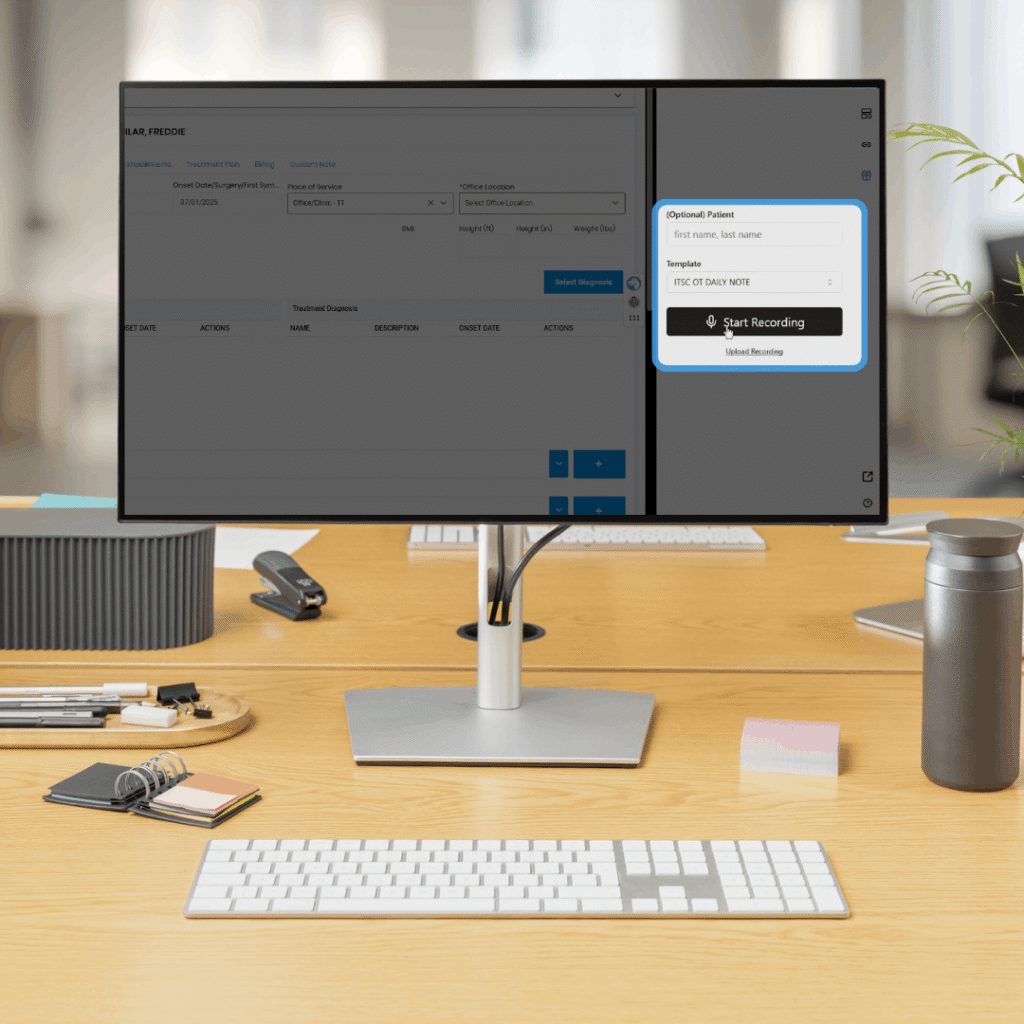
5,000+ PT, OT AND SLP practices use HelloNote to chart faster – with CPT and ICD-10 codes built directly into every note.

No credit card required · HIPAA Compliant · PT, OT & SLP

The Four Non-Negotiable Documentation Elements

  1. Name the exercise with clinical specificity

There is a meaningful difference between “shoulder strengthening performed” and “seated dumbbell external rotation, 3 x 12, 3 lb, pain-free arc 0–90 degrees.” The first tells a payer you did something. The second tells a payer you performed a specific skilled intervention at a documented resistance level targeting a specific movement deficit. Only one of those descriptions belongs in a 97110 note.

  1. Record every parameter

Sets, repetitions, resistance or load, patient position, and any significant modifications. These parameters are the clinical evidence that the exercise was progressive, intentional, and appropriate to the patient’s current status. They also protect you in an audit by showing consistent, documented clinical decision-making across visits.

  1. Track and document actual time

Start time and stop time for every timed code. Not an estimated range. The 8-minute rule is applied by payers whether you have tracked your time or not. If your documentation does not support the units billed, the units get denied. Our team records start and stop times as a non-negotiable standard for every 97110 session, and it has eliminated unit-related denials from our billing record entirely.

  1. Write the functional goal connection

This is the element that establishes medical necessity. Without it, the documentation describes a procedure. With it, the documentation describes a medically necessary skilled service. The sentence looks like this: “Shoulder external rotation strengthening targeting 5/5 strength required for patient’s goal of returning to overhead shelf stocking in her retail position.” That sentence connects the impairment-level work to the patient’s functional life, and it is the difference between a clean claim and a denial.

Why Our Team Stopped Writing Impairment-Only Notes

For the first two years our clinic was open, our therapists documented impairments well and functional connections poorly. Our notes were accurate records of what happened in the room. They were weak arguments for why a licensed therapist needed to make it happen. We had excellent goniometry. We had detailed exercise logs. What we did not consistently have was the sentence that linked the goniometry and the exercise log to something the patient needed to do in their daily life.

The shift happened after a Medicare review flagged a pattern in our billing and a billing consultant walked through our notes line by line. She was not pointing out clinical errors — she was pointing out documentation that told half the story. We updated our templates, retrained our team, and made functional goal connection a required field rather than a recommended one. Our denial rate dropped measurably within the next billing quarter. The clinical work had not changed at all.

CPT 97110 vs 97530 — The Distinction That Determines Your Claim

More therapists get this distinction wrong than any other code selection question our team encounters. The confusion is understandable because the activities genuinely overlap. A patient performing progressive strengthening can look identical to a patient performing functional activity practice from across the room. The difference is not visible. It is clinical and it is documented.

Looking up more cpt codes?

See 97110, 97530, and 50+ therapy procedure codes – with billing guidance and documentation tips in one place.
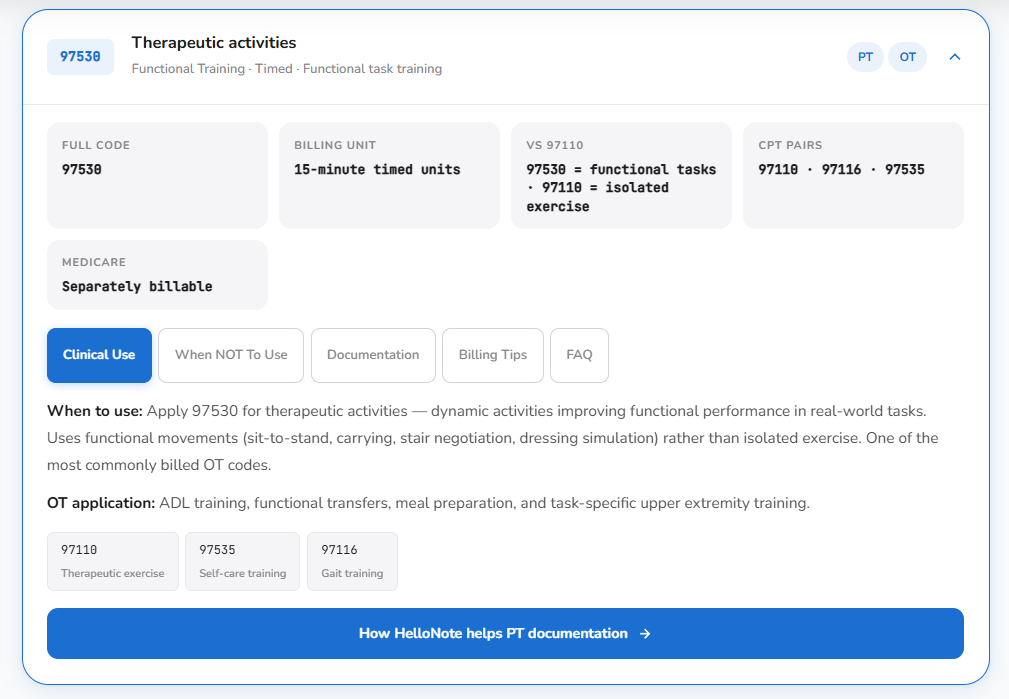
The System Being Treated

97110 addresses a musculoskeletal impairment — a specific deficit in the contractile or mechanical capacity of tissue. The exercise targets that tissue directly. The measure of success is a change in the tissue’s capacity: stronger, more mobile, better endurance. 97530 addresses a functional performance deficit — the patient’s inability to perform an activity of daily life or work task. The activity simulates or replicates that task. The measure of success is the patient’s ability to perform the functional task.

The Functional Arc Test

Our clinic trains therapists to apply what we call the functional arc test when selecting between 97110 and 97530. Does the activity look like something the patient would do in their daily life? Does it involve multiple joints moving through a functional pattern? Does it require the patient to coordinate movement across body regions simultaneously? If the answers are yes — it is 97530 territory. Does the activity isolate a single muscle group or movement direction? Does it target one specific measurable capacity? Does it function as a building block for functional movement rather than the movement itself? Those answers point to 97110.

A patient performing seated leg press for quadriceps strengthening after knee replacement is 97110. The same patient performing step-up and step-down practice targeting stair negotiation is 97530. The knee is involved in both. The clinical target — tissue capacity versus functional performance — is different in each.

Common Billing Mistakes and How to Avoid Them

These are the five documentation and billing errors our team has seen most often when reviewing denied 97110 claims — in our own practice early on and in conversations with therapists whose billing patterns we have helped troubleshoot.

Mistake 1 — Writing Exercise Descriptions Without Medical Necessity

The most common and most preventable error. A note that describes an exercise program accurately but does not establish why that program was medically necessary for this specific patient on this specific date is a denial waiting to happen. Medical necessity in outpatient therapy means demonstrating that a specific functional limitation exists, that it is caused by a specific impairment, and that the skilled therapeutic exercise being provided is specifically designed to address that impairment in service of that functional goal. All three elements need to be in the note. Exercise descriptions alone satisfy none of them.

Mistake 2 — Estimating Treatment Time

Our team analyzed our billing records during our first year and found that therapists who estimated treatment time were underbilling by an average of 4 to 6 minutes per timed code per session. Under the 8-minute rule, that gap translates to a lost unit on roughly one in four visits. Across a practice seeing 20 patients a week, that is $250 to $350 in unrecovered revenue every week — not from poor clinical work, not from billing errors, but from rounding down on time documentation.

Mistake 3 — Applying 97110 to Multi-Outcome Activities

97110 requires a single therapeutic target. When the documented intent of an exercise spans multiple outcomes — strengthening and coordination, range of motion and balance, endurance and functional movement pattern — the activity has crossed into 97530 territory. Our clinic had a period early on where therapists were defaulting to 97110 for exercises that involved both strength and functional movement components because the documentation template was familiar. The payer pattern review that followed was not something our team wanted to repeat. Code to what you are actually treating, document the single-outcome intent explicitly, and reserve 97110 for interventions where that intent is genuine.

Mistake 4 — Missing Laterality on Unilateral Diagnoses

A claim for shoulder strengthening without documented laterality is a CO-4 denial waiting to happen. Left, right, or bilateral must appear in the documentation for every unilateral condition. This takes two seconds to add and costs three weeks to fix after a denial. Our team built laterality as a required field in every 97110 note template so it cannot be omitted.

Mistake 5 — Not Progressing the Exercise Across Visits

Payers reviewing multiple visits of 97110 expect to see a progression narrative — documented changes in resistance, repetitions, range, or difficulty that demonstrate the skilled therapeutic process is advancing in response to the patient’s improvement. Notes that show identical exercise parameters across four or five visits raise a medical necessity flag. Our team documents progression explicitly at every visit: what changed from last session, why it changed, and what the next target is.

CPT 97110 in Practice — What We Actually Do

Our team’s 97110 workflow is built around three decisions that are made before the intervention begins, not during charting at the end of the day. When those three decisions are documented at the point of care, the note practically writes itself.

    • Decision 1: What is the single outcome we are targeting today?

Strength, endurance, ROM, or flexibility — one of the four, stated explicitly before the intervention begins. If the honest answer involves more than one, we are looking at 97530. This decision is made during the pre-treatment assessment and documented before the first exercise.

    • Decision 2: What is the measurable baseline and target for this session?

We do not begin a 97110 session without a number: current strength grade, current ROM measurement, current repetitions to fatigue. The target for the session is documented alongside the baseline. Without this, the exercise is undirected. With it, the session has a clinical purpose that the note can communicate.

    • Decision 3: Which plan of care goal does this session advance?

The note structure our team follows: specific exercise name, patient position, sets and reps, resistance level, start and stop time, session outcome measure compared to baseline, and the functional goal connection sentence. It takes under four minutes to write and has survived every billing review our clinic has been through.

How HelloNote Handles CPT 97110 Documentation

The 97110 template in HelloNote was built around the failure mode we saw most often in billing reviews: clinically appropriate interventions getting denied because the note did not establish functional goal connection. Our team designed the template so that connection cannot be skipped. The system will not allow sign-off until the exercise has been linked to a plan of care goal. That single structural requirement has reduced 97110 denial rates for our users more than any other feature in the template.

Here is what the 97110 workflow does inside HelloNote:

    • Functional goal linkage — Required before sign-off. The template pulls active plan of care goals into a selection field so the therapist links the exercise to the relevant goal in one click rather than one paragraph.
    • Start and stop time entry — Time fields are built into the timed code section. HelloNote calculates billable units using the 8-minute rule automatically. The therapist enters actual times; the system handles the unit math.
    • Exercise parameter fields — Structured inputs for exercise name, position, sets, reps, and resistance. Structured fields are faster to complete than free text and produce notes that are consistent, specific, and payer-ready.
    • Laterality selector — Built into every unilateral code entry. One click, never omitted.
    • Outcome measure entry — A dedicated field for the session’s objective measurement so baseline-to-current comparison is captured at the point of care, not reconstructed later.
    • Pre-submission claim scrub — HelloNote checks the 97110 claim against common denial triggers before it goes out and flags missing elements for review. The therapist addresses gaps before the claim leaves the building.

The design principle behind every element of the HelloNote 97110 template is that correct documentation should be the path of least resistance. Not an extra step at the end of a long day. The default.

READY TO STREAMLINE YOUR CLINIC?

See How HelloNote Handles All of This in One Platform

Managing staff hours, compliance, inventory, and financial reports — all inside one HIPAA-compliant EMR built for PT, OT, and SLP clinics.

No credit card required · HIPAA Compliant · PT, OT & SLP

Frequently Asked Questions About CPT 97110

What is CPT 97110?

CPT 97110 is a timed therapeutic procedure code used to bill for therapeutic exercise targeting a single outcome — strength, endurance, range of motion, or flexibility. Billed in 15-minute units, it requires direct one-on-one therapist contact throughout the service and is one of the most commonly billed codes in outpatient physical and occupational therapy.

When should I use CPT 97110?

Use 97110 when the therapeutic intent of your exercise is to address a single measurable impairment in one of the four qualifying categories. Building hip abductor strength after hip fracture, increasing shoulder external rotation ROM after repair, improving handgrip endurance for a manual labor return to work — these are 97110. If the exercise serves multiple simultaneous functional purposes or replicates an ADL, 97530 is likely more accurate.

What documentation is required to avoid a 97110 denial?

Every 97110 note needs four elements: the specific exercise name and parameters, actual start and stop time, an objective outcome measure compared to baseline, and a sentence explicitly connecting the exercise to a functional goal in the plan of care. The functional goal connection is the element most often missing from denied claims and the one that establishes medical necessity.

How many units of 97110 can I bill per session?

Units are determined by the 8-minute rule: one unit requires at least 8 minutes, two units require at least 23 minutes, three units require at least 38 minutes, four units require at least 53 minutes. Document actual start and stop times. Estimated durations are not defensible and will not support billing if the claim is reviewed.

What is the difference between 97110 and 97530?

97110 targets a musculoskeletal impairment — the contractile or mechanical capacity of tissue. 97530 targets a functional performance deficit — the patient’s ability to perform an activity of daily life or work task. The same exercise can fall under either code depending on clinical intent and documentation. The distinction must be explicit in the note.

What triggers an audit or denial for 97110?

Common triggers include missing functional goal documentation, time records that do not support the units billed, billing 97110 for multi-outcome activities that should be 97530, missing laterality, and absence of progression documentation across multiple visits. Secondary triggers

How does HelloNote help with 97110 documentation?

HelloNote’s 97110 template requires functional goal linkage before sign-off, includes start and stop time fields with automatic 8-minute rule unit calculation, structures exercise parameters into specific fields, and runs a pre-submission claim scrub. The template makes the four required documentation elements the default path through the note rather than an additional step.

Start Your Journey to Better CPT 97110 Documentation

Every 97110 claim is a record of skilled clinical work. The documentation should reflect that — not because payers demand it, but because your patients and your practice deserve notes that accurately represent what happened in that room and why it mattered. The right documentation habits are the difference between a billing system that protects your revenue and one that erodes it slowly and invisibly.

→ See 97110 and 97530 side by side in the CPT Code Library

PT Clinic Operations Management: A Complete Guide for Therapy Practice Owners

What is PT Clinic Operations Management?

PT clinic operations management covers the systems and processes that keep a physical therapy practice running efficiently — including staff scheduling and productivity tracking, documentation compliance, billing and revenue cycle management, multi-location coordination, patient communication, and inventory management. Effective clinic operations management directly impacts therapist retention, patient outcomes, and practice profitability.

Key Takeaways

  • Staff productivity in PT clinics is best measured through units per visit and notes-per-hour metrics — not just patient volume
  • Multi-location PT practices need centralized compliance tracking to ensure documentation standards are consistent across all sites
  • Revenue cycle management starts at scheduling — eligibility verification before the first visit prevents the majority of claim denials
  • Inventory and supply management is one of the most overlooked operational costs in outpatient therapy — tracking it reduces waste by up to 20 percent
  • HelloNote centralizes scheduling, documentation, billing, and reporting in one platform so clinic owners spend less time managing systems and more time growing the practice

Table of Contents

Running a therapy clinic involves far more than treating patients.

Between tracking staff hours, staying compliant across locations, managing supply costs, and preparing for audits — clinic owners carry an operational load that most practice management software wasn’t built to handle.

This guide covers the core pillars of PT clinic operations management: labor and productivity tracking, multi-location compliance, inventory control, and financial reporting — with insights from Dmitry Shevchenko, OTR/L, COO of HelloNote, who brings firsthand perspective as both a licensed occupational therapist and a multi-location clinic operator.

Everything covered here is built into HelloNote’s HIPAA-compliant practice management platform — designed specifically for PT, OT, and SLP practices across the United States.

Managing Staff Time and Productivity in a Therapy Clinic

Labor is typically the largest operating expense in any therapy practice — often accounting for 55–70% of total clinic costs. Yet many clinic owners still reconcile staff hours manually at the end of each week, leaving room for errors, disputes, and payroll delays.

HelloNote’s time-tracking system gives clinic owners a real-time view of how hours are being spent — broken down by clinical time (direct patient care) and administrative time (documentation, scheduling, meetings). This distinction matters because productive clinical hours generate revenue, while administrative time, though necessary, must be actively monitored.

Tracking Clinical vs. Administrative Hours

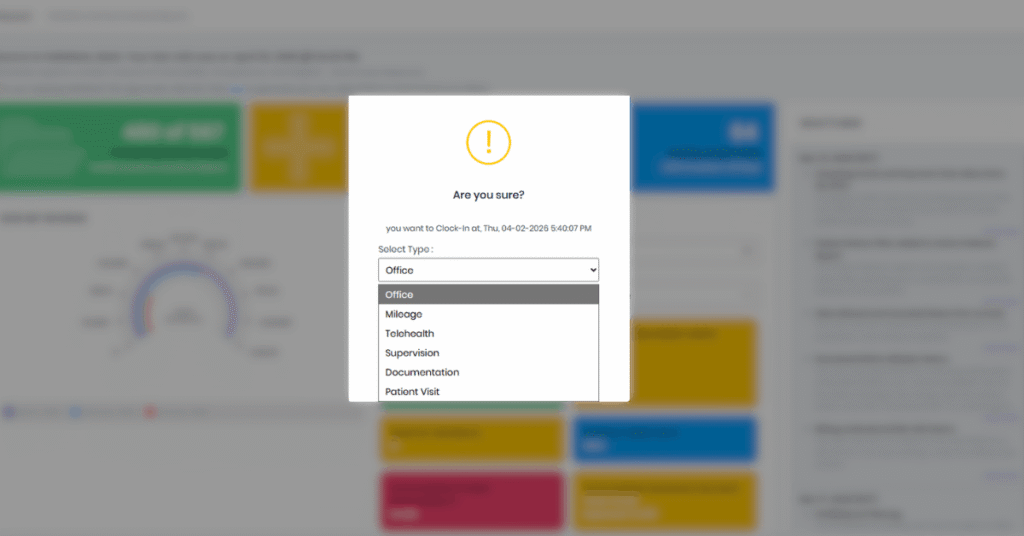
HelloNote’s Clock In / Clock Out system automatically categorizes each logged session. When a staff member clocks in for a patient visit, that time is flagged as productive/clinical. When clocking in for documentation, scheduling, or internal meetings, it is logged as administrative. This separation allows owners and clinical directors to run weekly productivity reports and identify where time is being lost.

HelloNote EMR Clock In screen showing session type categories for PT clinic staff time tracking

How Incomplete Documentation Affects Payroll Accuracy

HelloNote applies a documentation-completion requirement before payroll is processed: if a therapist has unsigned notes, their hours are flagged until the documentation is finalized. This keeps billing records clean and reduces compliance risk tied to unsigned clinical notes.

“Before HelloNote, Friday afternoons were a payroll nightmare. I watched owners scramble between different systems just to figure out how many hours staff worked. Now, Clock In and Clock Out live in the same place as the clinical notes — you eliminate an entire category of administrative error.”

— Dmitry Shevchenko, OTR/L — COO, HelloNote

Staying Compliant Across Multiple Clinic Locations

Medicare and Medicaid payer audits for PT, OT, and SLP practices are governed by CMS outpatient therapy documentation requirements — making active compliance oversight a financial necessity, not just a best practice.”

What "Compliance Drift" Is and Why It Happens

As therapy practices grow beyond a single location, documentation consistency becomes significantly harder to maintain. Staff at a second or third clinic may develop informal workflows — delaying note completion, skipping required fields, or signing off on documentation without full review. Over time, these small deviations compound into audit risk.

Dmitry Shevchenko calls this pattern “compliance drift” — and he has seen it affect even well-run practices:

“Compliance doesn’t break all at once — it drifts. The most dangerous moment for a growing clinic is when leadership stops actively reviewing what’s happening at other locations. By the time a problem is visible, it’s often already a liability.”

— Dmitry Shevchenko, OTR/L — COO, HelloNote

How to Audit Every Location From One Dashboard

HelloNote’s Global Audit feature consolidates documentation across all clinic locations into a single report view. Owners and administrators can filter by location, therapist, date range, or note status — without switching between accounts or systems.

Recommended workflow for multi-location owners:

  1. Navigate to Reports → Notes Report
  2. Clear the Office Filter to view all locations simultaneously
  3. Sort by note status — prioritize unsigned or incomplete notes
  4. Set a weekly review cadence (Friday morning works well before the week closes)

This process takes under 10 minutes and creates a documented audit trail that demonstrates active compliance oversight — relevant to both Medicare and Medicaid payer audits.

Inventory Management: The Hidden Cost in Every Therapy Visit

Why Consumable Supplies Are Typically Untracked

Most therapy practices track durable equipment and billable supplies — items like orthotic braces or TENS units. Consumable supplies, however — electrode pads, ultrasound gel, table paper, gloves, and kinesiology tape — are rarely tracked per visit, which means their true cost is almost never factored into per-visit profitability calculations.

Calculating Your True Cost-Per-Visit

“Most owners forget about the consumables. But at 1,000 visits a month, untracked supplies can represent thousands of dollars in unaccounted cost. You may think you’re profitable on a per-visit basis — and you’re not, because you’ve never actually calculated the supply component.”

— Dmitry Shevchenko, OTR/L — COO, HelloNote

HelloNote’s inventory tracking module allows clinics to log all supply categories — including consumables — and associate usage with visit volume. The result is an accurate cost-per-visit figure that accounts for both labor and materials.

What to Track in HelloNote Inventory:

  • Electrode pads and TENS supplies
  • Ultrasound gel
  • Table paper and sanitation supplies
  • Athletic tape and kinesiology tape
  • Disposable gloves

When stock falls below a set threshold, HelloNote generates a low-inventory alert — reducing the risk of running out of supplies mid-week.

HelloNote Operations Features: Quick Reference

HelloNote Feature

Primary Function

Operational Benefit

Clock In / Clock Out

Real-time staff time tracking

Eliminates manual hour reconciliation; separates clinical vs. admin time

Inventory Management

Consumable and supply tracking

Enables accurate cost-per-visit calculation

Revenue Report

Payment and collections overview

Distinguishes collected revenue from outstanding claims

Visits Analytics

Attendance and no-show reporting

Identifies patient retention issues by therapist or location

Global Audit

Cross-location note compliance

Single-view audit trail for multi-office practices

Mileage Tracking

Home visit distance logging

Simplifies IRS-compliant mileage reimbursement for mobile clinicians

Preparing Your Clinic for Payroll, Taxes, and Audits

Mileage Tracking for Home Visit Clinicians

For PT and OT practices that include home health or mobile visit components, IRS-compliant mileage tracking is a documentation requirement — not optional. HelloNote allows clinicians to log mileage at clock-out by selecting the Mileage category and entering odometer readings or distance in the Comments field.

This creates a timestamped, per-clinician mileage record that can be exported directly for tax reporting or reimbursement calculations — eliminating the need for separate mileage apps or manual spreadsheets.

What to Send Your Accountant (and When)

HelloNote’s Revenue Report distinguishes between payments received and outstanding claims — an important distinction for accrual vs. cash-basis accounting. Before your monthly or quarterly accountant review:

  1. Run the Revenue Report from the Reports dashboard
  2. Filter by “Payment Received” to isolate collected revenue
  3. Export the report as a CSV or PDF
  4. Include the date range and any location filters applied

This gives your accountant a clean, verified picture of actual cash collected — not projected billing — which is what matters for tax preparation.

Key Takeaways: Running a Tighter Therapy Practice

Key Takeaways

  • Labor is your largest controllable cost. HelloNote separates clinical and administrative hours in real time, eliminating end-of-week payroll guesswork.
  • Compliance drift is a real risk in multi-location practices. The Global Audit dashboard lets owners review documentation status across all offices from one screen.
  • Consumable supplies are an invisible cost driver. Tracking them per visit inside HelloNote reveals the true cost of care delivery.
  • Mileage and payroll documentation must be structured from the start. HelloNote creates an IRS and HIPAA-compliant record trail without additional apps.
  • Clean financial reporting starts with the right filters. Using HelloNote’s “Payment Received” filter gives accountants a verified cash-basis revenue figure.

HelloNote is a HIPAA-compliant, all-in-one practice management EMR built specifically for PT, OT, and SLP clinics — replacing disconnected tools with a single operational platform.

READY TO STREAMLINE YOUR CLINIC?

See How HelloNote Handles All of This in One Platform

Managing staff hours, compliance, inventory, and financial reports — all inside one HIPAA-compliant EMR built for PT, OT, and SLP clinics.

No credit card required · HIPAA Compliant · PT, OT & SLP

FREQUENTLY ASKED QUESTIONS

How do I identify which therapist has the highest no-show rate in HelloNote?

Navigate to Reports → Visits, set your date range, filter by status "No Show," and group results by therapist. This report helps clinical directors identify which staff may need support with patient communication or scheduling practices.

Does HelloNote support mileage tracking for home health or mobile PT visits?

Yes. Clinicians select the Mileage category at clock-out and log distance or odometer readings in the Comments field. These records are timestamped and exportable for IRS reimbursement reporting.

What is the best way to prepare financial reports for my accountant in HelloNote?

Run the Revenue Report, apply the "Payment Received" filter, and export the file. This isolates collected revenue from pending claims and gives your accountant an accurate cash-basis figure for the reporting period.

Is HelloNote compliant with HIPAA, IRS, and Department of Labor requirements?

HelloNote is built to meet HIPAA privacy and security requirements, IRS documentation standards for mileage and payroll, and DOL labor tracking compliance. It is designed specifically for therapy practices operating under these regulatory frameworks.

Can I manage and audit multiple clinic locations from one HelloNote account?

Yes. The Global Audit feature consolidates note status, documentation compliance, and visit data across all locations into a single dashboard view — without requiring separate logins or reports per office.

Does HelloNote offer a free trial or a free version?

While HelloNote does not offer a traditional time-limited free trial, we offer something better: a Free Forever EMR plan. This plan is specifically designed for startup practices and solo clinicians who need a professional, HIPAA-compliant system without the upfront cost. Limitations: The free plan is limited to 2 active patients and provides email-only support. It is the perfect "sandbox" to build your practice before you scale.

Looking up more cpt codes?

See 97110, 97530, and 50+ therapy procedure codes – with billing guidance and documentation tips in one place.

Best EMR for Cash-Based Physical Therapy: The 2026 Operational Guide

Table of Contents

In 2026, the cash-pay physical therapy model is no longer a niche experiment—it’s becoming the preferred model for clinicians seeking greater clinical autonomy and stronger margins.

By removing insurance billing complexity, cash-based clinics simplify operations and improve patient relationships. But that shift also changes what you need from your EMR.

Traditional insurance-focused EMRs prioritize claim scrubbing, ICD-10 validation, and payer workflows. A cash-pay practice needs something different. Your EMR should function less like a billing machine and more like the operational engine of your clinic, supporting patient acquisition, retention, and efficient documentation.

HelloNote physical therapy EMR dashboard displayed on a tablet with a connected keyboard, sitting next to a wireless payment terminal and a 'Cash-Based PT Guide' on a modern clinic desk.

What Cash-Based Clinics Actually Need from an EMR

When a patient pays directly for care, their expectations shift. They are not just patients—they are consumers of healthcare. That means the experience your clinic provides matters just as much as the clinical outcome.

1. Frictionless Patient Onboarding

In a cash-based model, the first impression often happens online. Patients expect to book appointments easily, complete forms from their phone, and interact with your clinic without administrative friction.

The Shift to Self-Service Scheduling

Industry data in 2026 shows that more than half of cash-pay therapy appointments are booked after business hours. If patients cannot book instantly, they will often move on to the next clinic.

Mobile-First Intake Forms

Asking patients to download, print, and scan paperwork feels outdated. Digital intake that flows directly into the patient’s chart removes this barrier and improves both convenience and documentation accuracy.

2. The Invisible Payment Workflow

One of the biggest operational differences in cash-based practices is how payments are handled. Modern systems remove friction through secure card-on-file workflows and automated billing.

Performance Membership Models

Platforms such as HelloNote allow clinics to automatically charge for visits or recurring memberships. This supports the increasingly common performance membership model, where patients pay a monthly fee for continued access to care.

One-Click Superbill Generation

For patients who wish to use their out-of-network benefits, generating a professional superbill with CPT codes in one click saves both the therapist and patient valuable time.

3. Documentation at the Speed of Care

Cash-based clinicians prioritize EMR platforms that allow them to complete documentation quickly. Custom templates, macros, and streamlined note structures help reduce the time spent on charting.

AI-Assisted Documentation Tools

A major development in 2026 is the integration of AI scribes. These allow therapists to narrate findings or capture portions of the clinical interaction, generating structured SOAP note drafts automatically.

HelloNote Hippo-Scribe AI documentation tool for physical therapy SOAP notes

As seen in the HippoScribe interface (above), therapists can now simply start a recording to capture the clinical encounter, letting the AI handle the heavy lifting of drafting the SOAP note while the clinician stays focused on the patient.

4. The Role of Patient Retention

For cash-based practices, Patient Lifetime Value (PLV) is the most important business metric. Without insurance referrals, clinics must focus more intentionally on keeping patients engaged.

Automated Follow-Up Reminders

If a patient hasn’t scheduled a follow-up, automated reminders can help bring them back before they disengage from treatment.

The Therapist’s Insight: The Efficiency Dividend

One pattern consistently appears among successful cash-based practice owners: They don’t just charge higher rates; they operate more efficiently.

Every extra minute spent navigating a complicated EMR is a minute that could have been spent treating a patient, building referral relationships, or strengthening the clinic brand. A practical rule many therapists use is the “Three-Click Test”: You should be able to move from the schedule to a clinical note to a payment screen in three clicks or fewer.

The Bottom Line

Cash-based physical therapy is growing because it allows clinicians to focus on outcomes rather than insurance processes. But the success of that model depends heavily on the tools that support your workflow.

In 2026, patients are not only paying for therapy—they are paying for convenience, clarity, and a smooth clinical experience. Choosing the right EMR helps ensure your clinic can deliver exactly that.

Frequently Asked Questions

Do cash-based physical therapists still need an EMR?

Yes. Even without insurance billing, an EMR is required for HIPAA-compliant documentation and the professional generation of superbills.

How does AI-assisted documentation work for PTs in 2026?

Modern EMRs like HelloNote integrate AI scribes that can listen to a session or a therapist’s narrated summary to draft a structured SOAP note. This allows therapists to focus on the patient rather than the screen, significantly reducing “pajama time” (charting at home).

What is the "Three-Click Test" for EMR efficiency?

It is a usability standard: a clinician should be able to navigate from the calendar to a patient’s clinical note and then to the billing/payment screen in three clicks or fewer. This minimizes administrative fatigue and keeps the focus on patient care.

Can a cash-based EMR handle patient memberships or packages?

Yes. Specialized EMRs allow you to set up recurring membership billing or pre-paid packages. This “Performance Membership” model is a key trend in 2026 for maintaining steady clinic revenue and long-term patient engagement.

How do my patients get reimbursed if I am a cash-pay provider?

The EMR generates a “Superbill”—a detailed receipt containing the necessary ICD-10 and CPT codes. The patient then submits this document to their insurance provider to seek out-of-network reimbursement directly, removing the billing burden from your clinic.

Avoid These 5 SOAP Note Mistakes to Improve Clinical Defensibility in 2026

Table of Contents

High-quality SOAP notes are the foundation of clinical defense and reimbursement. In 2026, the most common documentation mistakes include vague subjective reporting, non-standard objective data, and over-reliance on unverified AI output. By applying the “Red Thread” principle and SMART planning, therapists can improve clinical defensibility and reduce administrative burnout.

Understanding the SOAP Note Structure

A SOAP note organizes patient information into four structured, logical sections that create a clear narrative of the patient’s condition and recovery:

    • Subjective (S): The patient’s report of symptoms, limitations, or progress.

    • Objective (O): Measurable clinical findings (strength, ROM, functional tests, vitals).

    • Assessment (A): The clinician’s interpretation of findings and clinical reasoning.

    • Plan (P): Future treatment strategy, interventions, and follow-ups.

5 Common SOAP Note Mistakes (and How to Fix Them)

A physical therapist using HelloNote software to complete a clinical SOAP note on a tablet in a modern rehabilitation clinic.

Mistake #1: Surface-Level Subjective Documentation

The Problem: Vague statements like “Patient feels better today” lack the clinical depth to support medical necessity. 2026 Best Practice: Use specific patient statements and validated Outcome Measures (PROMs).

    • Example: “Patient reports reduced stiffness getting out of bed and states, ‘I can now carry grocery bags without the sharp pulling sensation in my shoulder.’ QuickDASH score improved from moderate to mild impairment.”

Mistake #2: Missing or Non-Standard Objective Data

The Problem: Using non-measurable phrases like “WNL,” “Strength improved,” or “Mobility better.” 2026 Best Practice: Use standardized, reproducible metrics such as TUG tests, Five Times Sit-to-Stand, or hand grip dynamometry.

    • Example: “Timed Up and Go completed in 11.4 seconds with improved stability compared to prior visit. Lumbar flexion measured via inclinometer shows increased movement without symptom reproduction.”

Mistake #3: Diagnostic Leaps in the Assessment

The Problem: Restating the diagnosis without explaining the why behind your clinical reasoning. 2026 Best Practice: Follow the “Red Thread” principle—connect your subjective report to your objective findings to justify your assessment.

    • Example: “Patient reports improved tolerance for overhead reaching (S). Observation during resisted external rotation shows improved motor control and reduced guarding (O). Findings are consistent with recovery from rotator cuff tendinopathy.”

Mistake #4: The AI Documentation Oversight

The Problem: Signing AI-generated notes that contain inaccuracies, such as incorrect laterality, auto-populated vitals, or tests not actually performed. 2026 Best Practice: Treat AI as an assistant, not an author. Always verify laterality (left vs. right) and ensure clinical negations are correct (e.g., “denies numbness”).

Mistake #5: Vague Treatment Plans

The Problem: Plans stating “Continue treatment” or “Exercises as tolerated” fail to demonstrate skilled care. 2026 Best Practice: Use SMART planning (Specific, Measurable, Actionable, Relevant, Time-bound).

    • Example: “Introduce resisted hip abduction with loop band to address lateral hip weakness. Provide instruction on step-down mechanics for stair negotiation. Reassess dynamic balance using single-leg stance during next visit.”

How Technology Supports Modern Documentation

Modern platforms like HelloNote provide structured documentation templates that guide therapists through the SOAP process. These systems help clinicians:

    • Maintain consistent note structure.

    • Document timed procedures correctly for billing.

    • Track outcome measures automatically over time.

    • Ensure the “Red Thread” logic is present in every note.

Frequently Asked Questions

Q1. Why is the "Red Thread" principle important for SOAP note audits?

The “Red Thread” principle ensures that every clinical decision is traceable. If an auditor cannot clearly link a patient’s complaint to your clinical reasoning and treatment plan, the session may be denied as “not medically necessary.”

Q2. How can I verify the accuracy of AI-generated notes effectively?

Always perform a “Targeted Audit” on every AI note: check the laterality (left/right side), ensure the vitals match your clinical notes, and double-check any “denied pain” statements against your physical examination.

Q3. What is the benefit of SMART planning in therapy documentation?

SMART planning transforms your documentation from a generic description into a measurable, clinical roadmap. It provides clear evidence of “skilled care,” which is essential for justifying continued treatment to payers.

Q4. Can structured templates reduce my charting time?

Yes. By using a template that forces structured input, you reduce the time spent deciding how to write a note, allowing you to focus on what the clinical findings actually mean.

Q5. Should I include PROMs in every patient encounter?

While not every single encounter requires a full PROM, consistent use throughout a plan of care is the gold standard for tracking objective progress and justifying continued services.

The Definitive Guide to Massage Therapy Software: 2026 Reviews & Comparison

Table of Contents

In 2026, massage therapy practices operate in a very different environment than they did just a few years ago. What once required a simple appointment calendar now demands a full digital system that manages scheduling, charting, payments, and patient communication.

With the global massage therapy market projected to reach $164 billion by 2034, clinics that invest in the right technology are seeing significant gains in efficiency and patient experience.

The best massage therapy software today does more than organize appointments. It helps practitioners streamline documentation, automate billing, and manage their entire practice without the administrative burden that traditionally comes with healthcare operations.

At-a-Glance: Top Massage Therapy Software in 2026

Software 

Best For 

Starting Price 

Key Advantage 

HelloNote 

Clinical & multidisciplinary practices 

$49 or Free 

Built for clinical massage practices that need SOAP notes, billing, and HIPAA-compliant workflows 

ClinicSense 

Solo therapists & small clinics 

~$39/mo 

Excellent automation and ease of use 

Jane 

Multidisciplinary clinics 

~$54/mo 

Advanced charting tools and shared clinical templates 

GlossGenius 

Brand-focused solo therapists 

~$24/mo 

Elegant client-facing booking experience 

Noterro 

Insurance-heavy practices 

~$30/mo 

Voice-to-chart documentation tools 

MassageBook 

Independent therapists 

~$20/mo 

Built-in client discovery marketplace 

Fresha 

Budget-focused practices 

Free* 

Large global booking marketplace 

Mindbody 

Large wellness centers 

~$129/mo 

Advanced marketing and business analytics 

Zenoti 

Multi-location spa chains 

~$400/mo 

AI-driven operational automation 

Boulevard 

Premium studios 

~$158/mo 

Precision scheduling system 

Square 

Retail-heavy practices 

Free* 

Strong payment processing hardware 

Acuity 

Simple booking systems 

~$20/mo 

Flexible appointment scheduling 

A sleek digital tablet on a desk displaying a dashboard for the Top 12 Massage Therapy Software solutions of 2026, showing practice management analytics and clinic efficiency tools.

1. HelloNote: Built for Clinical Massage Practices

Unlike platforms built primarily for spa-style services or front-desk booking, HelloNote is designed for massage therapists who need a more clinical, structured, and compliant way to run their practice.

That difference matters. Many massage therapy businesses eventually outgrow software that only handles appointments and reminders. Once documentation, billing, patient records, and compliance become part of daily operations, they need a system built for healthcare workflows rather than just convenience.

HelloNote stands out because it brings those pieces together in one place. It gives massage therapists the tools to document care clearly, manage billing more efficiently, and operate with the kind of structure that is especially valuable in medical massage, rehab-focused settings, and multidisciplinary clinics.

For massage therapists who collaborate with physical therapists, chiropractors, occupational therapists, or other healthcare providers, this level of clinical support can be a major advantage.

Key strengths include:

    • SOAP note documentation tools

    • Integrated billing and payment processing

    • HIPAA-compliant charting and data security

    • Scheduling tools designed for healthcare practices

    • Reporting features for practice analytics

Ideal for: Medical massage therapists, multidisciplinary clinics, and therapists who require clinical documentation tools.

2. ClinicSense: The Automation Specialist

ClinicSense is widely known for helping therapists reduce administrative workload. Users report major reductions in manual office tasks due to automated reminders, intake forms, and scheduling tools. One of the most notable recent features is No-Show Guard, which allows clinics to require deposits or cards-on-file for clients with a history of missed appointments.

Ideal for: Therapists who want software that quietly handles most administrative tasks.

3. Jane: For Multidisciplinary Clinics

Jane is popular among clinics where massage therapists work alongside other healthcare providers. Its charting system allows clinicians to use Smart Phrases, short codes that automatically expand into full documentation paragraphs. This significantly reduces documentation time while maintaining detailed clinical notes.

Ideal for: Clinics where massage therapy is integrated with rehabilitation services.

4. Noterro: Voice-Driven Documentation

Noterro, previously known as SOAP Vault, focuses heavily on documentation efficiency. Its voice-to-chart technology allows therapists to dictate notes immediately after sessions, which the system then organizes into structured SOAP notes. This feature appeals to therapists who prefer speaking over typing.

Ideal for: Insurance billing practices, therapists with high documentation volume, and clinics seeking faster note completion.

5. GlossGenius: Designed for Brand-Driven Businesses

GlossGenius is known for its sleek client experience. The platform emphasizes beautiful booking interfaces and customizable intake forms that adjust questions depending on the service being booked. For therapists building a strong personal brand or luxury studio experience, this can be a powerful advantage.

6. MassageBook: A Built-In Client Marketplace

MassageBook is unique because it doubles as both software and a discovery platform. Therapists using the system can appear in a public directory where clients search for massage providers in their area. This helps new therapists build a client base quickly.

7. Enterprise Platforms: Mindbody and Zenoti

For larger wellness centers and multi-location businesses, enterprise systems like Mindbody and Zenoti provide advanced analytics and marketing capabilities. Mindbody focuses heavily on client acquisition through its marketplace app, while Zenoti specializes in operational efficiency through predictive scheduling and revenue management tools.

These platforms are best suited for wellness franchises, multi-location spa chains, and businesses with large administrative teams.

What to Look for in Massage Therapy Software in 2026

The best software solutions now share several core features:

    • AI-Assisted Documentation: Modern systems increasingly help generate clinical documentation automatically.

    • Invisible Payments: Card-on-file payments allow clients to leave after a session while payment is processed automatically.

    • Cross-Platform Accessibility: Therapists expect to run their business from smartphones, tablets, or desktops without losing functionality.

Frequently Asked Questions

Q1. How much does massage therapy software cost in 2026?

Solo practitioners typically pay $20–$70 per month for essential features. Mid-tier solutions for small clinics cost $70–$150/month, while enterprise systems for multi-location operations can range from $300 to $700+ per month. Always factor in payment processing fees, which are typically 2.29–2.9% per transaction.

Q2. Is HIPAA-compliant software required for massage therapists?

Technically, HIPAA compliance is only mandatory if you are billing insurance or working within a medical setting (handling Protected Health Information). However, in 2026, most professional massage practices treat HIPAA-compliant software as the minimum standard to ensure patient trust and protect against data breach liability.

Q3. How does data migration work when switching to new software?

Data migration is the process of transferring your client history, contact details, and appointment records from your old system to your new one. Most modern platforms, especially those designed for clinical practices like HelloNote, offer professional migration services that map your old data into the new system’s fields, ensuring your records remain intact.

Q4. Can massage therapy software actually reduce no-shows?

Yes. Modern platforms use multiple layers of protection: automated SMS and email reminders sent 24–48 hours before appointments, card-on-file policies that allow you to charge deposits or cancellation fees, and waitlist management that automatically fills canceled slots. Users often report a 30–40% reduction in no-shows after implementing these tools.

Q5. What is the difference between simple "booking apps" and "practice management" software?

Booking apps are focused on scheduling and simple reminders. Practice management software—like HelloNote—provides a complete digital home for your business. It adds medical-grade SOAP note documentation, integrated insurance billing (CPT/ICD-10 coding), inventory management, and deep business analytics. If you are serious about growing a clinical practice, a management platform is essential.

Final Thoughts

The right software can dramatically improve how a massage therapy practice operates. The goal is not simply to schedule appointments—it is to create a system that reduces administrative work so therapists can focus on patient care. Most platforms offer free trials, making it worthwhile to test several systems before committing.

Streamlining Your Chiropractic Practice: Google’s “Blue Button” + HelloNote

Table of Contents

The 2026 Patient Capture Secret: Over 40% of online medical bookings occur between 7:00 PM and 7:00 AM. If your front desk is closed and you don’t have a direct “Book Now” button on Google, you are losing nearly half of your potential new patient volume.

A 1080x1080 high-fidelity visual of a person's hand tapping the bright blue 'Book Online' button on a mobile Google Business Profile for a chiropractic clinic, integrated with the HelloNote patient scheduling portal.

Why the "Blue Button" is the Modern Front Desk

In 2026, the patient journey almost always begins with a mobile search. When a patient with acute low back pain finds your clinic on Google Maps, the “Blue Button” represents the fastest path to relief. By integrating HelloNote’s unique Patient Portal URL directly into your Google Business Profile, you capture the patient at the peak of their intent—no phone tag required.

Step-by-Step Integration Guide

Connecting your HelloNote schedule to Google takes less than five minutes and requires zero coding knowledge:

  1. Retrieve Your Link: Log into HelloNote, navigate to Settings > Patient Portal, and copy your unique Online Scheduling URL.
  2. Access Google Business: Log into your Google Business Profile.
  3. Update Appointment Link: Click on “Edit Profile” and find the “Booking” or “Appointments Link” field.
  4. Paste & Verify: Paste your HelloNote URL and save.
  5. Test the Flow: Open Google Maps on your phone, find your clinic, and click the blue button to ensure it directs correctly to your HelloNote portal.

The Chiropractic Advantage: Real-Time Flow

For a high-volume chiropractic practice, every manual task removed from the front desk is a win for the bottom line.

Real-Time Availability & Intake

The HelloNote portal only shows the slots you want to fill, preventing double-bookings. Furthermore, patients can fill out their health history and sign consent forms digitally before they even arrive for their first adjustment.

AI Scribe Synergy

Once the patient arrives via your Google booking, use the HelloNote AI Scribe to document the session. The AI understands specific chiropractic terminology, such as:

    • “T5-T6 subluxation”

    • “Diversified technique”

    • “Activator adjustment”

    • “Cervical muscle strain”

It drafts your SOAP note in real-time while you perform the adjustment, ensuring your documentation is audit-ready before the patient leaves the table.

Comparison: Manual vs. Automated Booking

FeatureManual Phone BookingGoogle “Blue Button” + HelloNote
AvailabilityOffice hours only.24/7 (Always Open)
Data EntryManual staff entry; typos common.Direct patient entry into EMR.
No-Show RateHigh (without manual calls).Low (Automated SMS/Email reminders).
Staff FocusTied to the phone.Focused on patient care.

The Therapist’s Insight: The After-Hours Goldmine

My lived-experience tip: Don’t just set it and forget it. Use HelloNote’s Referral Source Tracking to see exactly how many new patients are coming from the “Google Button.”

Pro Tip: If your “Blue Button” volume is high on weekends, consider opening up specific “New Patient Evaluation” blocks on Monday mornings. This ensures weekend searchers are seen while their motivation (and pain level) is highest.

Frequently Asked Questions

Q1. Does Google charge a fee for using the "Book Online" button?

No. When you use your own HelloNote Patient Portal URL, Google does not charge a per-booking fee. You are simply adding a direct link to your own software, bypassing third-party “Reserve with Google” middleman fees.

Q2. Will online bookings cause double-bookings in my HelloNote calendar?

No. HelloNote’s scheduling engine features Real-Time Sync. When a patient books through the Google-linked portal, that slot is instantly blocked out across all your devices, ensuring your front desk and practitioners see the same availability.

Q3. Can I choose which "Visit Types" are available for online booking?

Yes. Within HelloNote’s Portal Settings, you can toggle which services appear. For example, you may want to allow “New Patient Exams” and “Routine Adjustments” to be booked online while keeping “Complex Re-evaluations” for phone scheduling only.

Q4. What happens to the patient's data once they book through Google?

Because the “Blue Button” links directly to your HIPAA-compliant HelloNote portal, the data never stays on Google. All health history and contact information are encrypted and sent directly into your HelloNote EMR, where a new patient shell is automatically created.

Q5. Does the AI Scribe work for different chiropractic techniques?

Yes. The HelloNote AI Scribe is trained on diverse chiropractic terminology. Whether you utilize Thompson Drop, Gonstead, or Webster techniques, the AI recognizes the verbal cues and accurately categorizes them into the “Objective” and “Plan” sections of your SOAP notes.

How Long Does Physical Therapy Take to Work? Your 2026 Recovery Timeline Guide

Table of Contents

Most patients experience measurable pain reduction and mobility improvements within 2 to 4 weeks of consistent physical therapy. However, meaningful functional recovery—the kind that restores strength, stability, and durability—typically requires 6 to 12 weeks for most orthopedic injuries and 3 to 6 months for post-surgical rehabilitation.

The Biology of Recovery: Understanding Tissue “Speed Limits”

A three-part clinical infographic showing the physical therapy recovery timeline: starting with pain reduction in weeks 1-2, moving to strength and stability in weeks 3-6, and achieving long-term durability with HelloNote tracking at 3+ months.

Recovery is governed by physiology, not motivation. The key variable is vascularity (blood supply). Tissues with rich blood flow heal faster; tissues with limited blood supply require longer remodeling phases.

Muscle (2–4 Weeks)

    • Highly vascular: Rapid cellular turnover.

    • Responds quickly: Progressive loading helps muscle strains feel better within weeks—but strengthening must continue beyond pain resolution.

Tendons & Ligaments (6–12 Weeks)

    • Limited blood supply: Heal through mechanotransduction (graded loading stimulates collagen repair).

    • The Risk: This is where most patients quit too early. Pain often decreases by week 4, but structural remodeling continues for months.

Cartilage (12+ Weeks)

No direct blood supply: Relies on joint compression and decompression for nutrient exchange. Therapy focuses on load management and symptom control, not true structural regeneration.

The Remodeling Reality in 2026

Research continues to confirm: Pain reduction ≠ full healing. Peak tensile strength of injured tissue may take up to 1–2 years. The most common cause of re-injury in 2026 remains: Stopping therapy once pain is gone.

2026 Recovery Timeline Estimates by Condition

Injury TypeInitial ReliefFunctional ProgressFull Recovery
Muscle Strain3–7 Days2–3 Weeks4–6 Weeks
Ligament Sprain1–2 Weeks3–4 Weeks6–12 Weeks
Post-Surgical (TKA/THA)1–3 Weeks6–12 Weeks3–6 Months
Chronic Low Back Pain2–4 Weeks8–12 WeeksOngoing Mgmt

The Therapist’s Insight: The “Two-Week Rule”

Week 2 is pivotal. Patients either feel better and think they are cured, or they don’t feel 100% and doubt the process. I use the first two weeks to calm inflammation and restore mobility, but I clearly explain: “Weeks 1–2 calm things down. Weeks 3–6 build things up.”

Objective Progress Changes Behavior

Subjective pain fluctuates, but objective metrics do not.

Using HelloNote’s outcome tracking, therapists can document range-of-motion improvements, track strength gains, and record functional outcome score changes (e.g., Oswestry, DASH, LEFS). When a patient sees improved gait symmetry or lower disability scores, they remain engaged. Data reduces dropout.

Red Flags: When Recovery Plateaus

If a patient plateaus for more than 3 weeks, it is a clinical signal. In 2026, therapists look beyond the joint:

    • Evaluate sleep quality and protein intake (~1.2g/kg).

    • Assess systemic inflammation and psychosocial stressors.

    • Check exercise dosing errors.

When Should Diagnosis Be Reassessed?

If there is zero improvement in 3 weeks, or increasing neurological symptoms, it may require advanced imaging, physician referral, or multidisciplinary care.

Insurance & Documentation in 2026

Medicare and other payers require documented proof of “significant functional progress,” typically reassessed every 10 visits. HelloNote supports this through:

    • Automated Outcome Measures: Calculates scores tied to medical necessity.

    • Trend Analytics: Visualizes trajectory to justify continued care.

    • HEP Adherence Logs: Links patient compliance to outcomes.

Frequently Asked Questions

Q1. Why does my friend heal faster than I do?

Recovery depends on age, biological baseline, fitness, and comorbidities. Comparison is rarely clinically relevant.

Q2. Does more PT make recovery faster?

Not necessarily. Tissues require 24–48 hours between heavy loading sessions. Overtraining can restart the inflammatory phase and delay progress.

Q3. What if I don’t feel better after a month?

Lack of change is data—not failure. It requires a diagnosis review, loading strategy modification, or referral consideration.

Q4. Is it safe to just do exercises I find online instead of seeing a PT?

No. Generic exercises online are not tailored to your specific biomechanical needs or tissue healing phase. Performing the wrong exercise at the wrong time can lead to compensation patterns or re-injury. A professional physical therapist ensures your loading strategy matches your body’s current biological recovery phase, which is critical for long-term durability.

Q5. Does insurance cover physical therapy until I am 100% back to normal?

Insurance coverage is typically tied to “medical necessity” and functional progress rather than a specific end-date or total symptom resolution. Payers expect documented improvements in function. If progress stalls, coverage may be reviewed. HelloNote helps therapists maintain the rigorous documentation required to justify continued care based on objective functional data.

Understanding the Palliative Performance Scale (PPS): A Clinical Guide

Table of Contents

The Palliative Performance Scale (PPS) is a validated functional assessment tool that measures five key domains—ambulation, activity level and evidence of disease, self-care, oral intake, and level of consciousness—to evaluate patients in palliative and end-of-life care settings. Developed in 1996 by Fern Anderson and Michael Downing at Victoria Hospice, the PPS was created as a modification of the Karnofsky Performance Scale (KPS) to better capture the functional declines specific to palliative care populations.

The Origin and Purpose of the PPS Scale

The PPS was introduced to address the limitations of existing prognostic tools. Instruments like the KPS often fail to account for the rapid fluctuations in oral intake or consciousness that occur once a patient becomes bedridden.

Unlike tools that rely heavily on a specific diagnosis, the PPS is function focused. By assessing the patient’s ability to perform activities of daily living—such as mobility, personal hygiene, and eating—the PPS allows clinicians to capture the real-world condition of the patient, which is essential for determining prognosis and treatment intensity.

A clinician using a tablet to review a Palliative Performance Scale (PPS) chart, illustrating functional decline trajectories and hospice eligibility thresholds.

The Five Functional Domains of the PPS Scale

The PPS measures five functional domains, with each level ranging from 0% to 100% in 10% increments.

Ambulation Domain

This domain categorizes mobility from “Full” (no restrictions) to “Totally bed bound” (unable to get out of bed or perform self-care).

Activity Level and Evidence of Disease Domain

This measures both daily routines (work, hobbies) and the physical evidence of disease. For example, in congestive heart failure, “extensive” disease refers to multiple hospitalizations despite optimal medical management.

Self-Care Domain

This tracks the level of assistance required, ranging from “Full independence” to “Total care,” where the patient requires assistance for all aspects of daily living.

Oral Intake Domain

This ranges from “Normal” eating habits to “Mouth care only,” indicating no oral intake at all.

Level of Consciousness Domain

This evaluates cognition and alertness, ranging from “Full” orientation to “Drowsy or comatose,” where the patient shows no response to external stimuli.

How to Use the PPS Scale in Clinical Practice

The PPS is completed by reading left to right, finding the best horizontal fit for the patient.

    • Step-by-Step: Start with ambulation, move across the domains, and apply leftward dominance when columns conflict.

    • Clinical Judgment: Always select the best overall fit. PPS scores are only valid in 10% increments; a score of 45% is not valid—you must use your judgment to determine if 40% or 50% is more accurate.

Determining Hospice Eligibility with PPS in 2026

PPS scores remain a gold standard for hospice referral.

    • Oncology: 70% or below.

    • Non-Cancer (e.g., Dementia, Heart Failure): 50% or below.

Functional Decline and Utilization Signals

Clinicians should track PPS trajectories over time. A patient with a PPS trending below 70% combined with weight loss or multiple emergency department visits in the last 90 days suggests that survival beyond six months is unlikely.

Distinguishing Eligibility from Readiness

Eligibility is regulatory (Medicare six-month prognosis), while readiness is clinical and relational. Often, a patient meets the eligibility criteria but lacks the family support or personal readiness to transition to comfort care.

    • Readiness Cues: Patient-reported statements like, “I am tired of the hospital,” or “I want to be at home.”

Common Misinterpretations

    • PPS is not a clock: It tracks functional need, not a specific expiration date.

    • Function does not equal comfort: A patient with a higher PPS can still suffer from severe, uncontrolled pain.

    • Decline patterns vary: The same score has different implications for a cancer patient versus a patient with dementia.

Clinical Applications Beyond Hospice

    • Interdisciplinary Collaboration: Provides a shared language across teams.

    • Workload Assessment: Helps determine if a patient needs increased home health aide hours or continuous home care.

    • Treatment Planning: Informs mental health therapists whether to focus on insight-oriented therapy or comfort and legacy work.

How Practice Management Systems Support Documentation

Integrated practice management systems (like HelloNote) allow clinicians to document PPS scores, track decline trajectories, and generate reports that support hospice eligibility, significantly reducing administrative burden.

Frequently Asked Questions

Q1. Does a low PPS score mean death is imminent?

No. PPS is a functional indicator of dependency, not a survival guarantee. Prognosis should always be communicated as a range.

Q2. Why is "leftward dominance" important in the PPS?

It prioritizes the most stable indicators of decline, such as ambulation, ensuring clinicians do not over-score a patient based on less significant, fluctuating symptoms.

Q3. What is the difference between hospice eligibility and patient readiness?

Eligibility is defined by medical prognosis (six months or less), while readiness involves the patient and family’s emotional and physical capacity to accept a comfort-oriented plan.

Q4. How can therapists use PPS scores for treatment planning?

PPS scores help therapists adjust the intensity of their care. A very low PPS score suggests a shift toward palliative comfort, legacy work, and family support, rather than aggressive rehabilitative therapy.

Document the trajectory rather than a single number. Linking objective PPS scores with specific clinical milestones—such as “FAST 7D with recurrent aspiration”—builds a stronger, more defensible clinical record.

You've found a hidden discount!

  • 00Hours
  • 00Minutes
  • 00Seconds