

















Table of Contents
In the high-energy world of pediatric therapy, documentation shouldn’t be the bottleneck that keeps you from your patients. Whether you are navigating the complex sensory needs of an OT patient, the gross motor milestones of a PT session, or the nuanced communication goals of an SLP, your EMR must act as a clinical accelerator, not a hurdle.
As we move through 2026, the standard for “good” software has shifted. It’s no longer just about digital checkboxes; it’s about interdisciplinary synchronization, technical speed, and payer compliance. This guide serves as the definitive resource for clinic owners and therapists looking to master the multidisciplinary pediatric landscape.
1. Why "General" EMRs Fail the Pediatric Clinic
Most EMR systems were designed for adult orthopedics—where progress is often linear and recovery-based. Pediatrics is different. It is developmental. A true pediatric pillar supports the fact that a child’s “baseline” is constantly moving. If your software doesn’t account for age-adjusted norms, pregnancy and birth history, or school-based IEP transitions, you aren’t just losing time—you’re risking claim denials.
The Technical Necessity: Speed and Responsiveness
In our recent technical audits, we’ve identified that Interaction to Next Paint (INP) is the silent killer of productivity. In a pediatric setting, therapists are rarely stationary. You need a platform that responds instantly on a tablet while you’re on the floor with a child. A “laggy” interface isn’t just a nuisance; it disrupts the clinical flow and patient engagement.
2. Deep Dive: Discipline-Specific Clinical Workflows
To build a true center of excellence, your EMR must speak the distinct “languages” of PT, OT, and SLP simultaneously.
Pediatric Physical Therapy: Mobility and Milestones
Pediatric PTs require a workflow built around movement. Your documentation should reflect the transition from reflexive movement to functional independence.
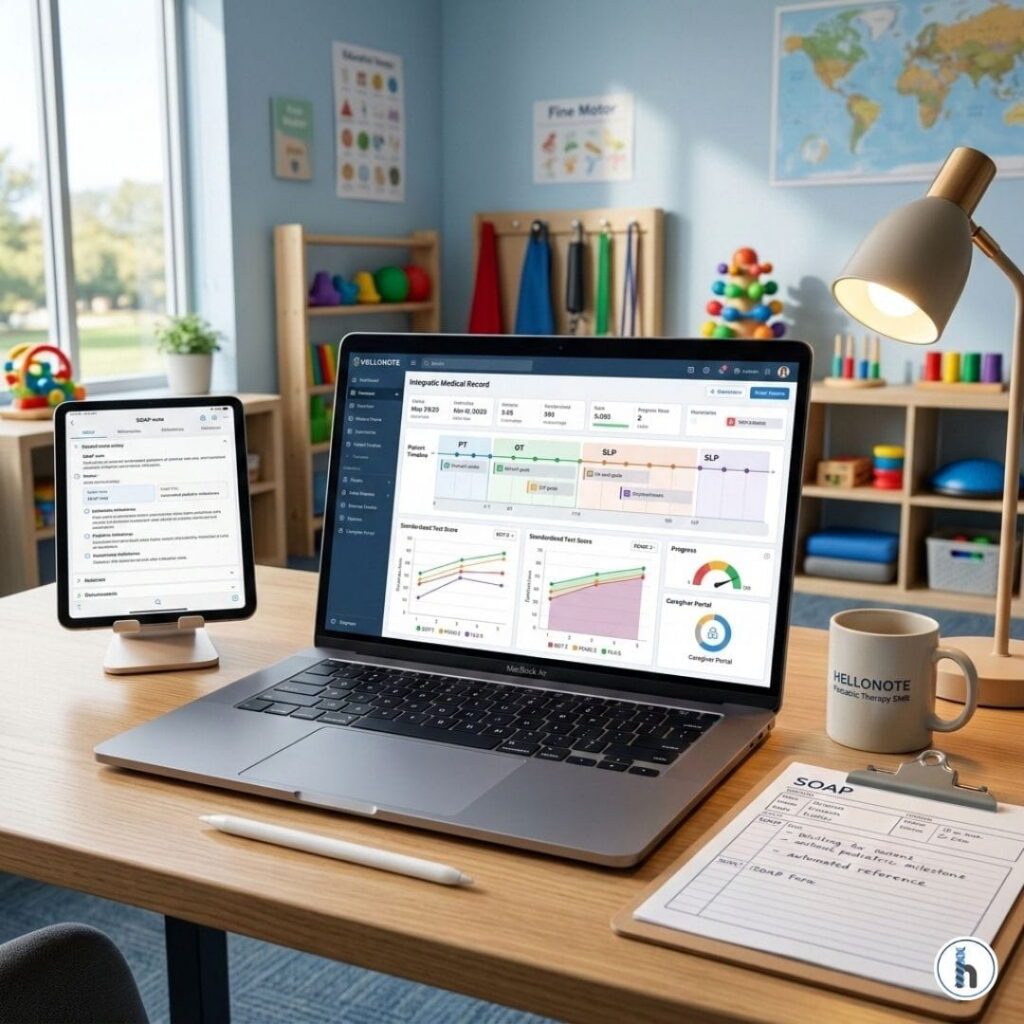
- Standardized Integration: Direct input for the BOT-2 and PDMS-2 (Peabody). The software should auto-calculate percentiles and standard scores, removing the need for manual calculators.
- Objective Tracking: Integrated tools for gait analysis, range of motion (ROM), and muscle tone (Modified Ashworth Scale) that visually graph progress over a 6-month episode of care.
- Equipment Management: Dedicated fields for tracking orthotics (AFOs/SMOs), wheelchair specifications, and durable medical equipment (DME) justifications.
Pediatric Occupational Therapy: Sensory and Independence
For the Pediatric OT, documentation is about the “whole child,” focusing on self-regulation and participation.
- Sensory Processing Profiles: Customizable templates that allow you to document a child’s response to tactile, vestibular, and proprioceptive input.
- Fine Motor & ADLs: One-click tracking for handwriting precision, dressing, and feeding milestones.
- Skilled Intervention Phrases: Smart phrases that describe the grading of an activity (e.g., “Therapist provided moderate tactile cues to facilitate pincer grasp during play-based task”).
Pediatric Speech-Language Pathology: Communication and Feeding
SLPs often have the most diverse goal banks, ranging from non-verbal communication to complex dysphagia.
- AAC Integration: Specialized fields for documenting a child’s proficiency with Augmentative and Alternative Communication (AAC) devices.
- Articulation & Language: Pre-loaded goal libraries for phonology, pragmatics, and expressive/receptive language.
- Feeding & Swallowing: High-compliance templates for oral-motor exams and swallow studies, ensuring every safety measure is documented for medical necessity.
3. The Compliance Frontier: Medicaid, IEPs, and 2026 Regulations
One of the biggest headaches for multidisciplinary clinics is the “Dual-Payer” problem. You may be billing private insurance for one child, Medicaid for another, and a school district for a third.
- The IEP-to-SOAP Bridge: Your EMR should allow you to carry over Individualized Education Program (IEP) goals into your clinical SOAP notes, ensuring your documentation satisfies both educational and medical requirements.
- Automatic Modifier Logic: The system should intelligently apply the GP (PT), GO (OT), and GN (SLP) modifiers based on the therapist’s credentials, preventing “simple” billing errors that lead to massive revenue leaks.
- Audit-Ready Documentation: With 2026’s increased scrutiny on “Skilled Care,” your software should prompt therapists to include the “why” behind their interventions, ensuring notes are always audit-proof.
4. Transforming the Caregiver Experience
In pediatrics, the “patient” is the entire family unit.
- The Digital Parent Portal: Modern parents expect to receive Home Exercise Programs (HEPs) via video on their phones, not on a crumpled piece of paper.
- Sibling Record Linking: Clinic admins save hours when they can link sibling accounts for unified billing and scheduling.
- HIPAA-Compliant Messaging: Direct, secure lines of communication between the therapist and parent ensure that carryover happens at home, leading to 25% faster goal mastery.
Frequently Asked Quetions
Q1. Can one EMR handle PT, OT, and SLP documentation in a single pediatric patient chart?
Yes. HelloNote allows for a unified patient record where therapists from different disciplines can see each other’s goals and progress, ensuring truly coordinated care.
Q2. Does the software include pediatric-specific standardized tests like the BOT-2 or PLS-5?
Absolutely. We provide automated templates for the most common assessments, allowing you to enter raw data and receive instant scoring and graphing.
Q3. How does the EMR support Medicaid billing and IEP compliance?
Our system is built with built-in rules for Medicaid and school-based billing, ensuring that your documentation meets the high threshold for “medical necessity” required for reimbursement.
Q4. What features help improve speed in a high-volume pediatric clinic?
We focus on Interaction to Next Paint (INP) optimization, meaning the software responds at the speed of your touch, even in clinics with complex, data-heavy patient charts.
Q5. Can I track developmental milestones and growth charts within the software?
Yes. Integrated CDC and WHO growth charts allow you to plot height, weight, and developmental progress directly within the clinical note.
Q6. Is there a parent portal for Home Exercise Programs (HEP) and messaging?
Yes. Our portal allows families to access video-based HEPs and communicate securely with their therapy team, improving engagement and outcomes.
Q7. How does the system handle billing modifiers (GP, GO, GN) for multidisciplinary claims?
The software automatically detects the therapist’s discipline and applies the correct modifier to the claim, ensuring higher first-pass acceptance rates.
Building Your Pediatric Center of Excellence
Choosing an EMR isn’t just about software—it’s about the future of your clinic. By choosing a platform that understands the specific needs of PT, OT, and SLP, you are investing in your therapists’ sanity and your patients’ success.
Ready to see a multidisciplinary demo? Connect with our Pediatric Specialists today.