


















Table of Contents
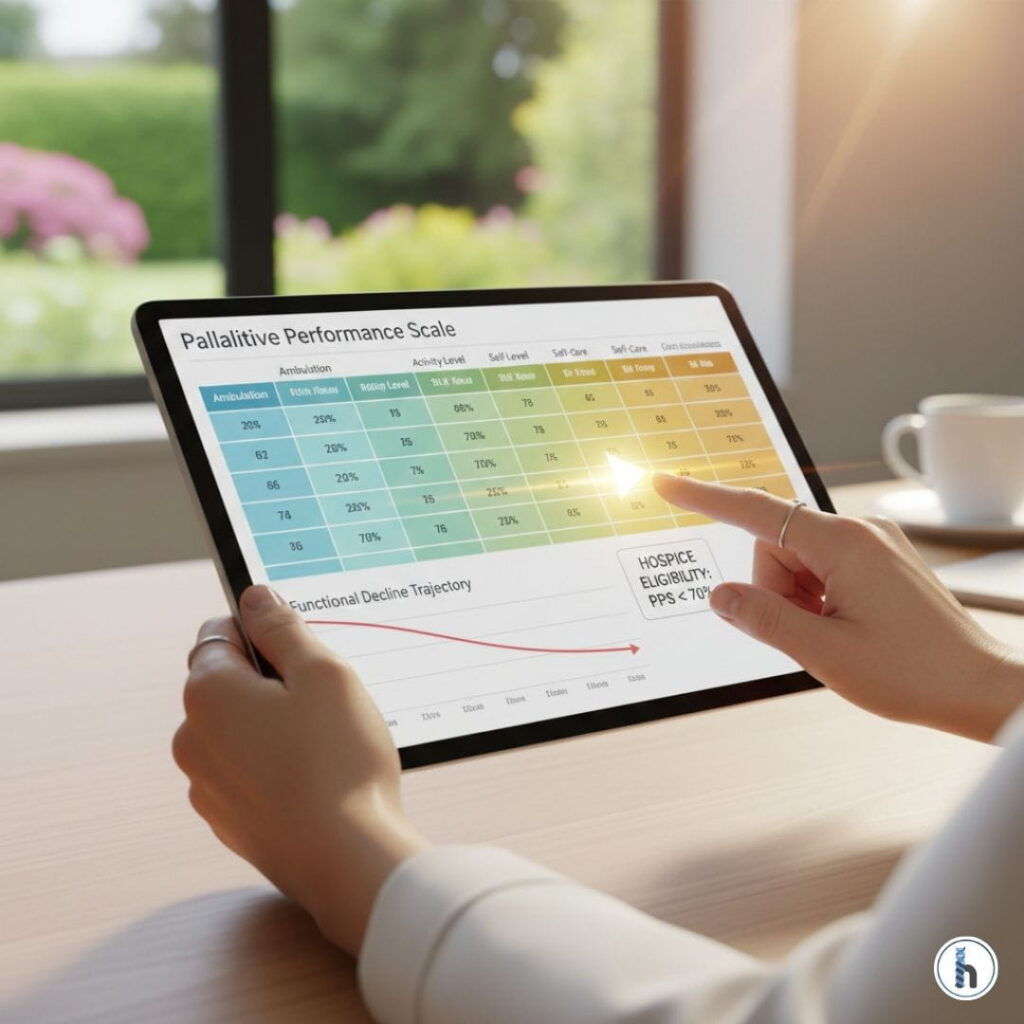
The Palliative Performance Scale (PPS) is a validated functional assessment tool that measures five key domains—ambulation, activity level and evidence of disease, self-care, oral intake, and level of consciousness—to evaluate patients in palliative and end-of-life care settings. Developed in 1996 by Fern Anderson and Michael Downing at Victoria Hospice, the PPS was created as a modification of the Karnofsky Performance Scale (KPS) to better capture the functional declines specific to palliative care populations.
The Origin and Purpose of the PPS Scale
The PPS was introduced to address the limitations of existing prognostic tools. Instruments like the KPS often fail to account for the rapid fluctuations in oral intake or consciousness that occur once a patient becomes bedridden.
Unlike tools that rely heavily on a specific diagnosis, the PPS is function focused. By assessing the patient’s ability to perform activities of daily living—such as mobility, personal hygiene, and eating—the PPS allows clinicians to capture the real-world condition of the patient, which is essential for determining prognosis and treatment intensity.
The Five Functional Domains of the PPS Scale
The PPS measures five functional domains, with each level ranging from 0% to 100% in 10% increments.
Ambulation Domain
This domain categorizes mobility from “Full” (no restrictions) to “Totally bed bound” (unable to get out of bed or perform self-care).
Activity Level and Evidence of Disease Domain
This measures both daily routines (work, hobbies) and the physical evidence of disease. For example, in congestive heart failure, “extensive” disease refers to multiple hospitalizations despite optimal medical management.
Self-Care Domain
This tracks the level of assistance required, ranging from “Full independence” to “Total care,” where the patient requires assistance for all aspects of daily living.
Oral Intake Domain
This ranges from “Normal” eating habits to “Mouth care only,” indicating no oral intake at all.
Level of Consciousness Domain
This evaluates cognition and alertness, ranging from “Full” orientation to “Drowsy or comatose,” where the patient shows no response to external stimuli.
How to Use the PPS Scale in Clinical Practice
The PPS is completed by reading left to right, finding the best horizontal fit for the patient.
Step-by-Step: Start with ambulation, move across the domains, and apply leftward dominance when columns conflict.
Clinical Judgment: Always select the best overall fit. PPS scores are only valid in 10% increments; a score of 45% is not valid—you must use your judgment to determine if 40% or 50% is more accurate.
Determining Hospice Eligibility with PPS in 2026
PPS scores remain a gold standard for hospice referral.
Oncology: 70% or below.
Non-Cancer (e.g., Dementia, Heart Failure): 50% or below.
Functional Decline and Utilization Signals
Clinicians should track PPS trajectories over time. A patient with a PPS trending below 70% combined with weight loss or multiple emergency department visits in the last 90 days suggests that survival beyond six months is unlikely.
Distinguishing Eligibility from Readiness
Eligibility is regulatory (Medicare six-month prognosis), while readiness is clinical and relational. Often, a patient meets the eligibility criteria but lacks the family support or personal readiness to transition to comfort care.
Readiness Cues: Patient-reported statements like, “I am tired of the hospital,” or “I want to be at home.”
Common Misinterpretations
PPS is not a clock: It tracks functional need, not a specific expiration date.
Function does not equal comfort: A patient with a higher PPS can still suffer from severe, uncontrolled pain.
Decline patterns vary: The same score has different implications for a cancer patient versus a patient with dementia.
Clinical Applications Beyond Hospice
Interdisciplinary Collaboration: Provides a shared language across teams.
Workload Assessment: Helps determine if a patient needs increased home health aide hours or continuous home care.
Treatment Planning: Informs mental health therapists whether to focus on insight-oriented therapy or comfort and legacy work.
How Practice Management Systems Support Documentation
Integrated practice management systems (like HelloNote) allow clinicians to document PPS scores, track decline trajectories, and generate reports that support hospice eligibility, significantly reducing administrative burden.
Frequently Asked Questions
Q1. Does a low PPS score mean death is imminent?
No. PPS is a functional indicator of dependency, not a survival guarantee. Prognosis should always be communicated as a range.
Q2. Why is "leftward dominance" important in the PPS?
It prioritizes the most stable indicators of decline, such as ambulation, ensuring clinicians do not over-score a patient based on less significant, fluctuating symptoms.
Q3. What is the difference between hospice eligibility and patient readiness?
Eligibility is defined by medical prognosis (six months or less), while readiness involves the patient and family’s emotional and physical capacity to accept a comfort-oriented plan.
Q4. How can therapists use PPS scores for treatment planning?
PPS scores help therapists adjust the intensity of their care. A very low PPS score suggests a shift toward palliative comfort, legacy work, and family support, rather than aggressive rehabilitative therapy.
Q5. How do I document functional decline trends effectively?
Document the trajectory rather than a single number. Linking objective PPS scores with specific clinical milestones—such as “FAST 7D with recurrent aspiration”—builds a stronger, more defensible clinical record.