

















Table of Contents
Most billing friction in rehab therapy happens in the “dead space” between a finalized note and a submitted claim. For Remote Therapeutic Monitoring (RTM), the 2026 CMS updates have eliminated the “all-or-nothing” 16-day rule. HelloNote helps you navigate these new tiers with a closed-loop system that automates CPT coding for both short-duration (2–15 days) and standard (16–30 days) monitoring, ensuring your practice is fully reimbursed for every unit of care delivered.
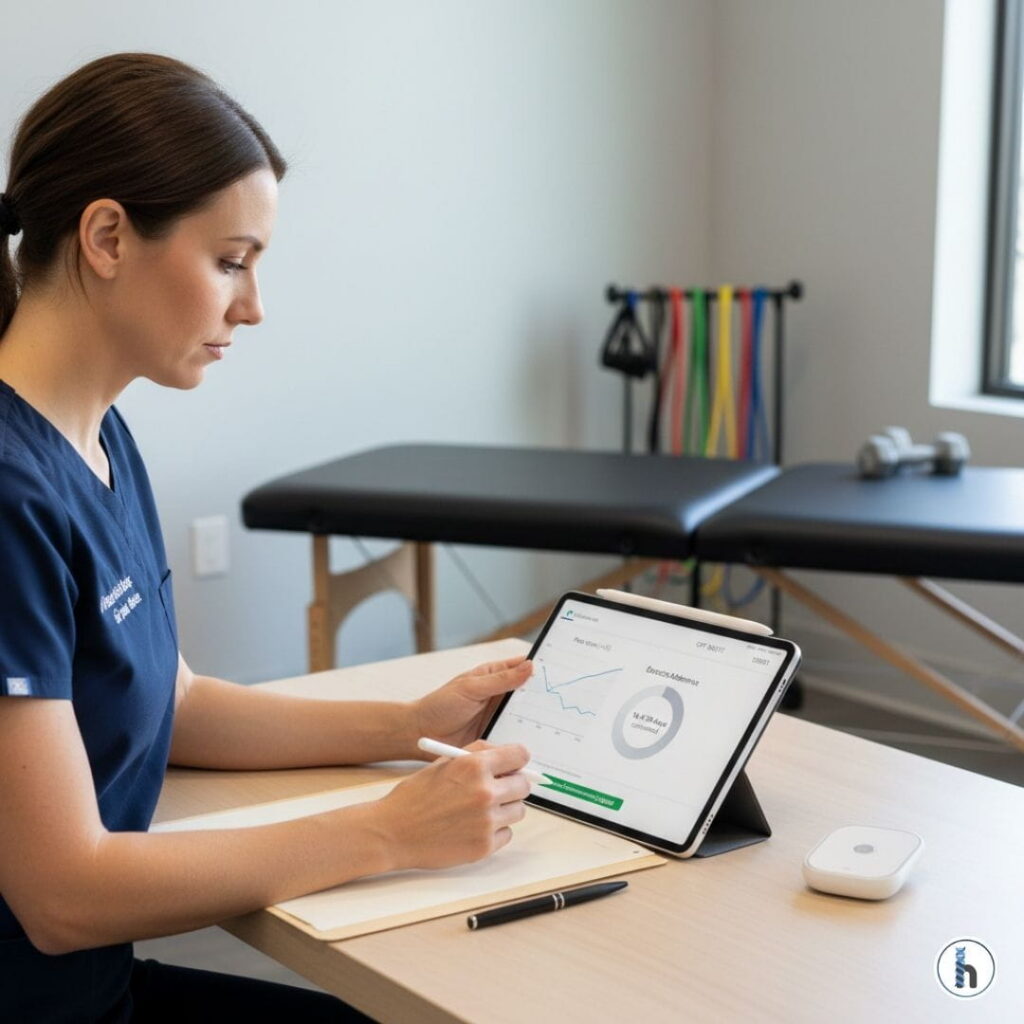
The 2026 RTM Revolution: Tiered Billing is Here
Historically, RTM was a high-stakes gamble. If a patient transmitted 15 days of data instead of 16, the clinic received $0 for that month. As of January 1, 2026, CMS has introduced a tiered structure that mirrors how patients actually engage with digital health tools.
This “Tiered Transformation” allows PTs, OTs, and SLPs to bill for non-face-to-face management of musculoskeletal (MSK) and respiratory conditions with far greater flexibility.
Breaking Down the New 2026 RTM Code Set
The 2026 update introduced two critical “bridge” codes that capture revenue that was previously lost to the “16-day cliff.”
-
-
CPT 98985 (NEW): MSK monitoring for 2–15 days of data transmission.
-
CPT 98979 (NEW): First 10–19 minutes of treatment management time.
-
CPT 98977 (REVISED): MSK monitoring for the standard 16–30 days of data.
-
2026 National Average Reimbursement Rates
Reimbursement rates for 2026 reflect a modest increase in the Medicare conversion factor. Below is the essential coding map for your billing department.
| CPT Code | Definition | 2026 Requirement | Est. National Rate |
| 98975 | Initial Setup & Education | 1-on-1 Patient Training | ~$21.71 |
| 98985 | MSK Monitoring (Short) | 2–15 Days of Data | ~$40.08 |
| 98977 | MSK Monitoring (Standard) | 16–30 Days of Data | ~$40.08 |
| 98979 | RTM Management (Tier 1) | 10–19 Minutes | ~$26.39 |
| 98980 | RTM Management (Tier 2) | 20+ Minutes | ~$54.11 |
Clinical Methodology and Regulatory Context
Unlike Remote Patient Monitoring (RPM), which focuses on physiological data (blood pressure, heart rate), RTM is designed for therapeutic data. This includes exercise adherence, pain scores, and functional responses.
The "Medical Device" Requirement
The 2026 software or hardware you use must meet the FDA definition of a medical device—often categorized as SaMD (Software as a Medical Device). Manual self-reporting into a standard spreadsheet does not qualify for RTM billing.
General Supervision Rules
RTM is a “General Supervision” service. This means you do not need to be in the same room (or even the same building) as the clinical staff performing the monitoring. However, the billing therapist must provide the overall direction and take ultimate responsibility for the care plan.
The "Therapist’s Insight": Winning the Engagement Battle
Even with the new 2-day minimum for short-duration billing, higher engagement leads to better clinical outcomes. In my experience, a “Day 12 Check-in” is the secret to moving a patient from the 98985 tiers (2–15 days) to the full 98977 tier (16–30 days).
Using HelloNote to Automate the "Nudge"
In HelloNote, I use the Patient Authorization Report logic to flag RTM patients. If a patient hasn’t synced their device in 72 hours, the system alerts the front desk to send a secure “nudge” message.
Frequently Asked Questions
Q1. Can I bill 98977 if the patient reports their pain via a phone call?
No. RTM requires data to be transmitted via a qualifying medical device. While the call counts toward management time (98979/98980), the data itself must be device-generated to satisfy the supply codes.
Q2. Does "Interactive Communication" have to be a video call?
No. It can be a phone call or a secure, two-way asynchronous HIPAA-compliant chat. However, it must be a documented clinical exchange; simply leaving a voicemail does not meet the requirement.
Q3. Can a PTA or COTA perform the monitoring?
Yes. Under 2026 guidelines, clinical staff (PTAs/COTAs) can perform the monitoring and management (98979/98980) under the general supervision of the therapist.
Q4. What is the difference between RTM and RPM?
RPM monitors physiologic data (e.g., blood pressure). RTM monitors non-physiologic therapeutic data (e.g., pain levels, HEP adherence). Physical and Occupational Therapists typically bill RTM codes.
Q5. How often can I bill for the initial setup (98975)?
98975 is billed once per episode of care. If a patient is discharged and then re-referred for a new condition six months later, you may bill the setup code again for the new episode.
Final Thoughts: Scaling Your Virtual Care
The 2026 RTM updates prove that CMS is committed to digital health. By lowering the barriers to entry with short-duration codes, they’ve made it possible for every clinic to build a sustainable remote care program.