



















Table of Contents
Massage therapy plays an important role in rehabilitation, pain management, and functional recovery. Yet for many therapists and clinic owners, one question keeps coming up:
Is massage therapy covered by insurance?
The answer is not a simple yes or no. While massage therapy can be covered by insurance, reimbursement depends far less on the technique itself and far more on medical necessity, documentation, coding accuracy, and compliance.
This guide explains when massage therapy is covered by insurance, why claims are often denied, and what clinics must do to bill correctly and protect revenue.
When Is Massage Therapy Covered by Insurance?
Massage therapy is generally reimbursable only when it is delivered as skilled medical care, not as a wellness service. Most payers look for four core requirements:
- The service is medically necessary
- It is part of a formal plan of care
- It is ordered or supervised by a licensed provider
- It is documented and billed using appropriate CPT codes
When these conditions are met, massage therapy covered by insurance typically appears in cases such as:
- Post-surgical rehabilitation involving soft tissue mobilization
- Treatment of musculoskeletal injuries under a PT, OT, or chiropractic plan
- Neuromuscular re-education where massage techniques support functional goals
Massage for relaxation, stress relief, or general wellness is not reimbursable.
What Insurance Companies Are Really Looking For

Insurance payers do not reimburse based on intent they reimburse based on proof. To approve claims involving massage therapy, documentation must clearly demonstrate the following:
Medical Necessity
Your notes must establish:
- A qualifying diagnosis
- Functional impairments
- Clinical rationale explaining why massage therapy is required
Goal-Based Treatment Justification
Each session should connect:
- Diagnosis
- Intervention
- Measurable functional improvement
If progress is not documented clearly, coverage is often denied—even when care is appropriate.
Correct CPT Code Usage
Massage therapy billing most often involves:
- 97124 – Therapeutic massage
- 97140 – Manual therapy
Using the wrong code, failing to justify time, or misclassifying the service can quickly invalidate a claim.
Consistent, Defensible Documentation
Payers expect:
- SOAP notes tied to functional goals
- Accurate time tracking per service
- Objective outcome measurements
Without this structure, massage therapy covered by insurance becomes difficult to defend.
Why Massage Therapy Claims Commonly Get Denied
Even clinics delivering high-quality care can experience denials due to workflow breakdowns. The most common reasons include:
- No clear link between diagnosis and intervention
- Incorrect CPT codes or missing modifiers
- Lack of objective progress tracking
- Vague or incomplete SOAP notes
- Using a generic EMR not built for rehab billing
When documentation and billing are misaligned, reimbursement risk increases significantly.
How HelloNote Supports Insurance-Covered Massage Therapy
For clinics providing massage therapy as part of PT, OT, or chiropractic care, HelloNote is designed to support compliant, efficient billing workflows.
How HelloNote Helps Clinics Get Paid
Structured SOAP Notes
Each intervention is linked to supported diagnoses through guided workflows.
Audit-Ready Documentation
Notes are time-stamped, goal-driven, and tied directly to the plan of care.
Integrated Billing Prompts
When massage therapy is documented, relevant CPT codes surface automatically reducing errors and missed charges.
By aligning documentation and billing from the start, massage therapy covered by insurance becomes easier to manage and defend.
Clinics That Benefit Most from This Workflow
HelloNote is especially valuable for:
- PT and OT clinics integrating massage into functional rehab
- Chiropractic practices using soft tissue modalities
- Multidisciplinary rehab clinics
- Medical massage practices treating post-injury or surgical patients
If massage therapy is part of skilled care not just a cash service your EMR must support that level of compliance.
Bottom Line: When Massage Is Medical, Your EMR Must Be Too
Massage therapy can be covered by insurance but only when it is:
- Documented as skilled medical care
- Tied to a valid, provider-driven plan of care
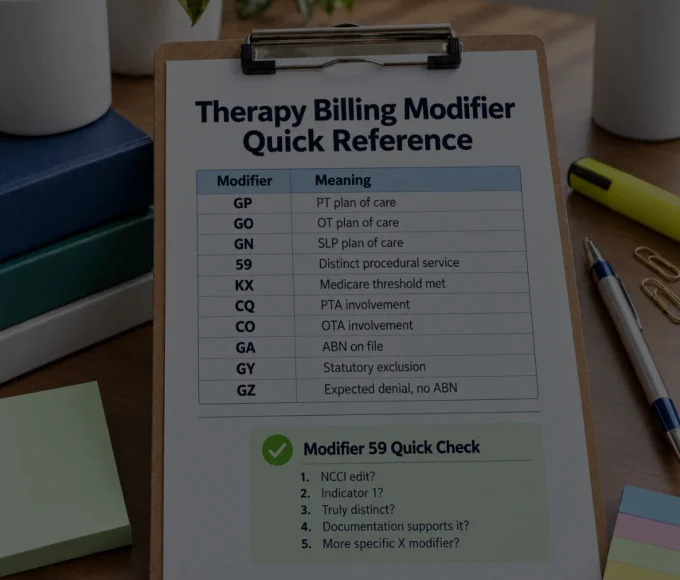
- Billed using compliant codes and modifiers
With HelloNote, clinics gain:
- Smart CPT and HCPCS code guidance
- Built-in medical necessity prompts
- Modifier support
- Audit-friendly documentation structure
Massage Therapy Insurance Coverage: FAQs
Q1. Is massage therapy covered by insurance?
Yes, when it is medically necessary, part of a provider-supervised plan, and properly documented.
Q2. Which CPT codes are commonly used?
97124 (therapeutic massage) and 97140 (manual therapy), depending on technique and intent.
Q3. Why are massage therapy claims denied?
Most denials stem from poor documentation, incorrect coding, or lack of medical necessity not the service itself.
Q4. Does HelloNote support massage therapy billing?
Yes. HelloNote aligns notes, diagnoses, CPT codes, and modifiers for compliant billing.
Q5. What clinics benefit most from HelloNote?
Any clinic providing massage therapy within a medical rehabilitation model, including PT, OT, chiropractic, and integrated care clinics.
Want to Simplify Billing for Massage Therapy?
HelloNote removes the guesswork from reimbursement so clinics can focus on care—not denials.
Book a demo to see how insurance-ready massage therapy workflows work inside HelloNote.

AboutHellonote Expert
The HelloNote Expert Research Team publishes educational resources for physical therapy, occupational therapy, speech therapy, and rehabilitation practices. Their content focuses on documentation workflows, Medicare operations, billing processes, clinician efficiency, AI-assisted charting, and therapy practice management. Articles are developed using healthcare industry research, CMS resources, operational workflow analysis, and therapy-focused EMR expertise.