



















Table of Contents
The 2026 Medicare Physician Fee Schedule has officially lowered the barriers to entry for Remote Therapeutic Monitoring (RTM). With reduced data transmission requirements and more flexible time-tracking codes, RTM is no longer just a “value-add”—it is a permanent, high-growth clinical modality for modern practices.
However, new rules bring new documentation requirements. At HelloNote, we’ve partnered with ptMantra to ensure that these favorable changes translate into actual revenue for your clinic without adding hours of paperwork.
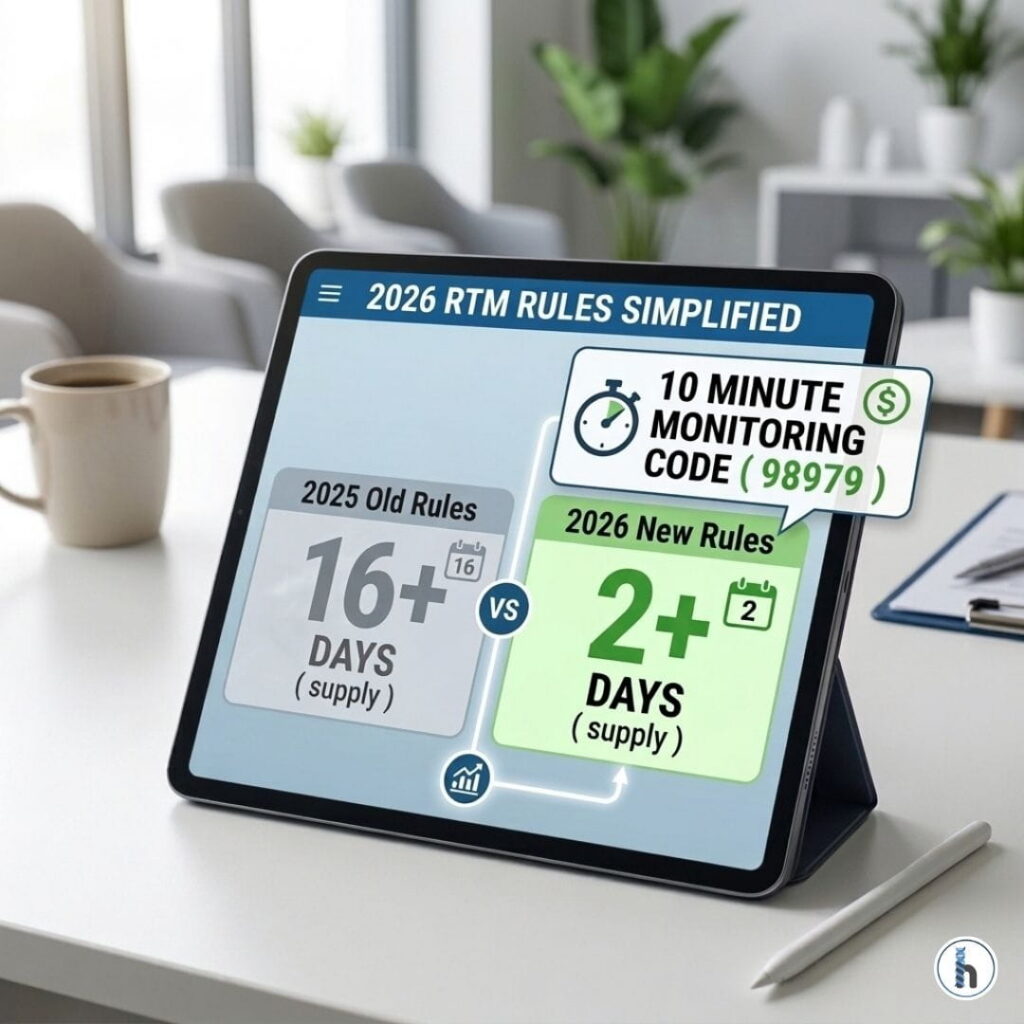
1. The "Two-Day" Revolution (Codes 98984–98986)
The biggest hurdle to RTM in the past was the 16-day data transmission requirement. Under the new 2026 rules, CMS has introduced codes 98984, 98985, and 98986, which allow providers to claim reimbursement when patients transmit data on just two days in a 30-day period.
The EMR Advantage: Through our FHIR-based API integration, ptMantra automatically notifies HelloNote when these transmission thresholds are met. You don’t have to manually count days; the system tracks the data, so you can focus on the clinical response.
2. Get Paid for Every Minute (Code 98979)
Previously, the initial 20-minute threshold (98980) often left providers with “uncompensated” time if they only reached 15 or 18 minutes. The new 98979 code allows for reimbursement at just 10 minutes of monitoring time.
The EMR Advantage: Every minute of “skilled work”—including updating home exercise programs (HEP) or reviewing clinical notes—counts toward this 10-minute goal. Because ptMantra and HelloNote sync clinical note exchanges, your time spent reviewing patient progress is automatically documented, ensuring no minute of care goes unpaid.
3. In-Person Communication Now Counts
One of the most significant clarifications for 2026 is that “interactive communication” no longer has to be a remote phone call or telehealth visit. A simple in-person conversation about RTM during a standard clinic visit now meets the requirement—provided it is documented in the EMR.
The EMR Advantage: HelloNote makes this “extra step” disappear. By documenting your RTM discussion directly within your daily encounter note, you satisfy the CMS requirement without needing to schedule additional follow-up calls.
4. Eliminating the "Extra Work"
The fear of RTM is often rooted in administrative bloat—manual claims, double-entry of data, and patient registration. Our partnership eliminates these hurdles:
Automated Registration: Register patients once in HelloNote; they are automatically synced to ptMantra.
Seamless Claims: Integration allows for the automated submission of RTM codes based on the data captured in ptMantra.
General Supervision: For PTs and OTs, the rules allow PTAs and OTAs to perform monitoring duties. HelloNote’s workflow ensures these are tracked under the required general supervision of the therapist.
The Bottom Line
The 2026 RTM rules are a clear signal from CMS: they want you to use this modality. By combining the clinical power of ptMantra with the administrative efficiency of HelloNote, your clinic can provide better care, improve patient adherence, and tap into new revenue streams—all while keeping your focus where it belongs: on the patient.
Frequently Asked Questions
Q1. What are the new 2-day RTM codes for 2026?
The 2026 update introduces CPT 98984 (Respiratory), CPT 98985 (Musculoskeletal), and CPT 98986 (Cognitive Behavioral). These codes allow for device supply reimbursement when a patient transmits data for 2 to 15 days in a 30-day period.
Q2. Can I bill CPT 98979 and 98980 in the same month?
No. CPT 98979 (10–19 minutes) and CPT 98980 (20+ minutes) are mutually exclusive. You must bill the single code that accurately reflects the cumulative treatment management time reached by the end of the calendar month.
Q3. Does "Interactive Communication" require a video call?
No. For 2026, CMS clarified that interactive communication can be an audio-only telephone call or even an in-person discussion during a standard clinic visit, provided the RTM management time is documented and not double-counted with other services.
Q4. Can PTAs and OTAs perform the monitoring for these codes?
Yes. RTM codes are billed under General Supervision for 2026. This allows physical therapist assistants (PTAs) and occupational therapy assistants (OTAs) to perform the monitoring and interaction under the overall direction of the therapist.
Q5. How does the HelloNote + ptMantra integration prevent billing errors?
The integration uses a FHIR-based API to sync data. When ptMantra detects that a patient has reached the 2-day or 10-minute threshold, it automatically flags the encounter in HelloNote, ensuring you only submit claims that meet Medicare’s technical requirements.