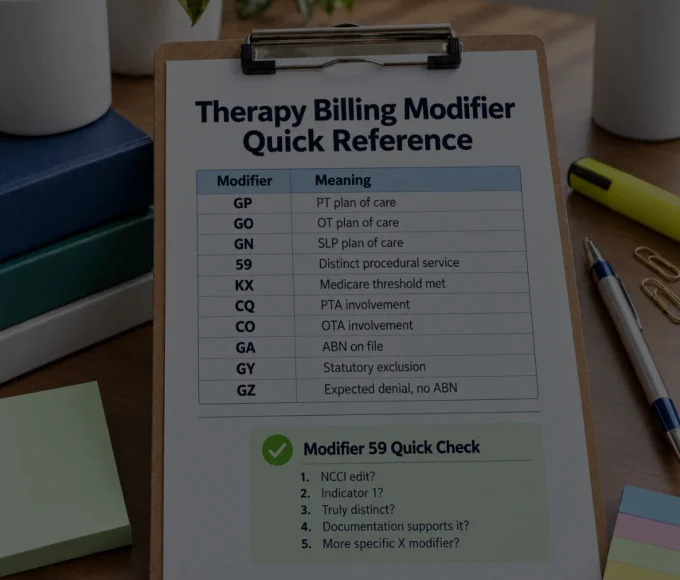




















What is CPT 97110 (Therapeutic Exercise)?
CPT 97110 is a timed therapeutic procedure code for therapeutic exercise targeting a single measurable outcome — strength, endurance, range of motion, or flexibility. Billed in 15-minute units, it requires direct one-on-one licensed therapist contact throughout. It applies when the clinical goal is improving a specific musculoskeletal impairment, not a functional performance deficit.
Key Takeaways
- 97110 targets one outcome per session — strength, endurance, ROM, or flexibility — and the documentation must establish that single-outcome intent explicitly
- The four required documentation elements are: specific exercise name and parameters, actual start and stop time, an objective outcome measure, and a functional goal connection sentence
- The 8-minute rule governs unit billing — track actual time, not estimates, or expect to consistently underbill
- 97110 is for impairment-level musculoskeletal work; 97530 is for functional activity practice; the distinction is clinical intent and must be documented, not assumed
- Laterality is required for every unilateral condition — build it into the template so it cannot be omitted
- Progressive documentation across visits is a billing protection strategy — document what changed, why, and what the next target is at every session
Table of Contents
There is a particular kind of frustration that hits when a claim gets denied for a patient you know you treated correctly. We had a 61-year-old construction foreman last spring — right shoulder, status post rotator cuff repair at eight weeks, progressing well on external rotation strength and doing everything the protocol asked. Three visits in a row came back denied. Not for lack of clinical necessity. Not for missing authorization. For documentation that described exercise without establishing single-outcome therapeutic intent. The insurer could not tell from our notes whether we were running 97110 or 97530. So they decided for us, and they decided wrong.
The thing about CPT 97110 is that it looks deceptively simple. Therapeutic exercise. How complicated can the documentation be? The answer, as anyone who has been through a billing review can tell you, is considerably more complicated than the code definition suggests. The AMA description covers four qualifying outcomes in one sentence. What it does not cover is the audit logic payers use when reviewing claims, the distinction between 97110 and 97530 that trips up experienced therapists, or the specific documentation elements that separate a clean claim from a denial letter.
Our team wants to close that gap in this post. Not the textbook version of 97110 — the version you learn when claims start coming back and you have to figure out why.
What Is CPT 97110 and When Do You Use It?
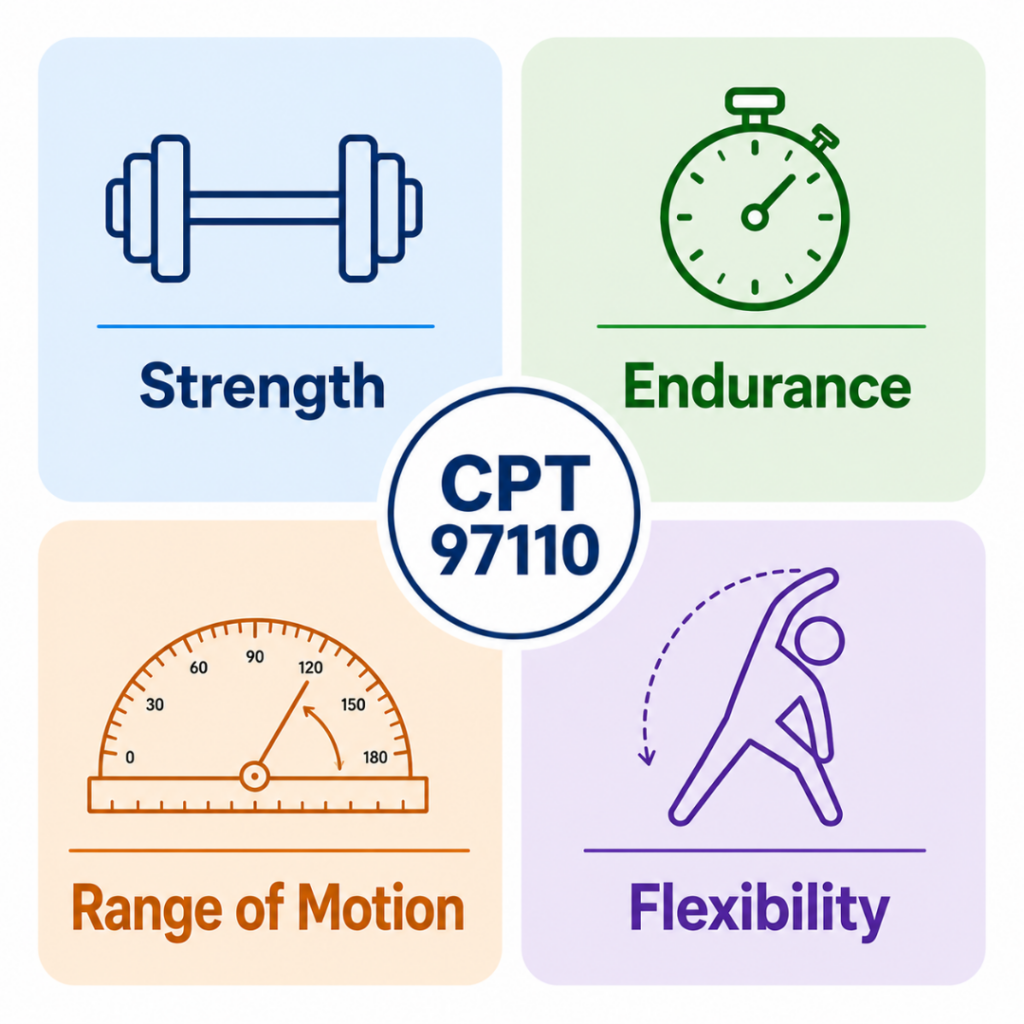
CPT 97110 is a timed therapeutic procedure code for therapeutic exercises designed to address a single measurable impairment: strength, endurance, range of motion, or flexibility. Each unit covers 15 minutes of direct therapist contact. The therapist must be actively involved with the patient for the entire duration — not observing from a distance, not charting at a workstation while the patient runs through a home program.
The clinical boundary that defines 97110 is specificity of target. One impairment. One measurable outcome. One therapeutic direction per session of this code. That is what distinguishes it from 97530 and what makes it defensible when a payer looks at it. When our team trains new clinicians on code selection, the test we use is simple: if you had to describe the goal of this exercise in one word — stronger, more flexible, greater endurance, increased motion — and that one word is accurate and complete, you are in 97110 territory. If you need more than one word to describe what the exercise is trying to accomplish, you likely need 97530.
The Four Qualifying Outcomes in Clinical Practice
- Strength: progressive resistance exercise targeting a specific muscle group or movement pattern with a documented baseline deficit and a measurable strength target.
- Endurance: exercise targeting the ability to sustain a muscle contraction or movement pattern over time, typically tied to a specific activity demand the patient needs to return to.
- Range of motion: structured exercise specifically intended to increase joint or soft tissue mobility, with documented goniometric baseline and target.
- Flexibility: elongation exercises targeting shortened tissue, with documented limitation and functional impact.
Each of these outcomes has one thing in common: you can measure it at baseline, track it across visits, and demonstrate progress toward a documented goal. That measurability is the backbone of a defensible 97110 claim. If our team cannot put a number on the outcome at the start, we cannot justify the code at the end.
Diagnoses and Presentations That Fit 97110
Post-surgical strengthening following orthopedic repair or replacement. Rotator cuff strengthening after tear or repair. Hip and knee strengthening after arthroplasty. Grip and pinch strengthening following hand fracture or tendon repair. In every case the formula is the same: specific tissue or joint, specific measurable deficit, and a specific single-outcome target.
How to Document CPT 97110 Correctly?
Our clinic has reviewed a lot of 97110 notes that were clinically appropriate and documentational thin. The treatment was justified. The paperwork did not show it. After going through that experience ourselves early in our practice and helping other therapists troubleshoot denial patterns, our team has identified four documentation elements that appear in every clean 97110 claim and are absent in most denied ones

BUILT FOR PT, OT & SLP
Still spending 20 minutes on every note?
5,000+ PT, OT AND SLP practices use HelloNote to chart faster – with CPT and ICD-10 codes built directly into every note.
No credit card required · HIPAA Compliant · PT, OT & SLP
The Four Non-Negotiable Documentation Elements
- Name the exercise with clinical specificity
There is a meaningful difference between “shoulder strengthening performed” and “seated dumbbell external rotation, 3 x 12, 3 lb, pain-free arc 0–90 degrees.” The first tells a payer you did something. The second tells a payer you performed a specific skilled intervention at a documented resistance level targeting a specific movement deficit. Only one of those descriptions belongs in a 97110 note.
- Record every parameter
Sets, repetitions, resistance or load, patient position, and any significant modifications. These parameters are the clinical evidence that the exercise was progressive, intentional, and appropriate to the patient’s current status. They also protect you in an audit by showing consistent, documented clinical decision-making across visits.
- Track and document actual time
Start time and stop time for every timed code. Not an estimated range. The 8-minute rule is applied by payers whether you have tracked your time or not. If your documentation does not support the units billed, the units get denied. Our team records start and stop times as a non-negotiable standard for every 97110 session, and it has eliminated unit-related denials from our billing record entirely.
- Write the functional goal connection
This is the element that establishes medical necessity. Without it, the documentation describes a procedure. With it, the documentation describes a medically necessary skilled service. The sentence looks like this: “Shoulder external rotation strengthening targeting 5/5 strength required for patient’s goal of returning to overhead shelf stocking in her retail position.” That sentence connects the impairment-level work to the patient’s functional life, and it is the difference between a clean claim and a denial.
Why Our Team Stopped Writing Impairment-Only Notes
For the first two years our clinic was open, our therapists documented impairments well and functional connections poorly. Our notes were accurate records of what happened in the room. They were weak arguments for why a licensed therapist needed to make it happen. We had excellent goniometry. We had detailed exercise logs. What we did not consistently have was the sentence that linked the goniometry and the exercise log to something the patient needed to do in their daily life.
The shift happened after a Medicare review flagged a pattern in our billing and a billing consultant walked through our notes line by line. She was not pointing out clinical errors — she was pointing out documentation that told half the story. We updated our templates, retrained our team, and made functional goal connection a required field rather than a recommended one. Our denial rate dropped measurably within the next billing quarter. The clinical work had not changed at all.
CPT 97110 vs 97530 — The Distinction That Determines Your Claim
More therapists get this distinction wrong than any other code selection question our team encounters. The confusion is understandable because the activities genuinely overlap. A patient performing progressive strengthening can look identical to a patient performing functional activity practice from across the room. The difference is not visible. It is clinical and it is documented.
Looking up more cpt codes?
See 97110, 97530, and 50+ therapy procedure codes – with billing guidance and documentation tips in one place.
The System Being Treated
97110 addresses a musculoskeletal impairment — a specific deficit in the contractile or mechanical capacity of tissue. The exercise targets that tissue directly. The measure of success is a change in the tissue’s capacity: stronger, more mobile, better endurance. 97530 addresses a functional performance deficit — the patient’s inability to perform an activity of daily life or work task. The activity simulates or replicates that task. The measure of success is the patient’s ability to perform the functional task.
The Functional Arc Test
Our clinic trains therapists to apply what we call the functional arc test when selecting between 97110 and 97530. Does the activity look like something the patient would do in their daily life? Does it involve multiple joints moving through a functional pattern? Does it require the patient to coordinate movement across body regions simultaneously? If the answers are yes — it is 97530 territory. Does the activity isolate a single muscle group or movement direction? Does it target one specific measurable capacity? Does it function as a building block for functional movement rather than the movement itself? Those answers point to 97110.
A patient performing seated leg press for quadriceps strengthening after knee replacement is 97110. The same patient performing step-up and step-down practice targeting stair negotiation is 97530. The knee is involved in both. The clinical target — tissue capacity versus functional performance — is different in each.
Common Billing Mistakes and How to Avoid Them
These are the five documentation and billing errors our team has seen most often when reviewing denied 97110 claims — in our own practice early on and in conversations with therapists whose billing patterns we have helped troubleshoot.
Mistake 1 — Writing Exercise Descriptions Without Medical Necessity
The most common and most preventable error. A note that describes an exercise program accurately but does not establish why that program was medically necessary for this specific patient on this specific date is a denial waiting to happen. Medical necessity in outpatient therapy means demonstrating that a specific functional limitation exists, that it is caused by a specific impairment, and that the skilled therapeutic exercise being provided is specifically designed to address that impairment in service of that functional goal. All three elements need to be in the note. Exercise descriptions alone satisfy none of them.
Mistake 2 — Estimating Treatment Time
Our team analyzed our billing records during our first year and found that therapists who estimated treatment time were underbilling by an average of 4 to 6 minutes per timed code per session. Under the 8-minute rule, that gap translates to a lost unit on roughly one in four visits. Across a practice seeing 20 patients a week, that is $250 to $350 in unrecovered revenue every week — not from poor clinical work, not from billing errors, but from rounding down on time documentation.
Mistake 3 — Applying 97110 to Multi-Outcome Activities
97110 requires a single therapeutic target. When the documented intent of an exercise spans multiple outcomes — strengthening and coordination, range of motion and balance, endurance and functional movement pattern — the activity has crossed into 97530 territory. Our clinic had a period early on where therapists were defaulting to 97110 for exercises that involved both strength and functional movement components because the documentation template was familiar. The payer pattern review that followed was not something our team wanted to repeat. Code to what you are actually treating, document the single-outcome intent explicitly, and reserve 97110 for interventions where that intent is genuine.
Mistake 4 — Missing Laterality on Unilateral Diagnoses
A claim for shoulder strengthening without documented laterality is a CO-4 denial waiting to happen. Left, right, or bilateral must appear in the documentation for every unilateral condition. This takes two seconds to add and costs three weeks to fix after a denial. Our team built laterality as a required field in every 97110 note template so it cannot be omitted.
Mistake 5 — Not Progressing the Exercise Across Visits
Payers reviewing multiple visits of 97110 expect to see a progression narrative — documented changes in resistance, repetitions, range, or difficulty that demonstrate the skilled therapeutic process is advancing in response to the patient’s improvement. Notes that show identical exercise parameters across four or five visits raise a medical necessity flag. Our team documents progression explicitly at every visit: what changed from last session, why it changed, and what the next target is.
CPT 97110 in Practice — What We Actually Do
Our team’s 97110 workflow is built around three decisions that are made before the intervention begins, not during charting at the end of the day. When those three decisions are documented at the point of care, the note practically writes itself.
- Decision 1: What is the single outcome we are targeting today?
Strength, endurance, ROM, or flexibility — one of the four, stated explicitly before the intervention begins. If the honest answer involves more than one, we are looking at 97530. This decision is made during the pre-treatment assessment and documented before the first exercise.
- Decision 2: What is the measurable baseline and target for this session?
We do not begin a 97110 session without a number: current strength grade, current ROM measurement, current repetitions to fatigue. The target for the session is documented alongside the baseline. Without this, the exercise is undirected. With it, the session has a clinical purpose that the note can communicate.
- Decision 3: Which plan of care goal does this session advance?
The note structure our team follows: specific exercise name, patient position, sets and reps, resistance level, start and stop time, session outcome measure compared to baseline, and the functional goal connection sentence. It takes under four minutes to write and has survived every billing review our clinic has been through.
How HelloNote Handles CPT 97110 Documentation
The 97110 template in HelloNote was built around the failure mode we saw most often in billing reviews: clinically appropriate interventions getting denied because the note did not establish functional goal connection. Our team designed the template so that connection cannot be skipped. The system will not allow sign-off until the exercise has been linked to a plan of care goal. That single structural requirement has reduced 97110 denial rates for our users more than any other feature in the template.
Here is what the 97110 workflow does inside HelloNote:
- Functional goal linkage — Required before sign-off. The template pulls active plan of care goals into a selection field so the therapist links the exercise to the relevant goal in one click rather than one paragraph.
- Start and stop time entry — Time fields are built into the timed code section. HelloNote calculates billable units using the 8-minute rule automatically. The therapist enters actual times; the system handles the unit math.
- Exercise parameter fields — Structured inputs for exercise name, position, sets, reps, and resistance. Structured fields are faster to complete than free text and produce notes that are consistent, specific, and payer-ready.
- Laterality selector — Built into every unilateral code entry. One click, never omitted.
- Outcome measure entry — A dedicated field for the session’s objective measurement so baseline-to-current comparison is captured at the point of care, not reconstructed later.
- Pre-submission claim scrub — HelloNote checks the 97110 claim against common denial triggers before it goes out and flags missing elements for review. The therapist addresses gaps before the claim leaves the building.
The design principle behind every element of the HelloNote 97110 template is that correct documentation should be the path of least resistance. Not an extra step at the end of a long day. The default.
READY TO STREAMLINE YOUR CLINIC?
See How HelloNote Handles All of This in One Platform
Managing staff hours, compliance, inventory, and financial reports — all inside one HIPAA-compliant EMR built for PT, OT, and SLP clinics.
No credit card required · HIPAA Compliant · PT, OT & SLP
Frequently Asked Questions About CPT 97110
What is CPT 97110?
CPT 97110 is a timed therapeutic procedure code used to bill for therapeutic exercise targeting a single outcome — strength, endurance, range of motion, or flexibility. Billed in 15-minute units, it requires direct one-on-one therapist contact throughout the service and is one of the most commonly billed codes in outpatient physical and occupational therapy.
When should I use CPT 97110?
Use 97110 when the therapeutic intent of your exercise is to address a single measurable impairment in one of the four qualifying categories. Building hip abductor strength after hip fracture, increasing shoulder external rotation ROM after repair, improving handgrip endurance for a manual labor return to work — these are 97110. If the exercise serves multiple simultaneous functional purposes or replicates an ADL, 97530 is likely more accurate.
What documentation is required to avoid a 97110 denial?
Every 97110 note needs four elements: the specific exercise name and parameters, actual start and stop time, an objective outcome measure compared to baseline, and a sentence explicitly connecting the exercise to a functional goal in the plan of care. The functional goal connection is the element most often missing from denied claims and the one that establishes medical necessity.
How many units of 97110 can I bill per session?
Units are determined by the 8-minute rule: one unit requires at least 8 minutes, two units require at least 23 minutes, three units require at least 38 minutes, four units require at least 53 minutes. Document actual start and stop times. Estimated durations are not defensible and will not support billing if the claim is reviewed.
What is the difference between 97110 and 97530?
97110 targets a musculoskeletal impairment — the contractile or mechanical capacity of tissue. 97530 targets a functional performance deficit — the patient’s ability to perform an activity of daily life or work task. The same exercise can fall under either code depending on clinical intent and documentation. The distinction must be explicit in the note.
What triggers an audit or denial for 97110?
Common triggers include missing functional goal documentation, time records that do not support the units billed, billing 97110 for multi-outcome activities that should be 97530, missing laterality, and absence of progression documentation across multiple visits. Secondary triggers
How does HelloNote help with 97110 documentation?
HelloNote’s 97110 template requires functional goal linkage before sign-off, includes start and stop time fields with automatic 8-minute rule unit calculation, structures exercise parameters into specific fields, and runs a pre-submission claim scrub. The template makes the four required documentation elements the default path through the note rather than an additional step.
Start Your Journey to Better CPT 97110 Documentation
Every 97110 claim is a record of skilled clinical work. The documentation should reflect that — not because payers demand it, but because your patients and your practice deserve notes that accurately represent what happened in that room and why it mattered. The right documentation habits are the difference between a billing system that protects your revenue and one that erodes it slowly and invisibly.

AboutDmitry Shevchenko, OTR/L
Dmitry Shevchenko, OTR/L is a licensed Occupational Therapist
and the COO of HelloNote EMR. With firsthand experience as both
a practicing clinician and a multi-location clinic operator,
Dmitry brings a unique operational perspective to HelloNote's
product development — having navigated the exact payroll,
compliance, and inventory challenges this platform is built
to solve.