












What is the difference between a native AI scribe and a third-party AI scribe in therapy?
A native AI scribe is built directly inside your EMR platform. The note draft is created within the patient record automatically, with no separate app, no copy-paste step, and no workflow gap. A third-party AI scribe is an external tool that records and processes session audio independently, then requires a manual transfer into the EMR. Native integration eliminates the hidden administrative tax that third-party tools create at every step of the documentation workflow.
Key Takeaways
- A native AI scribe lives inside your EMR. No switching apps, no copy-pasting, no workflow gap between the note draft and the patient record.
- Third-party AI scribe tools create a hidden integration tax: separate logins, separate BAAs, separate billing, and a copy-paste step that introduces documentation errors.
- When your AI scribe and your EMR share the same patient data, the draft note is already connected to the right case, the right payer, and the right CPT code context.
- HelloNote AI Scribe is built into the EMR, not integrated with it. That distinction changes everything about how documentation actually works in practice.
Table of Contents
We tried a third-party AI scribe before we built our own. We want to be honest about that, because it is relevant to everything, we are about to say.
The tool transcribed accurately enough. The notes it generated were reasonable first drafts. On paper, the workflow made sense: record the session in the scribe app, review the transcript, copy the note into HelloNote, connect it to the right patient, check that the payer information matched, reformat the sections to fit our documentation requirements, then sign. Seven steps where there should be two.
What nobody told us about third-party AI scribes is that the workflow gap between the tool and the EMR is where the time goes. Not in the recording. Not in the AI processing. In the space between a note that exists somewhere else and a finalized record that lives where it needs to live. We called that gap the hidden tax. Every practice using a third-party scribe is paying it, usually without calculating how much it actually costs per patient, per day, per year.
That experience is directly why HelloNote AI Scribe is native. Built inside the EMR, not connected to it from the outside. This post breaks down what that difference actually means in clinical practice, and why it matters more than most therapy practices realize before they make a documentation technology decision.
The Hidden Tax of Stitching Tools Together
How much time does a third-party AI scribe actually cost per session compared to a native tool?
A third-party AI scribe adds four to eight minutes of administrative time per session in copy-pasting, reformatting, and app-switching that a native workflow eliminates entirely. Across ten patients a day, that is 40 to 80 minutes of daily administrative time per therapist. Across a three-therapist practice, that is two to four hours every day that exists solely because the documentation tool and the patient record live in different places.
The word “integration” gets used loosely in healthcare software. Most of the time it means two products have been configured to share some data through an API. That is not the same as native. Integration means two systems talking to each other. Native means one system that does not need to talk to itself.
The Copy-Paste Step Is a Clinical Risk
When a therapist generates a note in a third-party AI scribe tool and then copies it into an EMR, that copy-paste step is not just inconvenient. It is a documentation integrity risk. Formatting gets lost. Sections get misaligned. A note generated for a Tuesday session gets pasted into a Wednesday encounter. Laterality details that were correct in the scribe tool get corrupted in the paste. These are not hypothetical errors. They are the kinds of documentation inconsistencies that show up in audits and payer reviews.
With a native AI scribe, there is no copy-paste step. The draft note is created inside the EMR, attached to the correct patient encounter, with the correct date, the correct case, and the correct payer context already populated. The risk does not exist because the workflow gap does not exist.
Switching Between Apps Costs More Time Than You Think
A therapist who records a session in a third-party scribe app, reviews the transcript, opens the EMR, navigates to the correct patient, pastes the note, reformats it, and then finalizes it has added approximately four to eight minutes of administrative work per session compared to a native workflow. Across ten patients a day, that is 40 to 80 minutes. Across a practice with three therapists, that is two to four hours of daily administrative time that exists solely because the documentation tool and the patient record live in different places.
Training Your Team on Two Systems
Every tool a practice adopts requires onboarding. A third-party AI scribe means training staff on the scribe workflow, the EMR workflow, and the handoff between them. When the scribe tool updates its interface, that is a retraining event. When the EMR updates its structure, the paste workflow may break. Native integration eliminates this category of problem entirely. There is one system, one workflow, one onboarding process.
One system. One workflow. No hidden tax.
HelloNote AI Scribe is built into the EMR, not bolted on from outside. No setup fees. No contracts.
No credit card required • HIPAA Compliant • PT, OT & SLP
What Native Integration Actually Means for Clinical Workflow
Most therapy practices do not discover the cost of third-party integration until they are already inside it. The demo looks seamless. The sales call does not cover the daily friction. What follows is what native integration actually changes in the workflow.
When a native AI scribe is part of the EMR, the session recording is activated from inside the patient encounter. The therapist is already in the correct record before the session begins. The draft note is generated inside that record. The finalized note lives there without any movement. That is not a minor convenience. It is the elimination of an entire category of administrative work.
A third-party scribe, by contrast, starts every session as a blank slate. It does not know which patient is being treated. It does not know what payer requirements apply to that case. It does not know what CPT codes are relevant. It captures audio and produces a draft that the therapist must then manually contextualize, connect, and transfer into the record where it actually belongs.
The HIPAA Problem Nobody Talks About With Third-Party Scribes
Do third-party AI scribes require a separate Business Associate Agreement?
Yes. Every third-party AI scribe tool that processes patient session audio is a Business Associate under HIPAA, which means your practice must have a signed Business Associate Agreement with that vendor before the first session is recorded. This creates a second compliance relationship with separate data retention policies, breach notification timelines, and permissible data uses. A native AI scribe solution consolidates this under a single vendor and a single BAA, reducing the compliance surface area of your practice.
Every third-party AI scribe tool that processes patient session audio is a Business Associate under HIPAA. That means your practice needs a signed Business Associate Agreement with that vendor before the first session is recorded. Most practices know this. What fewer practices think through carefully is what happens when you have a BAA with your EMR vendor and a separate BAA with your scribe vendor, and those two agreements have different terms for data retention, breach notification timelines, and permissible uses of protected health information.
Two BAAs Means Two Sets of Obligations
When your AI scribe and your EMR are separate vendors, you are managing two compliance relationships simultaneously. If your scribe vendor has a data breach, your notification obligation runs on their timeline, not your EMR vendor’s. If your scribe vendor decides to update their data retention policy, your compliance posture changes without any action on your part. With a native solution, there is one vendor, one BAA, one set of compliance terms. The surface area of your HIPAA exposure is smaller because the number of vendors handling PHI is smaller.
Where Does the Audio Actually Go?
Third-party AI scribe vendors vary significantly in their audio retention policies. Some delete session recordings within hours of processing. Others retain audio for weeks for quality review. Some use de-identified session data to train and improve their AI models. These are not theoretical concerns. They are policy differences that directly affect how your patients’ health information is handled after every session. With HelloNote AI Scribe, session data stays within the HelloNote platform under a single BAA, with consistent data handling standards across your entire practice workflow.
When the AI Knows Your Patient Before the Session Starts
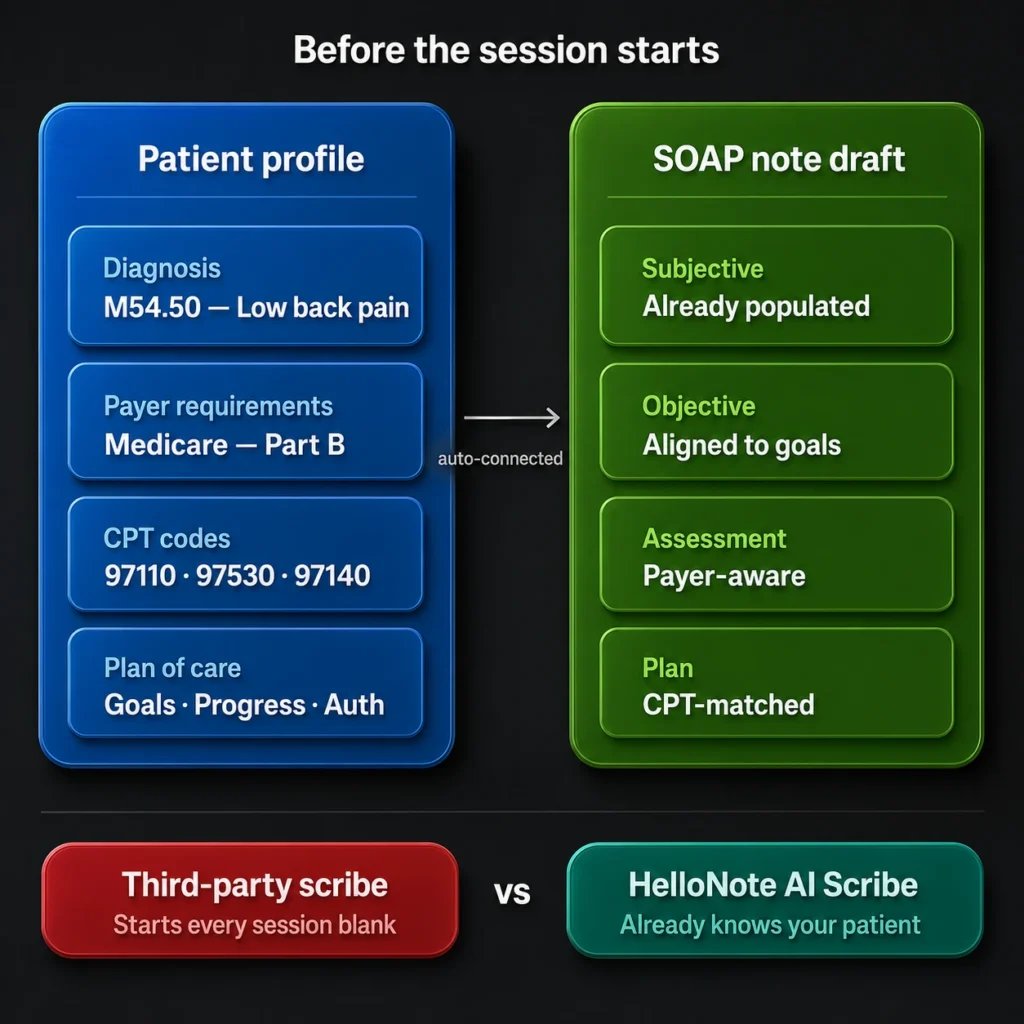
Here is the capability that only native integration makes possible: before the session begins, HelloNote AI Scribe already knows who the patient is, what their diagnosis is, what their payer requires for documentation, and what CPT codes are relevant to their case. A third-party scribe tool starts every session from scratch. It does not know any of that unless you manually provide it.
Context-Aware Draft Notes
A native AI scribe that has access to the patient record can generate draft notes that are already aligned with the patient’s plan of care, their established goals, and their payer’s documentation requirements. The AI is not just transcribing what was said. It is organizing what was said against the context of what the documentation needs to establish. That is a categorically different quality of draft note than one produced by a tool that sees a therapy session without any patient record context.
CPT Code Suggestions That Know the Case
When HelloNote AI Scribe generates a draft note, it can cross-reference that note against the CPT codes associated with the patient’s case and flag suggestions based on what was documented. A third-party scribe tool that exists outside the EMR does not have access to that billing context. It can suggest codes based on generic documentation patterns, but it cannot account for the specific payer rules, modifier requirements, or prior authorization limitations that live inside the patient record. Native integration makes the difference between a CPT suggestion that is generically accurate and one that is accurate for this specific patient.
Looking up more cpt codes?
See 97110, 97530, and 50+ therapy procedure codes – with billing guidance and documentation tips in one place.
How HelloNote AI Scribe Works as a Native Solution
HelloNote AI Scribe was built into the EMR from the start, not added later through an API partnership with a third-party vendor. Here is what that looks like in the actual clinical workflow.
- The therapist selects the patient and note type inside HelloNote before the session begins. AI Scribe is activated within the same interface the therapist is already using, not in a separate app.
- The session is recorded directly within HelloNote. The audio stays within the platform and is never transmitted to a third-party server for processing.
- The AI generates a transcript and then a structured SOAP note draft. Both are created inside the patient encounter in HelloNote, already connected to the correct record.
- The therapist reviews and finalizes the note without leaving HelloNote. No copy-paste, no format adjustment, no app switching.
- The completed note is marked as AI Scribe-generated in the patient record, making it clearly identifiable for review and audit purposes.
- One BAA covers the entire workflow. The same Business Associate Agreement that governs your HelloNote account covers AI Scribe use. No additional compliance agreements required.
Frequently Asked Questions
What is the difference between a native AI scribe and a third-party AI scribe?
A native AI scribe is built directly into the EMR platform. The note draft is created inside the patient record without any additional tools, logins, or copy-paste steps. A third-party AI scribe is a separate application that records and processes session audio, then requires the therapist to transfer the generated note into the EMR manually. Native integration eliminates the workflow gap that third-party tools create.
Is a third-party AI scribe HIPAA compliant?
Third-party AI scribe tools can be HIPAA compliant, but they require a separate Business Associate Agreement with your practice before any patient audio is processed. This creates a second compliance relationship with different data retention terms, breach notification timelines, and permissible data uses than your EMR vendor's BAA. Native AI scribe solutions consolidate this under a single vendor and a single BAA.
Do third-party AI scribes work with HelloNote?
HelloNote has its own native AI Scribe built into the platform. Because HelloNote AI Scribe is native, it integrates directly with the patient record, case information, and CPT code context inside HelloNote, which are capabilities that third-party scribe tools connecting via API cannot replicate.
Does HelloNote AI Scribe use a third-party AI vendor?
HelloNote AI Scribe is a native feature of the HelloNote platform. Session audio is processed within the HelloNote infrastructure under the same BAA and data handling standards that govern all patient data in HelloNote. Your sessions are not transmitted to a third-party AI vendor for processing.
How much time does a native AI scribe save compared to a third-party tool?
Beyond the documentation time savings AI scribe provides generally, a native workflow eliminates the four to eight minutes per session spent on copy-pasting, reformatting, and app-switching that third-party tools require. Across a full clinical day, that is 40 to 80 minutes of administrative time recovered per therapist.
READY TO STREAMLINE YOUR CLINIC?
See How HelloNote Handles All of This in One Platform
Managing staff hours, compliance, inventory, and financial reports — all inside one HIPAA-compliant EMR built for PT, OT, and SLP clinics.
No credit card required · HIPAA Compliant · PT, OT & SLP

AboutDmitry Shevchenko, OTR/L
Dmitry Shevchenko, OTR/L is a licensed Occupational Therapist
and the COO of HelloNote EMR. With firsthand experience as both
a practicing clinician and a multi-location clinic operator,
Dmitry brings a unique operational perspective to HelloNote's
product development — having navigated the exact payroll,
compliance, and inventory challenges this platform is built
to solve.