



















You've found a hidden discount!

HN Unlock Layer 1
HN Unlock Layer 2
HN Unlock Layer 3
HN Unlock Layer 4
HN Unlock Layer 5
  • 00Hours
  • 00Minutes
  • 00Seconds

5 Essential Features Every Pediatric Speech Therapy EMR Needs in 2026

Pediatric speech therapy EMR systems are becoming essential tools for clinics in 2026, especially as therapy practices face higher caseloads, greater documentation demands, and increased expectations from parents and payers. As pediatric speech therapy continues to evolve, clinicians need EMRs that not only store information but actively support better outcomes, smoother workflows, and more engaging family communication.

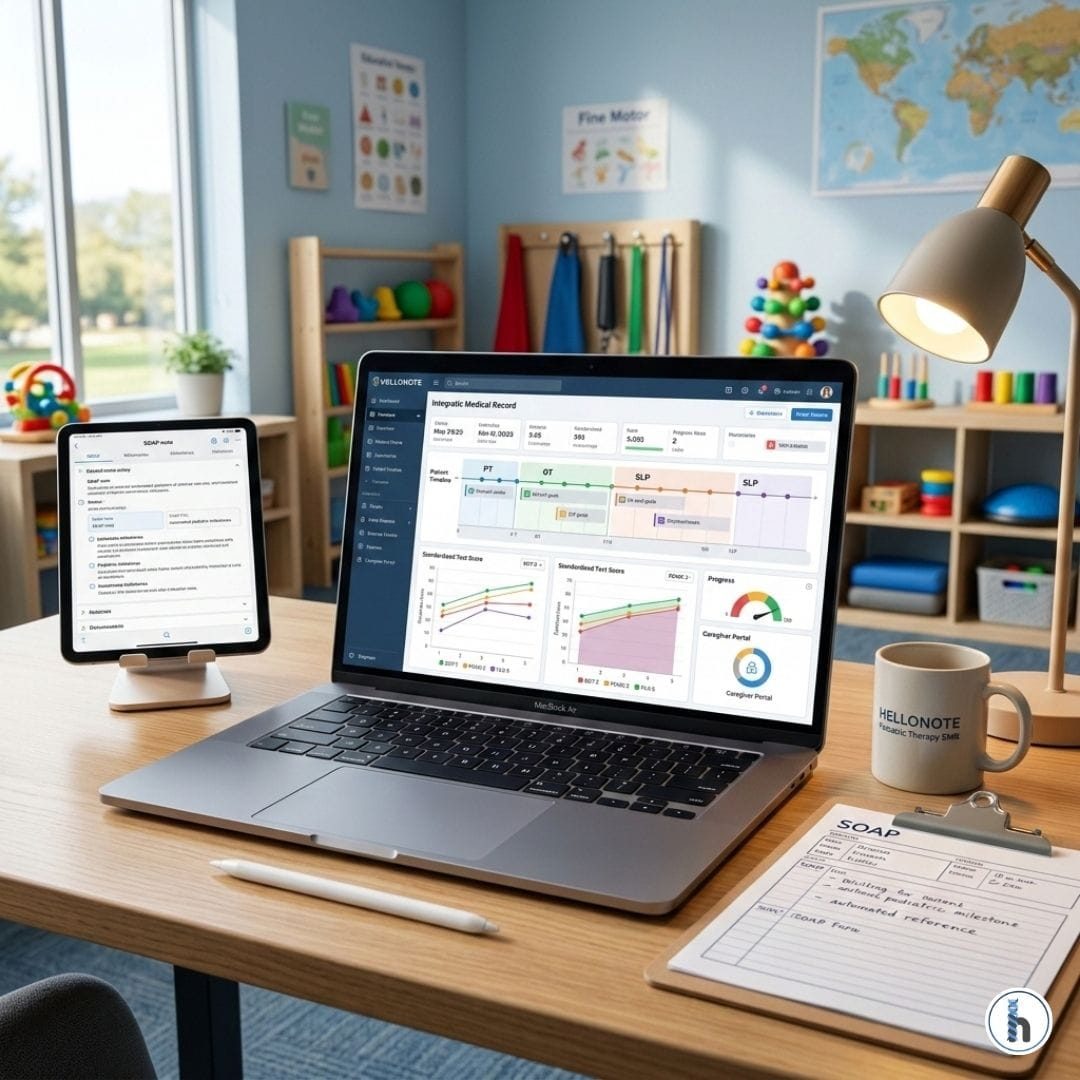
Tablet displaying a pediatric speech therapy EMR interface with icons for goal tracking, parent portal, teletherapy tools, and AI documentation.

Below are the five essential EMR features every pediatric speech therapy practice should prioritize in 2026, including why each feature matters, what impact it has on clinical care, and how forward-thinking EMRs like HelloNote help practices stay ahead.

1. Integrated Telehealth with Interactive Therapy Tools

Teletherapy has moved from a pandemic workaround to a long-term service model. Pediatric SLPs need EMR-integrated telehealth that supports engagement not just video calls.

A strong 2026-ready telepractice system should include:

    • Digital whiteboards for modeling, labeling, and visual prompts

    • Annotation tools to mark articulation targets, phonological patterns, or comprehension items

    • Parent co-viewing mode for caregiver coaching

    • Secure, consent-based session recordings for progress monitoring and payer audits

Why it matters:

A strong pediatric speech therapy EMR keeps these tools in one place, and the average pediatric teletherapy session requires 3–4 visual aids.. Moving across apps wastes time and reduces child engagement. Integrated tools keep therapy flowing and reduce distraction.

2. Dynamic Goal Tracking With Visual Progress Metrics

Static goal banks are no longer enough. Pediatric therapists need dynamic progress-tracking dashboards that show change over time not just checkboxes.

A modern pediatric speech therapy EMR should offer::

    • Automated graphs showing progress by domain (expressive language, articulation, fluency, pragmatic skills)

    • Visual milestone tracking for speech sound acquisition or language development

    • Parent-friendly progress summaries

    • Alerts when goals plateau or require modification

Clinical impact:

When parents see progress presented visually, home practice compliance increases by 22% (ASHA 2024). This is critical in pediatric therapy, where consistency outside the session determines progress speed.

3. AI-Powered Documentation That Actually Reduces Workload

AI has matured significantly and SLP-focused EMRs now use it to support (not replace) clinical judgment.

Tools pediatric SLPs should expect in 2026:

    • Voice-to-text optimized for speech therapy vocabulary

    • Smart templates that auto-fill sections based on session activities

    • Auto-generated SOAP notes pulled from timing, stimuli, and clinician comments

    • Coding suggestions to prevent insurance denials

Time savings:

Clinicians using AI-supported tools inside a pediatric speech therapy EMR report 35% fewer after-hours charting sessions, reducing burnout and freeing therapists to focus on patient care.

4. Comprehensive Parent Engagement Tools

Pediatric therapy is a collaborative process. Families need access to home practice materials, progress reports, and communication tools.

Your EMR should include:

    • Home exercise programs with video demos for articulation, oral-motor work, AAC modeling, etc.

    • Secure messaging with read receipts

    • Appointment and home-practice reminders (SMS or app-based)

    • A parent resource library (handouts, modeling videos, strategies)

Why it matters:

Parent engagement is the single biggest predictor of pediatric therapy success. Clinics using integrated parent portals see 40% higher home-program completion rates, leading to faster progress.

5. Interoperability With Pediatric Ecosystems

Pediatric providers don’t work alone. SLPs must collaborate with:

    • Early intervention programs

    • School IEP teams

    • Pediatricians

    • Occupational and physical therapists

    • AAC specialists and device manufacturers

In 2026, your EMR should be able to exchange data securely with these systems through:

    • HL7/FHIR interoperability

    • Secure eFax or digital transfer tools

    • Compatible formats for school and EI documentation

Compliance note:

Payers increasingly expect complete documentation across systems. Without interoperability, clinics waste hours faxing, scanning, and re-entering data.

Implementation Considerations for Pediatric SLP Clinic Owners

✔ Request pediatric-specific demos

General EMRs are not built for speech therapy workflows.

✔ Test documentation tools with real cases

You’ll quickly see whether the system supports you—or slows you down.

✔ Confirm pediatric billing compatibility

Speech therapy billing rules differ from OT/PT and require accuracy.

✔ Check mobile/tablet functionality

A 2025 survey found 67% of pediatric SLPs use tablets during sessions.

How HelloNote Supports Pediatric Speech Therapy in 2026

HelloNote is designed with therapy workflows at the center—especially pediatric SLP needs.

Key advantages include:

    • Interactive telehealth tools built into the platform

    • Pediatric-specific documentation templates and goals

    • Parent engagement and secure messaging

    • Automated progress tracking visualizations

    • Direct transmission of documentation to schools and physicians via eFax

    • Compatibility with AAC device documentation and early intervention workflows

By reducing redundant clicks and simplifying documentation, HelloNote allows SLPs to focus more on children and less on paperwork.

The Bottom Line for Pediatric SLP Practices in 2026

Upgrading your EMR isn’t just a technology decision it directly impacts:

    • Therapist workload and burnout

    • Speed and accuracy of documentation

    • Parent engagement and home carryover

    • Therapy outcomes

    • Revenue cycle efficiency

    • Data compliance and interoperability

Pediatric practices that adopt EMRs with specialized speech therapy tools will deliver better outcomes, retain their clinicians longer, and run more efficient operations.

As you plan your 2026 technology upgrades, prioritize a pediatric speech therapy EMR that grows with your practice while solving today’s specific challenges in pediatric speech therapy service delivery.

Q1. What features should a pediatric speech therapy EMR include?

A pediatric speech therapy EMR should include integrated teletherapy tools, AI-supported documentation, dynamic goal tracking, parent engagement portals, and secure data sharing with early intervention and school systems.

Q2. What is the best EMR for pediatric speech therapists?

The best EMR is one designed for therapy workflows offering pediatric-specific templates, progress visuals, built-in telehealth, and simplified documentation. Many SLPs prefer platforms like HelloNote because they reduce charting time and support parent involvement.

Q3. How does an EMR improve speech therapy documentation?

An EMR improves documentation by providing structured templates, auto-generated note assistance, smart goal tracking, and voice-to-text tools tailored to speech therapy terminology, helping clinicians complete notes faster and more accurately.

Q4. Do pediatric speech therapists still need teletherapy tools in 2026?

Yes. Teletherapy remains a core service model, and clinics benefit from EMR-integrated features like digital whiteboards, annotation tools, parent co-viewing, and secure recordings to support high-quality online sessions.

Q5. How do parent portals help with pediatric speech therapy?

Parent portals enhance communication and promote home practice by giving caregivers access to session summaries, progress metrics, videos, reminders, and secure messaging. This leads to higher engagement and faster child progress.

The OBBBA Impact on Therapy Clinics: What Rehab Practices Need to Know in 2026

The OBBBA impact on therapy clinics is significant, marking one of the most disruptive shifts in healthcare funding in the last decade. The One Big Beautiful Bill Act (OBBBA), signed into law in 2025, will begin affecting the financial stability of private therapy practices starting in 2026 and continuing in the years ahead.. With an estimated 11.8 million Americans expected to lose Medicaid coverage and adjustments coming to Medicare and ACA subsidies, therapy clinic owners face a new environment defined by coverage volatility, increased patient responsibility, and reimbursement pressures.

For PT, OT, and SLP practices already operating with tight margins, OBBBA is not a distant policy it is an immediate operational challenge that requires a proactive strategy.

Therapist reviewing the OBBBA 2025 policy document, evaluating the OBBBA impact on therapy clinics and upcoming changes to patient coverage and reimbursement.

Understanding the OBBBA’s Direct Impact on Therapy Clinics

The OBBBA brings two major changes that directly reshape therapy operations.

Coverage Reductions and Eligibility Volatility

The Act tightens Medicaid eligibility criteria while reducing funding levels. For rehab clinics serving pediatric, geriatric, or lower-income communities, this shift means:

    • A portion of the caseload will lose Medicaid eligibility

    • Increased movement between Medicaid, ACA plans, and self-pay

    • More patients experiencing coverage gaps mid–plan of care

As ACA premium subsidies subsidies phase out moving into 2026 and beyond, even insured patients may struggle with affordability, impacting adherence and continuity of care.

Reimbursement and Payer Mix Shifts

Medicare reimbursement formulas may also shift downward. This creates a new payer mix for therapy clinics:

    • More Medicare patients but at lower rates

    • Fewer Medicaid patients

    • More self-pay accounts requiring stronger financial workflows

As payer dynamics shift beginning in 2026, the OBBBA impact on therapy clinics becomes more pronounced, creating tighter margins and requiring stronger financial oversight.

Higher Patient Responsibility Leads to More Cancellations and No-Shows

Patients losing coverage or facing higher deductibles will struggle to maintain their therapy schedule.

The Financial Barrier to Care

Example:
A Medicaid patient arrives for a follow-up but discovers their eligibility ended. Unprepared to pay full price, they cancel or discontinue care breaking their progress.

Even privately insured patients may:

    • Reduce visit frequency

    • Delay starting a plan of care

    • Drop out prematurely

Actionable Strategy: Transparent Financial Conversations

Clinics must shift toward proactive financial communication.

    • Implement pre-visit cost estimates

    • Train staff in financial navigation

    • Update cancellation policies for cost-related no-shows

This reduces friction and builds trust.

Increase in Denied Claims and Slower Cash Flow

Eligibility-based denials are expected to rise sharply as OBBBA changes take effect starting in 2026.

The Eligibility Verification Gap

Coverage can lapse between sessions. A claim may be denied even if the patient was eligible at the evaluation.

Actionable Strategy: Continuous Eligibility Management

To reduce denials:

    • Verify eligibility at every visit

    • Use automated real-time eligibility tools

    • Audit denials weekly to fix workflow issues

This is essential to protect revenue under the OBBBA impact on therapy clinics.

Why Financial Engagement Is Now a Clinical Priority

Financial stress directly affects clinical outcomes, and this will become even more evident as OBBBA-related changes roll out in 2026 and beyond.

Patients worried about bills are:

    • Less engaged

    • More likely to cancel

    • More likely to abandon treatment

Improving financial communication becomes part of the clinical process.

Building a Financial Care Model

Best practices:

    • Screen early for financial assistance

    • Offer flexible payment plans

    • Communicate costs with empathy

Clear expectations reduce frustration and improve attendance.

How HelloNote Helps Therapy Clinics Adapt to OBBBA

Technology becomes essential as financial risk increases.

Real-Time Coverage Checks to Prevent Denials

HelloNote provides continuous eligibility monitoring not just at intake catching coverage changes before a claim is submitted.

Transparent Patient Financial Conversations

Built-in cost estimates help clinics:

    • Present patient responsibility upfront

    • Reduce surprise bills

    • Improve collections

Streamlining Self-Pay Management

As self-pay increases, HelloNote supports:

    • Payment plan tracking

    • Automated reminders

    • Consolidated balances

This keeps cash flow moving despite payer instability.

Automated Claims Management for Changing Payer Rules

HelloNote automatically updates billing rules to reflect OBBBA-related payer changes, reducing denials and administrative burden.

Positioning Your Practice for Stability in 2025

The OBBBA impact on therapy clinics introduces challenges but also an opportunity to strengthen operations.

Clinics that will thrive are those that:

    • Shift to proactive eligibility workflows

    • Embrace transparent financial communication

    • Use technology to automate billing and compliance

Protecting your revenue allows your team to stay focused on exceptional patient care.

Frequently Asked Questions (FAQ)

Q1. How will the OBBBA affect therapy clinic revenue starting in 2026?

The OBBBA will affect revenue through Medicaid disenrollment, higher patient out-of-pocket costs, and potential Medicare rate reductions. This results in more no-shows, self-pay balances, and inconsistent coverage.

Q2. Why are more therapy claims expected to be denied under the OBBBA?

Coverage volatility increases eligibility-related denials. Claims may be rejected if coverage lapses mid-plan of care. Continuous eligibility checks are now essential.

Q3. What can clinics do to reduce financial risk under the OBBBA?

Verify insurance every visit, offer payment plans, update cancellation workflows, train staff for financial discussions, and use EMR tools that automate billing and eligibility checks.

Q4. How will OBBBA Medicaid disenrollment beginning in 2026 impact pediatric and outpatient rehab clinics?

Pediatric PT/OT/SLP clinics are heavily affected. As families lose Medicaid eligibility, therapy adherence decreases, increasing cancellations and uncollectible balances.

Q5. How can an EMR like HelloNote help clinics manage OBBBA changes?

HelloNote provides eligibility monitoring, automated claim scrubbing, real-time payer alerts, cost estimate tools, and integrated self-pay workflows—critical under OBBBA’s new financial landscape.

97110 vs 97530: How to Choose the Right CPT Code for Therapy Billing

Table of Contents

Understanding 97110 vs 97530 is essential for accurate documentation, clean billing, and preventing costly denials. These two CPT codes Therapeutic Exercise (97110) and Therapeutic Activity (97530) are frequently misunderstood because they share similar goals yet represent very different types of interventions.

This guide explains when to use each code, key documentation requirements, billing rules, examples, and how an EMR like HelloNote helps streamline compliant coding.

A side-by-side comparison image showing therapeutic exercise (97110) and therapeutic activity (97530), illustrating the difference between isolated strengthening exercises and functional activity training — supporting the 97110 vs 97530 CPT coding explanation.

What’s the Difference Between 97110 and 97530?

Therapeutic exercise and therapeutic activity are both time-based CPT codes used by PT, OT, and SLP professionals. However, they address different clinical purposes.

Why Choosing the Right CPT Code Matters

Selecting the incorrect code can result in:

    • Claim denials

    • Reduced reimbursement

    • Compliance risks

    • Increased audit exposure

Understanding 97110 vs 97530 ensures you bill accurately and reflect true clinical intent.

CPT Code 97110 Therapeutic Exercise

What Is 97110?

Structured exercises used to improve strength, flexibility, ROM, or endurance.

Required Documentation for 97110

Documentation must include:

    • Body region treated

    • Specific muscles or joints

    • Purpose of each exercise

    • Relation to functional goals

Examples of 97110 Exercises

    • ROM exercises

    • Resistance training

    • Aerobic conditioning

    • Stretching

CPT Code 97530 Therapeutic Activities

What Is 97530?

Functional, dynamic, real-world activities that simulate daily tasks.

Required Documentation for 97530

Documentation should show:

    • Real-life task simulation

    • Functional significance

    • Multiple movement components

    • Direct link to functional goals

Examples of 97530 Activities

    • Lifting and carrying objects

    • Stair training

    • Reaching while balancing

    • Simulated transfers

Billing Guidelines for 97110 vs 97530

Both codes follow:

Using Modifier 59

Required when billing both codes in the same session.

Insurance Considerations

    • Medicaid: Often covers 97530, not always 97110

    • Private payers: Usually reimburse both with clear documentation

    • Medicare: Rates vary; 97530 often reimburses slightly higher

Common Reasons for Claim Denials

Insufficient Documentation

Vague vs. detailed examples included.

Incorrect Dual Billing

Must justify why both codes were used.

Time Rule Errors

Failure to meet the 8-minute rule leads to denials.

How HelloNote EMR Simplifies 97110 vs 97530 Coding

HelloNote helps clinics by:

    • Auto-applying modifiers

    • Providing documentation guidance

    • Validating codes before claim submission

    • Tracking progress and medical necessity

Final Thoughts on 97110 vs 97530

Mastering these distinctions helps ensure:

    • Accurate documentation

    • Fewer denials

    • Higher reimbursement

    • Better compliance

Frequently Asked Questions (FAQ)

Q1. What is the main difference between 97110 and 97530?

97110 focuses on improving measurable physical components like strength, endurance, or range of motion. In contrast, 97530 targets functional, real-world activities such as lifting, reaching, transfers, or stair climbing. If the activity simulates daily tasks and involves multiple movement parameters, it should be billed under 97530.

Q2. Can 97110 and 97530 be billed together in the same session?

Yes — but only if each service is distinct and separately documented. Modifier 59 must be applied to indicate that the therapist provided two unique interventions with different goals. Without clear documentation, payers may deny one of the codes as duplicate billing.

Q3. Which CPT code usually reimburses more 97110 or 97530?

CPT 97530 (Therapeutic Activity) generally reimburses at a higher rate because it involves more complex, functional, and task-oriented interventions. However, exact reimbursement varies by payer, state, and contract.

Q4. Does Medicaid cover both 97110 and 97530?

Coverage varies by state. Many Medicaid programs reimburse 97530 but have stricter limitations or exclusions for 97110. Clinics must verify Medicaid coverage for each patient before billing to prevent denials.

Q5. How can an EMR like HelloNote reduce CPT coding errors?

HelloNote automates modifier logic, validates CPT code selection, and prompts therapists when documentation is incomplete. It streamlines billing, reduces denials, and ensures compliance with 97110 vs 97530 rules, helping clinics protect revenue and improve claim approval rates.

Online Speech Therapy Preparation: A Complete Guide for Parents and Therapists

Table of Contents

Online speech therapy preparation is one of the most overlooked factors in successful telehealth sessions. While SLPs focus on communication goals, occupational and physical therapists know that posture, motor skills, and sensory regulation dramatically influence a child’s ability to engage in virtual therapy. Preparing the body is just as important as preparing the technology.

This guide gives therapists, clinic owners, and families practical strategies to improve otor and sensory readiness key components of effective online speech therapy preparation.

Child participating in an online speech therapy session with proper posture, sensory tools, and a structured workspace, demonstrating effective online speech therapy preparation.

Why Physical Readiness Matters in Online Speech Therapy

Virtual sessions remove many hands-on supports that clinicians normally use in person. Proper online speech therapy preparation must include attention to the child’s physical and sensory state.

Postural Stability and Breath Support

Children with poor posture may struggle with:

    • Reduced breath support for clear speech

    • Difficulty sustaining attention

    • Fatigue during longer virtual sessions

Therapist Tip: Encourage families to use a firm chair, ensure feet are supported, and place a small cushion behind the lower back.

Sensory Regulation for Screen Engagement

Common barriers include:

    • Difficulty filtering visual distractions

    • Auditory sensitivity to home noise

    • Constant movement or tactile-seeking

Therapist Tip: Recommend a simple, predictable therapy space with minimal clutter and low background noise.

When to Recommend OT/PT Co-Treatment for Telehealth

Co-treatment may be needed when children show:

    • Posture collapse during screen time

    • Difficulty following visual cues

    • Weak oral motor control

    • Sensory-seeking behavior that disrupts participation

Streamlining Telehealth Collaboration Through EMR Integration

For hybrid clinics, an EMR like HelloNote supports:

    • Shared goals between SLPs, OTs, and PTs

    • Consistent documentation of motor and sensory needs

    • Parent education stored in one place

    • Telehealth notes, reminders, and progress tracking

Integrated documentation enhances online speech therapy preparation by keeping the entire team aligned.

Key Takeaways for Clinicians

    • Online speech therapy preparation is essential for strong engagement

    • Environmental changes can significantly improve participation

    • Motor and sensory readiness should be part of every telehealth plan

    • OT/PT collaboration ensures more comprehensive care

    • EMR tools support communication and family follow-through

With the right preparation, children can participate more effectively in virtual sessions, benefiting both engagement and communication outcomes.

Q1. How do you prepare a child for online speech therapy?

Preparing a child for online speech therapy includes setting up a quiet workspace, ensuring proper seating and posture, checking technology, and completing a quick warm-up routine. Simple motor or sensory activities before the session can help improve focus and engagement.

Q2. What equipment is needed for online speech therapy?

Most children only need a stable device (laptop or tablet), a strong internet connection, and clear audio. Therapists may also recommend simple tools like fidgets, visual schedules, or oral-motor items depending on the child’s needs.

Q3. How can parents improve their child’s attention during virtual speech therapy?

Parents can improve attention by creating a distraction-free environment, placing the screen at eye level, using consistent routines, and offering movement breaks before and after the session. These steps are core to effective online speech therapy preparation.

Q4. What should parents do before an online speech therapy session?

Before a session, parents should complete a quick readiness checklist: posture support, oral motor warm-up, tech check, visual schedule setup, and having reinforcers ready. These steps help children transition smoothly into virtual learning.

Q5. When should a therapist recommend OT or PT support for online sessions?

Therapists should consider OT or PT collaboration if the child has difficulty staying upright, following visual cues, regulating sensory input, or using the oral musculature needed for speech tasks. Co-treatment can greatly enhance virtual progress.

Challenges of a Solo Practitioner: Real-World Lessons from a Therapy Business Owner

Table of Contents

Starting and running a therapy practice alone is both rewarding and demanding. From patient care to managing operations, the challenges of a solo practitioner are complex and often underestimated.

In a recent episode of The Clinic Talk Podcast, occupational therapist Michelle Holloway, owner of Lifestyle Transitions PLLC, shared her experience managing a solo practice. Her story offers not only perspective but real, actionable therapy clinic management tips for therapists building their practices from the ground up

Balancing Clinical Care and Administrative Work

One of the most common challenges solo practitioners face is time management. Michelle shared that early in her practice, her schedule was packed with home visits. While this reflected her dedication to patient care, it left her with little time for documentation, billing, or insurance processing. Like many therapists, she found herself catching up on paperwork over the weekend leading to burnout and stress.

To address this, she restructured her week. She blocked off specific days for administrative work, documentation, and scheduling. She also hired a virtual assistant to help manage time-consuming tasks. This shift gave her breathing room and brought consistency to her business.

Therapist sharing her story about the challenges of a solo practitioner, smiling confidently outdoors

Developing Effective Documentation Habits

For occupational therapists, documentation is critical for continuity of care, reimbursement, and compliance. But for solo providers, it’s easy to deprioritize in a packed schedule. Michelle realized that she needed more than time she needed better systems.

She began refining her workflow with clear occupational therapy documentation strategies:

    • Dedicate uninterrupted time for documentation

    • Use standardized templates tailored to OT

    • Integrate documentation into daily routines rather than pushing it to evenings or weekends

These changes helped her stay compliant and improved the quality of her clinical notes.

Choosing the Right Rehab EMR for Solo Therapists

Early in her business, Michelle tried multiple EMR systems. Most were not designed for solo therapists and added complexity to her day. Some were built for hospitals, others for general medical clinics. The result? Frustration, wasted time, and unnecessary expense.

She eventually switched to HelloNote EMR for solo practice, and found it was designed with her workflow in mind. HelloNote provided:

With a streamlined system, she spent less time on admin and more time focused on patients. It was the rehab EMR solution she needed to grow her practice with confidence.

Building Referral Streams Without a Marketing Team

nother common challenge of a solo practitioner is attracting consistent patient referrals especially without a full marketing department. Michelle, like many therapists, relied initially on word-of-mouth. But to grow, she had to get more intentional.

She began participating in community events, attending senior expos, and offering educational workshops. These efforts connected her with potential patients and referral sources, including neurologists, orthopedic surgeons, and primary care providers.

These grassroots strategies provided visibility and trust—key ingredients for building a strong referral network.

Strategic Partnerships that Expand Care and Referrals

Michelle also emphasized the power of collaboration. She built relationships with:

    • Speech-language pathologists

    • Physical therapists

    • Home health agencies

    • DME (Durable Medical Equipment) providers

These partnerships not only supported her patients with comprehensive care, but also created a steady stream of cross-referrals. If you’re looking for therapy clinic management tips, this one is simple but powerful: grow your network intentionally.

Hiring Decisions: 1099 vs W-2 Employees

As her business evolved, Michelle faced hiring decisions. Should she contract 1099 therapists or hire W-2 employees? She found that while 1099 workers offered flexibility, they lacked the consistency and investment of permanent staff.

Choosing W-2 employees gave her greater control over the quality of care and helped her build a more unified team critical for solo practitioners transitioning into group practice.

Transitioning the Therapist-Patient Relationship

One surprising challenge solo therapists face is patient attachment. When patients become used to seeing one therapist, transitioning care to another provider can be tricky.

Michelle addressed this by gradually introducing new staff into sessions, involving them in evaluations, and ensuring patients felt comfortable before handing off care. This helped preserve trust and continuity.

The Importance of SOPs for Growth

Perhaps the most important lesson Michelle shared was the value of structured operations. Early on, she began documenting her processes everything from scheduling to onboarding to insurance verification.

These standard operating procedures (SOPs) made it easier to train new hires, maintain consistency, and avoid confusion as her practice scaled. For any solo practitioner, SOPs are an investment in sustainability.

Final Takeaway: From Chaos to Clarity

Facing the challenges of a solo practitioner means learning how to manage your time, tools, and team with purpose. Whether you’re just starting out or looking to optimize your systems, HelloNote EMR can support your documentation, scheduling, and billing in one place.

The challenges of a solo practitioner are real but they’re manageable with the right tools and mindset. Michelle Holloway’s journey highlights what it takes to thrive:

    • Protect your time for admin and documentation

    • Invest in systems that work for you like a rehab EMR for solo therapists

    • Build strong local networks and community connections

    • Hire with intention, and communicate clearly with patients

    • Develop operational systems early to prepare for growth

Solutions like HelloNote EMR for solo practice help you simplify documentation, stay compliant, and reclaim your time so you can focus on what matters most: your patients.

Ready to Simplify Your Solo Practice?

Book a free HelloNote demo and see how our EMR is built specifically for physical, occupational, and speech therapists like you.

Frequently Asked Questions About Running a Clinic in a Recession

Q1. What is the best EMR for solo therapy practitioners?

The best EMR for solo therapy practitioners is one that reduces documentation time, simplifies scheduling, and supports billing without requiring a large staff. Solo providers benefit most from platforms built specifically for OT, PT, and SLP workflows. HelloNote offers templates, automated billing features, and an intuitive design ideal for single-provider clinics.

Q2. How can an EMR help reduce burnout for solo therapists?

Solo therapists often struggle with documentation overload, scheduling conflicts, and manual billing tasks. A well-designed EMR can automate reminders, streamline notes, and reduce administrative hours. HelloNote helps solo practitioners free up time by combining documentation, scheduling, and billing into one easy-to-use system.

Q3. How do solo therapy clinics stay compliant without extra staff?

Compliance can be overwhelming without admin support. Solo therapists rely on EMR systems that include Medicare-compliant templates, audit-ready documentation, and automatic updates to CPT and ICD-10 codes. HelloNote includes these built-in safeguards to help practitioners stay compliant with minimal effort.

Q4. What features should solo practitioners look for in a therapy EMR?

Solo therapists need prebuilt discipline-specific templates, simple scheduling tools, clean billing workflows, and strong mobile access. HelloNote provides OT, PT, and SLP templates, integrated billing, home-visit-friendly mobile access, and intuitive workflows that fit a solo provider’s daily routine.

Q5. How can a solo therapist manage referrals and growth more easily?

Referral building is a major challenge for independent therapists. Using an EMR with integrated communication tools, progress reports, and outcome tracking can help demonstrate value to referral partners. HelloNote supports these features, making it easier for solo practitioners to grow their clinic and maintain strong partnerships.

Therapeutic Activity CPT Code 97530: Complete Guide for Therapists

Table of Contents

Understanding the therapeutic activity CPT code 97530 is essential for accurate billing, compliant documentation, and maximizing reimbursement across physical therapy, occupational therapy, and speech-language pathology. This guide explains when to use CPT 97530, how to document it correctly, how it differs from 97110, and how to avoid common billing errors and claim denials.

Physical therapist assisting a patient with a functional lifting exercise during therapeutic activity CPT 97530 in a rehab clinic.

What Is CPT Code 97530?

The therapeutic activity CPT code 97530 is defined as:

“Therapeutic activities, direct (one-on-one) patient contact by the provider (use of dynamic activities to improve functional performance), each 15 minutes.”

Therapists use CPT 97530 when performing dynamic, functional, real-life activities designed to improve mobility, balance, coordination, endurance, and movement patterns needed for daily tasks.

Key Features of CPT 97530

    • One-on-one, skilled therapeutic intervention

    • Functional, activity-based movements

    • Billed in 15-minute units following the 8-minute rule

    • Must show clear functional goals tied to ADLs, work tasks, or mobility

Using the code 97530 correctly ensures compliance with Medicare and private insurance guidelines.

When to Use CPT Code 97530

Therapists across PT, OT, and SLP use the CPT code 97530 for a wide variety of clinical conditions.

Common Conditions Treated With 97530

    • Neurological impairments (stroke, TBI, PD)

    • Post-surgical rehab and orthopedic injuries

    • Pediatric developmental delays

    • Vestibular and balance disorders

Examples of Therapeutic Activities Billed Under 97530

    • Lifting/carrying objects to simulate work tasks

    • Reaching overhead for dressing or ADLs

    • Squatting and bending for functional mobility

    • Simulated car transfers for independence

    • Standing balance tasks combined with reaching

These examples meet medical necessity for the CPT code 97530 when linked to functional goals.

97530 vs. 97110 – Understanding the Difference

A common source of confusion is knowing when to bill 97110 (therapeutic exercise) versus the CPT code 97530.

Key Distinction

CPT CodePurposeExample
97530Functional training for daily tasksSimulating getting in/out of a car
97110General strengthening or ROMKnee extensions with resistance

If the activity is functional, dynamic, and task-based, bill CPT 97530.
If it is isolated strengthening or mobility, bill CPT 97110.

Documenting this difference protects against denials.

Billing & Documentation Requirements for CPT Code 97530

To meet insurance and Medicare standards, documentation for the therapeutic activity CPT code 97530 must clearly show:

Essential Documentation Elements

    • The specific functional activity performed

    • How it directly relates to the patient’s functional goal

    • Objective progress or measurable outcomes

    • Required level of assistance or cueing

    • Any adaptive equipment or tools used

Example Documentation

“Patient performed dynamic standing balance while reaching for objects at shoulder height to simulate dressing tasks. Activity performed to improve independence with ADLs. Required moderate verbal cues for posture. Goal: improve dressing independence within 4 weeks.”

This satisfies medical necessity for the CPT code 97530.

Avoiding Denials for CPT 97530

1. Insufficient Functional Detail

❌ “Patient performed dynamic standing activity.”
✔ “Patient completed repetitive standing balance tasks to improve dressing ability.”

2. Billing 97530 & 97110 Together Without Justification

When billing both on the same day, therapists must document different goals, different body parts, or different purposes.

3. Incorrect Use of Time-Based Billing

Each unit must meet the Medicare 8-minute rule.

Proper documentation prevents denials for the code 97530.

Using Modifier 59 With CPT Codes 97530 and 97110

When CPT 97530 and CPT 97110 occur in the same session, therapists must append Modifier 59 to indicate distinct services.

Correct use of Modifier 59 supports clean claims and reduces audits.

Best Practices for Using CPT 97530

    • Use 97530 only for functional, task-based activities

    • Document the purpose & functional goal clearly

    • Differentiate from strengthening and ROM exercises

    • Ensure at least 8 minutes of skilled therapy per unit

    • Follow payer-specific medical necessity guidelines

Mastery of the code 97530 helps clinics boost reimbursement and reduce compliance risks.

How HelloNote EMR Simplifies CPT 97530 Billing

HelloNote helps therapists document and bill the therapeutic activity CPT code 97530 with:

    • Auto-filled functional goal templates

    • Modifier 59 guidance

    • Compliance alerts

    • Time tracker for CPT units

    • Automated claim scrubbing

    • Real-time billing reminders

Using an EMR designed for therapists reduces errors and improves reimbursement rates.

Final Thoughts

Understanding and correctly applying the CPT code 97530 is essential for compliance, clinical accuracy, and financial success. By documenting functional goals clearly, differentiating from 97110, and using a supportive EMR like HelloNote, therapists can avoid denials and ensure clean, timely reimbursement.

Frequently Asked Questions (FAQ)

Q1. What is the therapeutic activity CPT code 97530 used for?

The therapeutic activity CPT code 97530 is used for functional, dynamic movements that improve performance in daily tasks such as lifting, reaching, squatting, mobility, and ADLs.

Q2. What is the main difference between 97110 and 97530?

CPT 97110 is for isolated strengthening or ROM exercises, while CPT 97530 is for functional, task-oriented activities tied to daily living or work demands.

Q3. How many minutes do you need to bill one unit of CPT 97530?

The therapeutic activity CPT code 97530 follows the 8-minute rule — meaning you must provide at least 8 minutes of skilled intervention to bill one unit.

Q4. Can you bill CPT 97530 and 97110 together?

Yes — but you must clearly document distinct goals or body parts and apply Modifier 59 to show the services were separate and medically necessary.

Q5. What documentation is required for CPT 97530?

Documentation must show the functional activity performed, the equipment used, the assistance needed, and the connection to the patient’s functional goal, supporting medical necessity for using the therapeutic activity CPT code 97530.

5 Signs It’s Time to Switch Your Speech Therapy EMR

Table of Contents

As a speech-language pathologist, your EMR should be your most helpful tool not your biggest frustration. If you spend more time clicking through irrelevant screens and creating clumsy workarounds than focusing on your patients, your system is failing you.

This guide covers the five critical red flags that indicate it’s time for a change and explains what to look for in the best EMR for speech therapy, especially if you need a platform truly designed for an SLP’s workflow.

The Core Problems: Signs Your EMR Isn't Working

1. You're Losing Billable Hours to Documentation

This is the most common pain point. If your sessions take longer to document than to conduct, or you’re regularly completing notes after hours, your EMR is costing you time and money. This often happens when required fields and templates don’t match SLP-specific workflows.

2. It Lacks Speech Therapy EMR - Specific Features

Speech therapist helping a young child with articulation exercises while using the best EMR for speech therapy on a tablet.

A generic EMR is a constant source of friction. The red flag is when you find yourself creating workarounds on paper or in external spreadsheets because your system lacks:

    • Templates for common SLP therapy interventions (e.g., articulation, fluency, voice).

    • Tools for tracking communication goals or documenting AAC use.

    • Integrated telehealth capabilities.

3. Billing Feels Like a Guessing Game

Frequent claim denials, confusion over CPT Codes, and a lack of alerts for expiring authorizations are signs your EMR’s billing function isn’t built for your specialty. One denied claim can cost you hours in appeals.

4. Parent and Caregiver Communication is Disjointed

If you’re juggling multiple platforms for secure messaging, home program delivery, and scheduling, you’re working inefficiently. This lack of integrated communication reduces home carryover and negatively impacts patient outcomes.

5. Mobile and Tablet Functionality is Unreliable

In a dynamic therapy environment, you need to document on the go. If your EMR is slow, crashes on a tablet, or has no offline access for home visits, it’s holding your practice back from modern, efficient care delivery.

The Solution: What to Look for in the Best EMR for Speech Therapy

When considering switching EMR for SLPs, prioritize a system designed by therapists, for therapists.

    • Efficient, SLP-Specific Design: Look for smart templates that match your workflow, visual goal tracking, and built-in tools for specialties like AAC or feeding therapy.

    • Integrated Communication: Seek out a single platform with a secure patient portal for messaging families, sharing resources, and delivering home programs.

    • Intelligent Billing: The system should help you select appropriate CPT codes based on your documentation and provide alerts for expiring authorizations.

    • Reliable, Mobile-Optimized Technology: A modern SLP documentation software should be fast, intuitive, and work seamlessly on a tablet.

Making the Switch: Key Considerations

  1. Data Migration: Ask any potential vendor how they handle the transfer of your patient history. Is training included for the transition?
  2. Financial Impact: Compare the new subscription cost to your potential time savings and the revenue gained from cleaner, faster claim submissions.
  3. Team Workflow: Involve your team in the decision-making process and ensure the new vendor provides comprehensive training and ongoing support.

Conclusion: Your EMR Should Work For You

Your EMR is a critical investment. If your current system consistently creates more problems than it solves, it’s time to consider a change. The right software can reclaim hours of your week, reduce daily frustrations, and improve the quality of care you provide.

For SLPs considering a switch, HelloNote was built with input from pediatric SLPs to solve these exact frustrations, offering speech-specific templates, integrated goal tracking, and an all-in-one communication platform.

Take the first step. Request a free demo of HelloNote today and see what a difference a truly therapist-focused EMR can make.

Frequently Asked Questions About Running a Clinic in a Recession

Q1. What is the best EMR for a private practice SLP?

The best option for a private practice SLP is a specialty-specific system. A dedicated EMR will have pre-built templates, goal-tracking tools, and billing features designed for your workflow, which can cut documentation time in half compared to a generic platform.

Q2. When should I switch my EMR?

You should switch your EMR when it consistently creates more work than it saves. If you’re spending billable hours on documentation, creating manual workarounds, or dealing with frequent claim denials because of your software, it’s time to find a better solution.

Q3. How hard is it to switch EMR systems?

While it requires planning, it’s easier than ever with the right partner. A good EMR company will have a dedicated team to manage your data migration, provide comprehensive training for your staff, and offer ongoing support to ensure a smooth transition.

Q4. How do I know when it’s time to switch to a new EMR for speech therapy?

You’ll know it’s time to switch when your current EMR slows down your workflow, requires constant workarounds, causes billing errors, or lacks key SLP-specific features like articulation templates, AAC documentation, and pediatric-friendly goal tracking. If you spend more time documenting than treating, an SLP-designed EMR like HelloNote can dramatically improve your efficiency.

Q5. What features should a speech therapy EMR have to support pediatric or adult SLP workflows?

A strong EMR for speech therapy should include smart templates for articulation, fluency, AAC, feeding, and cognitive-communication; integrated goal tracking; caregiver communication tools; reliable teletherapy support; and mobile-friendly documentation. Platforms like HelloNote are built specifically with these SLP workflows in mind.

Adult Speech Therapy: A Guide to Aphasia, Swallowing & More

Table of Contents

The field of adult speech therapy is dedicated to rebuilding lives by restoring the fundamental human functions of communication and swallowing. For adults facing challenges from a stroke, TBI, or neurological disease, the work of a speech language pathologist (SLP) is indispensable. The focus of SLP rehabilitation is to restore function, ensure safety, and maximize independence.

This guide delves into the critical areas of adult speech therapy, exploring common diagnoses like aphasia, effective swallowing therapy strategies, and how HelloNote EMR can enhance clinical efficiency for SLPs and rehab clinics.

Common Diagnoses in Adult Speech Therapy

1. Aphasia: Restoring Language After a Neurological Event

Aphasia disrupts the ability to process and use language. Therapy focuses on functional recovery using evidence-based approaches like Melodic Intonation Therapy (MIT), Constraint-Induced Language Therapy (CILT), and functional communication training.

Adult speech therapy session with a speech-language pathologist using visual cue cards and a digital EMR system during cognitive communication treatment.

2. Dysarthria: Improving Speech Clarity and Mechanics

This motor speech disorder, common in conditions like Parkinson’s or ALS, results in slurred or mumbled speech. Interventions target respiratory support, articulation precision, and prosody to improve intelligibility.

3. Dysphagia: Ensuring Safe and Efficient Swallowing

Swallowing disorders (dysphagia) increase the risk of pneumonia and malnutrition. SLPs use diagnostic tools like a Modified Barium Swallow Study (MBSS) or FEES to guide treatment, which includes compensatory strategies (e.g., chin tuck) and recommending modified textures based on frameworks like the International Dysphagia Diet Standardisation Initiative – IDDSI.

4. Cognitive-Communication Disorders: Addressing Thinking & Communication

Common after TBI or in dementia, these disorders affect attention, memory, and executive functions. Rehabilitation focuses on strategies like spaced retrieval, external memory aids, and social skills training.

The Importance of Interdisciplinary Collaboration

Effective adult rehabilitation is a team effort. SLPs work hand-in-hand with Physical Therapists (PTs) and Occupational Therapists (OTs) to coordinate goals related to breath support, posture for safe swallowing, cognitive demands during mobility, and using communication aids during Activities of Daily Living (ADLs).

Streamlining Complexity: The Role of HelloNote EMR

Documenting the intricacies of adult speech therapy can be time-consuming. A specialized EMR like HelloNote is invaluable.

    • SLP-Specific Templates: Save charting time with customizable templates for evaluations and progress notes.

    • Efficient Dysphagia Documentation: Easily track diet textures, strategies, and progress toward swallowing goals.

    • Integrated Goal Tracking: Link interventions directly to functional, measurable goals to demonstrate effectiveness.

    • Accurate Coding Support: Reduce compliance risks with features that help select appropriate CPT codes for speech (92507), swallowing (92526), and cognitive therapy.

By reducing the administrative burden, HelloNote allows SLPs to focus on direct patient care.

Conclusion: Empowering Recovery and Independence

Adult speech therapy is a critical component of the rehabilitation continuum. By employing evidence-based practices for complex acquired disorders, Speech-Language Pathologists (SLPs) empower individuals to reconnect with loved ones, ensure their safety, and reclaim their independence. The utilization of efficient documentation tools like HelloNote further amplifies the impact of these life-changing interventions.

Q1. What conditions are treated in adult speech therapy?

Adult speech therapy addresses disorders such as aphasia, dysarthria, dysphagia, cognitive-communication impairments, voice disorders, and communication challenges caused by stroke, TBI, or progressive neurological diseases.

Q2. How does adult speech therapy help with aphasia after a stroke?

Aphasia therapy focuses on rebuilding language skills through evidence-based techniques like Melodic Intonation Therapy (MIT), Constraint-Induced Language Therapy (CILT), and functional communication training. These methods help patients improve speaking, comprehension, reading, and writing.

Q3. What are the best treatment approaches for adult dysphagia?

SLPs use tools like Modified Barium Swallow Studies (MBSS), FEES evaluations, IDDSI guidelines, compensatory strategies (e.g., chin tuck), and targeted swallowing exercises to ensure safe and effective eating and drinking.

Q4. What is the difference between dysarthria and aphasia?

Aphasia affects language processing and word retrieval, while dysarthria is a motor speech disorder caused by muscle weakness or incoordination. People with dysarthria know what they want to say but struggle to articulate clearly.

Q5. How can EMR software help speech therapists working with adult patients?

EMR systems designed for SLPs help streamline documentation, track swallowing and communication goals, support accurate CPT coding (like 92507 and 92526), and organize interdisciplinary treatment plans. HelloNote offers SLP-specific templates, integrated goal tracking, and dysphagia documentation tools that improve efficiency and compliance.

How to Become a Physical Therapist: A Complete Guide

Table of Contents

Learning how to become a physical therapist is the first step toward a rewarding career dedicated to restoring function, reducing pain, and improving lives. As healthcare evolves, so do the physical therapist education requirements. This guide provides a comprehensive overview of the pathway to getting your PT licensure in the United States.

We will cover the academic steps, DPT program requirements, the NPTE exam, and how modern tools like HelloNote EMR support new graduates as they begin their careers.

Physical therapy students learning anatomy with a professor using a knee joint model in a classroom setting, illustrating the educational steps in how to become a physical therapist.

Step 1: Laying the Foundation – The Bachelor’s Degree

The first major step is earning a bachelor’s degree from an accredited university. While there is no single required major, success hinges on completing prerequisite coursework. Common majors include Kinesiology, Biology, and Health Sciences.

Mastering DPT Program Prerequisites

  • Anatomy & Physiology (2 semesters with labs)

  • General Chemistry (2 semesters with labs)

  • General Physics (2 semesters with labs)

  • Biology (additional general or cellular courses)

  • Psychology (general, developmental, or abnormal)

  • Statistics

Admission is highly competitive. A strong GPA (often 3.5+) and direct observation hours in various clinical settings are critical to strengthening your application.

Step 2: Professional Training – The Doctor of Physical Therapy (DPT) Program

The cornerstone of physical therapy education is graduating from a Doctor of Physical Therapy (DPT) program, which typically takes three years.

The Critical Role of CAPTE Accreditation

It is imperative to attend a program accredited by the Commission on Accreditation in Physical Therapy Education (CAPTE). Graduation from a CAPTE-accredited program is required to sit for the national licensure exam.

The DPT curriculum combines advanced coursework with over 30 weeks of full-time clinical rotations in diverse settings like orthopedic clinics, acute care hospitals, and pediatric centers.

Step 3: Demonstrating Competency – The NPTE Exam

After graduation, you must pass the National Physical Therapy Examination (NPTE), administered by the Federation of State Boards of Physical Therapy (FSBPT). This 250-question, 5-hour exam assesses the entry-level knowledge required to practice safely. A scaled score of 600 out of 800 is generally the minimum required to pass.

Step 4: Earning the Right to Practice – State PT Licensure

Passing the NPTE makes you eligible for your PT licensure, but each state has its own specific rules. These often include passing a jurisprudence exam on the state’s practice act and undergoing a criminal background check. Always consult the physical therapy licensing board for the specific state where you intend to work.

Step 5: Advancing Expertise – Optional Residency and Specialization

While not required, many licensed PTs pursue post-professional residency programs to accelerate their skills. This prepares them for board certification in one of the ten specialty areas recognized by the American Board of Physical Therapy Specialties (ABPTS).

Bridging Academia and Clinic: The Role of EMR Solutions

The transition from a DPT program to clinical practice can be challenging, especially regarding documentation. This is where Electronic Medical Records (EMR) systems like HelloNote become essential.

HelloNote EMR is tailored for PTs, helping ease this transition by:

    • Streamlining evaluation documentation with intuitive templates.

    • Facilitating effective goal setting and tracking.

    • Simplifying billing and CPT code selection (e.g., 97110, 97112, 97140).

    • Enhancing compliance with built-in regulatory checks.

By reducing charting time, an EMR empowers new PTs to focus on patient care and skill development.

Conclusion: Preparing for a Rewarding Career

The path to becoming a physical therapist is demanding, but the framework is clear: complete a bachelor’s degree with the right prerequisites, graduate from a CAPTE-accredited DPT program, pass the NPTE, and obtain state licensure. For new graduates entering the field, leveraging tools like HelloNote EMR can significantly ease the transition, allowing them to focus on honing their clinical skills and making a meaningful impact on their patients’ lives from day one.

Frequently Asked Questions About How to Become a Physical Therapist

Q1: How long does it take to become a physical therapist?

It typically takes about 7 years after high school. This includes a 4-year bachelor’s degree followed by a 3-year Doctor of Physical Therapy (DPT) program.

Q2: What is the required degree for physical therapy?

The entry-level degree required to practice as a physical therapist in the United States is the Doctor of Physical Therapy (DPT) from a program accredited by CAPTE.

Q3: What is the NPTE exam?

The NPTE is the National Physical Therapy Examination. It is a standardized exam that all DPT graduates must pass to become licensed physical therapists. It assesses the essential knowledge and skills required for safe and effective entry-level practice.

Q4: Is a physical therapy residency required?

No, a residency is not required to practice as a licensed physical therapist. Residencies are optional post-professional programs designed for PTs who wish to gain advanced expertise and specialize in a specific area like orthopedics, sports, or neurology.

Q5: How does an EMR help new PT graduates?

An EMR like HelloNote helps new graduates by providing a structured framework for documentation that ensures compliance and accuracy. It simplifies goal tracking, helps with correct billing codes, and reduces administrative time, allowing new PTs to build confidence and focus on patient care.

Massage Therapy for Chronic Pain: A Guide for PTs & OTs

Table of Contents

Massage therapy for chronic pain is a powerful, evidence-based intervention for physical and occupational therapists. For the millions of people affected by chronic conditions, finding effective, drug-free ways of managing chronic pain is a top priority. As a natural, evidence-based approach, therapeutic massage helps by addressing muscle tension, improving circulation, and restoring functional movement patterns.

This article examines how to use massage for conditions like low back pain, fibromyalgia, and tension headaches from a clinical perspective. We’ll explore the mechanisms, practical applications, and how HelloNote EMR can help you document progress and integrate massage into your treatment plans.

How Therapeutic Massage Techniques Address Chronic Pain

Physical therapist performing clinical massage therapy for chronic pain on an adult patient during a treatment session in a rehab clinic.

Chronic pain often involves muscle guarding, trigger points, fascial restrictions, and poor circulation. Soft tissue therapy helps by:

    • Reducing Muscle Hypertonicity: Calms overactive muscles that contribute to referred pain patterns.

    • Breaking Adhesions and Scar Tissue: Improves mobility restricted by post-surgical or injury-related fibrosis.

    • Enhancing Blood Flow: Reduces inflammatory markers, especially in conditions like fibromyalgia.

    • Modulating Pain Perception: Stimulates the parasympathetic nervous system, helping to lower cortisol and increase endorphins.

Applying Massage for Common Chronic Pain Conditions

1. Chronic Low Back Pain

    • Dysfunction: Tight quadratus lumborum (QL), weak glutes, and fascial restrictions.

    • Massage Approach: Deep tissue work on the QL and piriformis; myofascial release along the thoracolumbar junction.

    • PT/OT Integration: Pair with core stabilization exercises (e.g., dead bug progressions) and monitor sit-to-stand mechanics.

2. Fibromyalgia

    • Dysfunction: Widespread tender points, fatigue, and central sensitization.

    • Massage Approach: Gentle lymphatic drainage to reduce inflammation; light trigger point therapy.

    • PT/OT Integration: Pair with graded aerobic conditioning and track pain flare frequency in HelloNote EMR to identify triggers.

3. Tension Headaches & Cervicogenic Pain

    • Dysfunction: Forward head posture, scalene hypertonicity, and suboccipital nerve irritation.

    • Massage Approach: Suboccipital release to decompress cranial nerves; SCM and scalene stretching.

    • PT/OT Integration: Pair with ergonomic workstation adjustments and cervical strengthening exercises (e.g., chin tucks).

Integrating Massage into a Clinical Treatment Plan

In a therapy setting, massage is part of a multimodal plan:

  1. Assessment First: Use palpation, posture analysis, and functional tests to identify key soft tissue restrictions.
  2. Pair with Active Interventions: Follow massage for hamstring tightness with prescribed eccentric strengthening exercises.
  3. Measure Outcomes: Track pain scales, ROM improvements, and functional milestones like prolonged sitting tolerance.

How HelloNote EMR Supports Massage Therapy Documentation

    • Pre/Post Comparisons: Log changes in muscle tone or trigger point sensitivity.

    • Exercise Integration: Sync massage sessions with prescribed home exercise programs.

    • Functional Goal Tracking: Connect specific massage techniques to improvements in patient goals.

Key Takeaways for Therapists

    • Massage therapy complements PT/OT by addressing the soft tissue dysfunction that active rehab alone may not solve.

    • Focus on functional outcomes (e.g., “improved overhead reach”) instead of just subjective reports (“less pain”).

    • Use a robust EMR to document progress and justify ongoing care.

    • Teach patients self-massage techniques to empower them in their recovery.

For patients with chronic pain, massage isn’t just relaxation it’s a clinical rehab tool. It helps restore movement, reduce reliance on medication, and improve daily function. By combining hands-on therapy with active rehab, PTs and OTs can deliver more comprehensive, patient-centered care.

Frequently Asked Questions About Massage Therapy for Chronic Pain

Q1: How does massage help chronic pain?

Massage therapy helps by reducing muscle tension and trigger points, breaking down scar tissue, and improving circulation to decrease inflammation. It also calms the nervous system, lowering the body’s perception of pain and stress.

Q2: What type of massage is best for fibromyalgia?

Gentle techniques are ideal for fibromyalgia. Deep tissue work can cause flare-ups. Instead, therapists should use light lymphatic drainage or gentle myofascial release to reduce inflammation and avoid overstimulating tender points.

Q3: Is deep tissue massage good for low back pain?

es. Deep tissue massage is effective when low back pain stems from muscular dysfunction. Releasing tight muscles like the QL or piriformis can improve mobility and reduce pain significantly.

Q4: How do you document massage therapy for insurance?

Documentation must show functional purpose. Use an EMR like HelloNote to document:
– Specific techniques (e.g., “myofascial release to thoracolumbar fascia”)
– Functional goals (e.g., “to improve sit-to-stand transfer with less pain”)
– Objective changes in tone, ROM, or pain scores

Q5: How often should patients receive massage therapy for chronic pain?

Frequency varies, but many patients benefit from 1–2 weekly sessions initially, followed by maintenance every 2–4 weeks. Adjust frequency based on measurable outcomes such as improved ROM, reduced pain levels, or functional gains. HelloNote EMR helps track these changes to guide treatment decisions.

You've found a hidden discount!

  • 00Hours
  • 00Minutes
  • 00Seconds