

















Table of Contents
Understanding the therapeutic activity CPT code 97530 is essential for accurate billing, compliant documentation, and maximizing reimbursement across physical therapy, occupational therapy, and speech-language pathology. This guide explains when to use CPT 97530, how to document it correctly, how it differs from 97110, and how to avoid common billing errors and claim denials.
What Is CPT Code 97530?
The therapeutic activity CPT code 97530 is defined as:
“Therapeutic activities, direct (one-on-one) patient contact by the provider (use of dynamic activities to improve functional performance), each 15 minutes.”
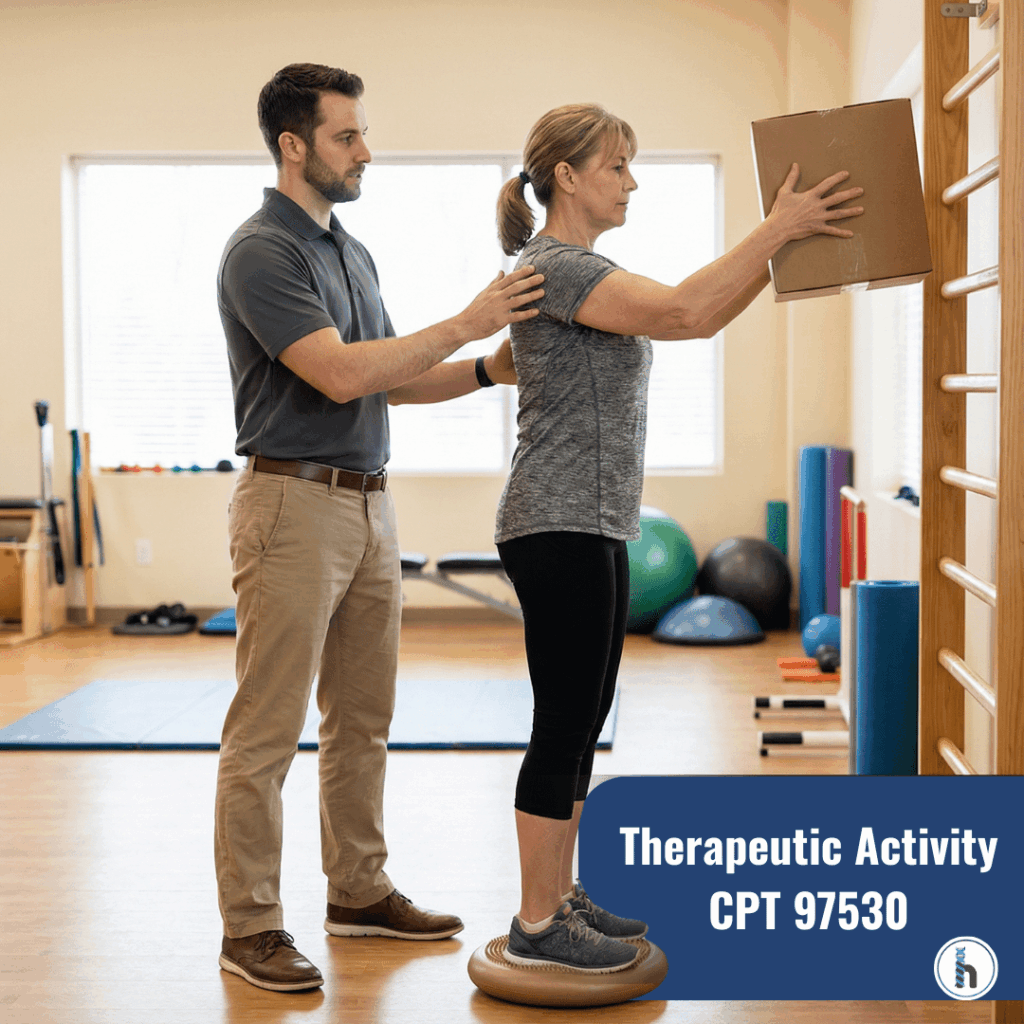
Therapists use CPT 97530 when performing dynamic, functional, real-life activities designed to improve mobility, balance, coordination, endurance, and movement patterns needed for daily tasks.
Key Features of CPT 97530
One-on-one, skilled therapeutic intervention
Functional, activity-based movements
Billed in 15-minute units following the 8-minute rule
Must show clear functional goals tied to ADLs, work tasks, or mobility
Using the code 97530 correctly ensures compliance with Medicare and private insurance guidelines.
When to Use CPT Code 97530
Common Conditions Treated With 97530
Neurological impairments (stroke, TBI, PD)
Post-surgical rehab and orthopedic injuries
Pediatric developmental delays
Vestibular and balance disorders
Examples of Therapeutic Activities Billed Under 97530
-
-
Lifting/carrying objects to simulate work tasks
-
Reaching overhead for dressing or ADLs
-
Squatting and bending for functional mobility
-
Simulated car transfers for independence
-
Standing balance tasks combined with reaching
-
These examples meet medical necessity for the CPT code 97530 when linked to functional goals.
97530 vs. 97110 – Understanding the Difference
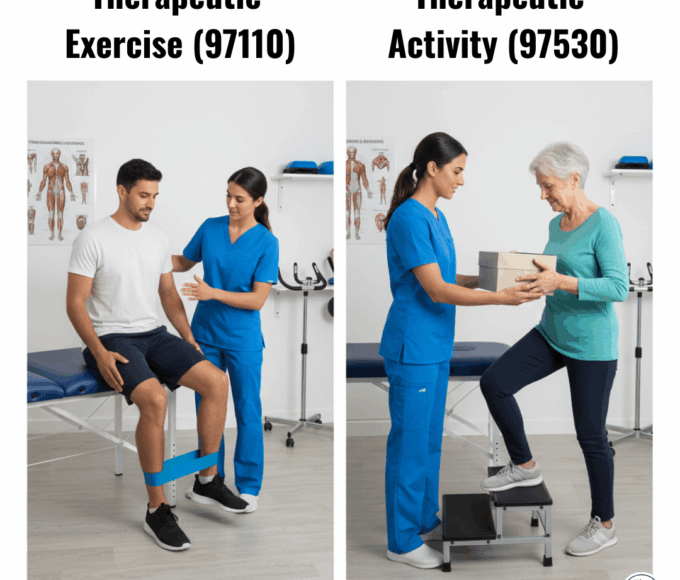
A common source of confusion is knowing when to bill 97110 (therapeutic exercise) versus the CPT code 97530.
Key Distinction
| CPT Code | Purpose | Example |
|---|---|---|
| 97530 | Functional training for daily tasks | Simulating getting in/out of a car |
| 97110 | General strengthening or ROM | Knee extensions with resistance |
If the activity is functional, dynamic, and task-based, bill CPT 97530.
If it is isolated strengthening or mobility, bill CPT 97110.
Documenting this difference protects against denials.
Billing & Documentation Requirements for CPT Code 97530
To meet insurance and Medicare standards, documentation for the therapeutic activity CPT code 97530 must clearly show:
Essential Documentation Elements
The specific functional activity performed
How it directly relates to the patient’s functional goal
Objective progress or measurable outcomes
Required level of assistance or cueing
Any adaptive equipment or tools used
Example Documentation
“Patient performed dynamic standing balance while reaching for objects at shoulder height to simulate dressing tasks. Activity performed to improve independence with ADLs. Required moderate verbal cues for posture. Goal: improve dressing independence within 4 weeks.”
This satisfies medical necessity for the CPT code 97530.
Avoiding Denials for CPT 97530
1. Insufficient Functional Detail
❌ “Patient performed dynamic standing activity.”
✔ “Patient completed repetitive standing balance tasks to improve dressing ability.”
2. Billing 97530 & 97110 Together Without Justification
When billing both on the same day, therapists must document different goals, different body parts, or different purposes.
3. Incorrect Use of Time-Based Billing
Each unit must meet the Medicare 8-minute rule.
Proper documentation prevents denials for the code 97530.
Using Modifier 59 With CPT Codes 97530 and 97110
When CPT 97530 and CPT 97110 occur in the same session, therapists must append Modifier 59 to indicate distinct services.
Correct use of Modifier 59 supports clean claims and reduces audits.
Best Practices for Using CPT 97530
-
-
Use 97530 only for functional, task-based activities
-
Document the purpose & functional goal clearly
-
Differentiate from strengthening and ROM exercises
-
Ensure at least 8 minutes of skilled therapy per unit
-
Follow payer-specific medical necessity guidelines
-
Mastery of the code 97530 helps clinics boost reimbursement and reduce compliance risks.
How HelloNote EMR Simplifies CPT 97530 Billing
HelloNote helps therapists document and bill the therapeutic activity CPT code 97530 with:
Auto-filled functional goal templates
Modifier 59 guidance
Compliance alerts
Time tracker for CPT units
Automated claim scrubbing
Real-time billing reminders
Using an EMR designed for therapists reduces errors and improves reimbursement rates.
Final Thoughts
Understanding and correctly applying the CPT code 97530 is essential for compliance, clinical accuracy, and financial success. By documenting functional goals clearly, differentiating from 97110, and using a supportive EMR like HelloNote, therapists can avoid denials and ensure clean, timely reimbursement.
Frequently Asked Questions (FAQ)
Q1. What is the therapeutic activity CPT code 97530 used for?
The therapeutic activity CPT code 97530 is used for functional, dynamic movements that improve performance in daily tasks such as lifting, reaching, squatting, mobility, and ADLs.
Q2. What is the main difference between 97110 and 97530?
CPT 97110 is for isolated strengthening or ROM exercises, while CPT 97530 is for functional, task-oriented activities tied to daily living or work demands.
Q3. How many minutes do you need to bill one unit of CPT 97530?
The therapeutic activity CPT code 97530 follows the 8-minute rule — meaning you must provide at least 8 minutes of skilled intervention to bill one unit.
Q4. Can you bill CPT 97530 and 97110 together?
Yes — but you must clearly document distinct goals or body parts and apply Modifier 59 to show the services were separate and medically necessary.
Q5. What documentation is required for CPT 97530?
Documentation must show the functional activity performed, the equipment used, the assistance needed, and the connection to the patient’s functional goal, supporting medical necessity for using the therapeutic activity CPT code 97530.